
Flick
SWITCH / BINARY CAUSE — *a switch has two states — on and off; flick it and the light turns on, flick again and it turns off; one cause, two clear results.*
Listen along — Flick
Loading audio…
Press play to listen along. The line being read lights up as you go.
Show full transcript
Loading transcript…
Flick and the On-and-Off
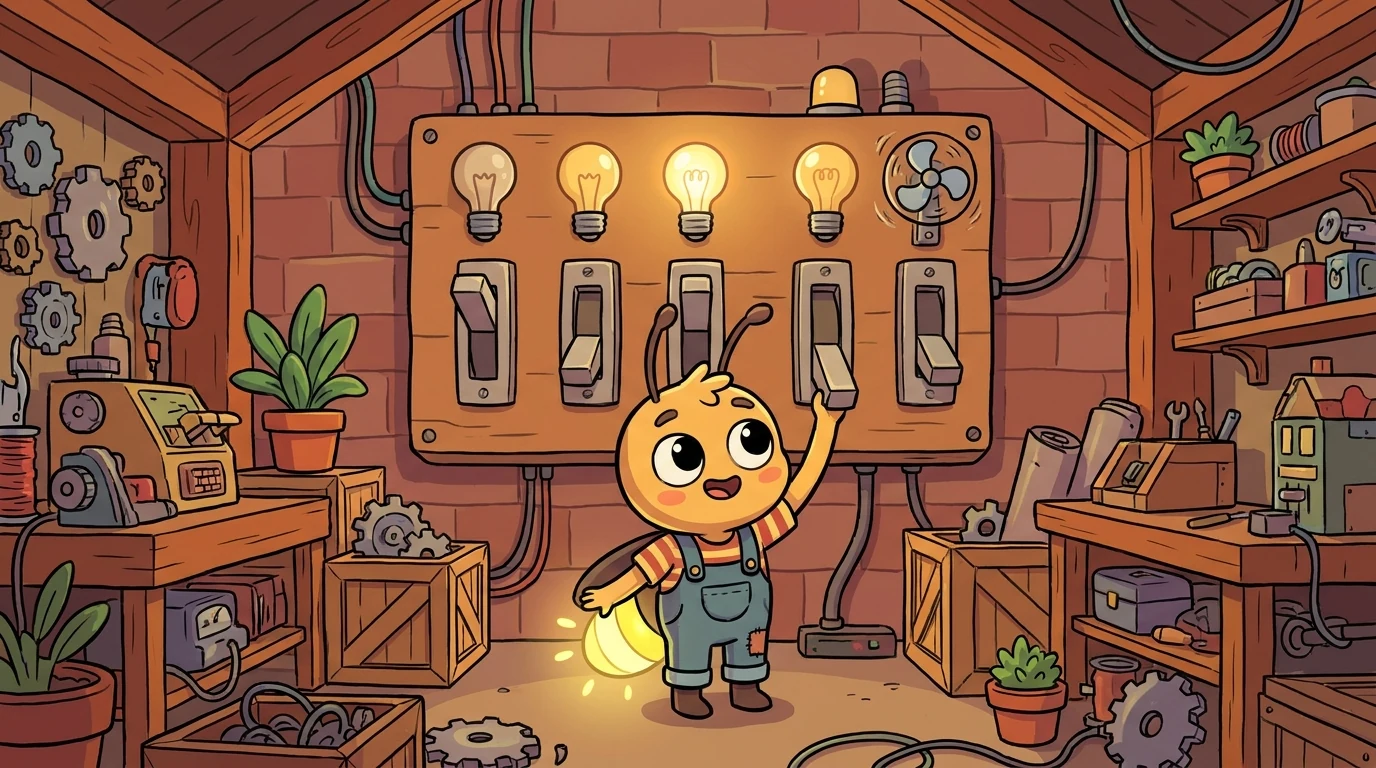
Flick is a twinkly little firefly-kid whose tail glows on and off, on and off. Flick lives near the switch-board in the Tinker-Shed — a panel of little switches, each one connected to a light, a bell, or a tiny whirring fan.
Flick shows the simplest, twinkliest truth in the shed: a switch has two states — on and off. Flick the switch up — the light pops ON. Flick it down — the light goes OFF. Up, on. Down, off. There’s no in-between: it’s one or the other, every time. “Flick it — ON,” Flick says, glowing bright. “Flick it again — OFF.” One little cause, two clear results.
Flick learned about switches by flicking every one in the shed.
When Flick was little, the switches seemed magical and mysterious — sometimes a light, sometimes a sound, who knew? Then Flick noticed the pattern: each switch had just two positions, and each position gave the same result every time. Up always meant on. Down always meant off. Never halfway, never surprising. “A switch is a two-way thing,” Flick discovered. “It’s this, OR it’s that.” That simple on-or-off was the beginning of understanding how buttons and switches make the whole shed work.
Today, Tink brings the kid over to Flick’s switch-board. “Flick shows how switches work,” Tink says. “Watch — on, and off.”
“Flick with me,” Flick says, tail twinkling. “See the switch? Guess first — will flicking it turn the light ON or OFF? Then flick, and watch.”
Flick shows the kid a switch below a little bulb, currently dark. “Guess first!” Flick says, borrowing Tink’s trick. “If we flick it up, on or off?” Then flick — and the bulb glows on. Flick again — off. A grown-up can flick switches along too: guess, then flick, then watch the light obey together — because tinkering is for trying together, never a test. And Flick never says “wrong.” If the kid guesses a flick will turn it off when it turns on, Flick just twinkles: “Let’s watch! Ooh — it turned ON. So up is on. Flick again — now it’s off. See? Just two ways.” At the switch-board, every flick is a tiny happy discovery.
By the end, the kid can guess and control every switch — on, off, on, off — all by themselves. Flick’s tail glows its brightest.
And here is what Flick loves most: that bright, snappy little pop of making a light turn ON exactly when you flick — the delighted, in-control, “I did that!” feeling of a clear cause and a clear result. Flick feels it twinkle through with every flick. “Flick it — ON. Flick it again — OFF,” Flick says, settling on the board with a warm steady glow, happy and content. That snappy, in-control pop of on-and-off — that’s the very best part for Flick.
The TinkerTots ensemble
Flick is part of TinkerTots's distributed-narrative cast. Each character embodies a different curricular primitive; together they teach the full subject.
-

Tink
Predict-then-test (hero) — a raccoon who asks 'what will happen if…?' then tries it; the predict-then-check IS science
-

Rolla
Motion & force — an armadillo who rolls down ramps to push things (a harder push goes farther)
-
Tipp
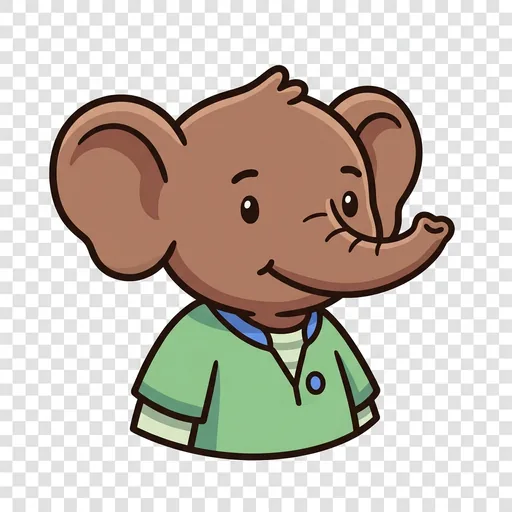
Weight & balance — an elephant-shrew who adds weight and the seesaw tips heavier-side-down