
The Fair on the Green · Reader · ages 6-8
Listen along
Loading audio…
Read by an AI-generated voice. The words on this page are the transcript.
1. The Booth at the End of the Row
The hammer rang once. A spark jumped off the anvil and did not go out. It waited. They followed.
Lan saw it first, because Lan was always first. She was already running before Inkling had finished saying, "Wait, I think that's a..."
The autumn fair had come to the Green on Friday. It came every year, and every year it was the same and somehow new. There was the cake stall, with its tower of lemon buns. There was the hoopla, where you threw rope rings at wooden pegs and almost never got one on. There was the big white games tent, which smelled of grass and canvas and somebody's toffee. Lan loved all of it. She loved it so much she wanted to do everything at once.
The spark did not stop at any of it. It hopped past the cakes. It hopped past the hoopla. It hopped right past the games tent, and Lan nearly went in there anyway, because she could hear dice rattling inside. But Inkling caught her sleeve.
"It's going to the end," said Inkling. "Look."
At the very end of the row, where the bunting ran out, stood a booth Lan had never seen before. It was striped red and white like a stick of rock. A hand-painted sign hung over the door:
ANY GAME YOU WISH, WHILE YOU WAIT.
The spark slipped under the curtain.
Lan looked at Inkling. Inkling looked at Lan. Then they ducked inside.
The booth's striped curtain swung shut behind them, and the noise of the fair went soft. The curtain had a long tear sewn up with red thread, and beside the stitches somebody had drawn a tiny hammer.
Inside it was warm and smelled of sawdust. There was a little workbench, a lamp and a stool. On the floor sat a wooden box full of parts: tracks and tiles, pegs and counters, spinners, string, tiny flags with nothing on them, and a great many small wooden pieces in every colour.
On the stool sat a round little capybara in a canvas apron. The apron had dozens of tiny pockets, and every pocket had something in it. She had a pencil behind one ear. She looked as if she had not slept since Friday.
"Hello," she said, and yawned. "I'm Trial. I build games."
"Any game?" said Lan.
"Any game you wish," said Trial. "I'll build it exactly as you wish. You only have until Sunday night, mind. The fair packs up on Sunday night, and my booth goes with it."
Inkling was looking at the box of parts the way other people look at a box of chocolates. "I think it's called a workshop," she said. "Is it a workshop?"
"Something like that," said Trial. She rubbed her eyes. "Well. Who's first?"
2. Exactly as You Wish
"I'll go first!" said Lan, before anyone else could even breathe in. "I know exactly what I want."
"Go on, then," said Trial.
"I wish for a race game," said Lan. "A race game that I always win."
Inkling opened her mouth and then closed it again.
"I promise it'll be great," said Lan. "I promise!"
Trial did not argue. She did not say it was a strange wish, or a selfish one, or a silly one. She only nodded, the way a baker nods when you ask for a currant bun, and reached into the box.
Out came a long wooden track, painted with twelve spaces. She laid it along the bench. Out came two pieces, one red and one blue. She set them both at the start.
"Red is yours," she said to Lan. "On every turn your piece moves three spaces." She tapped the blue piece. "Blue is yours," she said to Inkling. "On every turn your piece moves one."
"That's not..." Inkling began.
"Exactly as she wished," said Trial gently. "Let's see how they play it."
So they played.
Lan moved three. Inkling moved one. Lan moved three again, to six. Inkling moved one again, to two. Lan went to nine. Inkling went to three. Lan went to twelve, the very last space, and threw both arms in the air.
"I won!"
Inkling was on space four. She looked at her blue piece, standing all alone a long way back down the track.
Four turns. That was all it took. Lan had counted three, six, nine, twelve on her fingers, and it came out four every way she counted it.
"That was brilliant," said Lan. "Again!"
3. The Same Every Time
They played again.
Lan moved three. Inkling moved one. Lan moved three. Inkling moved one. Lan reached twelve on her fourth turn, and Inkling was on space four.
"I won!" said Lan, a little less loudly.
They played again.
Three, one, three, one, three, one, three. Twelve. Lan won. Inkling was on space four, the same place as before, which was the same place as the time before that.
Lan reached for her piece to set it up a fourth time. Inkling did not reach for hers. She was staring at the track.
"I noticed something," said Inkling slowly. "It's stuck because nothing can happen."
"What do you mean?" said Lan. "Things happen. I win."
"That's the only thing," said Inkling. "I already know how it ends. I knew how it ended before we started." She put her blue piece down on the bench, not on the track, and stepped back from it.
Lan looked at the clock on the booth wall. They had been playing for about a minute and a half. She thought about it, and she had to be honest with herself. It had been the most fun at the very start, the first time, when she did not know for sure. After that, each game had been a little bit less fun than the one before. By the third game, even winning had felt like brushing her teeth.
But Lan did not want to say so. Lan liked being right, and she liked winning even more.
Trial had not said a word. She was writing something in a little notebook with the pencil from behind her ear.
4. Make It Faster
"I know what's wrong," said Lan. "It's too slow. Make my piece jump six! Then it'll be exciting. I'll go first and I'll zoom!"
She turned to Trial, already grinning. "Please? I promise it'll be better."
Trial put down her pencil. But she did not reach into the box.
"Before I build it," said Trial, "turn round. Watch what she does, not what she says."
Lan turned round.
Inkling was not there.
The curtain was swinging a little, the way a curtain does when somebody has just gone through it. Lan pulled it aside and looked out. The fair was loud again, all bells and shouting. And there, at the cake stall, with her nose very close to the glass, stood Inkling, looking at a lemon bun.
She had not said "I don't want to play." She had not said anything at all. She had simply gone.
Lan let the curtain fall. Her cheeks went hot, and her ears went hot, and the back of her neck went hot too.
"She left," said Lan.
"She did," said Trial.
"I didn't even ask her," said Lan. "I just made it faster. I mean, I nearly did."
"Mm," said Trial, which was all she said.
Lan sat down on the floor next to the box of parts. Six spaces a turn would only have made the same thing happen sooner. She could see that now. A faster way to win was still just winning, over and over, with nobody to win against.
5. What the Notebook Said
Trial opened her little notebook and turned it round so Lan could see.
The pages were full of tiny tally marks in neat rows. At the top of each row was a wish, written very small. A GAME WHERE MY DOG IS THE KING. A GAME WITH NO LOSING. A GAME THAT IS ALL TREASURE. A RACE I ALWAYS WIN.
"Twenty wished games since Friday," said Trial. "I counted. Children played them forty times in all."
Lan counted on her fingers and gave up. "Is that a lot?"
"Forty games, twenty wishes," said Trial. "That's about twice each. Then they left, and they didn't come back."
"But did they say they liked them?" said Lan.
"Most of them did," said Trial. "They said, 'Thank you, it's great.' They said, 'Wow.' One said it was the best game in the world." She tapped the page. "But look what I wrote. I don't write down what they say. I write down what they did next."
Under every wish there were two tally marks, or one, or three. Never more than three.
"The dog one," said Lan, pointing. "What happened?"
"A boy wished for a game where his dog was the king," said Trial. "So I made the dog piece the king, and the dog piece could not be caught, and the dog piece always won. He played it twice. Then he went to the hoopla." She sighed. "His dog was very nice. I met it."
"So I keep building exactly what they ask for," said Trial, and she sounded very tired indeed. "And nobody plays anything for long. I don't know why. I only know what I see."
Lan looked at her own wish in the notebook, with its two short tally marks.
"I don't want my game to be a two," she said quietly.
"Then let's see what they do," said Trial. "Not here, though. Out there."
6. Six Ways to Make Seven
Lan went to find Inkling. She did not know what to say, so she said, "Sorry," and then, "Do you want half my bun?"
"I didn't buy one," said Inkling.
"Then do you want to look in the games tent?"
Inkling did.
The games tent was the loudest place in the whole fair. At one end, children were crowded round a low table, and the crowd kept getting bigger. Lan wriggled to the front.
On the table was a garden made of felt, with twelve little patches marked 2 to 12. A bright ladybird with seven spots on her back sat on the edge of the tray. Two dice tumbled across it.
"Five and two!" called a boy. "Seven!"
"Seven!" said Lucky. "Six ways to make seven."
The children groaned and cheered and leaned in. A girl had put her flower on patch 12 and was hoping very hard. A small mole had put his on 2. The dice rolled again. Four and three. Seven again.
"How do you always know?" said a mouse.
"Not luck. Counting," said Lucky cheerfully. "Two dice can land thirty-six different ways. Six of those ways add up to seven. Two has only one way: a one and a one. Try the seven patch if you like. But nobody knows what the next roll will be. Not even me."
Lan watched the faces. Nobody knew who would win. Not the girl on 12, not the mole on 2, not the boy who had picked seven. Every roll, somebody gasped. And when a round ended, nobody walked away. They all put their flowers back on the patches and played again.
"I think it's called chance," said Inkling. "I can name it. Chance."
"Can I have a go?" said Lan.
Lucky handed her a paper flower. Lan looked at the patches for a long time. She wanted to put it on seven, because seven had the most ways. But the boy was already on seven, and so was a hedgehog, and Lan did not want to win the same way as everybody else. So she put her flower on eight.
"Five ways to make eight," said Lucky. "Not bad."
The dice tumbled. Three and three. Six. Nobody won. Lan's heart was thumping, which was silly, because it was only a felt garden and a paper flower. The dice tumbled again. Six and one. Seven! The boy and the hedgehog cheered. Lan groaned.
"Again?" said Lucky.
"Yes!" said Lan, before she had even thought about it. She left her flower right where it was. The third roll was a five and a three, and Lan shrieked so loudly that the whole tent turned to look.
She had won once, and lost once, and the losing had not felt bad at all. It had felt like waiting for a door to open.
"And they keep coming back," said Lan. She said it out loud, slowly, as if she were reading it off a sign. "Because nobody knows the end."
7. The Job That Chance Does
When they got back to the booth, Trial was not alone.
A small fennec fox was sitting on the end of the workbench. She had very big ears, as big as her whole head, and she held three dice in one paw. She was rolling a plain wooden die across the bench, catching it, and rolling it again.
"This is Bones," said Trial. "She makes games too."
"Chance has a job," said Bones, without even saying hello. She rolled the die again. Five. "Did you know that? Most people think dice are just for luck. They're not. Chance has a job to do in a game."
"What job?" said Lan.
"Watch," said Bones. She pushed the die to Inkling. "You're behind. Say you're on space four and she's on space nine. Roll it."
Inkling rolled. Six.
"Now you," said Bones, pushing it to Lan.
Lan rolled. One.
"See?" said Bones, and her ears twitched with delight. "The one behind can still win. A die doesn't know who's winning. It doesn't know who wished for it, or who's older, or who goes first. Every single roll, each of you has the same chance of a six: one in six. Roll it and find out."
Lan picked up the die and turned it over in her fingers. It was smooth and light, with dots burnt into the wood. One, two, three, four, five, six. Each face was the same size. None of them was special.
"So in my game," said Lan slowly, "Inkling couldn't ever win. Not even if she did everything right."
"Nobody knows yet, that's the fun," said Bones. "Or it should be."
Inkling picked up a pencil and made a little drawing on the back of Trial's notebook: a die, and next to it, a question mark.
8. Sunday Evening
Lan wanted to fix the game at once. But Saturday was full of other things. There was the hoopla, where Inkling got a ring on a peg at last, by accident, and was so pleased she named the peg. There was Bà Tư, their grandmother, who wanted help carrying jam. There was Tí, who got lost behind the cake stall and was found again eating a lemon bun he had not paid for.
All through Saturday, Lan kept her hand in her pocket, where there was nothing yet. She kept thinking about the garden game, and about the mole on patch 2, who had not won once and had still played every round, grinning. She could not work out why that was, and it bothered her, like a stone in a shoe.
And then, all of a sudden, it was Sunday evening.
Lan ran to the end of the row with Inkling behind her. The hoopla was already coming down. A man was rolling up the bunting. The cake stall had three buns left, and a sign that said HALF PRICE. The fair packs up on Sunday night, Trial had said. And it was Sunday night, nearly.
The striped booth was still there. Inside, Trial was packing parts into her box, very slowly, and yawning between every one. Bones had gone.
Lan's race lay on the end of the bench where they had left it. The red piece was on twelve. The blue piece was on four. Nobody had touched it since Friday.
"Nobody played it," said Lan.
"No," said Trial.
"Not even once more."
"No," said Trial.
Lan sat down on the stool. She felt small, and sorry, and stuck. She had wished for exactly the thing she wanted, and she had got it, and it was no good to anyone, not even to her.
"You could wish for a new one," said Trial kindly. "There's still time for one more wish."
Lan thought about it. She looked at the race. She looked at Inkling's question mark on the back of the notebook. She looked at the box of parts, and at the plain wooden die that Bones had left behind on the bench.
"No," said Lan. "I don't want a new one. I want to mend this one."
9. Lan's Rule
She took the track back.
First she picked up both pieces and put them at the start, side by side, red next to blue. Nobody ahead. Nobody behind.
Then she took the plain die. "No more threes and ones," she said. "We both roll this. The same die, for both of us."
Inkling nodded.
Lan's hand hovered over the die. She was about to say "I'll go first!" because that was what Lan always said. And she stopped.
She thought about the tally marks in Trial's notebook. She thought about the mole on patch 2, still hoping. She thought about Inkling standing at the cake stall, not saying anything, just gone.
Then she thought of something that nobody had told her. Not Trial, not Lucky, not Bones.
"New rule," said Lan. "Whoever lost the last game rolls first."
"But nobody's lost yet," said Inkling.
"Then you go first," said Lan. "Because you lost all the other ones."
Inkling laughed, a surprised sort of laugh. She picked up the die and rolled.
Here is the place, if you are reading this to someone, to stop and find a die. Roll it a few times each. Who is ahead after three rolls? Could the one behind still catch up?
They raced. Inkling rolled a four, then a two, then a six. Lan rolled a five, then a one, then a one again, and groaned. A die moves three and a half spaces on a turn, if you average it out, so a race to twelve takes about four turns either way. But nobody plays the average. Inkling reached twelve first.
"I won!" said Inkling, and she said it so loudly that Trial dropped a peg.
"Rematch," said Lan. "And I go first, because I lost. That's the rule."
This time it was close. Lan was ahead, then Inkling was ahead, then Lan rolled a six and slid onto twelve just one space before Inkling. Lan won by one space.
And the strange thing was, it felt much better than winning by eight. It felt like winning something.
"Come on, quick! One more!" said Lan.
"One more," said Inkling. "And then one more after that."
10. The First Piece
They played a third game. Trial stopped packing and watched it.
She watched Lan's face when she rolled a one. She watched Inkling bite her lip on space ten. She watched them both lean over the track at the very end, when either of them could win on the next roll. She had her pencil ready. But she did not write anything down.
She only smiled. It was the first time Lan had seen her look less tired.
"Well," said Trial. "That one's a lot more than a two."
When the game was over (Inkling won, by two), Inkling sat back on her heels.
"I can name it," she said. "Your rule. It's a catch-up rule. The one behind gets a little push, so the game stays close."
Lan thought about that. On Friday, Inkling had named things too soon, before she had looked properly. This time she had watched three whole games first. And the name fitted, the way a lid fits a jar.
"Catch-up rule," said Lan. "I like it. It's still my rule, though."
"It's still your rule," said Inkling.
Trial reached into the box and took out the plain wooden die.
"Keep it," she said, and put it in Lan's hand. "You mended the game. Now tell the story back to someone, and it's yours."
Lan closed her fingers round it. It was the first thing in her pocket, and it felt just the right size.
Outside, the last of the bunting was coming down.
The curtain swung open, and the Green was full of fair again.
The spark was waiting on the grass. It hopped all the way back across the Green, past the folded hoopla and the empty cake stall, to the old anvil in the middle.
The spark dimmed to a warm dot and settled back on the anvil. The Green was just the Green again.
Back on the Green
At home that night, Lan set up a race on the kitchen table for her little brother, Tí. She drew twelve squares on the back of an envelope. She gave him her plain wooden die.
"Whoever lost goes first," said Lan. "And you've never played, so that's you."
Tí rolled a six on his very first go. He won by a mile, and he laughed so hard that Bà Tư came to see what the noise was. Then he wanted to play again. And again.
Tell the story back to someone. Why did nobody want to play Lan's first game? What did her new rule change?
Saved. The next chapter will be here whenever you come back.
Who you met
-
 Trial Watch what players do, not what they say from TableForge
 -
 Lan a child of the Green Goes first; makes a friend in a minute
 -
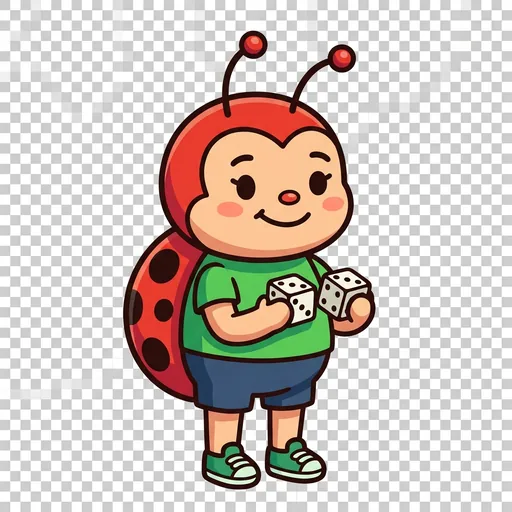 Lucky With two dice, seven has the most ways to come up from SevenPals
 -
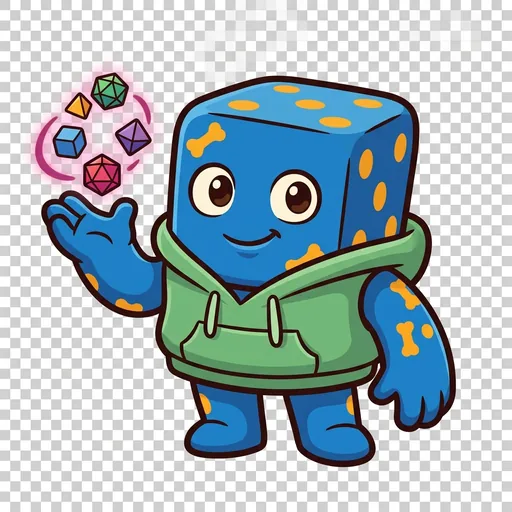 Bones Chance has a job in a game — it lets the one behind still win from TableForge
 -
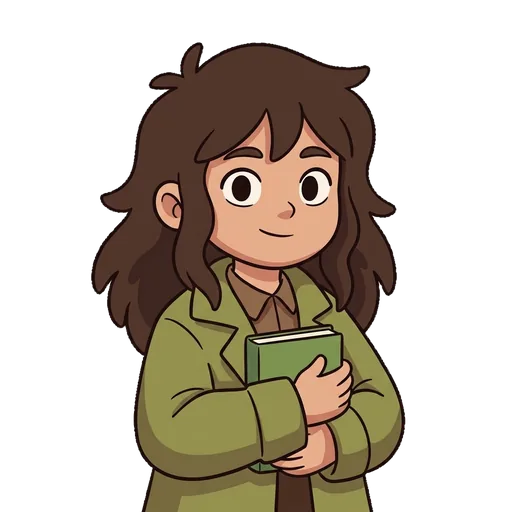 Inkling a child of the Green Names what she notices
Every recurring character has a short tune, so you can tell who is on stage before a word is said. The tunes play only when you tap, and the Reading Access sound switch turns them off.
The Honest Page
Which parts of this story are true, stretched or made up?
True
- With two dice there are thirty-six ways they can land, and six of them add up to seven. No other total has as many.
- On one fair die each number from one to six is equally likely, so a six comes up about one roll in six.
- Machines that build a playable game from a typed wish are real as of 2026. Google's Playground is one; it is for grown-ups. Source
Stretched
- A machine can build the game you ask for. What it cannot know is what your friend will find fun. Only playing with her tells you. What we simplified: Game-making machines do watch how people play in general; they cannot know one particular friend at your table.
Made up
- The wishing booth, its talking booth-keeper and the fair's animal stall-keepers are made up.