
The Day Before · Reader · ages 6-8
Listen along
Loading audio…
Read by an AI-generated voice. The words on this page are the transcript.
1. A City of Red Bricks
The hammer rang once. A spark jumped off the anvil and did not go out. It waited. They followed.
In the back of Inkling's green book, under DOOR and OPEN, there were three letters now: W, I and D, and one dash left at the end. Inkling had stopped crossing things out. She had written the three letters very neatly, and drawn the last dash very lightly, and left it alone.
"You know what it is," said Lan, on Saturday. "You've got your knowing face on."
"I think I do," said Inkling. "But I thought I knew last time, and the time before, and I said it, and it buzzed. So this time I'm going to find it. Properly."
"So am I," said Lan. "I'm not going first. I promise."
Inkling looked at her.
"I'm not," said Lan. "Really."
The spark took them to the bench under the big tree on the Green, where the old people sat in the afternoons. Then it simply waited there.
Warm wind blew the Green away, and the ground under their feet was somewhere else, the day before.
The first thing Lan noticed was how straight everything was. The second thing was how red.
They were standing in a long, wide street that went on and on, perfectly straight, like a line drawn with a ruler. Another street crossed it at the far end, just as straight, at a perfect corner. On both sides were tall plain houses with flat roofs, and every single house was made of the same red baked bricks. Not roughly the same. Exactly the same, brick after brick after brick, laid in neat rows, like the squares in Inkling's maths book.
"Look at the bricks," said Inkling. "They're all the same size."
"Somebody's very fussy," said Lan.
Down the middle of the street ran a deep trench. It was about as deep as Lan's knees, and as wide as her two arms held out, and it went all the way down the street from one end almost to the other, except for a gap in the very middle. Builders were working along it on both sides, lining the bottom and the sides of the trench with more of the neat red bricks, and laying big flat bricks over the top like a lid. It smelled of wet mud and warm dust.
People were everywhere. Women carried pots of water on their heads. A man went past leading two white cows with long curved horns, pulling a cart with solid wooden wheels. Children ran along the tops of the walls. Somewhere a woman was singing, and somewhere else a baby was crying, and a dog was barking at the cows, who did not care.
A boy about their age was standing at the edge of the trench, holding a long, straight wooden stick upright beside him, like a spear. He had a plain cotton cloth wrapped round his waist, and bare feet, and his hair tied up in a knot on top of his head. He was looking along the trench, all the way down the street, and frowning.
In the wall of the house behind him, low down, one of the red bricks had cracked once. Somebody had cut the broken brick out and fitted a new one into its place, a tiny bit redder than the rest. Beside the new brick, scratched into the old one next to it, was a tiny hammer.
Lan touched it. It was the same tiny hammer as all the others. Inkling saw her do it, and smiled, and neither of them said a thing.
The boy turned round and saw them. His eyes went up and down Lan's yellow raincoat, and Inkling's green coat, very slowly.
"Are you lost?" he asked. "Are you from the river boats?"
"Sort of," said Lan. "What are they building?"
2. Bzzz
"A drain," said the boy proudly. "A covered one. For the rain."
He pointed along the trench. "When the rains come, the water comes down off the roofs, and out of all the houses, and it has to go somewhere. So every street has a drain under it, and the water runs along the drain and out of the city. This street is new, so it needs a new drain."
"It's very long," said Inkling.
"That's why there are two teams," said the boy. "One team started at this end. Another team started at the far end, by the big crossroads. They're building towards each other. Tomorrow they meet in the middle, there." He pointed at the gap. "And I carry messages between them, because I'm the fastest runner on the street."
"What happens if the two halves don't fit?" asked Inkling.
The boy's frown came back.
"Then there's a gap at the join," he said. "Or one side's wider than the other, or higher. And when the rains come, the water comes rushing down the drain, and hits the join, and comes out. Into the street. Then into the houses. Everyone's things get wet, and the mud walls inside go soft. It happened on the next street, two years ago. My aunt lost all her grain."
Lan looked at the long trench, and the gap in the middle, and the two teams of builders, working away at either end, so far apart that the far team looked very small.
She knew what the boy needed. There was one in her pencil case at school. It was yellow, and it had a crack in the corner from when she had used it as a sword. She didn't even have to think about it.
And she had promised. On the bench. Out loud.
But the word was already in her mouth, the way it always was, and her mouth was already open.
"I know what that means!" said Lan. "Come on, quick. I'll go first. What you need is a..."
She said the word before she had looked at anything.
Bzzz.
It was a horrible noise, like a big fat bumblebee trapped in a jar. It came out of her mouth instead of the word, and buzzed for a moment, and stopped.
The two white cows stopped and looked round. The boy dropped his stick.
Lan went pink, right up to her ponytail. She stood there with her mouth still open, and shut it.
"I promised," she said. "I actually promised. Out loud."
Inkling squeezed her hand.
"You promised before you counted," said Inkling kindly. "You always do. It's all right."
"It is not all right."
"It's a bit all right," said Inkling. "The door. You can't bring the answer. Only the question. And you're very good at questions."
3. Four Hands Wide
The boy picked up his stick and looked at them doubtfully. "Was that a sort of song?"
"No," said Lan. "It just happens. Sorry. Can we help you think?"
"I need to tell the other team how wide to make their half," said the boy. "So the two halves are the same. Our builder told me." He nodded at a short, broad man kneeling at the edge of the trench nearby, pressing a brick into the mud. "Four hands wide. He measured it."
"Four of his hands?" asked Inkling.
"Four hands," said the boy, as if that was obvious. "I'll go and tell them."
And he was off. He really was the fastest runner on the street. He went down the side of the trench like a hare, round the women with the water pots, past the white cows, all the way to the far team, and they watched him tell them, and point, and hold up four fingers.
Then he ran all the way back again, hardly out of breath at all.
"Done," he said.
A little later, Lan and Inkling walked down the street with him to see. The far team's builder was a tall woman, with long arms and long fingers. She was kneeling at the edge of her trench and spreading her hands across it, one after the other, to measure it. One, two, three, four.
Her hands were enormous. Much bigger than the short man's hands. Each of her hands covered as much as one and a bit of his.
The boy stood and looked at her half of the trench, and then all the way back up the street at his own team's half. Even from here, you could see it. Her half was wider.
"Four hands," said the boy, "is not the same as four hands."
"Not if they're different hands," said Inkling quietly.
4. Two Sticks
The boy sat down on the edge of the trench and thought.
"Hands are no good," he said at last. "Hands are all different. But sticks don't change. A stick is a stick."
He went to his team's builder, the short man, and talked to him, and the short man nodded. They found a straight piece of wood, and the short man laid it along his own arm, from the point of his elbow to the tips of his fingers, and cut it there.
"That's the length of an arm," said the boy. "Now we measure everything with that."
He ran all the way down the street again, to the far team, and told them. The tall woman nodded. She found a straight piece of wood, and laid it along her own arm, from her elbow to her fingertips, and cut it there.
Then both teams went back to work, measuring everything with their own new sticks. How wide the trench was. How deep. How long each brick should be. How long the mould for the bricks should be, the wooden box that they pressed the wet clay into, to make every brick the same.
It half worked. Lan and Inkling went to look at the near team's half, and every brick matched every other brick, perfectly. Then they went to look at the far team's half, and every brick there matched every other brick there, perfectly too.
But the two sticks were not the same.
The boy held them side by side, when the builders stopped for a drink. Inkling measured them with her fingers. The short man's stick was fifty fingers long. The tall woman's stick was forty-six. Wait, no. She checked again. The tall woman had long arms, so hers was the longer one. Fifty fingers. And the short man's was forty-six.
"Four fingers different," said Inkling. "That's not very much."
"But the trench is lots of sticks long," said the boy. "Ten sticks, on each side, from the end to the middle." He counted on his fingers. "Ten of her sticks would be forty fingers longer than ten of his."
Inkling wrote it in her book. Ten times four fingers. Forty fingers.
"That's nearly a whole stick," said Lan.
"So the halves still won't meet," said the boy. "Not properly. One will be too long, or too wide, or the bricks won't line up." He put his face in his hands. "It's better than hands. But it's still not right."
"Half right," said Lan.
"Half right floods the street," said the boy.
5. One Length
They sat in a row on the edge of the trench, and nobody said anything for a while.
Inkling was looking at the two sticks lying side by side on the bricks. She had a word in her head. She had had it since before they came through the door. She could feel it sitting right behind her teeth, the name of the thing in Lan's pencil case, the thing that had buzzed.
She did not say it. She asked instead.
"I noticed something," said Inkling. "Can I ask some questions?"
"Yes," said the boy, through his fingers.
"Why didn't the hands work?"
"They were different hands," said the boy. "Big ones and small ones."
"And why didn't the sticks work?"
"They were different sticks," said the boy. "Because they came from different arms."
"So it isn't really the hands," said Inkling slowly. "Or the sticks. It's that there were two of them. Two lengths, that were meant to be the same, and weren't." She looked at the sticks. "Is there one length both teams could use? Not two lengths that are meant to match. Just one."
The boy took his hands away from his face.
"Wait," said Inkling. "I can name it. Not the thing. The idea." She took a breath. "If two teams are going to make things that fit, they need one length. The same one. For everybody."
"But there's only one of each stick," said the boy. "And the teams are at opposite ends of the street."
That was true, and nobody could think what to say back.
6. Sunset Over the Roofs
The sun began to go down. It went down behind the flat roofs at the end of the street, and turned the red bricks redder, and then a deep dark orange, and long shadows stretched down the trench. The builders put down their tools and wiped their hands and went home. The white cows went home. The women with the water pots went home.
The boy stood by the gap in the middle of the trench, holding his team's stick.
"Tomorrow they'll come together," he said. "Right here. And they'll find out that one half is wider than the other, and the bricks don't line up, and there's a crooked step at the join." He kicked a little stone into the trench. "And they'll try to squash it together, and stuff mud in the gap. And when the rains come, the water will hit the join and pour out. Into the street. Into the houses." He looked at the house with the mended brick. "That's where I live."
Lan sat on the edge of the trench with her chin on her knees, very still.
She still had the buzz inside her somewhere. She could feel where it had been. She had gone first and promised and not counted and buzzed. But there was a question sitting in her head, too, quietly, under the buzz. She had been listening to it while the sun went down.
7. The Copy
"Can I ask you something?" said Lan.
The boy looked at her.
"The other team can't use your stick," said Lan. "Because there's only one, and they're at the other end. And you can't use their stick, for the same reason. So you need two sticks." She frowned, trying to get the question right. "But could there be two sticks that really are the same? Not meant to be the same. Actually the same?"
"How?" said the boy. "Every stick is different. Every arm is different."
"Not if it didn't come from an arm," said Lan. "What if you made the second stick from the first stick?"
The boy stared at her.
8. Exactly Level
"How do you mean?" said the boy. "From the first stick?"
Lan stood up. She was not sure, but she said it anyway, slowly, one bit at a time, so that she could hear if it was wrong.
"Get a new stick," said Lan. "A straight one. Longer than yours. Lay it right beside your stick, touching it, on something flat. Line them up at one end, so the ends are exactly together. Then look at the other end of your stick, and make a mark on the new stick, exactly level with where yours stops. And cut it there."
"Then it's the same," said Inkling softly. "Not because of anyone's arm. Because it was made against the first one."
The boy did not say anything. He ran into his house and came back with a long straight piece of new wood, and a sharp stone knife.
He laid his team's stick on the flat top of the drain's lid, where the bricks were smooth. He laid the new stick beside it, touching. He pushed the two ends together at one end, with his thumb, until they were perfectly level. Then he ran his finger along to the other end of his team's stick, and with the point of the knife he scratched a line on the new stick, exactly where the old one stopped.
He cut it there. It took a long time, sawing with the stone knife, and Lan and Inkling held the stick still for him.
Then he laid the two sticks side by side, and lined up one end, and looked at the other.
They were exactly the same length. Not nearly. Exactly. You could not see the difference at all.
"Now run," said Lan. "Take the copy to the other team. Before it's dark."
The boy ran, faster than ever, down the side of the trench in the last orange light, all the way to the far end. Lan and Inkling ran after him, much more slowly.
The tall woman was still there, packing up her tools. The boy held out the copied stick and talked very fast, waving his arms, pointing back up the street. The tall woman listened. She laid the copied stick beside her own long stick and looked at them, and her eyebrows went up. Then she called the rest of her team back.
They worked by the light of little clay lamps, until late. They measured their trench again, with the copy. They took their brick mould, the wooden box, and checked it against the copy, and found it was too long, and cut it shorter. They pulled up the last few bricks that did not fit, and made new ones in the new mould, and laid them.
At the near end of the street, the short man checked his team's work against the old stick, the first one. It was already right, because it had been made with it all along.
Now both halves had been made with one length. The same one.
In the morning the two teams brought their halves of the drain together, in the middle of the street, at the gap. Everybody came out of the houses to watch. The children sat along the tops of the walls. Even the white cows stopped.
The last bricks went in. The two halves of the drain met.
They fitted. Brick against brick. The same width. The same depth. Not a step, not a gap, not a crooked edge.
The tall woman and the short man looked at the join, and then at each other.
"Even," said the tall woman. "Perfectly even."
"Even," said the short man, and laughed, and shook the boy by the shoulders until his hair came out of its knot.
9. The First Rain
They stayed for days. The boy's mother fed them flat bread and lentils and sweet mangoes, so ripe that the juice ran down to Lan's elbows, and they slept on the flat roof of the boy's house under more stars than Lan had ever seen.
Then, one afternoon, the sky went dark, and heavy, and purple, and the first rain came.
It came all at once, as if somebody had tipped a bucket over the city. It drummed on the flat roofs. It ran off the roofs in streams, and gushed out of little pipes in the walls, and poured down into the street. It ran into the drain, under the brick lid, along the near half, and over the join, and along the far half, and away, out of the city, gurgling.
Not a drop came out of the join.
The boy stood in the doorway of his house, soaking wet, grinning.
Nobody would write down the boy's name.
When the rain had stopped and the street was steaming in the sun, the spark rose up out of a puddle by the mended brick, and waited.
Lan and Inkling said goodbye. The boy gave them each a little red brick, a tiny one, exactly the right shape, made for a toy house.
Warm wind blew the day before away, and the grass under their feet was the Green.
The bench was there, and the big tree, and the anvil, glowing in the evening light, warm and steady.
Lan and Inkling walked to it together. Neither of them ran.
Under DOOR, and under OPEN, after the W and the I and the D, there was a new letter in the last space. It had a straight line down the side, and three straight lines going out from it, like a comb with three teeth.
"E," said Lan.
Inkling wrote it in her green book, on the last dash. Then she held the book up between them.
"W, I, D, E," she read. "WIDE."
Lan put one finger on the top line of the anvil. "Door," she said. Then the next line. "Open." Then the last. "Wide."
They stood there for a while, in the evening, saying nothing.
"Door open wide," said Lan at last. "You knew that, didn't you? Right from the start."
"I thought it might be," said Inkling. "But I didn't say it. So it's found." She shut the book. "Every one of those was somebody sharing something. A sound. A count. A worth. A length. So that people far away could have it too."
"So the door is open wide," said Lan, "for what?"
Inkling looked at the anvil for a long time.
"I wonder who's coming through," she said.
The spark dimmed to a warm dot and settled back on the anvil. The Green was just the Green again.
Back on the Green
On Sunday Mum and Lan bought a new bookcase, in a flat box, and Mum wanted to know if it would fit in the gap beside Lan's bed.
Lan nearly measured the gap with her hands. Her hands were already spread out. Then she remembered the tall woman, and the short man, and the crooked step that never happened.
She fetched Mum's tape measure, and measured the gap with it. Then she measured the bookcase box with the same tape measure. Not a different one. The same one.
It fitted, with a finger's width to spare.
Tell the story back to someone. Why did measuring with hands not work? Why did the two sticks not work, even though each team was careful? Why did the copied stick make the two halves meet even?
Saved. The next chapter will be here whenever you come back.
Who you met
-
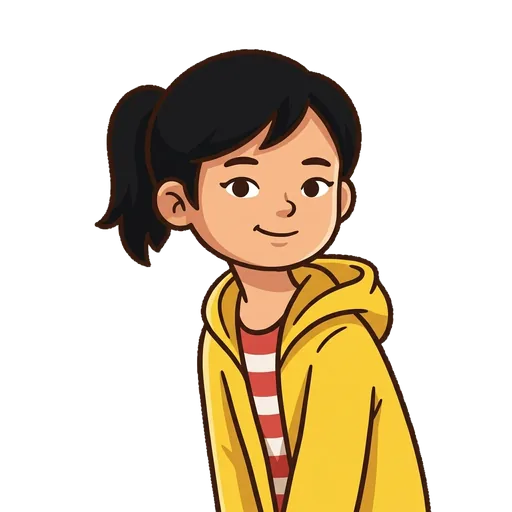 Lan a child of the Green Goes first; makes a friend in a minute
 -
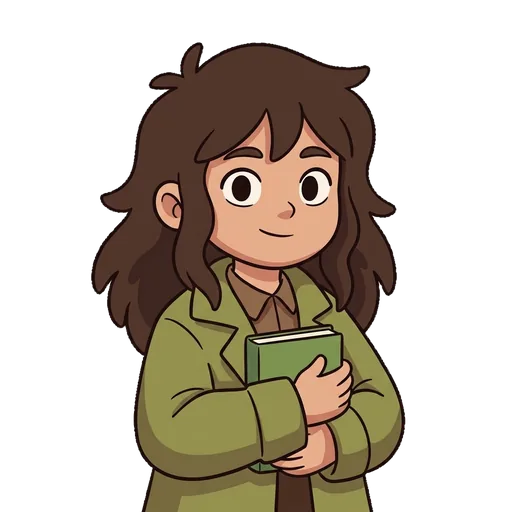 Inkling a child of the Green Names what she notices
Every recurring character has a short tune, so you can tell who is on stage before a word is said. The tunes play only when you tap, and the Reading Access sound switch turns them off.
The Honest Page
Which parts are true, stretched or made up — and what does nobody know?
True
- About four thousand five hundred years ago, cities of the Indus Valley (now Pakistan and north-west India), such as Mohenjo-daro, had straight streets with covered brick drains running along them. Source
- Indus builders made their bricks the same shape in many different cities: four long, two wide and one high. Source
- Indus cities were careful about their weights and measures, which stayed remarkably the same from place to place. A ruler made of ivory, marked in very small equal parts, was found at Lothal. Source
- A stick fifty fingers long and a stick forty-six fingers long differ by four fingers, so ten of each differ by forty fingers.
Stretched
- In the story, a boy makes two teams use one stick, copied from the first, the day before their drain meets. What we simplified: Nobody knows how the Indus people agreed their measures, or who decided them. The story shows one simple way a shared length can spread: by making each copy against the one before.
Made up
- Lan and Inkling, the spark, the buzzing word, the boy, the two building teams and their sticks are made up.
Nobody knows
- Nobody knows who first decided the lengths and weights that Indus builders used, or what they called them. They had a writing system, but nobody has yet been able to read it. Source