
The Day Before · Reader · ages 6-8
Listen along
Loading audio…
Read by an AI-generated voice. The words on this page are the transcript.
1. The Lake With No Other Side
The hammer rang once. A spark jumped off the anvil and did not go out. It waited. They followed.
The four letters were still there on the side of the anvil. D, O, O, R. DOOR. Lan had touched them every morning that week, on her way past to school, to check they had not gone. They had not. They were scratched in neatly, like the letters on an old gravestone.
"What's the door for, though?" Lan said on Friday. "A door has to open onto something."
"Maybe that's the next word," said Inkling. She had written DOOR on the first page of her green book, in her best capitals, with a box round it. Underneath, she had drawn a line and left it empty.
The spark took them to the bench under the big tree on the Green, where the old people sat in the afternoons. Then it simply waited there.
Warm wind blew the Green away, and the ground under their feet was somewhere else, the day before.
The first thing Lan noticed was the light. It was early, and the sun was low and pink, and it lay across a sheet of water so wide that she could not see the other side at all. It was a lake, Inkling said afterwards, though it looked more like the sea. Little waves came in and went out over smooth stones. Tall reeds grew in the shallow water, thick and green, taller than a grown-up. Behind them, low hills went up and up, covered in trees and grass, and somewhere in the trees a bird was making a sound like a bottle being filled.
A little way along the shore there was a camp. It was a ring of round huts, each one made of bent branches with reeds and grass laid over them, like upside-down baskets. In the middle a fire was smoking, and something was cooking on flat stones beside it. People were already busy. Two men were sitting on the ground mending a long net, passing a wooden needle in and out so fast that Lan could not follow it. A woman was scraping a bone smooth with a sharp stone. A baby was asleep in a sling on somebody's back. Everybody seemed to be packing things up, or tying them together, or putting them in bundles.
At the edge of the water, very close to them, a girl was standing with her feet in the lake. She was about their age, with short hair and a necklace of tiny white beads. She was holding a basket in both arms. It was long and thin, like a bottle, woven out of reeds, with a narrow mouth at one end.
She saw them, and stared. They were in their own clothes, Lan in her yellow raincoat and Inkling in her green coat, much too warm for this place. But she did not seem to mind. She looked them up and down, and then looked back along the shore, and frowned.
"Are you from the other camp?" she said. "The one over the hill?"
"No," said Inkling. "We're just visiting. What's that you're holding?"
"A fish trap," said the girl, as though everyone knew. She tipped it so they could see inside. "The fish swim in at the wide end and they can't find the way out. I set them all along the shore. In the reeds. By the big rock. Under the fig tree." She pointed, one place after another, along the curve of the beach. "I check them every morning."
"There are lots of fish in this lake," said Lan, looking at the net.
"There are," said the girl proudly. "My grandmother says it is the best lake in the whole world for fish. She has fished here since she was smaller than me." Then the frown came back. "But we are moving the camp tomorrow."
"Why?" said Lan.
"Because it's time," said the girl simply. "We always move, when the rains are coming. We walk round the lake to the other shore, where the hill keeps the wind off. And every trap has to come in tonight, because we're taking them with us. My grandmother and I wove them. It took days and days." She looked at the trap in her arms. "If I leave one behind, it's gone."
Lan looked along the shore. The reeds went on and on. The big rock was a long way off. The fig tree was further still.
"How many did you set?" she asked.
The girl opened her mouth to answer. Then she shut it again.
2. Too Soon
Inkling knew what this was. She was sure she did.
She had seen it on a scoreboard at football, and on the back of Lan's mum's shopping list, and at school, where Miss Okoro drew little lines on the board when they were voting for something and crossed every fifth one. She knew the word for it. It was a short, clever word, and it was right there.
And Inkling, as Lan knew perfectly well, liked naming things more than almost anything. She liked it so much that sometimes she named things before she had properly looked at them, the way you might shout out the answer in class before the teacher has finished the question.
"I noticed it straight away," said Inkling eagerly. "I think it's called a..."
She said the word.
Bzzz.
It came out as a buzz, a small, sharp one, like a bee that has flown into a window by mistake.
The girl at the water's edge blinked at her.
Inkling went pink from her ears to her chin. She had watched Lan do this four times. She had whispered the rule to Lan every single time. And she had done it herself, straight away, without even looking.
Lan did not laugh. She slipped her hand into Inkling's and squeezed it.
"The door," Lan said softly. "You can't bring the answer. You can only bring the question."
"I know," said Inkling, very quietly. "I know. I said it too soon."
"You always tell me to look first," said Lan. "So let's look first."
Inkling took a deep breath, and nodded, and put her green book back in her pocket. She did not take it out again for a long time.
3. More Than Two Hands
"How many traps did you set?" Inkling asked the girl. It was a question, so it came out as words.
The girl put the trap down carefully on the stones. Then she held up her hands, and began to count on her fingers. She counted one finger for each place she had put a trap, walking along the shore in her head. One by one, her fingers went down.
She got to the end of one hand. She got to the end of the other.
Then she stopped, and looked at her two closed fists, and frowned harder than ever.
"More than that," she said. "More than my hands."
"Ten fingers," said Lan. "Five and five. And there are more traps than that."
"I'll remember," said the girl, though she did not sound sure. "I'll just remember as we bring them in."
So they helped. They walked along the shore to the reeds, which was the nearest place, and waded out into the warm shallow water. The bottom was soft mud that squeezed up between Lan's toes. The traps were tied to the reeds with twisted grass, and the girl knew exactly where each one was. They lifted them out, dripping and heavy, with fish flipping and shining inside. They carried them back to the camp and laid them in a row by the girl's hut.
Then they walked on to the big rock.
The big rock was grey and round, like a giant's knee sticking out of the lake. The girl waded round it, feeling under the water with her feet. She found one trap, then another, then a third.
Then she stopped.
"Did I put three here," she said slowly, "or four?"
Nobody knew. Lan did not know. Inkling did not know. The girl screwed up her face and tried to remember setting them, days ago, one cool morning. She remembered the first one. She remembered the one with the broken rim. She remembered being cold. But she could not remember whether there had been three or four.
"I had it," she said. "I had it all in my head this morning. Now it's gone."
"Heads are full of other things," said Lan, who knew this very well.
They searched all round the big rock, up to their waists, and found nothing. Either there had only been three, or the fourth was somewhere they could not find. And by now the girl could not remember how many she had brought in from the reeds either.
4. Pebbles
The girl's grandmother came down from the camp to see where they were.
She was small and quick, with grey hair cut very short and strong brown hands. She had a bag over her shoulder and a bone harpoon tucked into her belt, with sharp barbs carved down one side of it. When she heard what was wrong, she did not laugh, and she did not get cross. She sat down on a stone and thought about it.
"You can't keep twelve traps in your head," she said at last, "or eleven, or however many it is. Nobody can, when they are busy. You need to put the count somewhere outside your head."
She reached into her bag and took out a little pouch made of soft leather, with a cord to pull it shut. Then she walked along the beach, picking up small, smooth pebbles.
"Walk along the shore in your head," she told the girl, "and give me one pebble for every trap you set. Every single one. Take your time."
The girl closed her eyes. She walked along the shore in her head, from the reeds to the rock to the fig tree, and each time she remembered a trap, she held out her hand, and her grandmother put a pebble in it. Then the girl dropped the pebbles into the pouch, one by one. Clack. Clack. Clack.
"Now," said the grandmother. "Every time a trap comes in, throw one pebble into the lake. When the pouch is empty, every trap is in."
"Oh," said the girl. Her face cleared, like the sky after rain. "Oh, that's clever."
"It's very old," said the grandmother. "My grandmother showed me."
It worked. It worked beautifully, for a while. They went back to the reeds and counted out the traps already brought in, and the girl threw that many pebbles into the water with a little plop each. They went back to the rock, and threw three more. Then they set off along the shore towards the fig tree, with the pouch still clacking at the girl's hip, and Lan felt sure it was going to be all right.
Then, by the fig tree, the girl slipped.
The rocks there were green with weed, and as slippery as soap. Her foot went out from under her, and she sat down hard in the shallow water with a splash. She was not hurt. But the pouch had come open when she fell. The pebbles tumbled out into the water and rolled away between the stones, and when she scrabbled for them she only found two, and she could not tell which of the pebbles on the bottom of the lake were hers and which were just pebbles.
The girl sat in the water and looked at the empty pouch in her hand.
"Now I don't know how many there were," she said, and her voice wobbled. "I don't know how many are left."
5. What Was Each Pebble?
They helped her up and out of the water. She sat on a dry stone and wrung out the end of her wrap.
Inkling had not said anything for a long time. She had been watching. Now she sat down beside the girl and spoke carefully, so that every word was a question.
"I noticed something," said Inkling. "Can I ask you about the pebbles? What was each pebble?"
"One trap," said the girl.
"Every pebble was one trap?" said Inkling. "Not two traps? Not a bit of a trap?"
"One pebble for one trap," said the girl. "That was the whole idea."
"And did that part work?" said Inkling. "Before you fell?"
The girl thought about it. "Yes," she said. "It worked really well. I didn't have to remember anything. I just had to look in the pouch."
"So what went wrong?" said Inkling.
"The pebbles fell out," said Lan.
"The pebbles fell out," said Inkling slowly. She looked at the pouch. She looked at the lake, where the lost pebbles lay among a thousand other pebbles. Then she looked at Lan, and Lan could see her trying very hard not to say anything too soon.
"Wait," said Inkling. "I think I can name it now. I looked first this time."
"Go on," said Lan.
"One mark for one thing," said Inkling. "That's the part that works. Not in your head. Outside your head, where you can see it. But the mark has to stay where you put it. Pebbles roll away. The mark has to stay."
It came out as words. Not a buzz at all. Inkling let out her breath in a great whoosh.
"One mark for one thing," the girl said, trying it out. "And the mark has to stay."
6. The Low Sun
But the sun was getting low.
It had crossed the whole sky while they waded and counted and searched. Now it was sinking towards the hills on the far side of the camp, and the lake had turned from blue to gold to orange. The people in the camp were tying the last bundles. Somebody was rolling up the net. The smell of cooking fish drifted along the beach.
Some traps were in, lying in a row by the hut. Some were still out in the water, somewhere. And nobody, not the girl, not Lan, not Inkling, not even the grandmother, could say how many were left.
The girl sat on the shore with her knees pulled up to her chin and her arms wrapped round them.
"It's hopeless," she said. "We'll go tomorrow, and one of them will be left behind, and I won't even know which one. I won't even know if there is one."
Lan sat down beside her. She did not know what to say. She looked at the sky, and at the lake, and at the camp, where the woman she had seen that morning was still scraping her bone smooth with a sharp stone. Scrape, scrape, scrape. The woman held the bone up to the light, turned it, and scraped again. Little white lines were appearing on it, where the stone had cut.
Lan watched the white lines for a long moment.
7. Cut In
"Can I ask something?" said Lan.
The grandmother looked at her.
"The marks have to stay where you put them," said Lan, slowly, feeling her way through it like walking through the reeds. "Pebbles roll away. Fingers forget. But that lady is making lines on that bone, and they don't roll away. They're cut in." She pointed. "Could the marks be cut into something? So they can't fall out?"
It came out as words, every one.
The grandmother looked at the woman with the bone. Then she looked back at Lan, for a long time, as though Lan had said something very interesting.
Then she got up and went to the fire, where there was a little pile of old bones left over from making tools. She chose one. It was about as long as a hand, clean and pale and smooth, a bone from the leg of some animal. She gave it to the girl, and she gave her a sharp chip of stone, the kind that sparkled when it caught the light.
"Cut one notch for every trap you set," said the grandmother. "Walk along the shore in your head, the way you did for the pebbles. Take your time."
The girl closed her eyes.
She walked along the shore in her head, from the reeds to the rock to the fig tree, very slowly this time. Each time she remembered setting a trap, she opened her eyes and cut one little notch across the bone with the sharp stone. Scritch. It made a tiny white line. Then she closed her eyes again and walked on.
When she had finished, there was a row of little white notches along the bone.
"Now count them," said Inkling. "But touch each one once. Only once. So you don't count one twice, or miss one out."
So they counted together, Lan and Inkling and the girl, touching each notch with a fingertip as they said its number. Touch, one. Touch, two. All the way along, each notch touched once and only once.
"Twelve," said the girl. "Twelve traps. I set twelve."
"Twelve," said Lan. "More than your hands. That's why your fingers ran out."
The girl held the bone up to the setting sun and looked at the twelve little white lines. They did not roll away. They did not fall out. They would not be forgotten, even if she was busy, or cold, or slipped in the water.
"It stays," she said. "It just stays."
8. Three, Four, Five
Six traps were already lying in a row by the hut, from the reeds and the rock. For each of them, the girl scratched a little line right across one notch, like crossing something off a list, so that it made a tiny X. Six notches crossed. Six to go.
But Lan was frowning at the bone.
"Can I ask one more thing?" said Lan.
"Ask," said the grandmother, who was beginning to look as if she enjoyed Lan's questions.
"When there's only one notch left without a line," said Lan, "how will we know where that trap is? The bone says how many. It doesn't say where."
The girl looked at the bone. Lan was right. There were twelve notches in a row, all looking the same. A notch for a trap in the reeds looked exactly like a notch for a trap under the fig tree.
"What if," said Lan slowly, "the notches were in groups? With a gap between? One group for each place along the shore?"
The girl's eyes went wide.
She turned the bone over to the clean side. Then she closed her eyes and walked along the shore in her head again, one more time. In the reeds: three traps. She cut three notches close together. Then she left a gap. By the big rock: four traps. Four notches, close together, and another gap. Under the fig tree: five traps. Five notches.
"Three and four and five," said Inkling, counting the groups. "That makes twelve. The same as before. But now they're in places."
The girl crossed off the traps already in. Three crossed notches in the reeds group. Three in the big-rock group. There was one big-rock notch still bare.
"There was a fourth one at the rock!" said the girl. "I was right the first time!"
They ran back to the big rock and searched again, further out, and found the fourth trap sitting on the bottom in deeper water, where it had been pulled by a wave. The girl crossed off its notch with a whoop.
Then they went along to the fig tree, and brought in one trap, two, three, four, and the girl crossed them off as they came, one notch each.
By dusk, as the last of the orange light was fading from the water, eleven notches had a line across them.
One did not. It was in the fig-tree group.
"It's at the fig tree," said the girl. "The last one is at the fig tree. The bone says so."
9. The Twelfth Trap
They waded back to the fig tree in the last of the light, the girl first, holding the bone up in front of her like a lantern.
The fig tree grew right at the edge of the lake, and its roots went down into the water like fingers. The girl felt along under the roots with her hands. Lan felt along with her feet. Inkling held the bone and read it out loud, as though it might help: "One more. One more. One more."
Then the girl gave a shout.
There, wedged under the biggest root, where the water was dark, was the twelfth trap. It had drifted in under the root and stuck there. It was so heavy with fish that it took all three of them to lift it out.
They carried it back to the camp together, laughing, with water running down their arms.
The girl laid it in the row with the others. Twelve traps, side by side. Then she took the bone and the sharp stone and, very carefully, scratched a line across the last notch in the fig-tree group.
Twelve notches. Twelve lines. Every trap was in.
The grandmother picked up the bone and turned it over in her strong brown hands. She ran her thumb along the groups of notches: three, gap, four, gap, five. She did not say anything for a while.
"I am going to keep this," she said at last. "Next time we set the traps, we will cut a new one. And when we go fishing far along the shore, and come back, we will know." She put it carefully into her bag, beside the bone harpoon.
That night everybody in the camp ate fish cooked on the flat stones, and the girl told the story of the twelfth trap three times, getting louder each time. The two men with the net laughed at the part about the slippery rock. The woman with the sharp stone came over to look at the bone, and turned it over, and nodded, and went back to scraping her own.
Nobody would write down the girl's name, or her grandmother's.
When the fire was low and the stars were out over the lake, so many of them that Lan could not count them, not even on twelve notches, the spark rose up out of the embers and waited.
Lan and Inkling said goodbye. The girl gave each of them a single white bead from her necklace.
Warm wind blew the day before away, and the grass under their feet was the Green.
The bench was there, and the big tree, and the anvil, glowing faintly in the dusk.
Lan ran straight to it.
Under the word DOOR, so small that she had to put her nose almost on the iron to see it, there was a new letter. It was round, and it was scratched in neatly, like all the others.
"O," said Lan.
"A new word," said Inkling. She took out her green book for the first time since the lake, and wrote O under DOOR, in the empty line she had left. Then she looked at it for a long time.
"I'm not going to guess it," she said.
"No," said Lan, and grinned at her. "You're going to find it."
The spark dimmed to a warm dot and settled back on the anvil. The Green was just the Green again.
Back on the Green
That weekend Lan helped her mum sort the washing. Every time she found a lost sock under the sofa, she drew a little line on the list stuck to the fridge. She drew them in groups: one group for the sofa, one for under the bed, one for behind the washing machine. By Sunday night there were seven lines, and she knew exactly where every one had come from.
Tell the story back to someone. Why did the notches work when the fingers and the pebbles did not? How did putting the notches in groups help them find the last trap?
Saved. The next chapter will be here whenever you come back.
Who you met
-
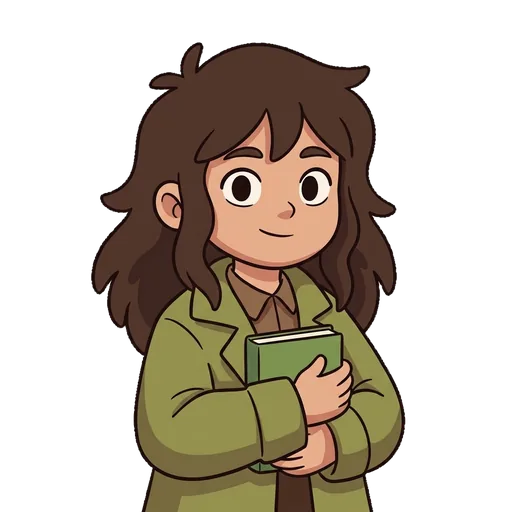 Inkling a child of the Green Names what she notices
 -
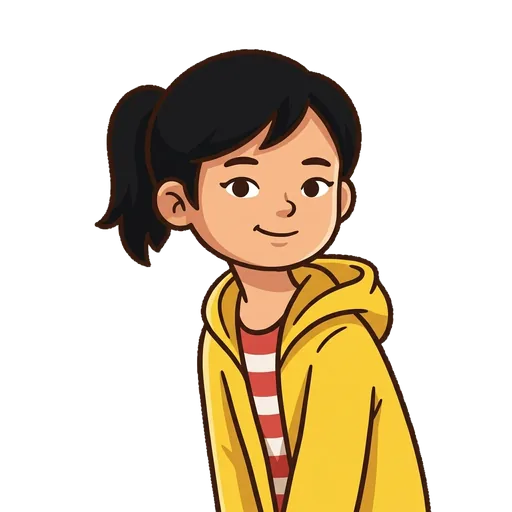 Lan a child of the Green Goes first; makes a friend in a minute
Every recurring character has a short tune, so you can tell who is on stage before a word is said. The tunes play only when you tap, and the Reading Access sound switch turns them off.
The Honest Page
Which parts are true, stretched or made up — and what does nobody know?
True
- The Ishango bone was found at an old fishing settlement where Lake Edward runs into the Semliki River, in what is now the Democratic Republic of the Congo. It is about twenty thousand years old, and it has groups of notches cut along it in three rows. Source
- An even older notched bone, the Lebombo bone, comes from a cave in the Lebombo Mountains between South Africa and Eswatini. It is about forty-two thousand years old. Source
- A tally keeps a count by making one mark for each thing, and the marks are often put in groups so they are easier to read. Source
Stretched
- In the story the girl's fish traps are woven baskets, and the notched bone is made in one afternoon to count them. What we simplified: The people at Ishango fished and gathered food, but nobody knows whether they used basket traps. Twenty thousand years is a long time, and how dates this old are worked out is still argued about.
Made up
- Lan and Inkling, the spark, the buzzing word, the girl, her grandmother and the twelve traps are made up.
Nobody knows
- Nobody knows what the notches on the Ishango bone were for. Some people think they were a count, some think a calendar of the moon, and some think they were cut to make the bone easier to hold. Source