
The Day Before · Reader · ages 6-8
Listen along
Loading audio…
Read by an AI-generated voice. The words on this page are the transcript.
1. The Valley of Falling Leaves
The hammer rang once. A spark jumped off the anvil and did not go out. It waited. They followed.
There were six letters on the anvil now. DOOR across the top, and underneath it, on a line of their own, O and P. Inkling had written them in her green book with two empty dashes after them. She had said, on Thursday, that she had a feeling about the word. She had not said what the feeling was. Lan had asked four times.
"Is it a nice feeling?" Lan asked again on Saturday, on the way past the anvil.
"It's a door kind of feeling," said Inkling, which was no help at all.
The spark took them to the bench under the big tree on the Green, where the old people sat in the afternoons. Then it simply waited there.
Warm wind blew the Green away, and the ground under their feet was somewhere else, the day before.
The first thing Lan noticed was the cold. It bit her nose and her ears straight away, a clean, sharp, early-morning sort of cold, and she was glad of her raincoat for once. The second thing she noticed was the sound of water. Not the sea this time. A river, fast and busy, talking to itself over stones.
They were standing on a grassy rise above a wide green valley. Down below them a river ran, clear as glass, so clear that Lan could see the brown and grey stones on its bed. Birch trees grew along its banks, and their leaves had gone yellow, and every time the wind blew, a few more came spinning down onto the water and were carried away. On the far side of the river, low hills rose, dark with pine woods, one behind another, until the last ones were blue. It was nearly evening. The sky was pale and clean, and very low over the hills, so thin that Lan nearly missed it, there was a new moon, like a curl of fingernail.
On the rise behind them there was a camp. It was a ring of low shelters made of long poles leaning together, covered in animal skins sewn into big sheets, with smoke drifting out at the tops. In the middle a fire was burning. People were working all round it. A man was scraping the inside of a deer skin with a sharp stone, long smooth strokes, over and over. Two women were stacking firewood into a wall as tall as a child. A boy was carrying water up from the river in a bag made of skin, and spilling a lot of it. Somewhere a dog was barking at nothing.
On a skin bag by the fire there was an old mend, where a tear had been sewn up with thin strips of leather. Beside the mend, scratched into the bone toggle that closed the bag, there was a tiny hammer.
Lan saw it, and touched it, very lightly, and did not say anything.
A girl about their age was sitting by the fire with her chin on her fists. She had a hood of soft brown fur, and a necklace of small shells, and she was looking at the thin moon as if she were cross with it.
She saw them. She looked at Lan's yellow raincoat, and at Inkling's green coat, for quite a long time.
"You must be from a long way off," she said.
"Quite a long way," said Inkling. "What are you looking at?"
"The moon," said the girl. "I'm trying to remember it."
2. Too Soon
The girl's uncle came and sat down by the fire. He was tall and quiet, with grey in his beard and a pack beside him, already tied up. He nodded to Lan and Inkling as though visitors in strange clothes came every day.
"My uncle is going away tomorrow," the girl explained. "He goes up into the far hills every winter, to hunt. He won't be back until the spring." She looked at him. "He always keeps the count."
"The count of what?" said Lan.
"Of the seasons," said the girl. "Of when things happen. When the geese go. When the berries come. When the salmon come back up the river." She pointed down at the water. "In the spring the salmon swim all the way up from the sea, up the river, to the falls. If you're at the falls on the right day, you catch so many that you eat well all year. If you're late, they've gone up past the falls and you can't get them. If you're too early, you wait in the cold for nothing."
"And this winter," said her uncle, "the count is hers."
The girl looked at the fire.
Inkling knew what this was. She was quite sure. She had one on the wall at home, in the kitchen, with a picture of a different cat for every month. Her teacher had one on the wall at school, with all the children's birthdays on it. It was a short, clever word for a thing that tells you what day it is, and when things are coming, and it was right there.
And Inkling, as Lan knew perfectly well, liked naming things more than almost anything, and sometimes she named them before she had looked.
"I noticed it straight away," said Inkling. "What you need is called a..."
She said the word.
Bzzz.
It came out as a buzz, small and cross, like a wasp at a window.
The girl stared at her. Her uncle raised his eyebrows a very little.
Inkling went pink from her chin to her hair. At the lake, she had done exactly this. She had promised herself, after the lake, that she would look first. She had told Lan to look first, at the sea, only last week. And she had done it again, before she had looked at anything except a cat calendar in her own head.
Lan did not laugh. She slid her hand into Inkling's and squeezed it.
"The door," said Lan softly. "You can't bring the answer. You can only bring the question."
"I know," said Inkling. "Look first."
"Look first," said Lan. "Then ask."
Inkling took a deep breath, and nodded, and put her green book away in her pocket.
3. When It Feels Warm
"How will you know when it's the right day?" Lan asked the girl. "For the salmon?"
It was a question, so it came out as words.
"When it feels warm," said the girl at once. "When the snow's gone, and the days are warm, and the birds come back. That's spring. Then we go down to the falls."
Her uncle shook his head, slowly.
"That's what everybody says," he said. "And last year, in the middle of the winter, there was a week as warm as spring. The snow went. The sun came out. A family over the hill said, it feels warm, it must be time, and they packed up and walked all the way down to the falls."
"What happened?" said Inkling.
"The river was empty," said the uncle. "Empty and grey and frozen at the edges. Not a fish in it. The salmon were still down in the sea, where they always are at midwinter. Then the snow came back, and the family had to walk home again in it." He looked at the girl. "Warm is a feeling. Feelings come and go. The salmon don't come when it feels warm. They come when it's time."
The girl looked down at her hands.
"Then I don't know how to tell," she said.
4. Knots
They sat by the fire for a while. Then the girl jumped up and went into the nearest shelter, and came out with a long cord, twisted out of plant fibres, light brown and strong.
"I know," she said. "I'll count the days. Every day I'll tie a knot. One knot, one day. When my uncle comes back, I'll tell him how many days it's been."
"But how many days is it until the salmon?" said Lan.
The girl looked at her uncle.
"I've never counted days," said her uncle. "Nobody can count that many days."
"I'll try," said the girl stubbornly.
She tied a knot in the cord, a tight little lump. "That's today," she said. Then another. "That's yesterday." Then another. "That's the day before, when the geese went over."
She held the cord up. It had three knots on it, near one end. It looked very small.
"How many moons until the salmon?" Inkling asked the uncle.
"Six, usually," said the uncle. "Sometimes seven."
"And how many days in a moon?"
The uncle thought about it. He held up both hands, and then both hands again, and then both hands again. "About that many," he said. "From one thin moon to the next. Thirty, nearly."
Lan tried to work it out in her head, with her fingers. Thirty knots for one moon. Thirty more for the next. And the next. Six times.
"That's a hundred and eighty knots," said Inkling quietly. She had done it in her green book, which she had taken out again just for a sum. "About thirty a moon, six moons. A hundred and eighty."
The girl looked at her cord with its three knots.
"A hundred and eighty," she said.
She tried to imagine it, the long cord, all knots, from one end to the other, wound round and round on itself, tangled in a heap by the fire. She tried to imagine, in the spring, picking it up and counting a hundred and eighty knots without missing one, or counting one twice. She tried to imagine what would happen if she forgot to tie a knot one day, when she was ill, or when it was dark, or when the snow was deep.
She let the cord drop into her lap.
"I'll lose count," she said. "I can't even tell how many knots are on a cord by looking at it, once it's tangled. Nobody can."
5. What Comes Round Again?
Inkling had not said anything for a while. She had been watching the sky.
Now she spoke carefully, so that every word was a question.
"I noticed something," said Inkling. "Can I ask you about the moon? You said you were trying to remember it. What does it do?"
The girl looked up at the thin curl of moon, low over the hills.
"It's thin now," she said. "Just born. In a few days it'll be fatter, like half a stone. Then round and bright, so bright you can see your shadow. Then it gets thinner from the other side. Then it's gone, for a night or two, dark. Then it's thin again, like now."
"And then?" said Inkling.
"And then it does it all again," said the girl. "Thin, round, thin, gone. Every time."
"Does anybody make it do that?" said Inkling.
"No," said the girl. "It does it by itself. It always has."
"So the days go past one by one," said Inkling slowly. "And you'd have to count every one, a hundred and eighty of them. But the moon comes round again, all by itself. How many times does it come round before the salmon?"
"Six," said the uncle. "Sometimes seven."
Inkling looked at Lan, and Lan could see her trying very, very hard not to say anything too soon.
"Wait," said Inkling. "I think I can name it now. I looked first."
"Go on," said Lan.
"Count the thing that comes round again," said Inkling. "Not every single day. The moon comes round all by itself, and you can see it from anywhere. Six moons is easy to count. A hundred and eighty days isn't. Count moons, not days. Moons are bigger."
It came out as words. Not a buzz at all.
"Count the moons," said the girl, trying it out. She looked up at the sky. "Six moons."
6. The Cold Night
But it was getting dark.
The sun had gone behind the far hills, and the valley had filled up with blue shadow, and the cold had got deeper, the kind that creeps in through the seams of your clothes. The people of the camp had come in close round the fire. Someone had put meat to cook on a flat stone. The dog had stopped barking and was asleep with its nose in its tail.
The girl sat with her arms round her knees and looked at the moon, which was sinking now behind the hills.
"It's easy to count six moons tonight," she said. "But it's a whole winter. In the deep snow, when we're all inside, and the clouds come for days, and I can't see the moon at all. And when I'm busy, and when I'm ill." Her voice went small. "I'll forget whether it's been four moons or five. And by the spring I'll have lost count, and we'll miss the salmon, and everyone will be hungry. And it will be my fault."
Lan sat down next to her. She did not know what to say. She looked at the fire, and at the ground, at the short, flat grass where people had been walking, worn smooth by many feet. Near her foot there was a little hollow in the ground, where someone had dug out a stone for the hearth. It was still there, and so was the stone, sitting beside it.
Lan looked at the little hollow for a long moment.
7. Pits
"Can I ask something?" said Lan.
The uncle looked at her.
"The knots on the cord get tangled," said Lan, feeling her way, the way you feel your way in the dark. "And you can't see the moon when it's cloudy. And you can't keep it in your head. But that hole in the ground..." She pointed. "It doesn't go anywhere. It's just there. Could each moon have a place in the ground? A place that stays, here by the camp, so anyone can look at it and read it?"
It came out as words, every one.
The uncle looked at the little hollow. Then at Lan. Then he got up without saying anything, and went to the shelter, and came back with a digging stick, a strong, pointed stick with its end hardened in the fire. He gave it to the girl, and sat down again.
The girl knelt on the grass by the fire. She looked at the stick, and at the ground, and then she began to dig.
She dug one shallow pit, round, about as wide as her two hands, and patted the edges smooth. Then she moved along and dug another. Then another. Lan and Inkling helped scoop out the earth with their hands, which went black and cold. The girl dug in a long row, one pit after another, all the same size, all the same distance apart.
"How many?" said Lan.
"One for every moon," said the girl. "For the whole year. Right round, from the salmon to the salmon."
When she stopped, there was a row of pits stretching away across the grass in the firelight. They counted them together, touching the edge of each pit once, so that they did not miss one or count one twice.
"Twelve," said Inkling.
"Twelve moons," said the girl, "from one spring to the next."
Then she went down to the river in the dusk and came back with a smooth grey stone from the water, round and heavy, just the right size to sit in a pit. She put it in the first pit.
"This is this moon," she said. "The thin one tonight. When the next thin moon comes, I move the stone one pit along." She moved it to the second pit, to show them, and then back again. "And the next. And the next. And when the stone gets to the right pit, it's time for the salmon."
"And if it's cloudy?" said Lan.
"Then I wait for the next clear night, and see if the moon's fat or thin," said the girl. "You can always tell, if you can see it once. You don't have to see it every night. And the stone doesn't move unless somebody moves it."
"It stays," said Inkling.
"It stays," said the girl. Her face had changed. "It just stays where you put it."
8. The Dip in the Hills
The uncle had been watching all of this without saying a word. Now he leaned forward and looked along the row of pits.
"There is one thing," he said. "My mother's mother found it, and her mother before her. Twelve moons are not quite a year."
"What do you mean?" said Lan.
"If you count twelve moons from this one," said the uncle, "you don't come back to the same time of year. You come back a little bit early. Next year a little more early. After a few years, you think it's spring, by the moons, and it's still winter. The count slips."
Inkling got out her green book again. She did not name anything. She asked the uncle how many days there were in a moon, exactly, and he said nearly thirty, a little less, and she did it on a page.
"About twenty-nine and a half days a moon," she said slowly, "times twelve moons, is about three hundred and fifty-four days. And a whole year is about three hundred and sixty-five." She looked up. "Eleven days. Twelve moons are about eleven days shorter than a year."
"So every year," said the girl, dismayed, "the stone gets eleven days too early?"
"Eleven days," said the uncle. "And then twenty-two. And then thirty-three. Which is a whole moon."
The girl looked at her row of pits, and her face began to fall again.
But Lan was looking at the hills.
The sun had set behind them a little while ago. The sky above them was still faintly orange, and the hills were black against it, a long wavy line of them. In one place there was a deep dip in the line, like a bite out of a biscuit.
"Can I ask one more thing?" said Lan.
"Ask," said the uncle. He had started to look as if he liked her questions.
"Is there a day that comes round exactly once a year?" said Lan. "Not by the moon. A day you can always see. Like the shortest day, in the middle of winter, when it gets dark really early. Where does the sun come up on the shortest day?"
The uncle turned and looked out to the south-east, across the valley.
"There," he said. He pointed at the dip in the hills, the bite out of the biscuit. "On the shortest day of winter, the sun comes up in that dip. Every year. It's the only day it does. The days after that, it moves along, and the days get longer."
The girl had gone very still.
"Then if the pits pointed at the dip," she said slowly, "and I watched it in the morning..."
"On the morning the sun comes up in the dip," said Lan, "the stone goes back to the first pit. Wherever it is. And the count starts again on the right day."
"Every year," said the girl. "So it can't slip. The sun puts it right."
They all got up. They dug the pits again, a little way along, so that the row pointed straight across the valley at the dip in the hills, with the first pit at the far end. It took a long time. The uncle helped, this time, without saying anything, and so did the boy with the water bag, and the man who had been scraping the skin. When they had finished, the girl lay down on the cold grass at the end of the row and looked along it, the way you look along an arrow, and it pointed straight at the dip.
She put the river stone back in the pit for this moon.
The uncle stood and looked at it for a long time.
"I'll go up into the hills tomorrow," he said at last, "and I won't worry."
9. Silver Fish
All winter the girl kept the count.
At every thin new moon she went out to the pits and moved the stone one along. When the clouds came for days, she waited for a clear night and looked at the moon to see whether it was fat or thin. When the snow came, she brushed it out of the pits with her hands. On the shortest day of winter she got up in the dark and stood at the end of the row, with her breath steaming, and watched the dip in the hills. The sun came up exactly in the dip, red and slow. The stone was two pits early, so she moved it back to the first pit, where it belonged, and went back to bed.
In the middle of winter there was a warm week. The snow went. The birds sang. A family from over the hill came past and said, it feels like spring, it must be time for the salmon.
The girl looked at the stone in its pit, and at the moon, and shook her head.
"Not yet," she said. "Three more moons."
The family laughed, and went down to the falls anyway, and came back two days later, cold and cross, with no fish.
Then, at last, the stone came to the pit the girl had marked with a white pebble on its edge. The next morning she stood at the end of the row, and looked at the stone, and looked at the moon, which was thin and new.
"Now," she said. "It's time."
The whole family walked down the valley to the falls, where the river came roaring over a ledge of rock in a sheet of white water. They waited by the pool below.
For a while there was nothing.
Then a fish leaped out of the white water, silver all over, shining in the sun, and fell back. Then another. Then ten, then twenty, all along the falls, flashing and jumping, trying to get up the river.
Everybody shouted.
And coming down the path from the far hills, with his pack on his back and grey in his beard, was the girl's uncle, who had kept his own count up in the hills. He saw them all there at the falls, on exactly the right day, and he smiled the biggest smile Lan had ever seen.
That night there were salmon cooked on hot stones, and more salmon hung up in the smoke to keep, enough for the whole year. The girl told the story of the stone and the dip in the hills to everyone who would listen. When she got to the part about the family from over the hill, the uncle laughed so much he had to lie down.
Nobody would write down the girl's name, or her uncle's.
When the fire was low, and the thin moon was setting over the hills again, the spark rose up out of the embers and waited.
Lan and Inkling said goodbye. The girl gave each of them a small flat stone from the river, smooth and grey, the kind she had moved along the pits.
Warm wind blew the day before away, and the grass under their feet was the Green.
The bench was there, and the big tree, and the anvil, glowing faintly in the dusk.
Lan ran straight to it.
Under the word DOOR, after the round O and the P, so small that she had to put her nose almost on the iron to see it, there was a new letter. It had a straight back and three arms, scratched in neatly, like all the others.
"E," said Lan.
Inkling wrote it in her green book, in the third dash. Then she looked at the one dash that was left.
"O, P, E," she said. "One more."
"Are you going to say it?" said Lan.
"No," said Inkling. "I'm going to wait for it." She shut the book. "It comes round on its own, if you wait."
The spark dimmed to a warm dot and settled back on the anvil. The Green was just the Green again.
Back on the Green
When Lan got home, she drew a long row of boxes along the bottom of the calendar on the fridge, one for each day until her birthday. She put a button in the first box. Every morning she moved it one box along, and every morning her mum asked how many to go, and Lan could tell her straight away without counting, just by looking.
Tell the story back to someone. Why did counting moons work better than counting days? Why did they point the row of pits at the dip in the hills?
Saved. The next chapter will be here whenever you come back.
Who you met
-
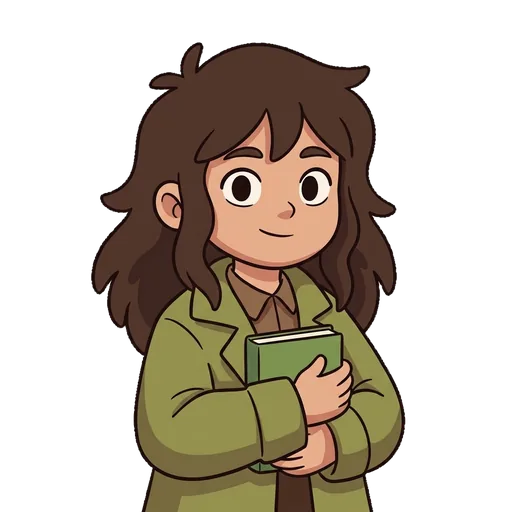 Inkling a child of the Green Names what she notices
 -
 Lan a child of the Green Goes first; makes a friend in a minute
Every recurring character has a short tune, so you can tell who is on stage before a word is said. The tunes play only when you tap, and the Reading Access sound switch turns them off.
The Honest Page
Which parts are true, stretched or made up — and what does nobody know?
True
- At Warren Field, near Crathes Castle in Aberdeenshire, Scotland, people dug a row of twelve pits about ten thousand years ago. They were first dug up by archaeologists in 2004. Source
- In 2013 a team of archaeologists explained the pits as a calendar of the moon's phases, lined up with the place on the skyline where the sun rises on the shortest day of winter. They called it the oldest calendar of its kind yet found, made by people who hunted and gathered their food. Source
- From one new moon to the next takes about twenty-nine and a half days, so twelve moons come to about 354 days, about eleven days short of a year. Source
Stretched
- In the story one girl digs all twelve pits in one evening and keeps the count for a winter. What we simplified: Nobody knows who dug the real pits, or how long it took. People at the time hunted, fished and gathered, but nobody knows whether these pits were used to time the salmon.
Made up
- Lan and Inkling, the spark, the buzzing word, the girl, her uncle and the salmon falls are made up.
Nobody knows
- Nobody knows for certain what the pits were for. The calendar is how archaeologists explained them; the people who dug them left no words to tell us. Source