Ama
A RECORD YOU CAN TRUST
Listen along — Ama
Loading audio…
Press play to listen along. The line being read lights up as you go.
Show full transcript
Loading transcript…
Ama and the Page Nobody Could Change
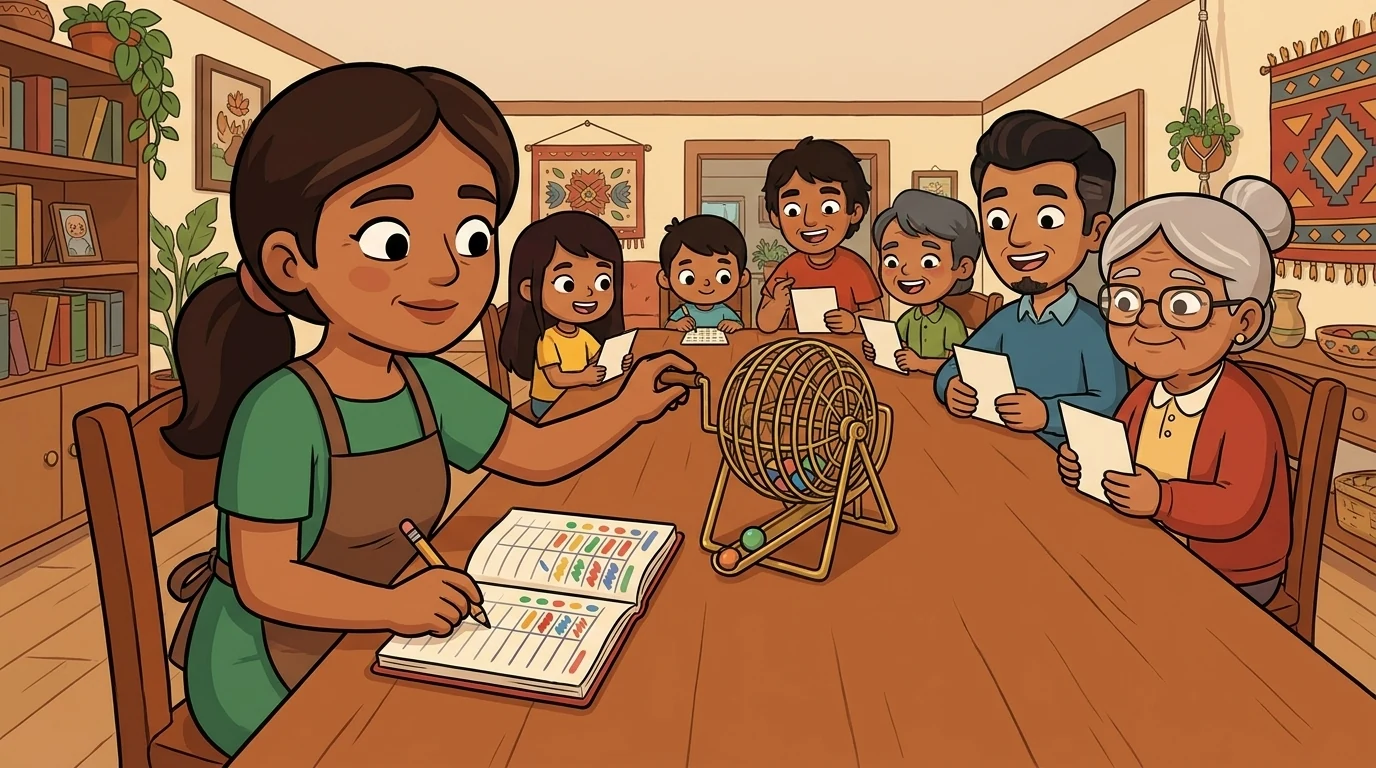
By the fourth night of the river fair, Ama could turn the cage without looking. Handle round twice, door open, one ball out. She wrote each number in the red book before she said it aloud, because Rima had told her that was the order that mattered: pen first, voice second.
The tables were bigger here than at home. Sixty players, maybe more, on benches under strings of paper lanterns, and a prize at the end of the night that people actually cared about: a basket with a rice cooker in it, wrapped in red cellophane.
On the forty-first ball, a woman near the front stood up with her card held high.
“Full house!”
Ama ran her finger down the page, checking the woman’s numbers as she read them out. Every number was there until the last one. “Eighty-three,” the woman said, and Ama’s finger stopped.
There was an eighty-three in the book. But it had a line through it.
“Eighty-three was called,” the woman said. “I heard it. Everybody heard it.”
Ama remembered. On the thirtieth ball she had written 83, and then Tam, reading it to the crowd, had frowned and held the ball up to the lantern. It was 38, turned upside down in Ama’s hand. Ama had drawn one neat line through the 83 and written 38 beside it. Tam had called “Thirty-eight, sorry, thirty-eight” to the whole table.
“It was a mistake,” Ama said. “I wrote it wrong and fixed it straight away. The ball was thirty-eight.”
The woman’s face hardened. “Then the book is wrong. How do we know which number is the mistake? Maybe you’ve changed it now, to stop me winning.”
The whole square went quiet. Ama felt her face burn from her neck to her ears. She wanted very badly to say I’m not a cheat, but she could hear how that would sound. Anyone could say that.
Rima, behind her, said nothing at all. Ama understood that this was hers to settle.
She turned the book around so the woman could see it.
“Look at the page,” she said. Her voice wobbled, so she slowed it down. “I didn’t rub anything out. You can still read eighty-three under the line. And thirty-eight is written right next to it, in the same pen, in the same place. If I’d changed it tonight, the thirty-eight would be squeezed in somewhere else, or in a different colour.”
The woman leaned closer.
“And look at what comes after,” Ama went on. “Ball thirty-one is twelve. Ball thirty-two is sixty. Every number is in order. If I’d added something later, there wouldn’t be room for it in the order.”
“Your book,” the woman said, but less sharply now. “Your handwriting.”
That was the part Ama hadn’t got an answer for. It was true. A book only she had written could only be checked against her.
Then Tam stepped forward with a crumpled square of paper.
“I keep a tally,” Tam said. “Every time I call a ball, I make a mark in the box for that number. Rima told me to, on the first night. I don’t look at Ama’s book when I do it.”
She smoothed it out on the table. A grid of ninety boxes, each with a tiny pencil tick or nothing. In the box for thirty-eight, there was a tick. In the box for eighty-three, there was nothing.
Two lists. Two people. Neither had looked at the other’s. They agreed.
The woman looked from the book to the tally and back again for a long time. Then she let out a breath and laughed, a little embarrassed. “Upside down,” she said. “Thirty-eight upside down is eighty-three. Of course it is.” She sat down. A few people near her laughed too, kindly, and somebody patted her shoulder.
The game went on. Seven balls later, an old man at the back called full house, and both lists agreed on every number, and he carried the rice cooker away as if it were a trophy.
Afterwards, while the stools were stacked, Ama sat on the edge of the stage with the book open on her knees.
“I almost rubbed it out,” she said to Rima. “On ball thirty. My first thought was to scribble over the eighty-three so the page looked tidy.”
“What would have happened?”
Ama thought about it. “She’d have seen a scribble. A blot where a number used to be. And then nobody could have proved what was under it.” She ran her thumb over the neat single line. “The mistake being readable is what made the page believable.”
“A record you can’t trust isn’t a record,” said Rima. “It’s a story. The book is trusted because of how it’s kept. Written when it happens. In order. Nothing taken away, only crossed through. And it’s even better when someone else keeps a second record without copying the first.”
“Like Tam’s tally.”
“Like Tam’s tally. One record can be honest. Two that agree are hard to argue with.”
Ama turned back through the old pages from her great-aunt’s time. Now she noticed things she hadn’t noticed before. Here and there a number had a line through it and a new one beside it. Once, in pencil, someone had written misheard, corrected in the margin. On one page from long ago there were two columns of numbers side by side, in two different handwritings. Two keepers, checking each other.
None of the old mistakes had been hidden. Every one was still there to read.
Ama took out her pen and, at the bottom of the night’s page, wrote: Ball 30: wrote 83, it was 38. Corrected at the time. Tam’s tally agrees. Then she drew the little brass cage, and closed the book.
The CallerTales ensemble
Ama is one of the friends in CallerTales. Each friend shows you one idea by how they act; meet them all and you have the whole subject.
-

Tam
Reads every call aloud, and gets braver each stop
-

Rima
Ends every call on a rhyme, as lô tô singers do
-

Riddla
Never names a thing — only riddles it, like a cantor
-

Smorfia
Sees a picture in every number, as tombola players do
-

Hiệu
Sings the hint before the card, the way bài chòi is sung
-

Kelly
Gives every number a nickname, like a housie caller
-

Beano
Marks with whatever is to hand — beans, bottle caps, buttons
-

Cartella
Is a tombola card: three rows, five numbers each, every column its own decade
-

Quina
Shouts the moment five in a line are marked, and checks the line twice