Ama
KEEP THE RECORD
Listen along — Ama
Loading audio…
Press play to listen along. The line being read lights up as you go.
Show full transcript
Loading transcript…
Ama’s Call Book
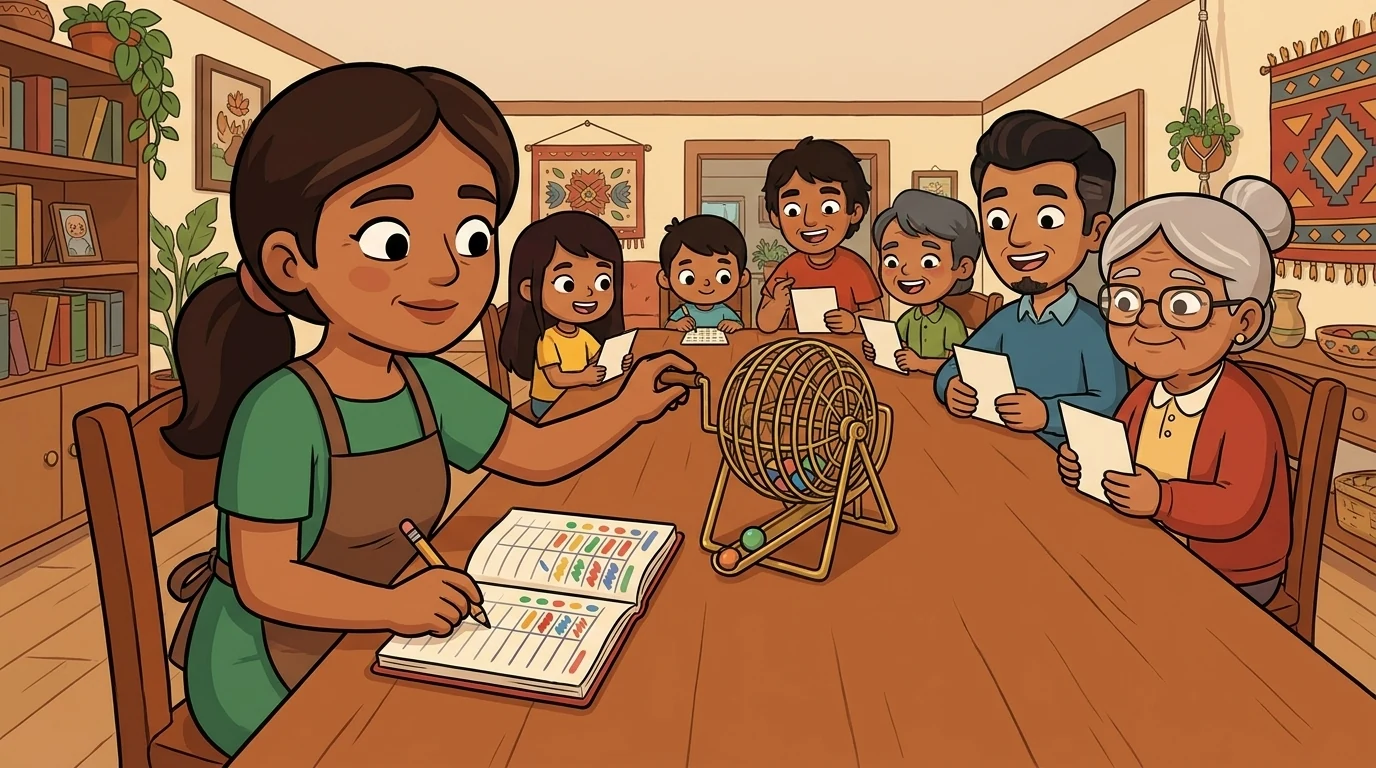
The cage came to Ama on her twelfth birthday, wrapped in a tea towel. It was brass, the size of a lunchbox, with a little handle that turned it round and a door just big enough for one wooden ball at a time. Her great-aunt had left it to her with a note: Every ball is a year. Look after them.
With it came a notebook with a soft red cover. Most of the pages were already full. Rows and rows of numbers, in handwriting that changed every few pages. Some were in pencil, some in blue ink, one page in green crayon.
“It’s a call book,” said Rima. Rima was nineteen and sang lô tô at the Tết fair every year, and she had come over to help. “Whoever turns the cage writes down every ball, in order. Every single one.”
“Why?” said Ama. “Everyone can hear the numbers.”
Rima only smiled. “You’ll see.”
That evening the whole family played. Ama turned the handle, the balls clattered, and the first one rolled out. “Fourteen,” she said, and wrote 14 in the book. Then 3. Then 57. Her cousin Tam leaned over her shoulder and read each one out to the table.
On the twentieth ball, two voices shouted at once.
“Line!” cried Uncle Duc.
“Line!” cried Grandma.
They both waved their cards. Then they both looked at Ama.
Ama’s stomach dropped. She could feel everyone waiting for her to decide, and she didn’t want to choose between her uncle and her grandma. Her face went hot.
Then she remembered the red book.
“Read me your line,” she said to Uncle Duc. “One number at a time.”
“Fourteen. Twenty-two. Thirty-nine. Fifty-seven. Sixty-one.”
Ama ran her finger down the page. Fourteen, yes. Twenty-two, yes. Thirty-nine, yes. Fifty-seven, yes. Sixty-one…
She looked twice. It wasn’t there. “Sixty-one hasn’t been called yet,” she said. “It was sixteen.”
Uncle Duc peered at his card, then laughed. “My glasses! Sixteen. You’re right.”
Grandma read hers out. Every number was in the book. “Grandma has the line,” said Ama, and this time her voice came out steady.
Nobody argued. Nobody needed to. The answer wasn’t Ama’s opinion. It was written down, in order, for anyone to see.
Afterwards Ama turned the old pages of the book. She found a page from a fair long ago where someone had written, in tiny letters next to a number, disputed — checked — fine. Another page had a little sketch of a tent. Every page was a game that had really happened.
“Now you see,” said Rima.
“The book isn’t just for remembering,” said Ama slowly. “It’s so nobody has to trust anyone’s memory. Not even mine.”
Rima nodded. “A good record is the fairest thing at the table. It doesn’t take sides.”
Ama wrote the date at the top of the next clean page and drew a small brass cage beside it. Tomorrow the cage would take them somewhere new, Rima said. Wherever it was, Ama would be writing every ball down, in order, one after another.
More stories with Ama
Another short audio story about Ama. Open one when you are ready.
The red book
Loading audio…
Read the script
- Narrator: From Spark and Anvil and CallerTales — this is Ama, in chapter 1 of the CallerTales cast.
- Narrator: This drama uses an AI-generated voice. Voiced via Gemini 2.5.
- Narrator: At the river fair, Ama turns the brass cage, and before she says a number, she writes it down. Pen first. Voice second.
- Ama: Twenty-one. Written. Twenty-one!
- Tam: Why do you write it before you call it? Everyone can hear you.
- Ama: Because hearing isn't the same as knowing. Ears forget. Ears argue. The book doesn't.
- Narrator: Three balls later, two players shout at once.
- Tam: They both say they've won. Who decides?
- Ama: Not me. The book does. Read me your line, one number at a time.
- Narrator: Ama runs her finger down the page. Every number is there for the first player. For the second, one is missing.
- Ama: Sixty-one hasn't been called. It was sixteen. Easy to mix up.
- Tam: Nobody's arguing. Not even the one who lost.
- Ama: Because it isn't my opinion. It's a list, in order, written the moment it happened. And if I ever write one wrong, I don't rub it out. I cross it through, neatly, so everyone can still read it.
- Tam: Even your mistakes stay in the book?
- Ama: Especially my mistakes. A page with a smudge on it makes people wonder what was there. A page with a line through it shows exactly what happened.
- Narrator: Write it when it happens. Keep it in order. Never rub it out. That's how a list becomes something a whole table can trust.
- Narrator: You've been listening to a Spark and Anvil chapter, written by the Spark and Anvil writing team for ages 9 to 14.
- Narrator: Apps stay free forever.
- Narrator: Curriculum aligned to English language arts — rhyme and riddle and wordplay in the calling games of many cultures.
- Narrator: Released under Creative Commons BY-NC-SA 4.0 for educational reuse. Visit Spark and Anvil for the full transcript.
The CallerTales ensemble
Ama is one of the friends in CallerTales. Each friend shows you one idea by how they act; meet them all and you have the whole subject.
-

Tam
Reads every call aloud, and gets braver each stop
-

Rima
Ends every call on a rhyme, as lô tô singers do
-

Riddla
Never names a thing — only riddles it, like a cantor
-

Smorfia
Sees a picture in every number, as tombola players do
-

Hiệu
Sings the hint before the card, the way bài chòi is sung
-

Kelly
Gives every number a nickname, like a housie caller
-

Beano
Marks with whatever is to hand — beans, bottle caps, buttons
-

Cartella
Is a tombola card: three rows, five numbers each, every column its own decade
-
Quina
Shouts the moment five in a line are marked, and checks the line twice