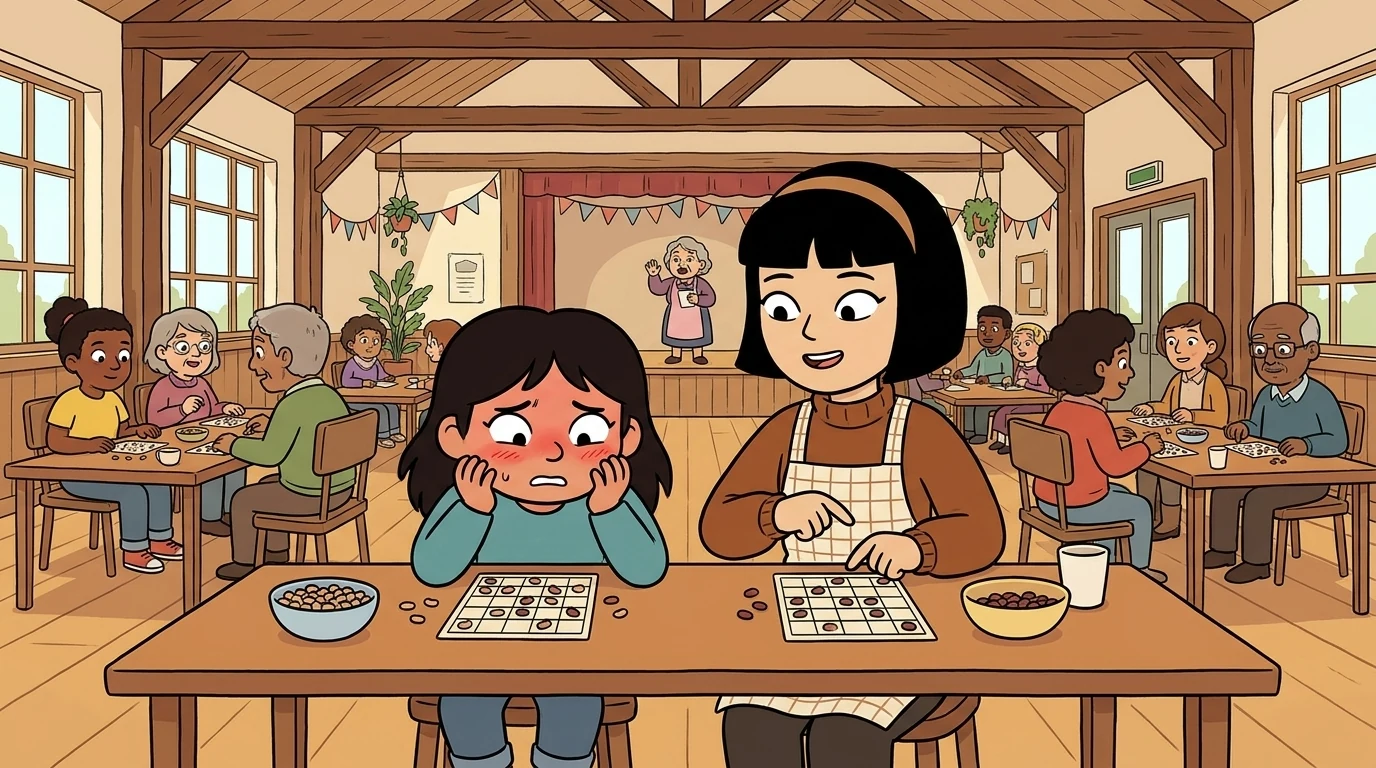
Cartella
A STRUCTURE YOU CAN REASON WITH
Listen along — Cartella
Loading audio…
Press play to listen along. The line being read lights up as you go.
Show full transcript
Loading transcript…
Cartella and the Sheet of Six
On Christmas Eve, at Smorfia’s family table in Naples, somebody handed Tam a whole sheet of cards instead of one.
Six cards, printed together on one long strip of card, red and white and folded like a map.
“Six?” said Tam. “I can barely keep up with one.”
Cartella slid onto the bench beside her, apron and headband and all, and pulled the strip towards them. “You can keep up with six,” she said, “once you know what six of me are for. Count my numbers.”
Tam counted the first card. Three rows of five. “Fifteen.”
“And six cards?”
“Ninety.”
“And how many numbers are in the bag?”
Tam looked at the wooden cage, at the old cloth bag of tokens beside it, at Smorfia’s nonno shaking it. “Ninety,” she said slowly.
“So?”
Tam stared at the sheet. “So every number is on here somewhere.”
“Every number, once,” said Cartella. “No repeats, nothing left out. Whoever made this sheet shared all ninety numbers between six cards. Which means that whatever ball comes out of that bag, it lands on exactly one of your cards. Every single call, you mark something.”
“Twenty-seven,” called the nonno.
Tam’s eyes went to the third column of the first card, the twenties. Twenty-one, twenty-four. Not there. Second card, third column: twenty-six, twenty-nine. Not there. Third card: twenty-seven. She put down a lentil.
“Faster than that,” said Cartella. “You know it’s on one card. You only have to search the twenties column on each, and there are at most three numbers in a column.”
“At most three?”
“Every card has three rows. A column can’t hold more than one number per row. So a column has one number, two, or three. Never four. Never zero, either, on a properly made sheet.”
The next call was eighty-eight. Tam ran her eye along the last column of each card and found it on the fifth card without having to look anywhere else. Then three, then fifty-one, then ninety. Each time, one column, six cards, a handful of numbers.
“Why is the last column always crowded?” Tam asked after a while.
Cartella looked pleased. “You noticed. The first column is one to nine, that’s nine numbers. The middle columns are each ten numbers: ten to nineteen, twenty to twenty-nine and so on. The last column is eighty to ninety. That’s eleven. So across the six cards, the first column holds nine numbers, the last column eleven, and the others ten each.”
Tam counted it in her head. Nine, plus ten seven times, plus eleven. Ninety. It worked.
“You’re not a jumble at all,” she said.
“I never was. People only think so when they don’t know the rules.”
Halfway through the game, Smorfia’s little cousin Dario began to cry. He had been playing his own single card, and he said it was broken. Nobody could tell what he meant.
Tam took the card. It looked normal at first. Then, because she had spent an hour looking at columns, something snagged in her eye.
The second column had a number fourteen and a number nineteen. Fine. But the fourth column, which should have held only thirties, had a number twenty-eight in it.
“This card’s wrong,” she said. “Twenty-eight belongs in the twenties column. It’s printed in the thirties.”
Dario sniffed. “When they called twenty-eight, I looked in the twenties and it wasn’t there. So I didn’t mark it. Then my brother said I’d missed it.”
“You didn’t miss it,” said Tam. “You looked exactly where you should look. The card was in the wrong place, not you.”
Cartella was beaming. “That’s what knowing the rules gives you,” she said. “Not just speed. You can tell when something breaks them. A card that keeps the rules lets you look in one column. A card that breaks them can make you miss a number, and you won’t know why.”
Smorfia’s nonno took the misprinted card, turned it over in his hands, and laughed. “Forty years I’ve had this set, and nobody ever saw that.” He gave Dario a fresh card from the box and, with a stub of pencil, wrote sbagliata across the old one. Wrong.
Late in the evening, when the coffee cups were empty and the children were drowsy, Tam asked Cartella the question she had wanted to ask all night.
“Why would anyone bother building cards so carefully? It would be easier to print random numbers.”
“Easier for the printer,” said Cartella. “Harder for everyone else. If the numbers were scattered anywhere, the fastest eyes would win and everyone else would fall behind. With columns, a slow reader can still keep up, because they only ever look in one place. And with a sheet of six that shares all ninety numbers, nobody holding six cards ever sits through a call with nothing to do.”
“So the structure is for the slow people.”
“The structure is for everybody,” said Cartella. “The fast ones just don’t notice they need it.”
On the walk back to the hotel, Tam carried the folded sheet under her arm. That night, in the call book, she drew a small grid of nine columns and wrote underneath:
Tombola sheet: six cards, ninety numbers, each number once. Five to a row. Every column its own ten: nine numbers in the first, eleven in the last, ten in each of the rest. A column holds one, two or three numbers. If a number is in the wrong column, the card is wrong, not you.
The CallerTales ensemble
Cartella is one of the friends in CallerTales. Each friend shows you one idea by how they act; meet them all and you have the whole subject.
-
Ama
Draws the balls and keeps the call book
-

Tam
Reads every call aloud, and gets braver each stop
-

Rima
Ends every call on a rhyme, as lô tô singers do
-

Riddla
Never names a thing — only riddles it, like a cantor
-

Smorfia
Sees a picture in every number, as tombola players do
-

Hiệu
Sings the hint before the card, the way bài chòi is sung
-

Kelly
Gives every number a nickname, like a housie caller
-

Beano
Marks with whatever is to hand — beans, bottle caps, buttons
-
Quina
Shouts the moment five in a line are marked, and checks the line twice