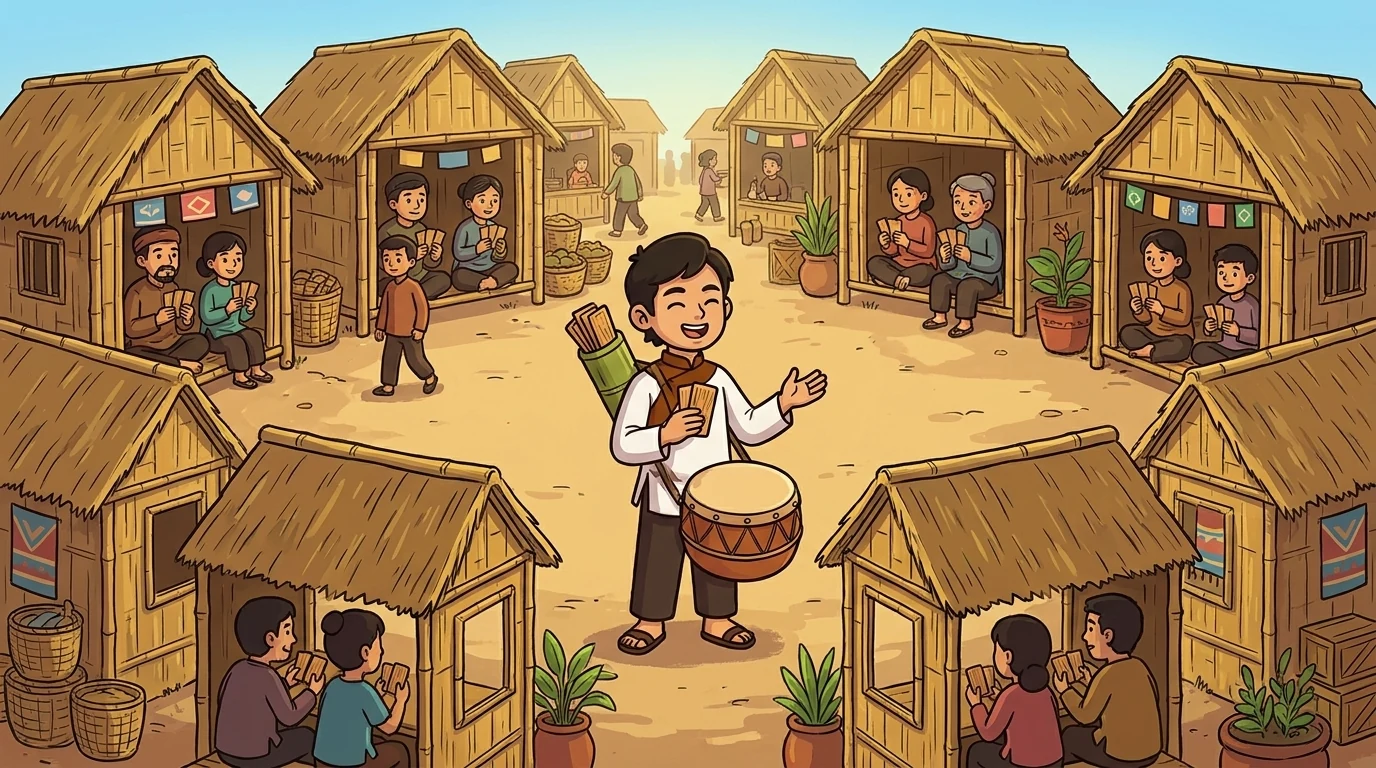
Hiệu
A HINT THAT MAKES YOU THINK
Listen along — Hiệu
Loading audio…
Press play to listen along. The line being read lights up as you go.
Show full transcript
Loading transcript…
Hiệu and the Tally of Guesses
The cage brought them back to Hiệu’s village in the dry season, when the yard between the nine bamboo huts was baked hard and the drum could be heard from the river.
Hiệu had a stub of chalk behind his ear and a slate under his arm.
“You’ve come at a good time,” he told Ama. “Tonight I’m trying new verses. My grandmother’s are the best, but there are new cards in my set now, and new cards need new songs.”
“Can I write one?” Ama asked.
Hiệu looked at her for a moment, then handed her a card face down. “Write one for this. Don’t show anyone.”
Ama peeked. A buffalo. She thought about it while the first rounds were sung, and when Hiệu nodded to her, she stood by the drum and sang, not very well:
“Big and grey, with horns so wide, it pulls the plough from side to side.”
Every hut groaned at once. Three players shouted “Buffalo!” before she had finished.
Ama sat down, red-faced.
“Too easy,” said Hiệu, not unkindly. “You told them everything in the first line. There was nothing to think about. The gap between the song and the card is where the fun is, and you closed it before the drum.”
He handed her another card. A drum, as it happened. Ama, determined not to be too easy again, sang:
“I speak but have no mouth, I travel north and south.”
Nobody guessed anything. The huts went silent. Somebody said “Wind?” and somebody else said “A letter?” and when Hiệu turned the card, there was a puzzled murmur, as if the answer didn’t really fit.
“Too hard,” said Hiệu. “Or not hard, but unfair. A drum does speak, a little. But it doesn’t travel north and south any more than a pot does. When the card is turned, the listener should think of course. If they think how was I supposed to get that, the verse has failed too.”
Ama’s cheeks burned again. “So it has to be not too easy and not too hard.”
“It has to let them guess,” said Hiệu, “but not let them be sure. Not until the very end of the verse. Then the card should feel like a door opening.”
He showed her the slate. Down one side he had chalked a word for each card that had been sung that night: fox, lantern, boat, buffalo, drum. Next to each he had made little marks.
“What are those?”
“How many huts guessed right before I turned the card. There are nine huts.” He tapped the marks next to fox. “Five. Good. Half the yard got it, half didn’t. People who got it felt clever, people who didn’t still said of course.” His finger moved to buffalo. “Nine. Everyone. That verse doesn’t make anyone think.” Then drum. “Zero.”
Ama looked at the slate. “So you can tell which verses work just by counting.”
“Counting tells you where to look,” said Hiệu. “A verse everyone gets every time, I make harder. A verse nobody ever gets, I make fairer. My grandmother did the same thing for sixty years. That’s why her verses are so good. She kept score.”
Ama tried once more. The card was a lantern again; Hiệu let her, to see if she could do better than the old verse.
She thought for a long time. She wanted a first line that made people think of several things, a middle that narrowed it, and an ending that fitted only one card. She thought about the moon, a candle, a lantern, a firefly.
“At night I glow, but I’m not the moon, children carry me, humming a tune, a little fire in a paper room.”
The huts went quiet in a different way this time. Leaning in. On the second line, a few people sat up. On the third line, a girl in the end hut grinned. When the drum boomed and Hiệu turned the lantern, there was a ripple of aah and laughter.
Hiệu chalked six marks beside it.
“Six out of nine,” he said. “And the three who missed it laughed when they saw it. That’s a good verse.”
Ama felt the jolt again, the bright, fizzy one, but this time it came from the other side of the drum. It wasn’t the feeling of guessing right. It was the feeling of making other people’s guesses interesting.
Later, Hiệu showed her his own guesses from when he was small. His grandmother had made him keep a tally too, while he listened from the huts. Rows of ticks and crosses in a child’s handwriting in an old exercise book.
“When I started, I guessed right maybe one time in four,” he said. “I kept the tally anyway. After a few months I noticed I was always wrong when I guessed after the first line, and usually right when I waited for the last. So I learned to wait.”
“The tally taught you which clues to trust,” said Ama.
“It taught me that the first clue is never enough.” He grinned. “Which is also why a good verse puts the best clue last.”
That night Ama wrote in the call book: Bài chòi, again. A good hint lets you guess but not be sure until the end. Keep count of guesses: if everyone gets it, make it harder; if nobody does, make it fairer. Lantern verse: six out of nine.
The CallerTales ensemble
Hiệu is one of the friends in CallerTales. Each friend shows you one idea by how they act; meet them all and you have the whole subject.
-
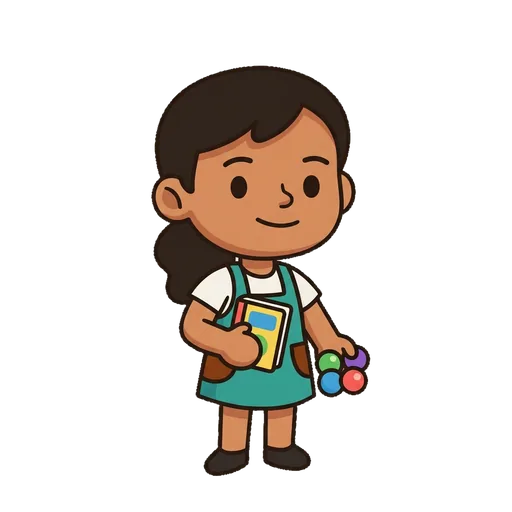
Ama
Draws the balls and keeps the call book
-
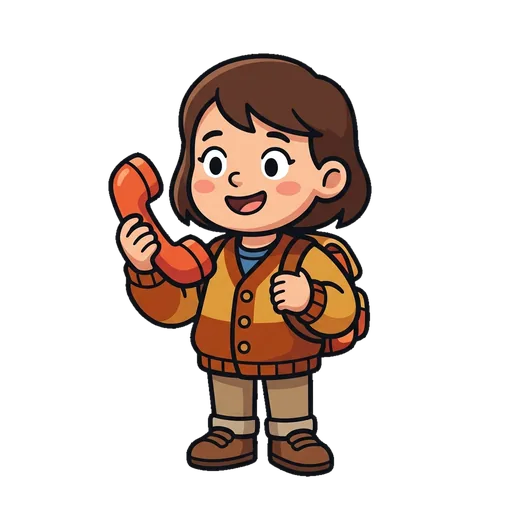
Tam
Reads every call aloud, and gets braver each stop
-

Rima
Ends every call on a rhyme, as lô tô singers do
-

Riddla
Never names a thing — only riddles it, like a cantor
-
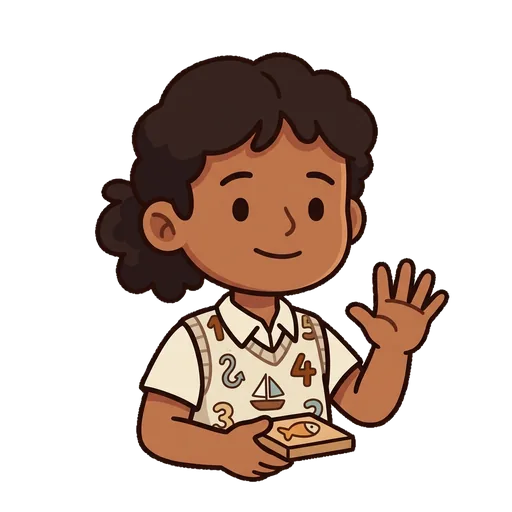
Smorfia
Sees a picture in every number, as tombola players do
-

Kelly
Gives every number a nickname, like a housie caller
-

Beano
Marks with whatever is to hand — beans, bottle caps, buttons
-
Cartella
Is a tombola card: three rows, five numbers each, every column its own decade
-
Quina
Shouts the moment five in a line are marked, and checks the line twice