
Lattice
MODERN CRYPTOGRAPHY FUNDAMENTALS — *XOR, public-key concept, hashing; the irreversible / asymmetric family.* The cryptography primitive of *one-way operations + asymmetric keys as the foundation of modern secure communication.*
Loading audio…
Press play to listen along. The line being read lights up as you go.
Show full transcript
Loading transcript…
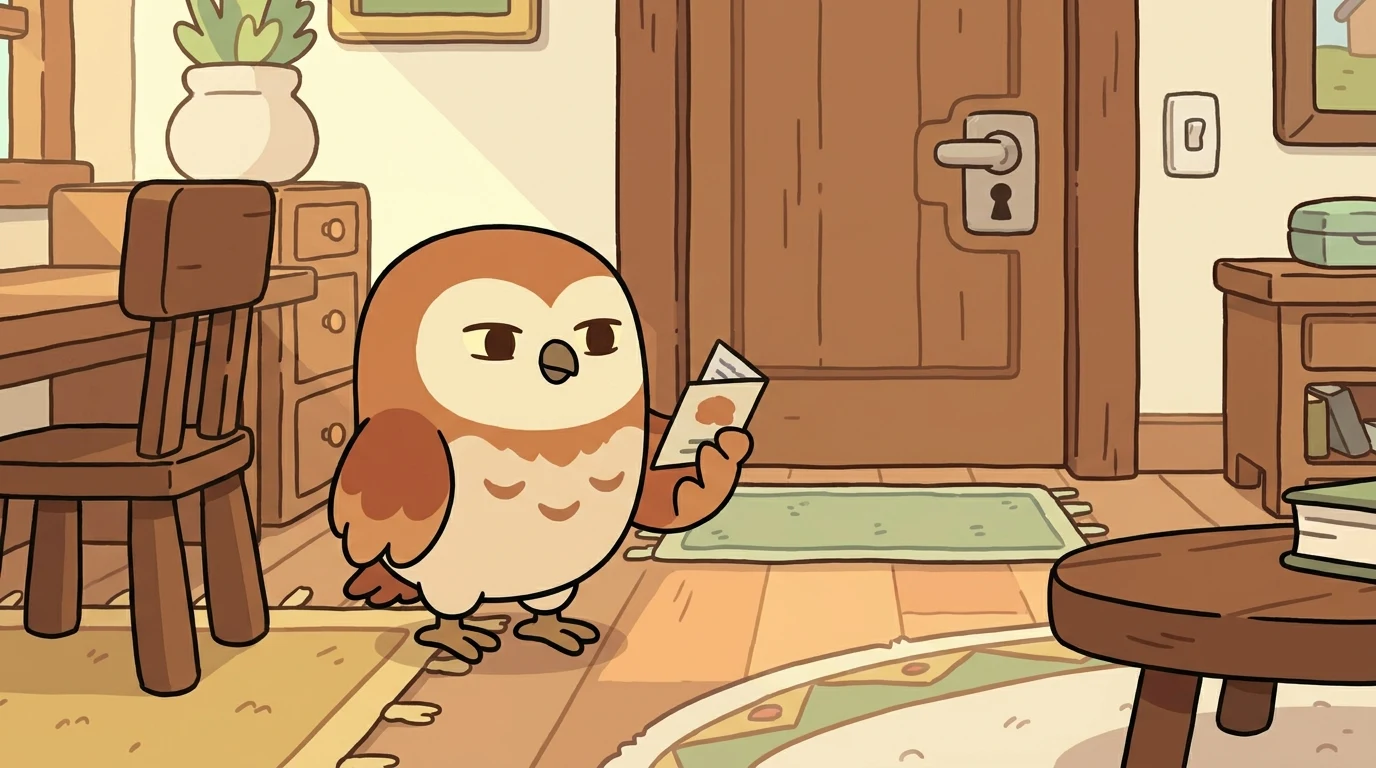
In the coldest corner of CipherForge, where the wind came down off the crags and rattled the shutters, a small owl sat very still and folded a card in half.
Her feathers were warm brown and cream, soft against all that cool air. She was young — a tween, really — but she held herself with a slow, watchful patience, the kind that made older cracksmen slow down when they passed her bench. In her claw was a plain little card, worn at the corners. On one side of it she had drawn a door with a friendly handle, the sort you'd push open without thinking. On the other side she had drawn the same door blank and solid, no handle, no seam, nothing to grip.
A boy from the letter-shifting benches leaned over to look. "That's a strange picture," he said. "It's a door you can only use once."
"No," Lattice said, not looking up. "It's a door you can only use one way. Push it open from this side — easy. Try to come back through from the other side —" she turned the card, "— and there's nothing to hold. That's the whole idea I keep."
He didn't understand yet. She could tell. She set the card flat on the bench between them, blank side up, and let it sit there, patient, waiting.
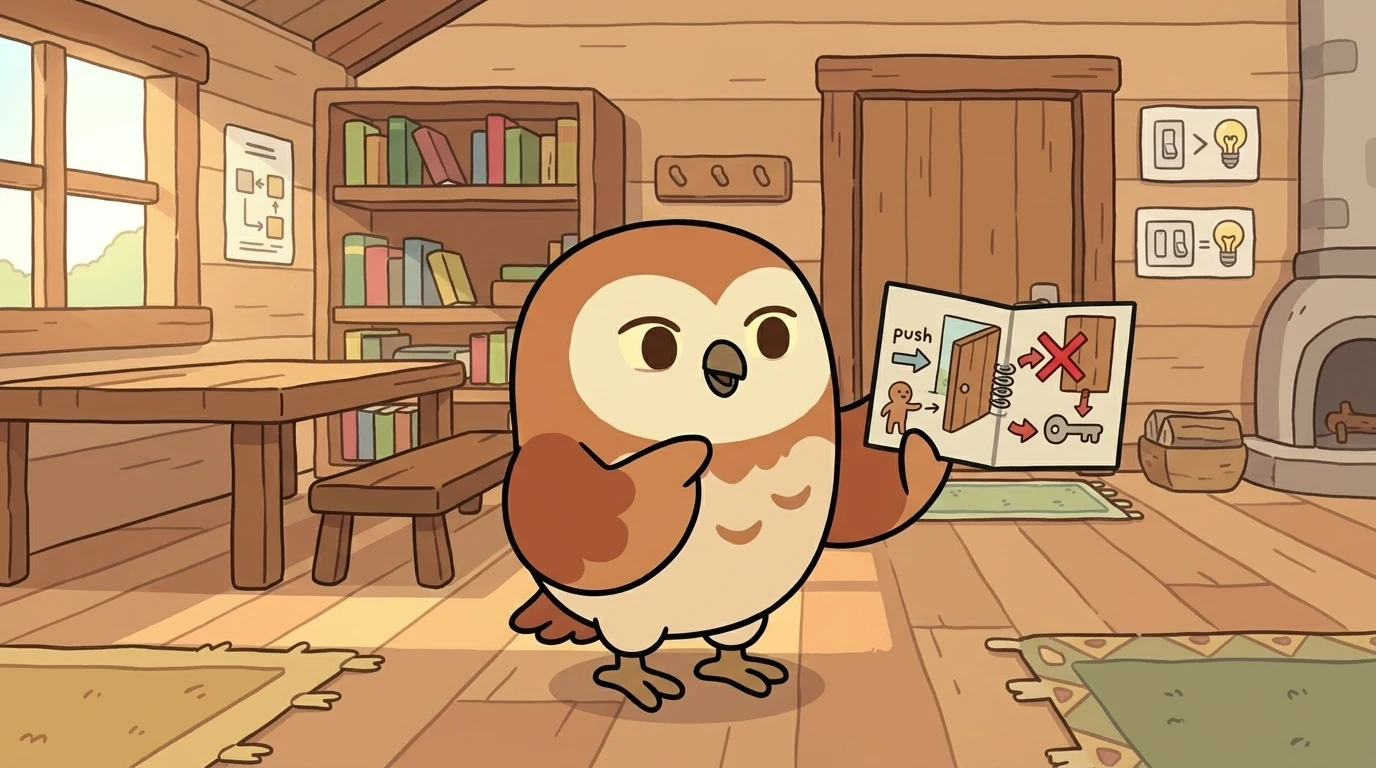
Lattice had not been born to codes. She had been born to locks.
Her family lived high in the crags and had, for six generations, been the village gate-smiths — the owls who built the great one-way gates. From inside the village you could lift the bar and walk out to the fields or the market with a single easy push. But from outside, without the shaped key that only the village kept, those gates were solid stone and iron. You could throw your whole weight against them for a week and they would not give.
As a chick she had thought this was ordinary. Every gate she knew worked that way. It was only when a traveling tinker complained about it — "Easy one way, impossible the other, what a nuisance!" — that Lattice understood her family had built something clever, not just something heavy.
"The trick isn't the strength," her grandfather told her one night, tapping the cold hinge with a talon. "Anyone can make a thing hard to break. The trick is making it easy one direction and impossible the other. Same door. Same iron. The difference is which side you stand on and whether you hold the key."
She had turned that over in her head for years, the way you turn a smooth stone. Easy forward. Impossibly hard backward. It felt, to her, like the most honest kind of secret in the world — not a hidden thing, but a shaped thing, protected by the plain difficulty of undoing it.
She walked down out of the crags to CipherForge when she was twenty-two, the folded card already worn soft in her claw.
The forge master, Cypher, met her with a gaze like grinding stone. The old ciphers had been settled here for ages — Caesar's shift, Vigenère's shifting keys, the honest symmetric locks where the same secret opened and closed a message. Cypher had heard every explanation there was.
"What," he asked, "is modern cryptography?"
Lattice did not reach for grand words. She held up her card, friendly-handle side out. "A door anyone may push open," she said, "and only one person may come back through." She turned it to the blank side. "The old ciphers here share one secret between two friends. If an enemy learns the secret, both ends fall. Mine are different. I hand everyone a way to lock a message to me — out in the open, where all can see it — and I keep, for myself alone, the only way to unlock it." She lowered the card. "Easy forward. Impossibly hard backward. The mathematics does the guarding, not the hiding."
Cypher was quiet a long moment. Then he nodded, slow as the crag wind. "You are appointed," he said.
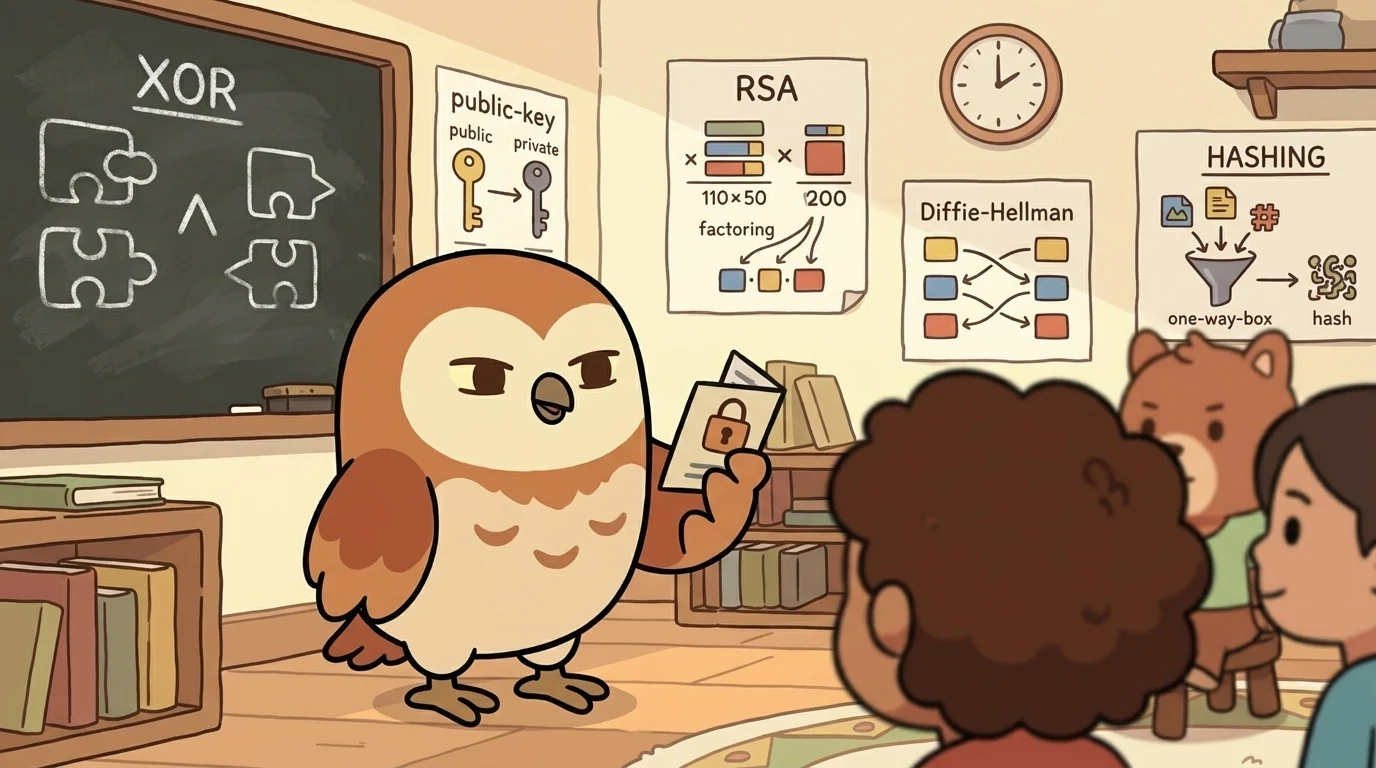
Her corner filled, over the seasons, with cracksmen who found her ideas maddening.
One afternoon a sharp-eyed girl named Sift — the finest pattern-breaker in the forge — dropped onto the stool across from Lattice with her arms crossed. "I can crack anything with a pattern in it," Sift said. "Frequency, repetition, rhythm. Give me enough letters and every symmetric cipher in this building falls. But yours won't. Why won't yours?"
Lattice slid two small wooden tiles onto the bench, one carved with a 0, one with a 1. "This is the smallest lock I have. It's called an exclusive-or." She overlaid them. "Feed a bit through a secret, and it flips or it doesn't. A one and a one settle back to zero. A zero and a one wake up to one." She flipped the pair. "Run it once, the message is scrambled. Run it again with the very same secret — and it comes right back. No leftover pattern for you to find, Sift. Nothing repeats."
"That's just a switch," Sift said, but she was leaning in now.
"Now the big lock." Lattice held up the friendly side of her card. "Multiply two enormous prime numbers together. That's fast — a child could do it with patience." She turned the card blank-side-out. "Now try to walk backward. Take only the huge answer and find the two primes that made it. That takes longer than the world will last." She set the card down. "That gap — fast forward, hopeless backward — is the whole of it. Your patterns need a door that opens both ways. I only build doors that open one."
Sift stared at the blank side of the card for a long while. Then, grudgingly, she almost smiled. "So I'm not losing to a better hiding place," she said. "I'm losing to arithmetic."
"To honest arithmetic," Lattice agreed. "The kindest kind. Anyone may learn exactly how the lock works and still not be able to force it."
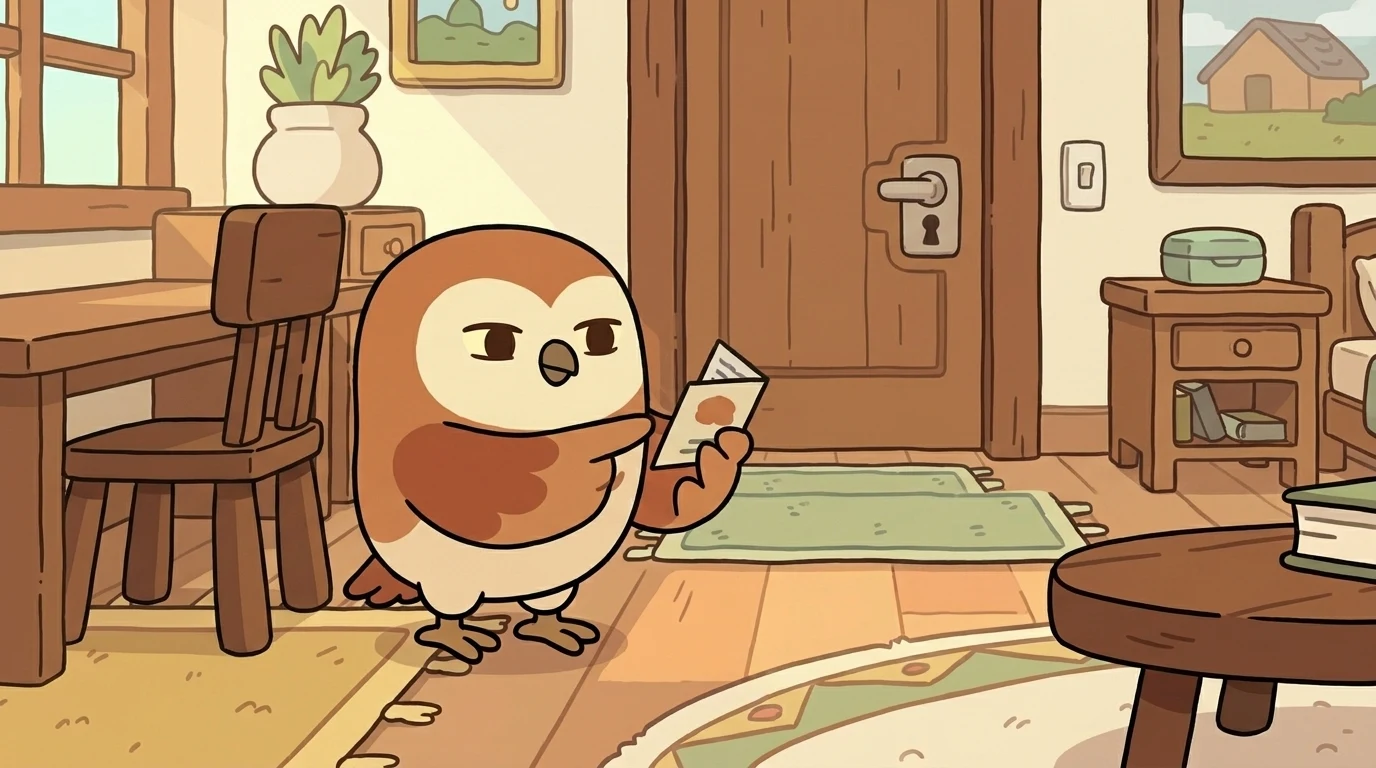
That evening, when the benches had emptied and the shutters had stopped their rattling, the boy from the letter-shifting bench came back. He turned Lattice's card over and over in his fingers.
"It bothered me all day," he admitted. "A thing you can't undo. It seems... sad, almost. Like a mistake you can never take back."
Lattice thought about the great gates of her village, and the traveler who had called them a nuisance, and the smooth stone of her grandfather's words.
"I thought that too, once," she said gently. "But turn it over." She tapped the friendly side. "The reason you can send me a secret across a room full of strangers — the reason no one between us can read it — is because the door only opens one way. The no-undoing isn't the sadness. It's the safety. It's the whole reason the secret gets to stay a secret."
The boy went quiet. He pressed his thumb to the blank side of the card, feeling the soft worn corner, and something in him let go — the small clenched worry he'd carried since morning easing open like a held breath finally let out. He wasn't looking at a locked door anymore. He was looking at a promise kept.
"So it's not a wall," he said slowly.
"No." Lattice folded the card closed and rested it in her claw the way you'd hold something alive. A warmth she rarely showed rose steady and quiet through her chest — the good, settled gladness of being understood at last. "It's a door I built so you'd be safe on the other side of it. That's all it ever was."
The one-way-door card waited in her claw, patient, ready for the next person who needed to feel it.
The CipherForge ensemble
Lattice is part of CipherForge's distributed-narrative cast. Each character embodies a different curricular primitive; together they teach the full subject.
-

Caesar
Caesar shift / monoalphabetic shift cipher
-
Mask
Atbash + general monoalphabetic substitution (every letter has a fixed substitute)
-
Vigenère
Vigenère / polyalphabetic keyword cipher (the Caesar-on-a-rotating-keyword pattern)
-

Echo Pair
Playfair digraph cipher (letters encoded in pairs through a 5×5 grid)
-
Rail
Rail-fence + columnar transposition ciphers (rearrange letter order without changing the letters themselves)
-

Tally
Number-based codes (A1Z26, ASCII, binary, book ciphers — any mapping that converts letters to numbers)
-

Sift
Frequency analysis + cryptanalysis-by-statistics (the cipher-breaking method, not a cipher itself)
-

Hollow
Hides a secret message inside something ordinary, so nobody even knows there is a message to look for.
-
Tome
Keeps a shared code-book where whole words stand for secret words, so only someone with the same book can read the note.