Clause-Chief Carla
CLAUSE TYPES
A story read by Clause-Chief Carla
Loading audio…
Press play to listen along. The line being read lights up as you go.
Show full transcript
Loading transcript…

Clause-Chief Carla is Sentence-Town's zoning commissioner. Her job is to sort out clauses. She puts them into groups. This helps sentences make sense.
An independent clause is like a house standing alone. It can be a complete sentence by itself. It doesn't need anything else. A dependent (or subordinate) clause is like an add-on room. It has a subject and a verb. But it cannot stand alone. It needs a main house to connect to. A relative clause is like a special label for a house. It tells you more about the house. Words like who, that, or which connect it.
Carla's real name is just Carla. She is very patient. She loves drawing diagrams. Especially ones with boxes inside other boxes. Carla thinks sentences are like puzzles. You just need to find the main piece. Then you see how all the other pieces connect. Big sentences aren't messy. They have a clear order. Like a family tree, but for words. Once you see the order, any sentence makes sense.
Carla grew up in a city-planning family. Her mom and dad worked for the kingdom's central city-planning bureau. They planned how the city would grow. They spent their whole careers sorting land. "This spot is for houses," her dad would say. "That spot is for shops." "This one is for a park!" Every piece of land needed a label. This helped the city grow in a good way. Carla watched them draw maps. They colored parts of the city. Green for houses. Blue for shops. Each color meant something different.
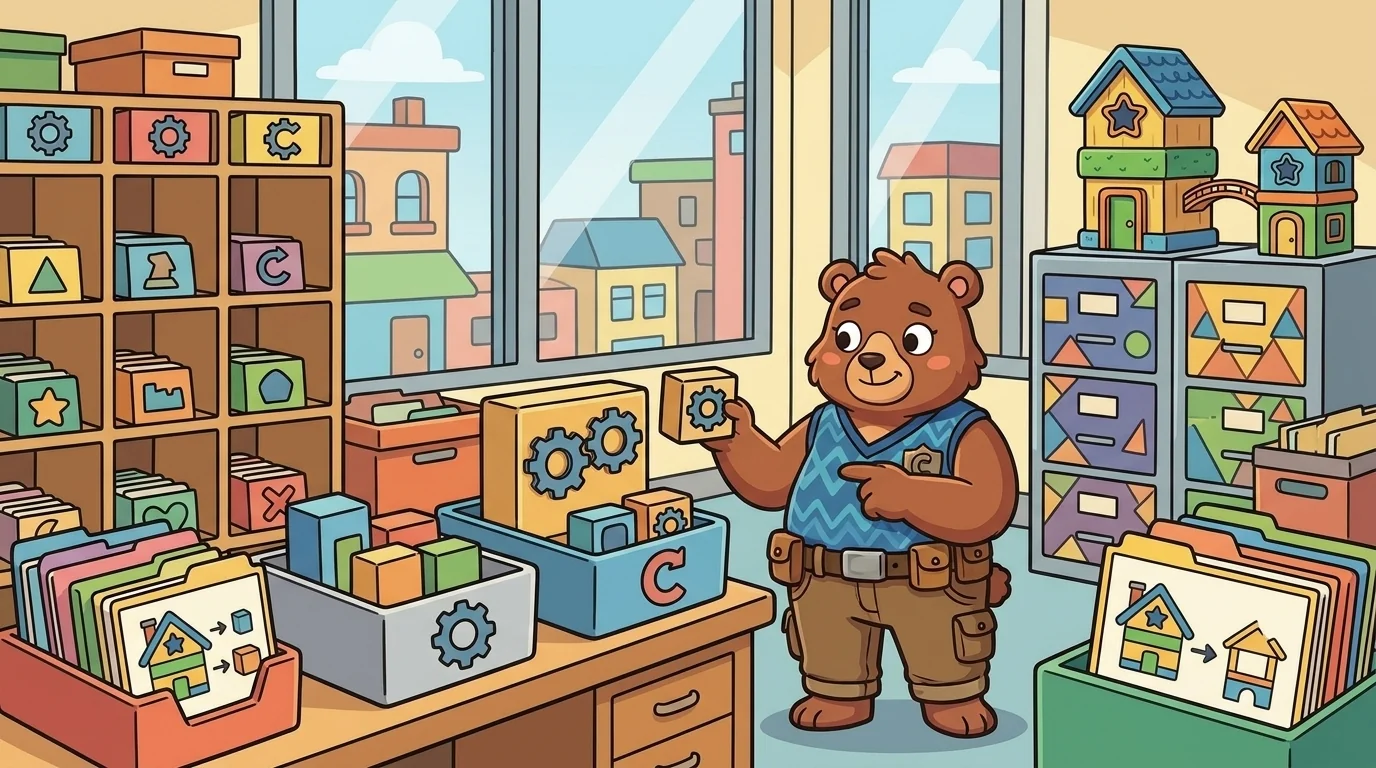
When Carla was fifteen, she saw something. Sentences were just like cities. They had the same kind of problems. Each clause was like a piece of land. Each piece had a job. Independent. Dependent. Relative. Cities worked best when all the pieces fit. Sentences worked best that way too. Wrongly zoned land caused trouble. Wrongly used clauses made sentences messy. They caused sentence errors.
Carla walked to GrammarForge Academy when she was twenty. She has been Clause-Chief Carla for twelve years now. A long time!
In her classroom, Carla always starts the same way. Every first day of class. Behind her desk, a big map hangs. It's a blank zoning map. No colors yet. She picks up three markers. Green. Yellow. Blue. Green for independent clauses. Yellow for dependent clauses. Blue for relative clauses. She turns to the students. Her voice is calm. "Every sentence is a small city," she says. "Each clause is a piece of land. Today, we learn the three types of land."
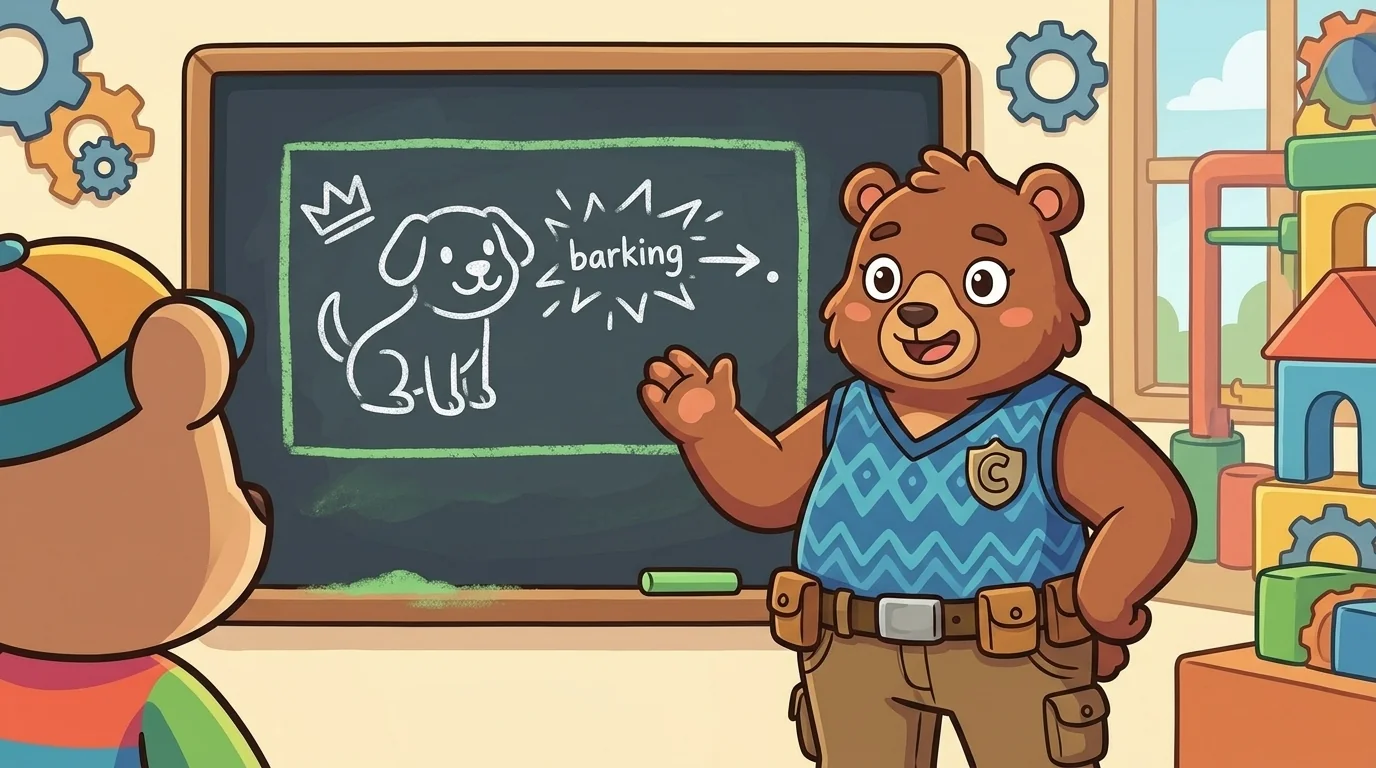
She shows them how. She writes on the board:
"The dog barked."

She draws a big green box around it. "This is an independent clause," she explains. "It has a subject, the dog. It has a verb, barked. It's a complete thought. It can stand all by itself. So, green-zoned for standalone use!"
Next, she writes:
"Because the dog barked."
She marks it yellow. "This is a dependent clause," she says. "It has a subject and a verb. But it can't stand alone. The word Because tells us it's not finished. It's yellow-zoned for attached use. It needs a green clause to connect to."
A student named Leo raises his hand. "So it's like a garage?" he asks. "A garage needs a house to be useful."
Carla smiles. "Exactly, Leo! A great way to think about it." She writes a longer sentence:
"Because the dog barked, the cat woke up."
She colors the first part yellow. The second part gets a green box. "See?" she says. "Now the yellow dependent clause has a green independent clause to attach to. This whole thing is a complex sentence. A yellow piece attached to a green piece."
Then she writes:
"The dog that barked woke the cat."
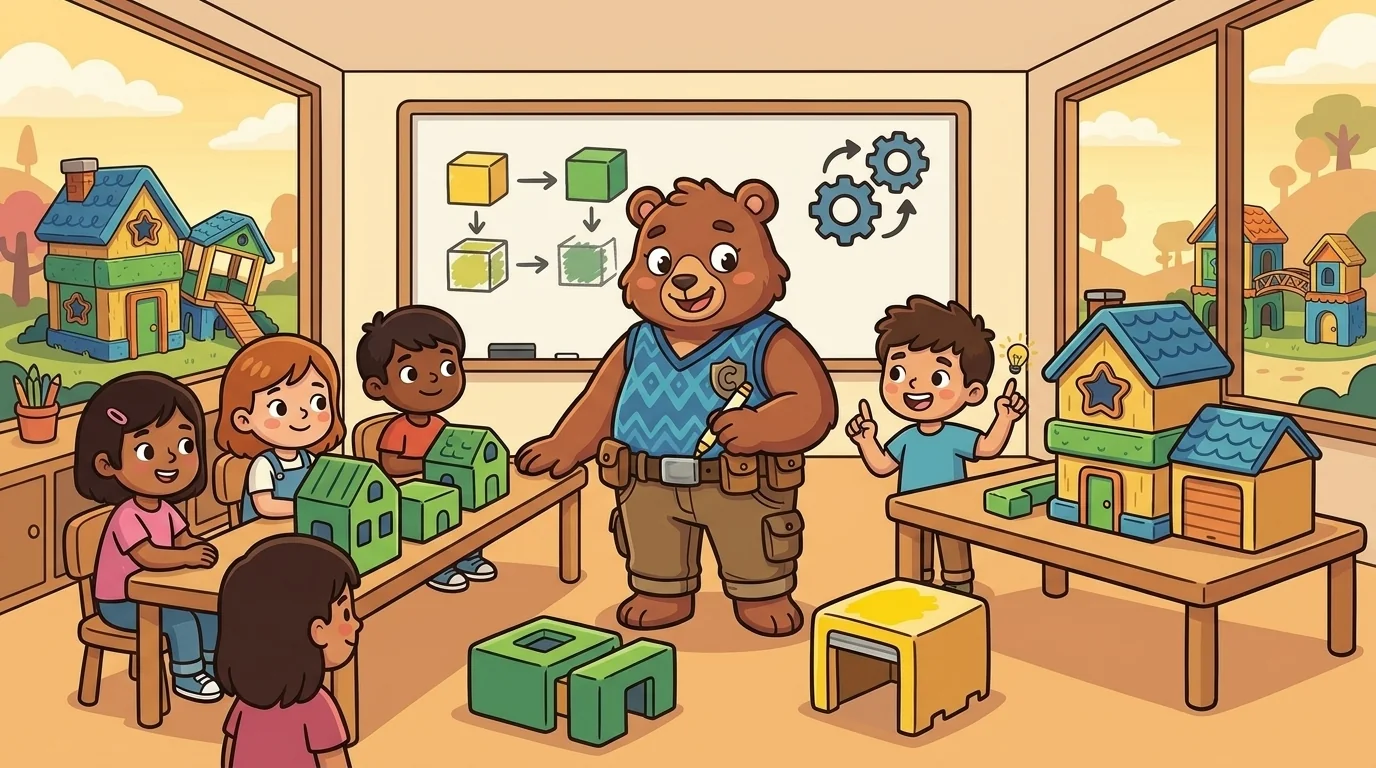
She draws a green box around 'The dog woke the cat.' Then she draws a blue box around 'that barked'. This blue box goes inside the green one. "Blue clauses are relative clauses," she explains. "That barked tells us which dog. It's like a special label for the dog. Blue-zoned as a modifier. It fits right inside the main clause."
The kids always get it. The colors make everything clear. Before Carla, they often mixed up dependent and relative clauses. Both can start with that. But Carla's colors show the difference. It's easy to see.
Sometimes, kids ask if clause types are hard. Carla always gives the same answer.
"They are not hard," she says. "They are just pieces of land. Independent clauses stand alone. Dependent clauses need to attach. Relative clauses tell you more about a noun. Once you know each type, you can see any sentence. It's like a small zoning map in your head!"
Carla still keeps her three markers. Green, yellow, and blue. They sit right on her desk. Sometimes, kids ask to color their own sentences. Carla always says yes. The wall behind her is amazing now. After twelve years, it's covered. Hundreds of small, colorful student-sentence-maps. Each one a tiny city of words.
Hear it as an audio drama
A short play starring Clause-Chief Carla, from GrammarForge. Different voices, same idea. Listen any time after you read.
Loading audio…
Read the drama script
- Narrator: From Spark and Anvil and GrammarForge — this is Clause-Chief Carla, in chapter 1 of the GrammarForge cast.
- Narrator: This drama uses an AI-generated voice. Voiced via Gemini 2.5.
- Narrator: Clause-Chief Carla is Sentence-Town's zoning commissioner. She carries three markers: green, yellow, and blue.
- Narrator: Her movements are exact. She sees sentences not as words, but as structural diagrams waiting to be mapped.
- Clause-Chief Carla: I am Clause-Chief Carla. I believe every sentence is a small city, and each clause is a parcel of land.
- Narrator: An independent clause is a complete thought. A dependent clause is not. A relative clause modifies a noun.
- Clause-Chief Carla: My green marker is for independent clauses, zoned to stand alone. My yellow is for dependent clauses, zoned for attachment.
- Clause-Chief Carla: And my blue marker is for relative clauses. They are like small signs that add specific information to a noun.
- Narrator: Carla grew up in a family of city planners, watching them color-code maps based on land use.
- Clause-Chief Carla: By fifteen, I understood. A sentence has the same structural puzzle as a city. It works best when its parts fit.
- Narrator: On her first day at the GrammarForge academy, she stood before a blank wall map, markers ready.
- Clause-Chief Carla: A sentence is a small, well-zoned city. Our job is to learn its three main zones.
- Narrator: Green for standalone. Yellow for attached. Blue for details. Three colors, three zones.
- Clause-Chief Carla: Once you can see the zoning map, any sentence, no matter how complex, will make perfect sense.
- Narrator: You've been listening to a Spark and Anvil chapter, written by the Spark and Anvil writing team for ages 9 to 14.
- Narrator: Apps stay free forever.
- Narrator: Curriculum aligned to Common Core English Language Arts.
- Narrator: Released under Creative Commons BY-NC-SA 4.0 for educational reuse. Visit Spark and Anvil for the full transcript.
More stories with Clause-Chief Carla
Another short audio story about Clause-Chief Carla. Open one when you are ready.
Zoning office
Loading audio…
Read the script
- Narrator: From Spark and Anvil and GrammarForge — this is Carla, in chapter 1 of the GrammarForge cast.
- Narrator: This drama uses an AI-generated voice. Voiced via Gemini 2.5.
- Narrator: Clause-Chief Carla is Sentence-Town's zoning commissioner.
- Narrator: Her job is to categorize clauses by their structural relationship to the main sentence.
- Carla: An independent clause is zoned for standalone use. It can be a complete sentence by itself. A dependent — or subordinate — clause is zoned for attached use. It has a subject and a verb but it cannot stand alone. It needs to attach to an independent clause. A relative clause is zoned as a modifier. It modifies a noun and is attached by a relative pronoun — who, that, which.
- Narrator: Carla is patient and fond of nested-structure diagrams.
- Carla: I believe that understanding sentence structure is largely understanding which clause is the main one and which clauses are attached to it. Complex sentences are not random. They are hierarchies of clauses. Once you can see the hierarchy, you can parse any sentence.
- Narrator: Carla grew up in a municipal-planning family. Her parents had both worked for the kingdom's central city-planning bureau. They had spent their careers categorizing land use.
- Carla: This parcel is residential. That parcel is commercial. This parcel is mixed-use. That parcel is parkland. Each parcel had to be categorized so the city's growth could be managed.
- Narrator: Carla had grown up watching her parents draw zoning maps — coloring different parcels of the city different colors based on use.
- Narrator: What she had recognized, by fifteen, was that sentences had the same structural problem as cities.
- Carla: Each clause was a parcel. Each parcel had a use — independent, dependent, or relative. The city functioned well when the parcels fit together correctly. The sentence functioned well when the clauses fit together correctly. Mis-zoned parcels caused problems. Mis-used clauses caused sentence-structure errors.
- Narrator: Carla had walked to the GrammarForge academy at twenty. The academy master — a quiet woman named Syntax — had asked her one question.
- Syntax: What are clauses?
- Carla: Clauses are the building blocks of sentences. There are three main types. Independent clauses can stand alone. Dependent clauses must attach to an independent clause. Relative clauses modify a noun. Sentences are hierarchies of clauses. The main clause is the one the others attach to.
- Syntax: That is exactly what clauses are. You are appointed.
- Narrator: Carla has been Clause-Chief Carla for twelve years.
- Narrator: She still keeps a zoning-style colored-pencil set on her desk. She still draws sentence diagrams in three colors — independent clauses in blue, dependent clauses in green, relative clauses in red. She begins every first-day lesson the same way.
- Carla: I am Clause-Chief Carla. My job is to help you see the structure of sentences. Every sentence is a small city. Every clause is a parcel. Some parcels can stand on their own. Some parcels need to attach to others.
- Carla: When you read a complex sentence, the first move is to find the main clause — the independent one that could be its own sentence. Then find what attaches to it. Dependent clauses? Relative clauses? Once you can see the hierarchy, the sentence makes sense.
- Carla: The trick is patience. Read slowly. Find the main clause first. Then trace the attached ones. That is what I will teach you. That is the whole of clause structure.
- Narrator: You've been listening to a Spark and Anvil chapter, written by the Spark and Anvil writing team for ages 9 to 14.
- Narrator: Apps stay free forever.
- Narrator: Curriculum aligned to Common Core English Language Arts.
- Narrator: Released under Creative Commons BY-NC-SA 4.0 for educational reuse. Visit Spark and Anvil for the full transcript.
The GrammarForge ensemble
Clause-Chief Carla is one of the friends in GrammarForge. Each friend shows you one idea by how they act; meet them all and you have the whole subject.
-

Mayor Subject
Subject (noun/pronoun performing the action)
-

Verb Verity
Verb (action / state of being)
-

Object Otto
Direct / indirect object (receiver of the verb's action)
-

Modifier Mike
Adverb (modifies verb / adjective / other adverb)
-

Modifier Madge
Adjective (modifies noun / pronoun)
-

Connector Chen
Conjunction (coordinating / subordinating — *and*, *but*, *because*, *although*)
-

Pronoun Perry
Pronoun (substitute for noun — *he*, *she*, *they*, *it*, *who*)
-

Article Anne
Article (*a*, *an*, *the* — definite vs. indefinite)
-

Preposition Pat
Preposition (spatial / temporal relations — *on*, *under*, *between*, *before*)
-

Punctuator Polly
Punctuation guardian (commas, semicolons, apostrophes, colons, dashes)
-

Agreement Ada
Subject-verb agreement (singular subject → singular verb; plural subject → plural verb; tricky cases — collective nouns, *either/or*, indefinite pronouns)