
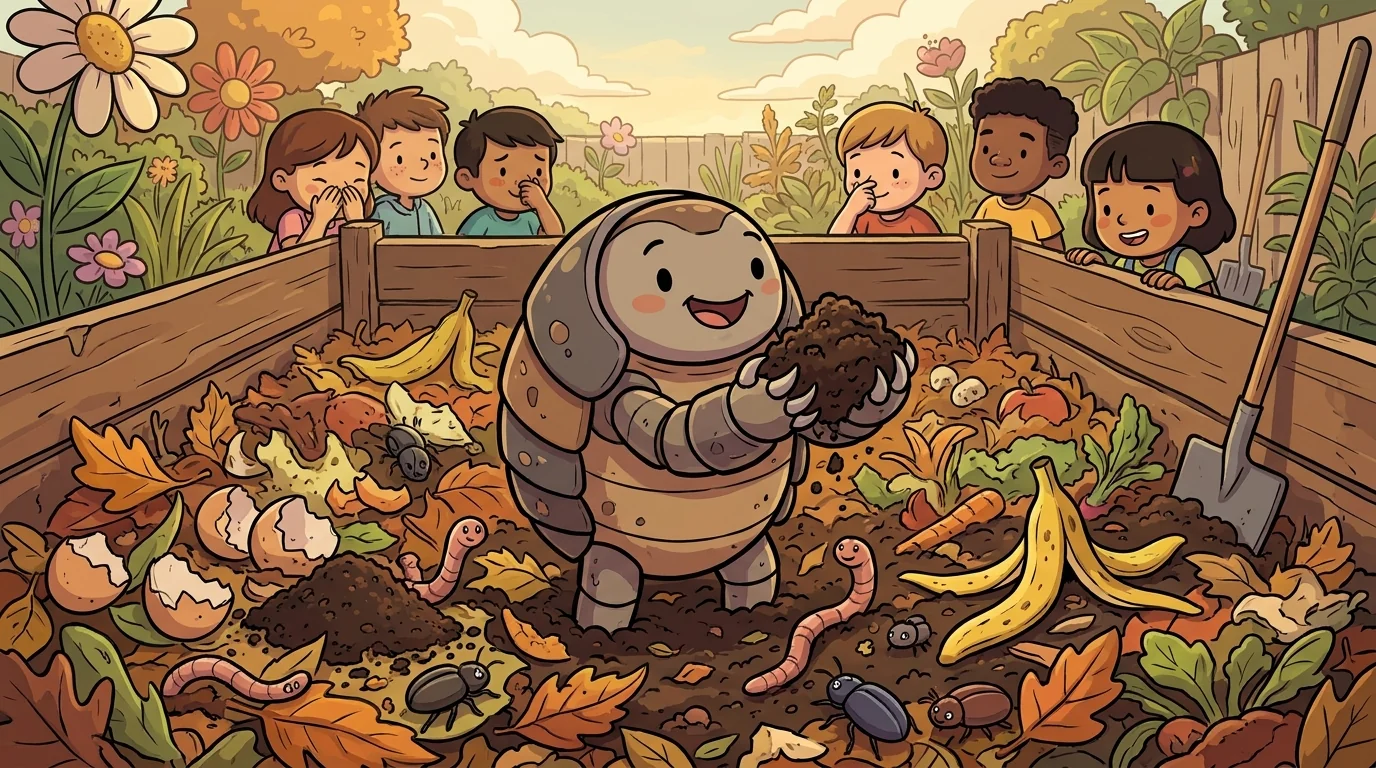
Crumb
CRUMB — yesterday's dead leaves are tomorrow's dinner; the soil is alive.
Listen along — Crumb
Loading audio…
Press play to listen along. The line being read lights up as you go.
Show full transcript
Loading transcript…
Chapter 6 — Crumb and the Kitchen Under Your Feet
Crumb was standing knee-deep in a bin of rotting leaves and eggshells and coffee grounds, and she looked like she’d won something. The older garden club had come to learn her primitive — yesterday’s dead leaves are tomorrow’s dinner — and Crumb was delighted to show them it wasn’t a slogan. It was a kitchen. “Everyone thinks soil is dead brown stuff,” she said, plunging a paw into the warm heap. “It’s the opposite. Soil is the busiest kitchen on Earth, and this bin is where the cooking starts.”
She held up a crumbling handful. “When a leaf falls, it doesn’t just ‘rot away’ — nothing vanishes. It gets eaten, in a long relay called the soil food web. First the big shredders — worms, sowbugs, beetles — tear the leaf into tiny pieces. Then the real chefs move in: fungi and bacteria, billions of them in a spoonful, breaking the pieces down molecule by molecule. What they leave behind is humus — dark, crumbly, rich — and locked inside it are the exact nutrients a growing plant needs. The dead leaf didn’t disappear. It got turned back into food.”
A young vole named Sprout wrinkled his nose. “But it’s just… garbage rotting.”
“That’s the word that fools everyone,” Crumb said. “There’s no ‘garbage’ in a garden — only food that hasn’t been cooked yet. Watch the relay: the worm’s tunnels let air and water reach the roots; the fungi weave threads that pass nutrients along; the bacteria unlock minerals no plant could reach alone. Every scrap in this bin is being disassembled and handed forward, and the whole thing runs on creatures you’ll never see. That’s what I mean when I say the soil is alive. It’s not dirt with some bugs in it. It’s a community, and it’s feeding your whole garden for free.”
Crumb had learned to see it when she was small, the day her grandmother caught her about to throw away a pile of ‘useless’ autumn leaves. “She stopped me,” Crumb told the club, “and said, ‘You’re about to throw away next spring’s dinner.’ I didn’t believe her — how could slimy old leaves become anything good? So she buried a jar of scraps at the edge of the bed and had me dig it up months later. It was gone. In its place was this —” she lifted the dark crumbly humus — “the richest handful of soil I’d ever seen. The scraps hadn’t been lost. They’d been transformed, by a kitchen full of workers I couldn’t see.” The someday-it’s-just-trash feeling had turned, in that moment, into a lifelong wonder at the invisible cooks.
“So here’s the craft,” Crumb finished, patting the warm heap. “You don’t feed the plants — not really. You feed the soil, and the soil feeds the plants. Give the kitchen its raw ingredients — dead leaves, scraps, spent stalks — keep it moist and airy so the cooks can work, and it will hand you back the finest food a root ever drank. Nothing in a garden is waste. It’s all just dinner at a different stage of being cooked. Yesterday’s dead leaves really are tomorrow’s dinner — and the soil doing the cooking is the most alive thing in the whole garden.”
The GrowForge ensemble
Crumb is part of GrowForge's distributed-narrative cast. Each character embodies a different curricular primitive; together they teach the full subject.
-

Tuck
Seed + planting — every seed knows what it wants; read-the-packet-then-the-soil
-

Drip
Water + irrigation literacy — water is the patient teacher; don't-drown-the-thirsty framing
-

Glow
Photosynthesis + plant biology — leaf-makes-lunch-from-light; cell-level wonder framing
-
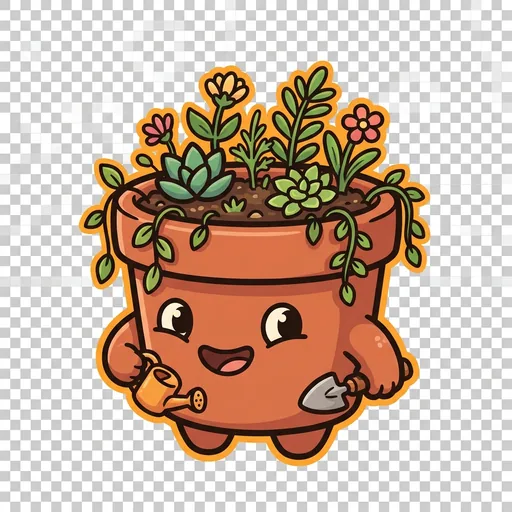
Pot
Container + apartment gardening — windowsill-is-a-garden-too; nature-deficit + privilege gate anchor
-

Vigil
Observation + plant-doctoring patience — look-every-day-don't-pluck-what's-working; intellectual humility framing
-
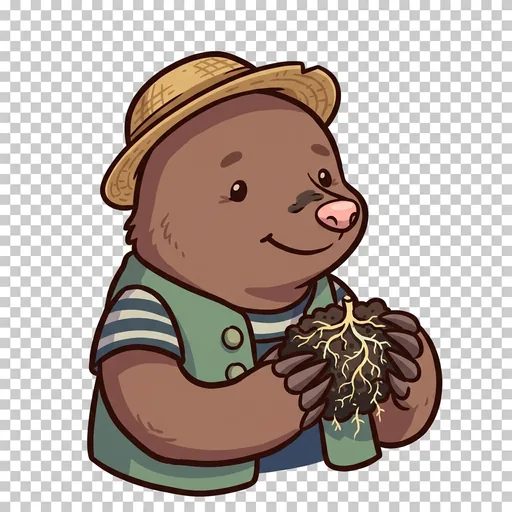
Delve
Roots & uptake — underground-nutrient posture (a plant eats through its roots; the hidden half below does the feeding)
-

Drowse
Seasons & dormancy — right-timing posture (rest is not death; a plant's dormant nap is how it survives to grow again)
-
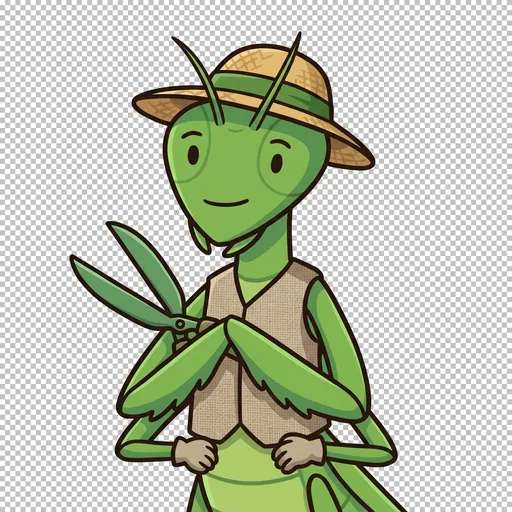
Shear
Pruning — redirect-the-growth posture (cutting the right stem sends the plant's energy where you want it to go)
-

Sip
Pollination — flower-to-fruit partnership posture (a flower becomes fruit only with a pollinator partner as the bridge)