Shear
SHEAR — a wise cut sends the plant's strength where you want it.
Loading audio…
Press play to listen along. The line being read lights up as you go.
Show full transcript
Loading transcript…
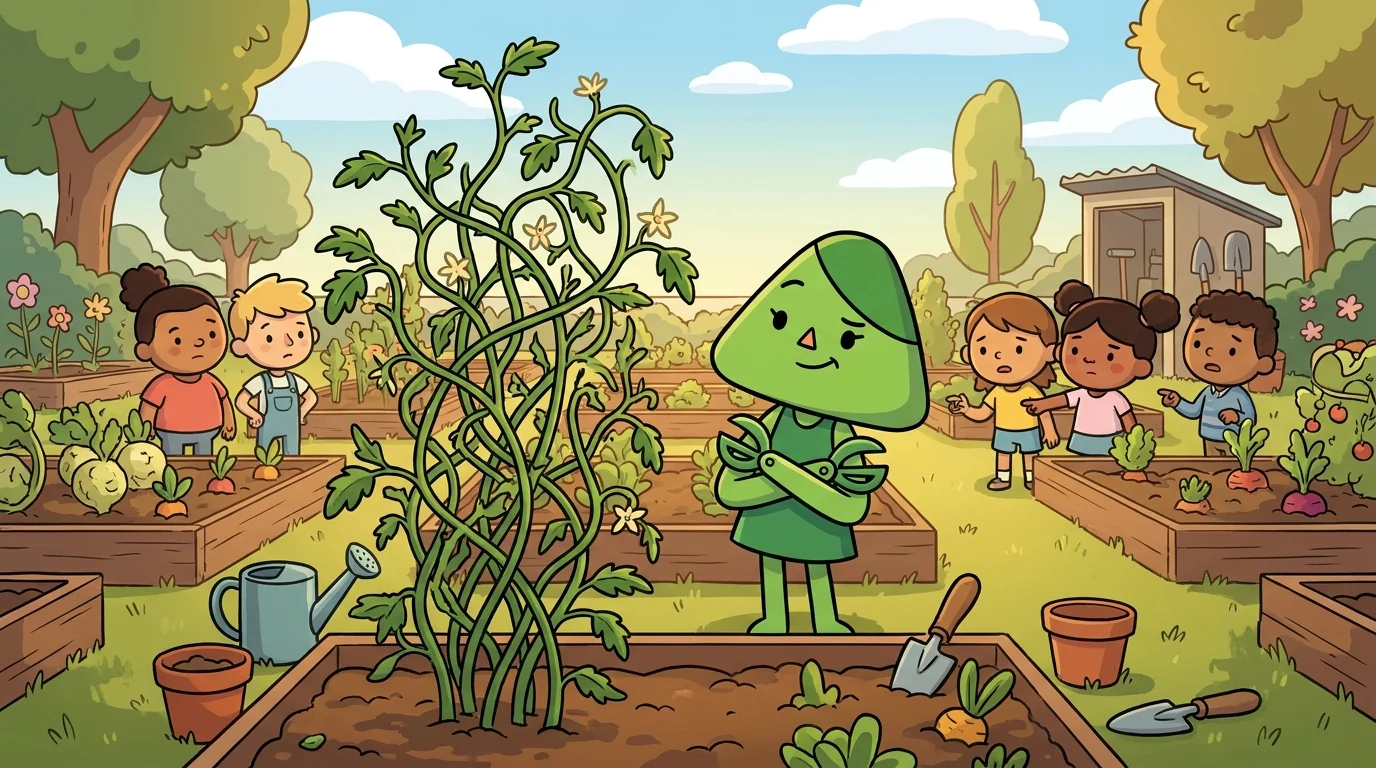
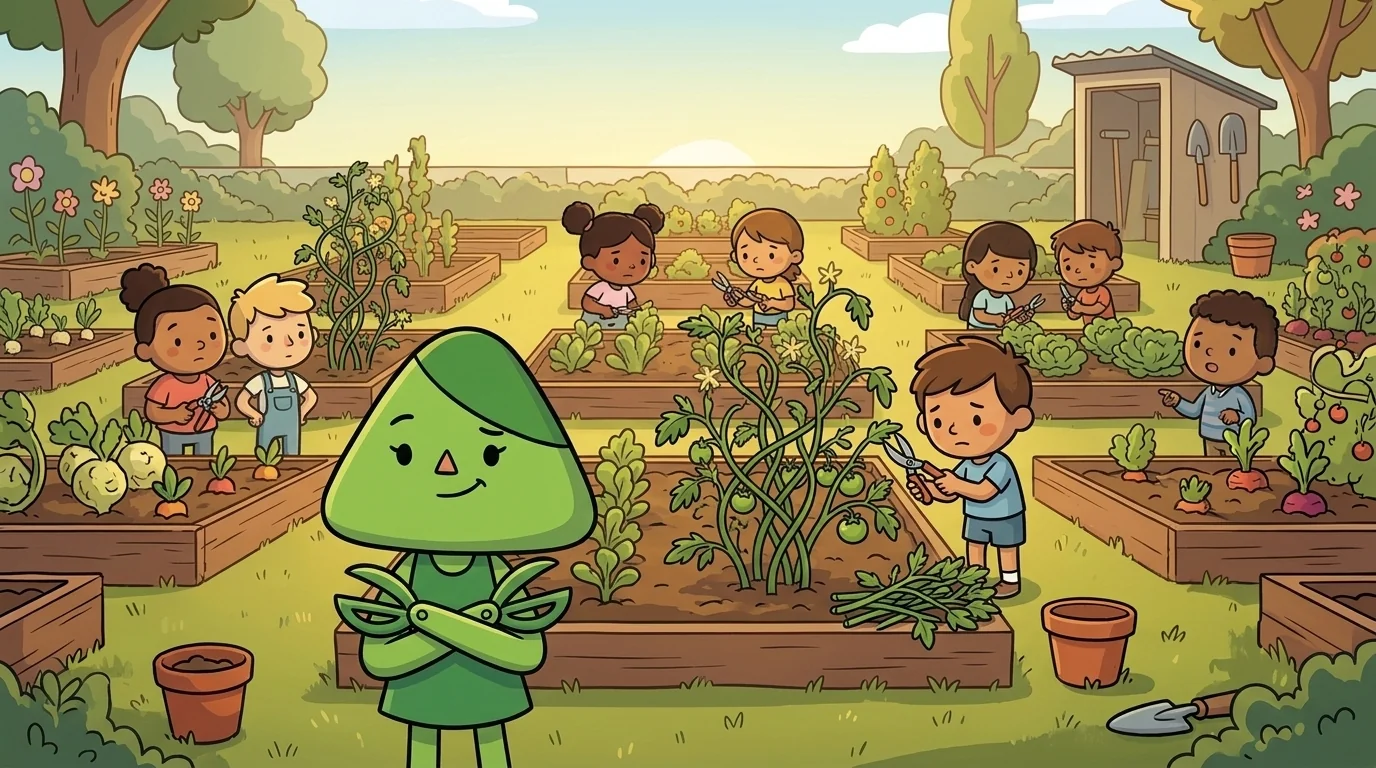
Shear stood over a leggy tomato plant with her long green forearms folded like a pair of patient scissors, studying it the way a barber studies a first customer.
The plant was a tangle — a dozen stems shooting every direction, leaves everywhere, a few sad little flowers lost in the middle of all that green. The kids thought it looked magnificent, all that growth. Shear thought it looked exhausted.
"It's doing too much," she said, tilting her triangular head. "See all these little side shoots?" She touched one with the tip of a forearm. "Every one of them is drinking up food and water and sun, growing more leaves, more stem, more more. And the plant only has so much strength to spend. It's splitting itself a hundred ways. Which is why —" she nodded at the pale, struggling flowers — "it's got nothing left for the fruit."
A girl frowned. "So it needs to grow more?"
"It needs to grow less, better," Shear said. And with two clean, precise snips of her forearms she took off two of the greediest side shoots. "There. I just took away some growth. But watch what happens now — all the strength those shoots were spending goes back into the plant, and it'll pour it into the flowers and the fruit instead. A cut isn't a punishment. A cut is aim. You're not hurting it. You're telling it where to point."
The girl stared at the two little cut shoots on the bench, then at the plant, which somehow already looked less frantic.
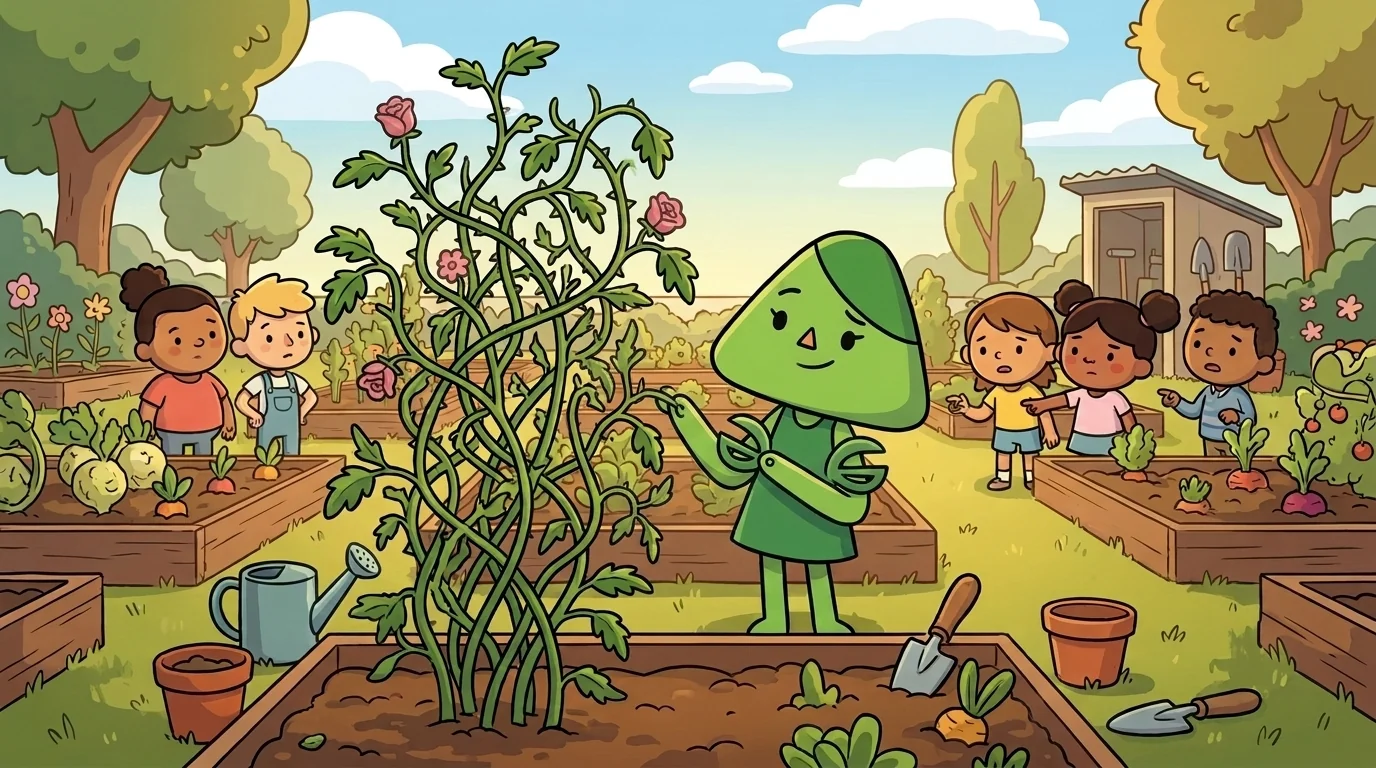
Shear remembered the day she learned that cutting could be a kindness.
She'd been young, a small mantis who loved every green thing too much to touch it. Her family were pruners — careful, precise, snipping and shaping the garden — and it had horrified her. She'd hidden the first time she was handed the shears. Cutting a healthy stem felt like a cruelty. Like breaking something that hadn't done anything wrong.
Her grandfather, an ancient mantis whose forearms had gone smooth with a lifetime of careful cuts, had found her hiding among the leaves. He didn't tell her cutting didn't hurt. He handed her a rosebush that had gone wild — huge, thorny, sprawling, and blooming almost nothing at all.
"You think a cut is taking away," he said. "Look closer. This bush is spending everything on being big. It's forgotten how to bloom." He made one slow, sure snip, low on an old woody stem. "There. I just gave it permission to stop holding that up. Come back in three weeks."
Three weeks later she'd come back, and the rosebush — smaller now, tidier, half the size — was covered in more roses than she'd ever seen it grow. Fat ones. Bright ones. Blooming like it had been waiting for someone to lift the weight of all that pointless green.
"You didn't cut the roses off," her grandfather said. "You cut the roses free."
And Shear had felt it settle deep in her — a clean, quiet, oh, letting go is how you make room feeling that turned her from a hider into the steadiest hand with the shears in the whole garden.
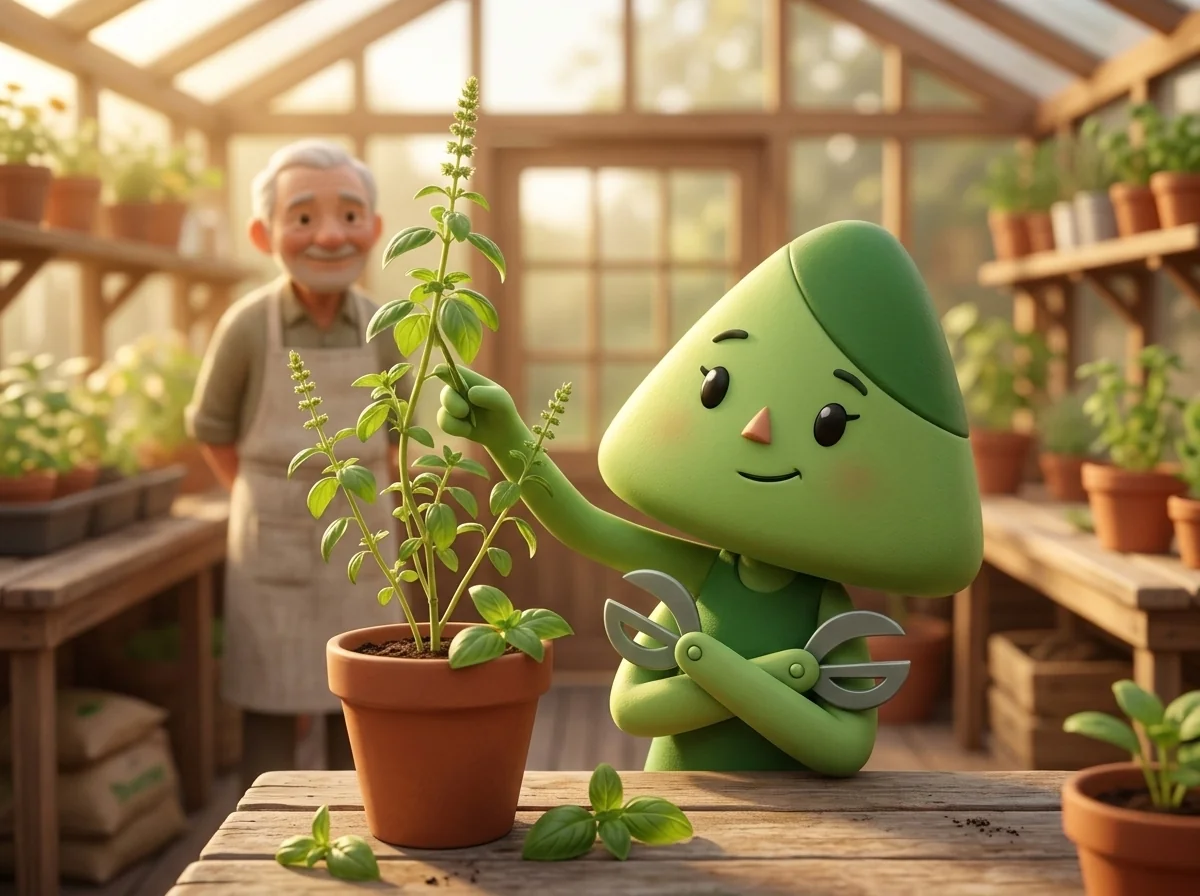
She came to Growforge at twelve, forearms folded and calm about it now.
Sprig, the old mentor who ran the greenhouse, met her at the door. He didn't ask if she was gentle. He handed her an overgrown basil plant, tall and leggy and gone to seed, and asked, "How would you make this more?"
Most kids started listing things to add — more sun, more food, more water. Shear turned the basil in the light and found the two leggy tops.
"By taking away," she said. She pinched off the two tallest tips. "It's racing up to make seeds and quit. But pinch the tops, and it can't. So instead it pushes out sideways — two new stems for every one I take, bushier, fuller, more leaves to pick. The way to get more basil isn't to let it run. It's to cut it back so it branches. Less, on purpose, becomes more."
Sprig was quiet a moment, then he smiled. "Most people think growth is always adding," he said. "You know that sometimes you grow a thing by subtracting. You belong here."
Shear's corner of the greenhouse was where kids came holding plants that were huge and unhappy at the same time.
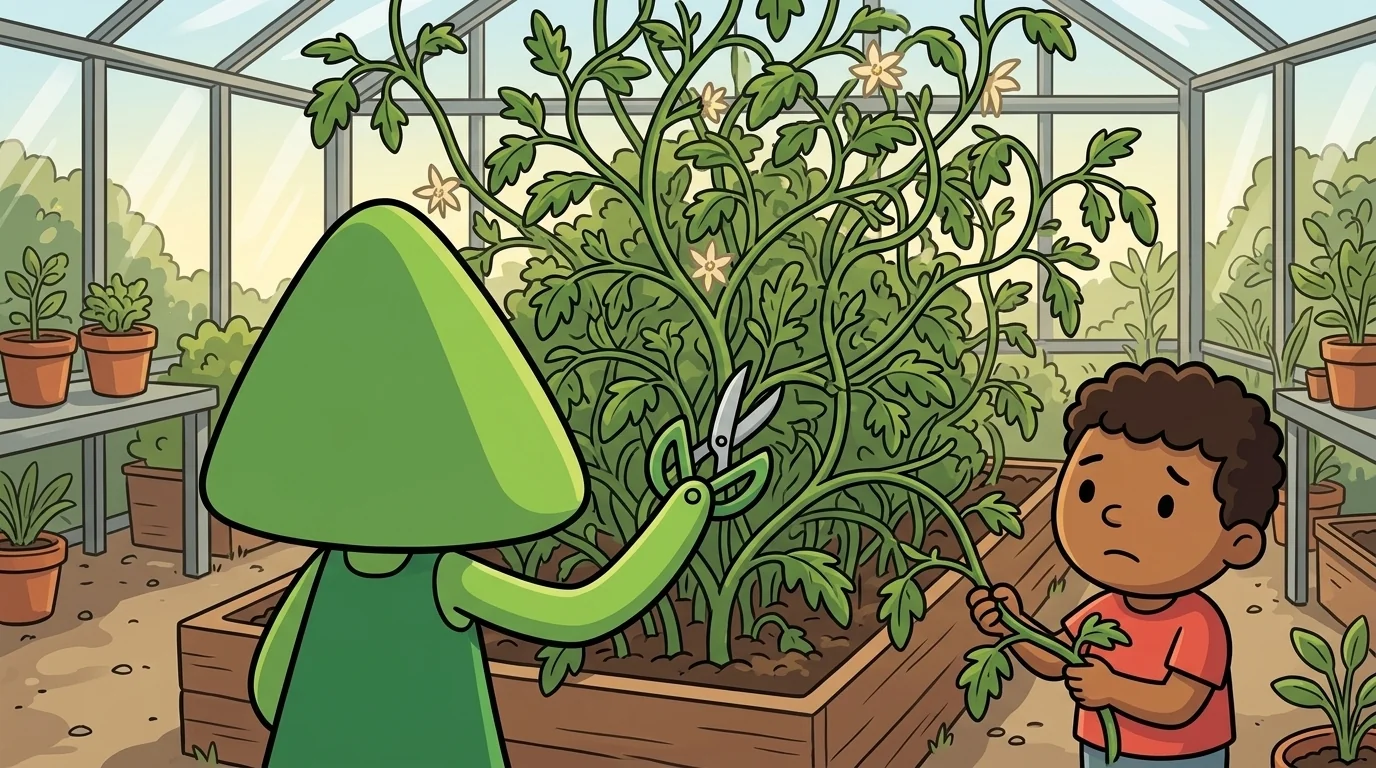
A boy carried in a tomato vine that had swallowed its whole cage — a green monster, six feet of leaves and stems, and, when Shear looked, barely a tomato on the whole thing. "It's the biggest plant in the class," he said, half proud, half worried. "But everybody else has tomatoes and I don't. Mine just keeps getting bigger."
Shear walked the length of it, reading it. "Because you never told it to stop," she said. "You fed it and fed it, and it did exactly what a well-fed plant does when nobody guides it — it grew everywhere. All that strength went into leaves and vine because you never pointed it anywhere else. It's not lazy. It's lost."
"So I cut... the whole plant?"
"You cut the parts that are stealing." She showed him — the "suckers," the little shoots growing in the crooks between stem and branch, each one a whole new vine trying to start. "Every one of these is a plant's worth of ambition drinking food that could've made a tomato. Snip them, and the strength has nowhere to go but into the fruit you already have." She made two clean cuts to demonstrate. "You've been growing a plant that does everything a little. Let's grow one that does the right thing a lot."
The boy took the little shears, hesitated over the first healthy shoot — and then, understanding, made the cut.
He came back at the end, a harder question in him.
"It feels wrong, though," he said quietly. "Cutting off parts that are fine. They're not sick. They're growing great. It feels like a waste. How do you know which good thing to cut?"
Shear thought about her grandfather, and the wild rosebush that bloomed only after it was made smaller, and the day she stopped hiding from the shears.
"You cut the good thing that's in the way of the better thing," she said. "That's the whole art. Nothing I cut is broken — that's exactly why it's hard. But a plant only has so much to give, and every direction it spends itself is a direction it isn't spending on the thing you actually want. So you choose. You look at the fruit you're hoping for, and you cut whatever's drinking the strength meant for it." She folded her long forearms, gentle now. "It's not waste. It's aim. Letting go of a fine thing so a great thing has room. The plant can't choose for itself. That's what the shears are for. Not to punish it. To point it."
The boy looked at the leggy monster, then at his shears, and made the next cut a little more surely.
And Shear felt it settle clean and quiet through her folded green arms — that steady, sure, making room is a kindness feeling she'd carried since a rosebush taught her that some things only bloom once you're brave enough to cut. She'd spend her whole life doing the hard, loving work of subtraction — taking away the good so the best could grow. The garden was always trying to do everything at once. Somebody had to help it choose.
The GrowForge ensemble
Shear is part of GrowForge's distributed-narrative cast. Each character embodies a different curricular primitive; together they teach the full subject.
-

Tuck
Seed + planting — every seed knows what it wants; read-the-packet-then-the-soil
-

Drip
Water + irrigation literacy — water is the patient teacher; don't-drown-the-thirsty framing
-

Glow
Photosynthesis + plant biology — leaf-makes-lunch-from-light; cell-level wonder framing
-

Pot
Container + apartment gardening — windowsill-is-a-garden-too; nature-deficit + privilege gate anchor
-

Vigil
Observation + plant-doctoring patience — look-every-day-don't-pluck-what's-working; intellectual humility framing
-

Crumb
Compost & soil life — decomposition posture (the underground food loop: decay makes the meal; feed the soil, not just the plant)
-
Delve
Roots & uptake — underground-nutrient posture (a plant eats through its roots; the hidden half below does the feeding)
-

Drowse
Seasons & dormancy — right-timing posture (rest is not death; a plant's dormant nap is how it survives to grow again)
-

Sip
Pollination — flower-to-fruit partnership posture (a flower becomes fruit only with a pollinator partner as the bridge)