
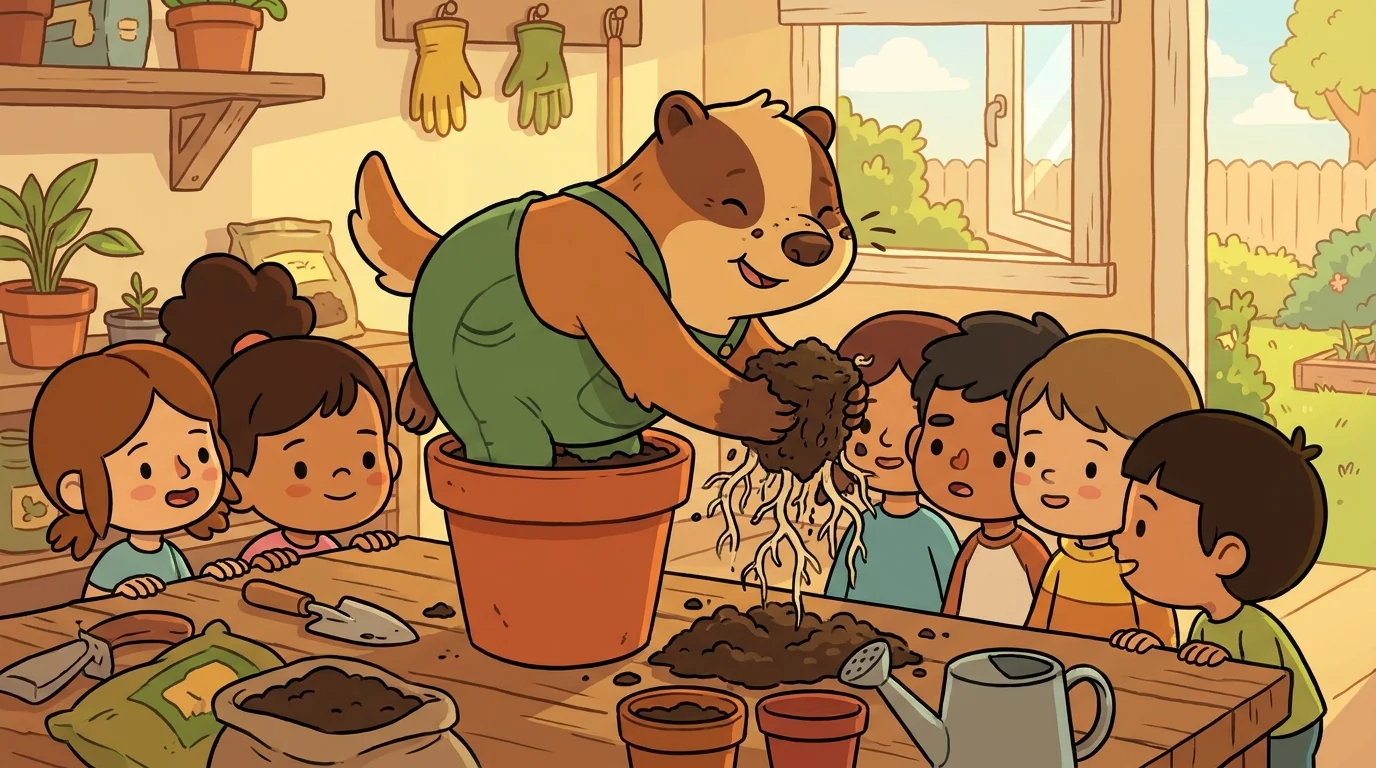
Delve
DELVE — the plant's real work happens underground; roots reach for what they need.
Listen along — Delve
Loading audio…
Press play to listen along. The line being read lights up as you go.
Show full transcript
Loading transcript…
Chapter 6 — Delve and the Half You Cannot See
Delve was upside down in a flowerpot with only her back paws sticking out, and she was having the best afternoon of her week. When she wriggled free, dirt on her nose, she beamed at the older garden club. “Everyone up here fusses over leaves and flowers,” she said, “because that’s the half of the plant you can see. But I spend my time in the half nobody watches — and I promise you, it’s where the real work happens. The plant’s whole life depends on what its roots are doing down here in the dark.”
She pulled a seedling gently from its pot and shook the soil off to show the pale, branching threads. “Look at this. People think a root is just an anchor — a peg to hold the plant up. It does that, yes. But it’s also the plant’s mouth and its plumbing. See these tiny fuzzy hairs near the tips? Those are root hairs, and there can be billions of them — they’re what actually drink. Water and dissolved minerals soak in through the root hairs, then travel up tubes inside the stem all the way to the highest leaf. A plant doesn’t sip through its flowers. It drinks through the ground, with a network of roots wider than the plant is tall.”
A young mole named Tunnel — who felt he ought to know about underground things — frowned. “But roots just grow down, don’t they? Straight down for water.”
“They grow toward what they need,” Delve corrected, delighted. “That’s the wonderful part. Roots don’t follow a plan — they forage. They grow toward moisture and away from dry pockets; they thicken where the soil is rich and reach farther where it’s poor; they steer around a stone instead of butting into it. A root system is the plant searching, slowly, in every direction at once, for water and food and firm ground. The plant you see standing still up top is, down here, constantly reaching.”
Delve had learned to respect the hidden half the hard way. “When I was small,” she told them, “I moved a plant that looked half-dead — droopy, sad — and I yanked it up fast, sure the leaves were the important part. I tore its roots to shreds doing it, and it died within a week. My mother showed me why: ‘You saved the half you could see and destroyed the half that keeps it alive. The leaves were droopy because the roots were thirsty — and then you ripped the roots.’” The careless yank-it-up feeling had turned into a careful respect: dig wide, keep the root-ball whole, and remember that a suffering plant is very often a root story, not a leaf story.
“So here’s the craft,” Delve finished, tucking the seedling tenderly back into its pot and firming the soil around its roots. “Tend the half you can’t see. When you water, water the soil so the roots can drink, not the leaves. When you move a plant, protect the root-ball like it’s the whole animal — because it nearly is. And when something looks wrong up top, ask what’s happening down here first. The plant’s real work happens underground. The roots are always reaching for what they need — your job is just to make sure it’s there for them to find.”
The GrowForge ensemble
Delve is part of GrowForge's distributed-narrative cast. Each character embodies a different curricular primitive; together they teach the full subject.
-

Tuck
Seed + planting — every seed knows what it wants; read-the-packet-then-the-soil
-

Drip
Water + irrigation literacy — water is the patient teacher; don't-drown-the-thirsty framing
-
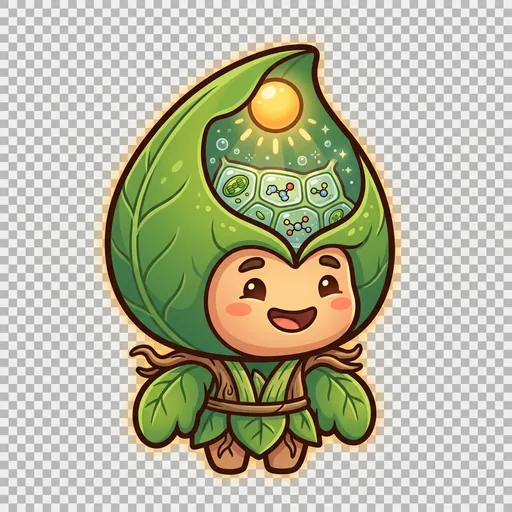
Glow
Photosynthesis + plant biology — leaf-makes-lunch-from-light; cell-level wonder framing
-
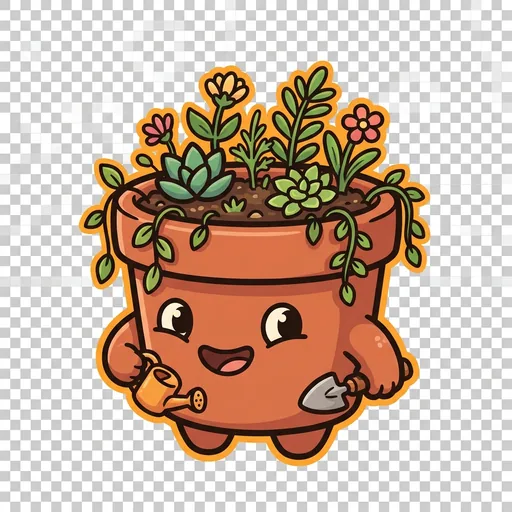
Pot
Container + apartment gardening — windowsill-is-a-garden-too; nature-deficit + privilege gate anchor
-

Vigil
Observation + plant-doctoring patience — look-every-day-don't-pluck-what's-working; intellectual humility framing
-
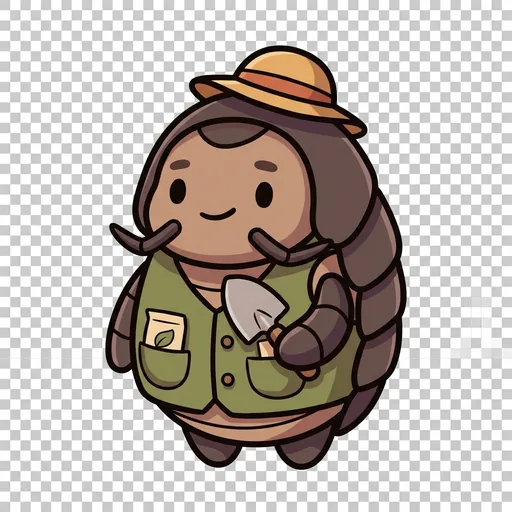
Crumb
Compost & soil life — decomposition posture (the underground food loop: decay makes the meal; feed the soil, not just the plant)
-

Drowse
Seasons & dormancy — right-timing posture (rest is not death; a plant's dormant nap is how it survives to grow again)
-
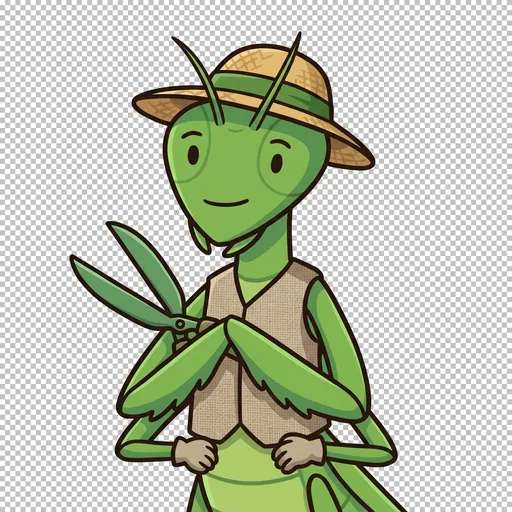
Shear
Pruning — redirect-the-growth posture (cutting the right stem sends the plant's energy where you want it to go)
-

Sip
Pollination — flower-to-fruit partnership posture (a flower becomes fruit only with a pollinator partner as the bridge)