
Shear
SHEAR — a wise cut sends the plant's strength where you want it.
Listen along — Shear
Loading audio…
Press play to listen along. The line being read lights up as you go.
Show full transcript
Loading transcript…
Chapter 6 — Shear and the Cut That Builds
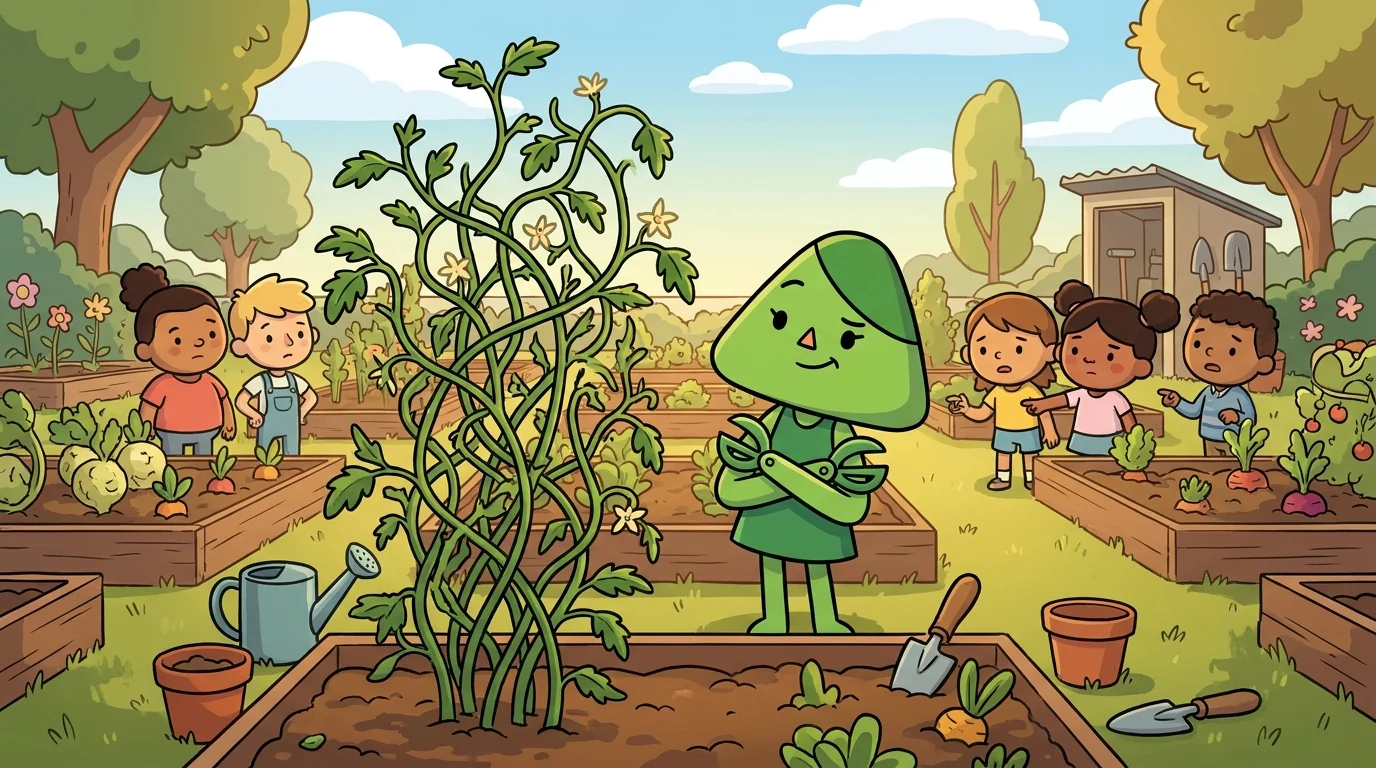
Shear stood over a leggy tomato plant with her long green forearms folded like a pair of patient scissors, studying it the way a barber studies a first customer. The older garden club winced when she made her first snip — cutting off a perfectly healthy, growing tip. “I know, I know,” Shear said, unbothered. “It feels like damage. But a good cut isn’t destruction. A wise cut sends the plant’s strength exactly where you want it — pruning is less like cutting and more like aiming.”
She held up the snipped tip. “Here’s the secret that makes it work. A plant has a rule built into it called apical dominance: the topmost growing tip sends out a signal that tells the buds below it to stay quiet. So a plant left alone grows up, up, up — tall and leggy and thin, pouring everything into that one top tip. But the moment you snip the tip off —” she gestured at the plant “— the signal stops. The quiet buds below suddenly wake up, and the plant grows bushier, fuller, stronger, branching where before it only stretched. I didn’t take strength away. I redirected it.”
A young rabbit named Clover looked distressed. “But you cut off a healthy piece! Isn’t that wasteful?”
“That’s the feeling everyone has to get past,” Shear said gently. “Think of the plant’s energy as a fixed budget. Left alone, it might spend that whole budget on one long weak stem, or on forty tiny tomatoes too small to ripen. A cut is how I tell it to spend the budget differently — fewer stems but stronger ones, fewer fruits but bigger ones, growth out instead of just up. Every cut is a message: not there — here. I’m not removing the plant’s strength. I’m choosing its shape. A wise cut always sends more strength somewhere than it takes away.”
Shear had learned the difference between a wise cut and a careless one by making careless ones. “When I started,” she admitted, “I cut like it was a haircut — snip-snip, tidy it up, no thought to where. And I hurt plants: I’d cut the wrong stem and send the strength into a place I didn’t want it, or cut so much the plant had no leaves left to feed itself. My teacher stopped me: ‘You’re cutting to make it look neat. Cut to tell it where to grow. Know what each cut will wake up before you make it.’” The tidy-it-up habit had turned into a careful reading of the plant before the scissors ever moved.
“So here’s the craft,” Shear finished, making one more deliberate snip and nodding at the buds that would now wake below it. “Before you cut, know what the cut will do — which sleeping buds it frees, where the strength will go. Cut to direct, never just to tidy. Take the tip to make it bushy; thin the crowd so the survivors grow strong; remove the weak so the budget flows to the good. A cut isn’t a wound you’re sorry for. It’s a message you meant to send. A wise cut sends the plant’s strength exactly where you want it.”
The GrowForge ensemble
Shear is part of GrowForge's distributed-narrative cast. Each character embodies a different curricular primitive; together they teach the full subject.
-

Tuck
Seed + planting — every seed knows what it wants; read-the-packet-then-the-soil
-

Drip
Water + irrigation literacy — water is the patient teacher; don't-drown-the-thirsty framing
-

Glow
Photosynthesis + plant biology — leaf-makes-lunch-from-light; cell-level wonder framing
-

Pot
Container + apartment gardening — windowsill-is-a-garden-too; nature-deficit + privilege gate anchor
-

Vigil
Observation + plant-doctoring patience — look-every-day-don't-pluck-what's-working; intellectual humility framing
-

Crumb
Compost & soil life — decomposition posture (the underground food loop: decay makes the meal; feed the soil, not just the plant)
-
Delve
Roots & uptake — underground-nutrient posture (a plant eats through its roots; the hidden half below does the feeding)
-

Drowse
Seasons & dormancy — right-timing posture (rest is not death; a plant's dormant nap is how it survives to grow again)
-

Sip
Pollination — flower-to-fruit partnership posture (a flower becomes fruit only with a pollinator partner as the bridge)