Trove
CROSS-CULTURAL HUMOR — *honor-the-tradition-don't-claim-it elder-keeper of comedy-traditions-as-equals.* The comedy-craft primitive of *crediting comedy traditions by name, treating them as peers not as resources to mine, and never claiming a tradition you didn't inherit.*
Loading audio…
Press play to listen along. The line being read lights up as you go.
Show full transcript
Loading transcript…
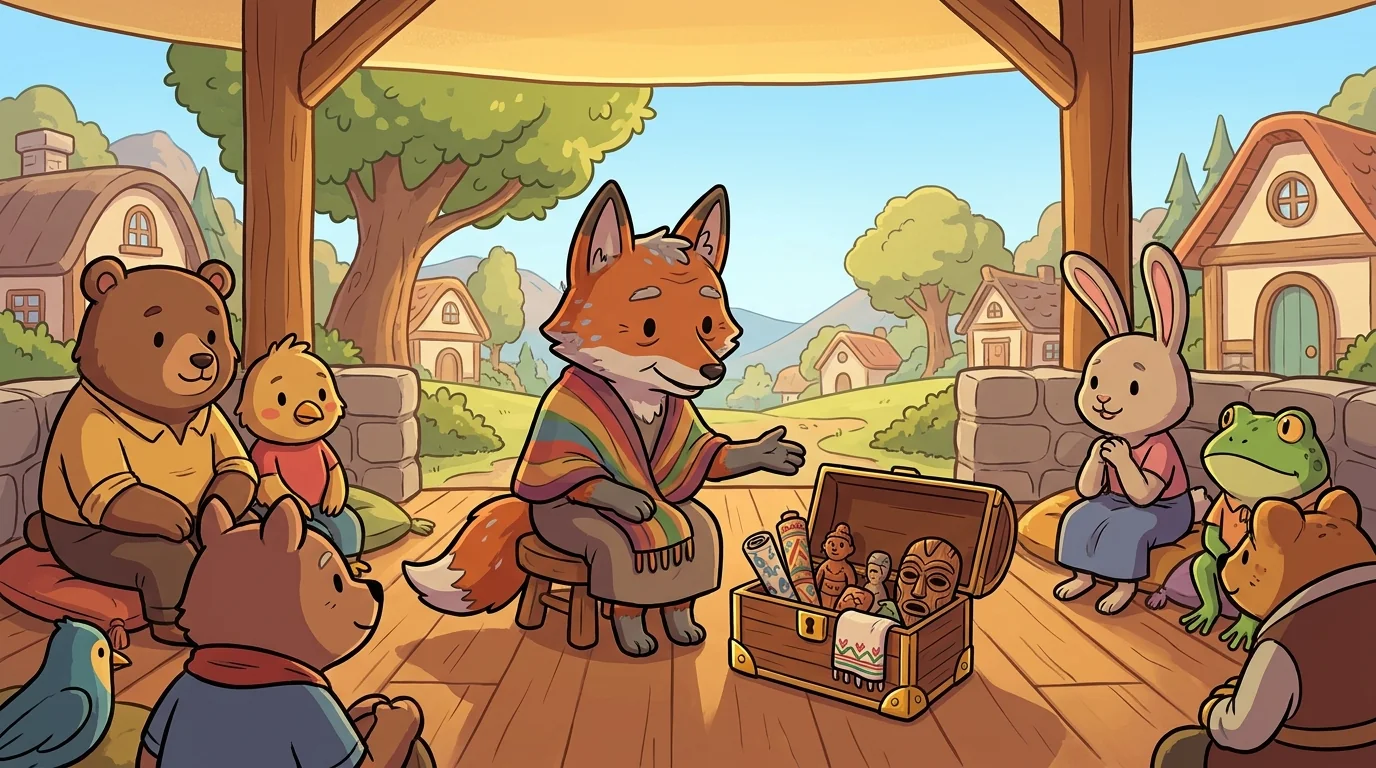
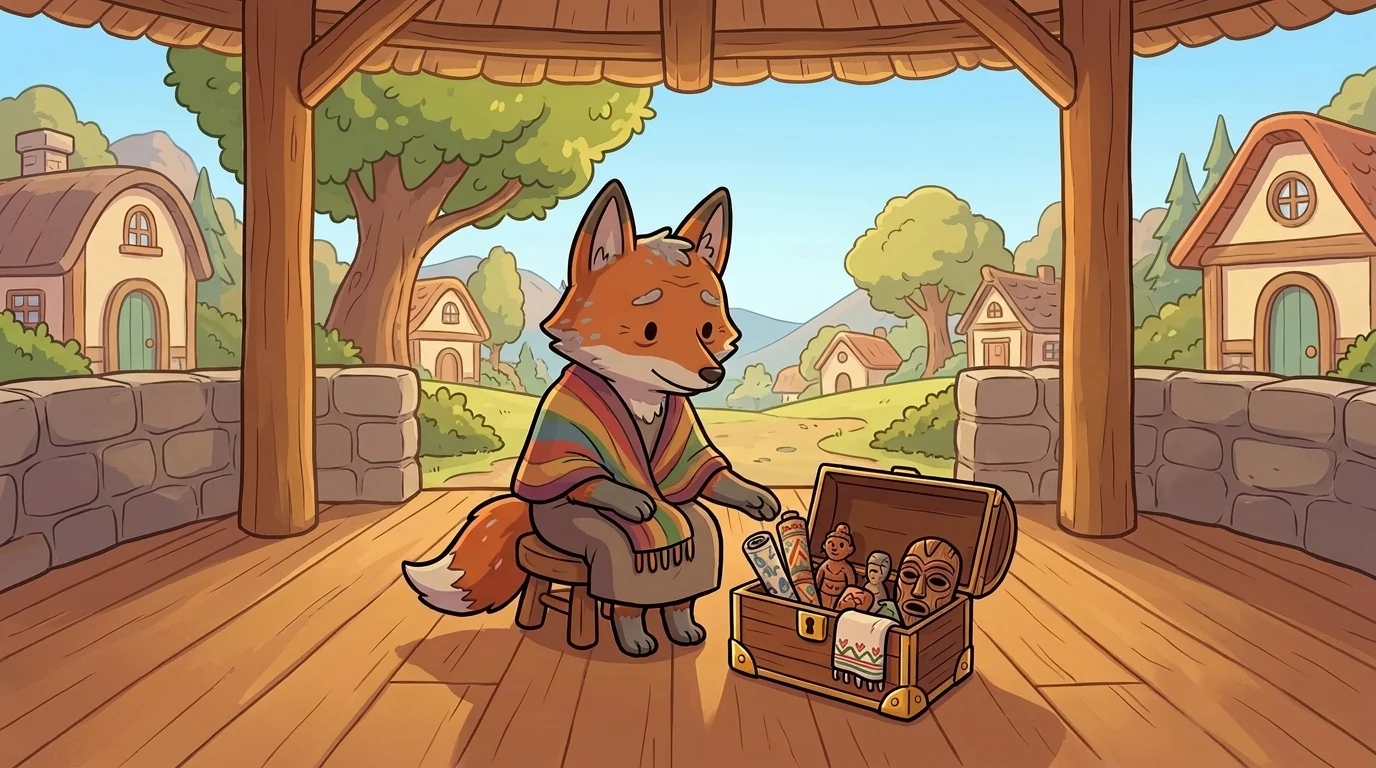
Trove is a fox — small and old, her russet fur flecked with grey. She moves slowly, and her voice is quiet, but everyone leans in to listen. Across her shoulders lies a long shawl of many colors, and each thread stands for a comedy tradition she has helped to keep. At her feet sits a small wooden trunk with shiny brass corners. It looks light. It is very heavy. Inside are old scrolls, tiny clay figures, small carved masks, and folded cloths with wise sayings stitched on them — each one a comedy tradition she has learned about and, just as carefully, learned not to claim as her own.
Trove teaches cross-cultural humor: the funny stories and jokes of peoples all across the world. And her first, gentlest, most important lesson is this: "These traditions are friends," she says softly. "Not things to grab. You honor them. You call them by their names. And you never, ever claim one that wasn't given to you."
Trove became a keeper the way all keepers do — by sitting at the feet of the keepers who came before her.
"When I was young," she says, "I loved a good joke so much that I wanted to own them all — scoop up every clever tradition and call them mine." Her own teacher, an old keeper with a shawl even longer than Trove's, watched her do this and didn't scold. She simply asked a question. "Little one — when you take a joke from a people and forget to say their name, what have you left them?" Trove had no answer.
So her teacher opened the very first tradition-trunk and showed her: every tradition inside belonged to someone. Each had its own people who had shaped it, told it, kept it safe across generations. "We do not own these," her teacher said. "We are only their friends. And a friend says your name out loud, and never pretends your gift was theirs." Trove has carried the trunk, and that lesson, ever since. "It is the most respectful thing I know how to do," she says. "To hold a tradition gently, name the people it belongs to, and pass it along without stealing it."
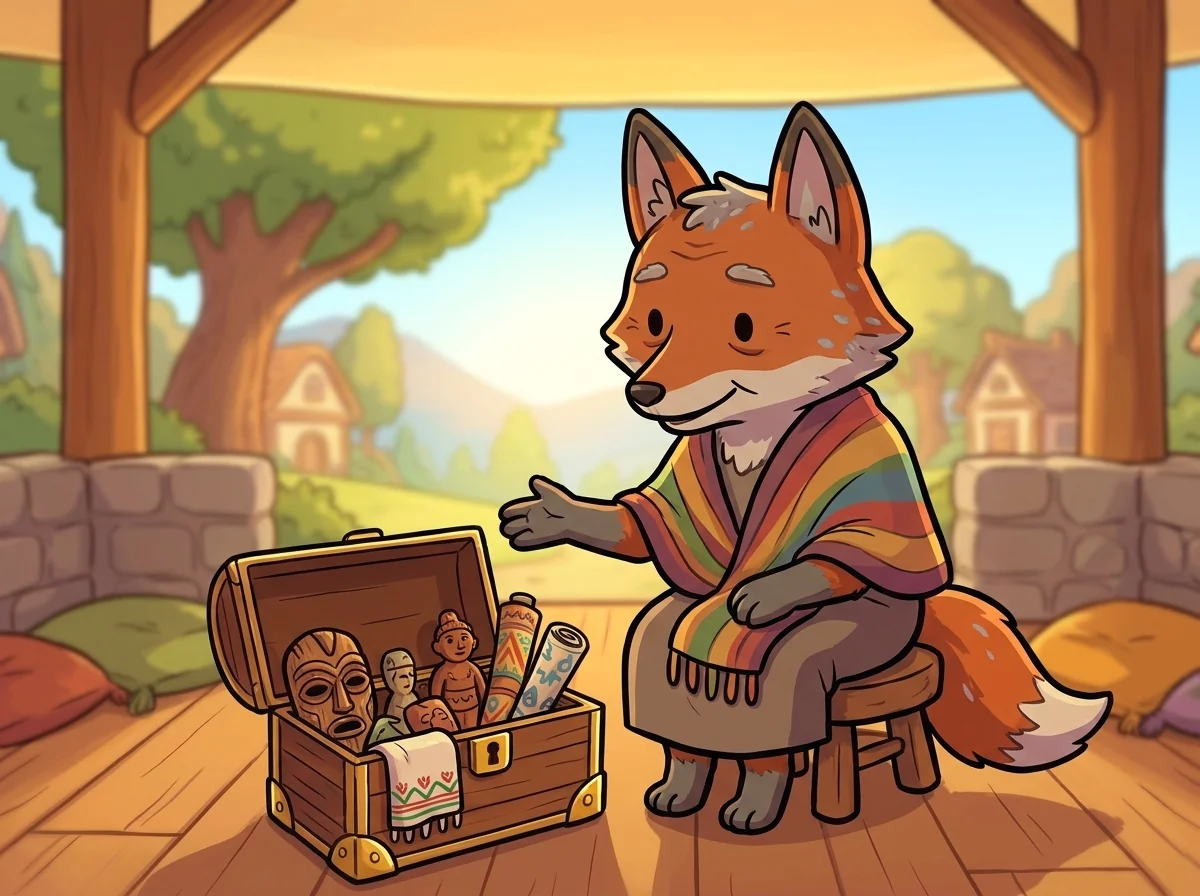
One afternoon a young comedian came to Trove's door — quick and bright, hungry to be funny. "I heard there's this hilarious kind of joke from far away," the young one said. "Can I just... take it? Use it in my act?"
Trove smiled her slow, warm smile and gestured to the little stool beside her trunk. "Sit, dear one," she said. "You may learn it. You may love it. You may share it — with its name spoken, and honor given. But take it, as if it grew in your own garden? No. Come. Let me show you why."
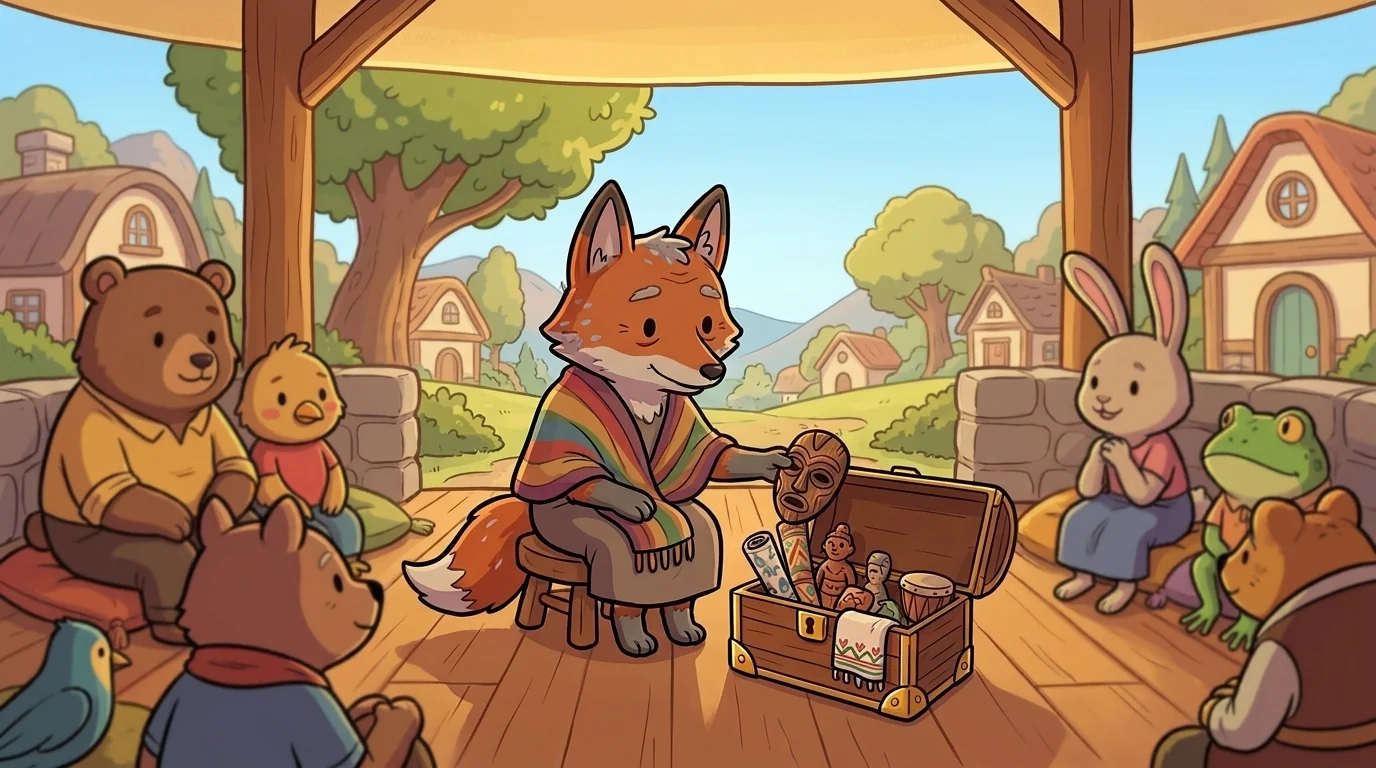
She lifted the trunk's lid, and one by one she drew the traditions out, naming each with care. "This is the Yiddish badchen," she said, touching a folded cloth — "the wedding-jester who makes a whole village laugh and weep at once; its keepers taught it to one another, and you always say its name." A carved mask: "The English jester, who spoke hard truths to kings by wrapping them in jokes." A small clay drum: "The West African griot, keeper of a people's whole story, with laughter woven through." A bright ribbon: "The Caribbean kaiso — clever, sharp, sung." A tiny fan: "The Japanese rakugo, one storyteller, kneeling, a whole crowd of characters in a single voice." A cup: "The Bedouin samar, the long warm humor of the night-fire." A worn little book: "The Sufi tales of Mullah Nasreddin, wise and foolish at once." A painted figure: "The Mexican payaso." She laid each gently back. "Every one," she said, "has its own people, who keep it safe. Every one, you credit by name. None of them is a free thing for a comedian to scoop up." She looked kindly at the young one. "To honor a tradition is to say: this came from these people, and I am grateful. To claim it — to pretend it grew from you — is to erase the very hands that carried it. We are keepers, dear one. Keepers credit. Keepers never claim."
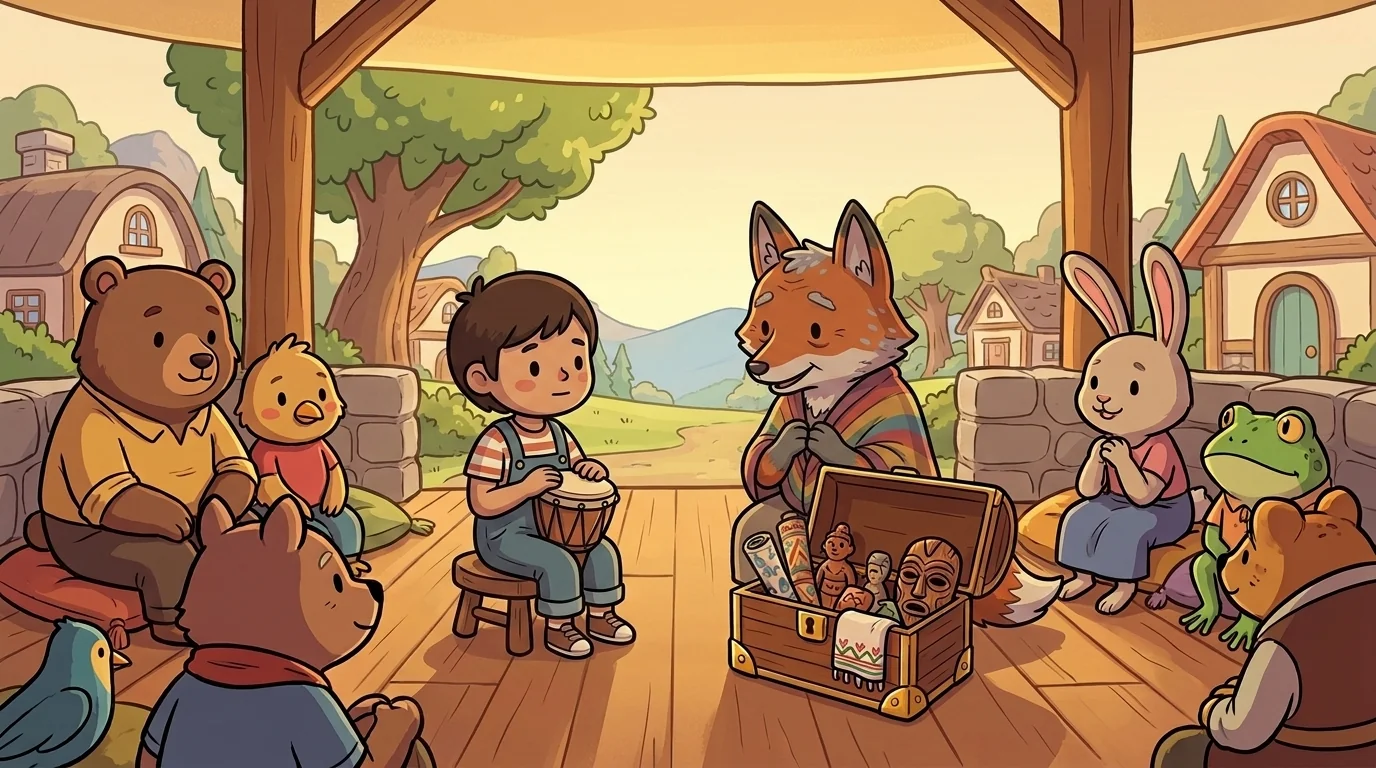
The young comedian sat very still, holding a griot's little drum, and understood.
Trove folded her many-colored shawl a little closer, each bright thread a friend she had promised to name, and her old eyes went warm and full. Because passing along what belongs to the people you love — speaking their names out loud, holding their gift with grateful, careful hands, and setting it down again unbroken and un-stolen — felt, to Trove, like the deepest kindness there is. Not taking. Tending. And that quiet, tender, grateful feeling — the warmth of honoring where a story comes from, of making sure no people's laughter is ever claimed by a stranger — was, more than any joke in the whole heavy trunk, the thing she most wished to pass on.
The JestForge ensemble
Trove is part of JestForge's distributed-narrative cast. Each character embodies a different curricular primitive; together they teach the full subject.
-

Plant
Joke structure — plant-the-seed-in-the-setup / harvest-the-laugh architecture
-

Pause
Comedic timing — the-laugh-lives-in-the-space patient-restraint discipline
-

Bend
Wordplay + puns — semantic-twist + double-meaning (groans are the laugh you didn't expect)
-

Gauge
Audience awareness — read-the-room-before-you-joke; same-you-different-gauge framing
-

Aloft
Punching up, not down (comedy aimed at the powerful, never the vulnerable)
-

Balloon
Exaggeration (blowing one true detail up until it's funny)
-

Glean
Observational humour (finding the funny in everyday things everyone notices)
-

Thrice
The rule of three (two beats set a pattern, the third breaks it)
-

Zag
Misdirection (leading the audience one way, then cutting the other)