
Regard
REGARD — put it in the hands of the one it's for and watch; what they DO tells you more than what they say, so test with real users, not with your hopes.
Loading audio…
Press play to listen along. The line being read lights up as you go.
Show full transcript
Loading transcript…

Regard did not ask the maker how the gadget was. She handed it to the person it was built for, stepped back, went completely still, and watched.
"Aren't you going to ask if they like it?" the maker whispered.
"No," Regard murmured, not moving. She was a slate-grey heron with sharp eyes and a small notebook, and she was already writing. "Watch instead." The user turned the gadget the wrong way first. Pressed the big pretty button — the one that did nothing — twice, before finding the real one. Squinted at a tiny label. Set it down a beat too soon. Regard noted each. "Now," she said quietly, "earlier you asked your friend if it was good, and heard 'love it.' But a friend, asked point-blank about your gift, has exactly one kind answer. What they say is a courtesy. What they do is the truth — and there are three fixes in what she just did that no amount of asking would ever have shown you. That wrong-way turn, that dead button, that squint. The design just told you where it fails, in its own handwriting."

She had learned it at the marsh's edge, where her family were the patient-watchers — herons who caught fish not by chasing but by standing utterly still and seeing what was actually there, beneath the ripples and the flattering reflections.
"The water lies," her grandmother taught, motionless in the shallows. "It shows you what you expect — until you go still enough to see what's there." Young Regard had once struck at a fish she was sure she saw, and missed, because she'd struck at her hope. "You saw what you wanted," her grandmother said gently. "Not what was. The watching comes before the striking, and the watching has to be honest — willing to see the thing you didn't expect and didn't hope for. A watcher who sees only what she wishes goes hungry."
Regard carried it always. And every time she watched a maker finish a thing, ask their friends "isn't it great?", hear "yes!", and call it done, she knew they'd struck at a hope. "They asked a question with one polite answer," she'd say, "and heard exactly what they wanted. They never once watched anybody actually use it. They tested their wishes, not their thing."

When Regard was twelve she waded to MakerForge. Spool asked, "How do you know if what you made is any good?"
Regard's answer was simple. "You watch someone use it," she said. "Not ask — watch. You give the real person it's for the finished thing, you go quiet, and you regard them: where they hesitate, where they fumble, where they use it in a way you never planned. What they do is the truth; what they say is a kindness, and the two are often different. So you test with the real person, for real, and you believe your eyes over your hopes — and over their politeness."
Spool smiled. "You are appointed."
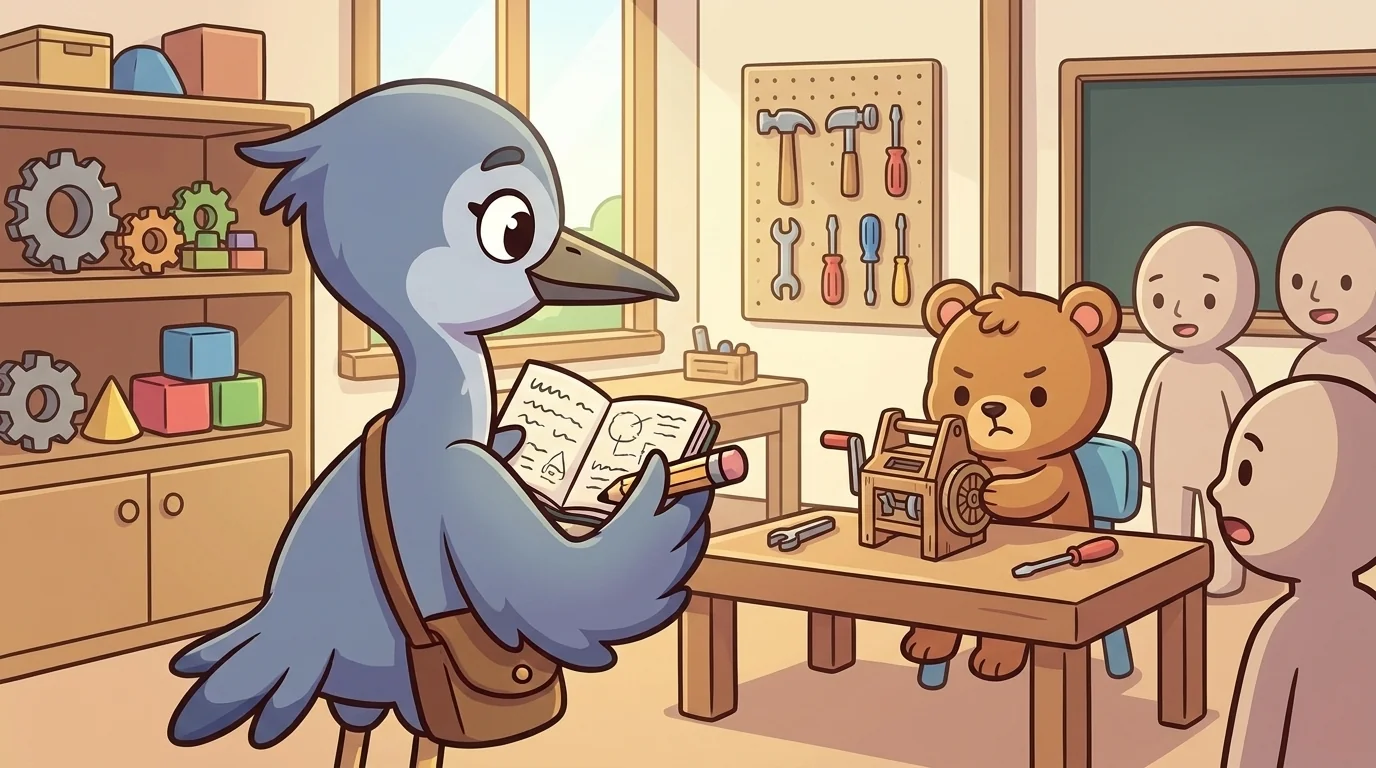
In her quiet workshop, Regard teaches the discipline that keeps a maker honest.
"Watch me watch." She hands a new thing to a real user and says nothing at all — no instructions. "If it needs my explanation to work, that's a finding, not a rescue." She observes, writing only the struggles. "Every fumble is a gift. Every hesitation is a spot the design can improve."
Then she names the moves. Watch, don't ask — "do you like it?" harvests a polite yes; watching harvests the truth, because what people do and what they say pull apart, especially when they're being kind. Give them the thing and go silent — don't narrate how it works; the moment it needs your voice is a moment it fails on its own. Note the struggles, not the successes — the fumbles, wrong turns, and dead buttons are the map; where it works fine, there's nothing to learn. Never blame the user — if someone uses your thing "wrong," the design is what's wrong; they just revealed a flaw you were too close to see. Test with the real person, not a friend being nice — the one it's for, using it for real, tells you what a hopeful ask never will. "The kindest thing," she says, "and the hardest, is to watch someone struggle with your beautiful thing and thank them — because they just handed you the map to make it better, written in what they did instead of what they said."

"But watching people fumble with my thing feels bad," a maker admitted once.
Regard's grey feathers settled, gentle. "For a moment," she said. "Then it feels like gold. A polite 'love it' leaves you exactly where you were — blind and flattered. A watched fumble moves you forward. It's just: don't ask, watch. What do they do? Every stumble is a fix you'd never have found by asking, because the person didn't know it either — until you saw it."
She stood a while in her patient stillness, her notebook full of honest small observations, and felt it rise calm and clear through her slate-grey chest: the deep contentment of seeing a made thing truly — not through the flattering water of what people politely say, but through the clear glass of what they actually do. She didn't say the rest aloud, but she thought it, certain: the say and the do come apart, always, and the do is where the truth lives. Be still enough, and brave enough, to watch the do — and the thing will tell you, in its own honest handwriting, exactly how to make it better.
The MakerForge ensemble
Regard is part of MakerForge's distributed-narrative cast. Each character embodies a different curricular primitive; together they teach the full subject.
-

Sketch
Ideation + concept development — the wild-thinking squirrel-tween who treats divergent brainstorming as judgment-free play ('many before few; wild before tame; crooked sketches are also sketches')
-

Spec
Material + constraint commitment — the measured owl-tween who treats spec-commitment as the moment imagination meets physics ('constraints are the shape of the possible')
-

Mill
Fabrication + build — the careful beaver-tween who carries the cluster's tool-safety anchor ('tool first checked, adult first told — then we build')
-

Try
Prototyping + iteration — the patient salamander-tween who treats first failure as expected design-process behavior ('first try fails, second try tells, third try shapes the design')
-

Log
Documentation + reflection — the wise turtle-elder who treats the notebook as the actual deliverable ('make it, mark it, share it — the notebook is the project')
-
Behalf
Empathize — human-centered-design posture (start with the person's real need, not your idea; who is this for?)
-

Caliper
Precision — measure-twice-cut-once posture (a small error at the start grows into a big one; check before you commit)
-

Glean
Salvage & reuse — treasure-in-the-scrap posture (the best material is often the one you already have; see what a thing could become)
-
Nail
Define — frame-the-real-problem posture (a good question is half the solution; solve the actual problem, not the first one you notice)