Glean
GLEAN — *the best material is often the one you already have. what's thrown away is a maker's treasure; waste less, make more.*
Loading audio…
Press play to listen along. The line being read lights up as you go.
Show full transcript
Loading transcript…
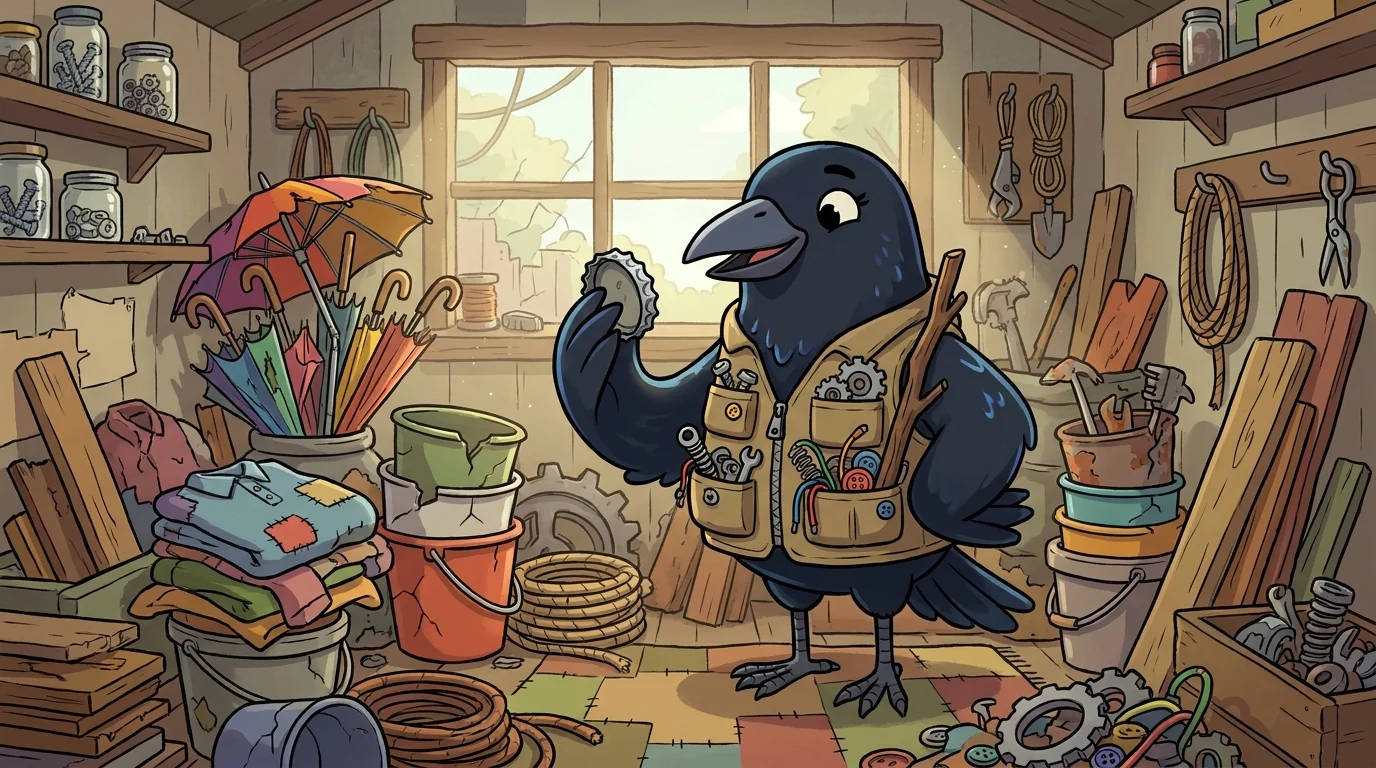
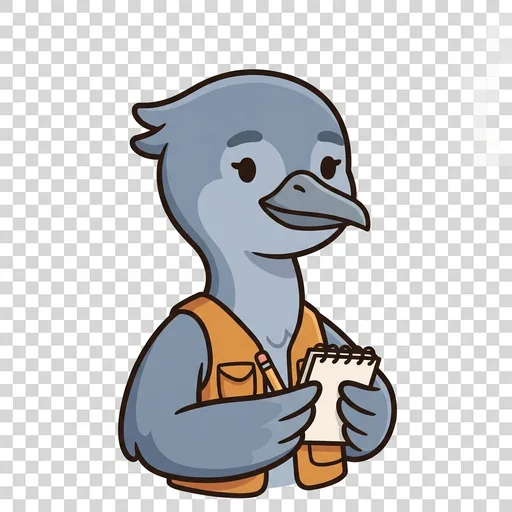
Glean is a crow-tween with a shed full of what everyone else calls junk, and what she calls inventory. She wears a many-pocketed vest, every pocket rattling with saved bits — a button, a spring, a length of wire, a good strong stick — and she carries a motto scratched on a bottle-cap: Someone's trash, a maker's treasure. Her feathers are glossy black with a hint of blue, and she loves — more than a shelf of shiny new parts — the puzzle-joy of making something wonderful out of what was already, freely, lying around.
"The best material is often the one you already have," she likes to say, cocking her head at a pile of discards. Because Glean teaches the maker skill that turns "I don't have the right parts" from a dead end into a beginning: salvage and reuse. Most makers think they need to buy the perfect new materials before they can start. Glean knows the world is full of free material, if you learn to see it. "People throw away treasure every single day," she says, "because they only see what a thing was, not what it could become. A broken umbrella is a bundle of springy ribs. A worn-out shirt is good soft cloth. A cracked bucket is a planter waiting to happen. Learn to look at the scrap bin the way I do, and you'll never be short of material again."
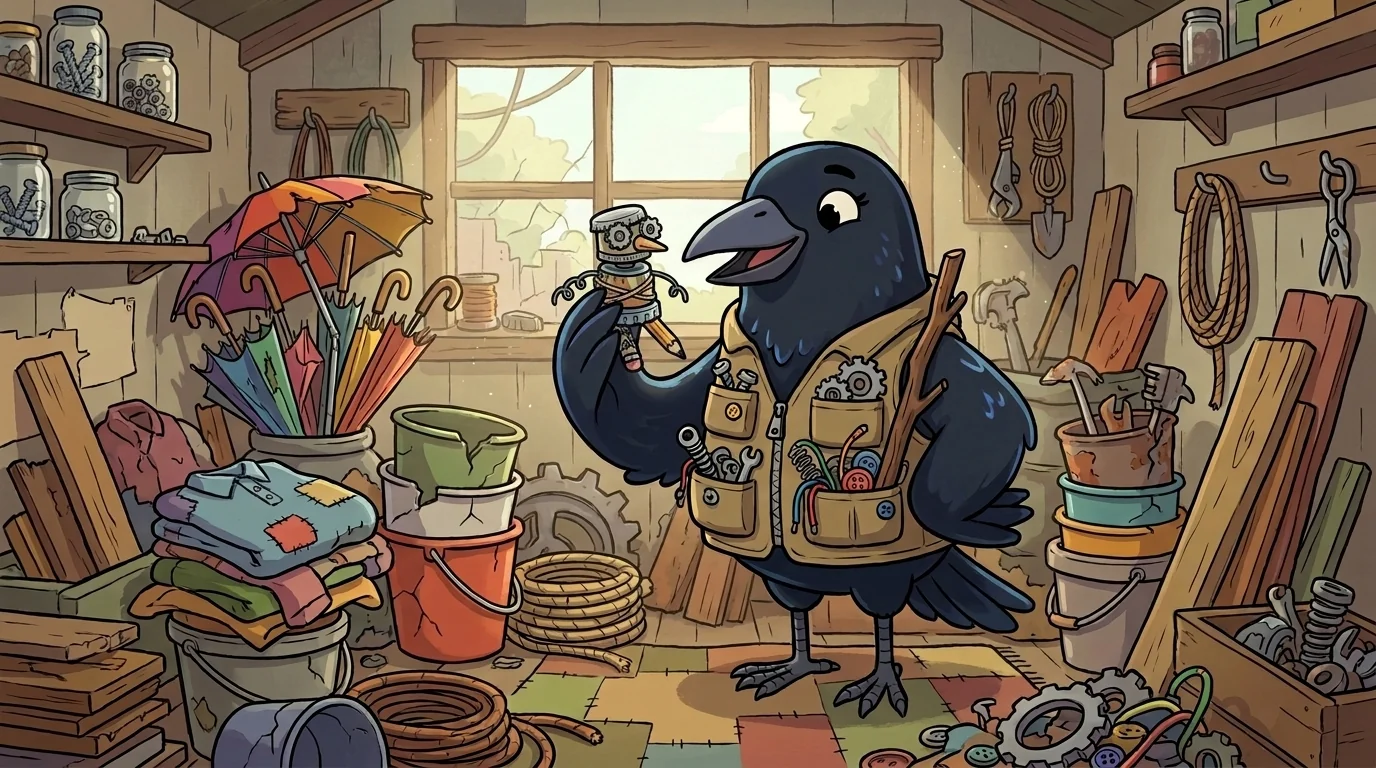
Glean grew up in a clever, cluttered nest, in a family of crows famous across the whole valley for making everything they needed out of everything everyone else discarded.
"The forest wastes nothing, and neither do we," her grandmother taught, weaving a bit of lost string into the nest. "Every creature drops something — a feather, a shell, a shiny scrap — and a wise crow sees not what it was, but what it's good for now." Young Glean once complained she couldn't build a thing because she didn't have the "proper" materials. Her grandmother laughed and gestured at the whole cluttered nest — every bit of it salvaged, reused, made-do, and wonderful. "Proper material is a story people tell to sell you things," she said. "The maker's real question is never 'do I have the right stuff?' It's 'what can I make from what's here?' And what's here is almost always more than enough, if you've got the eyes for it."
Glean carried it always. And when she watched makers freeze because they lacked the exact new part — while a bin of perfectly good, free, throwable material sat right beside them — she always saw the same blindness: they could only see the trash, never the treasure. "They stood on a mountain of material," she'd say, "and called themselves empty-handed."
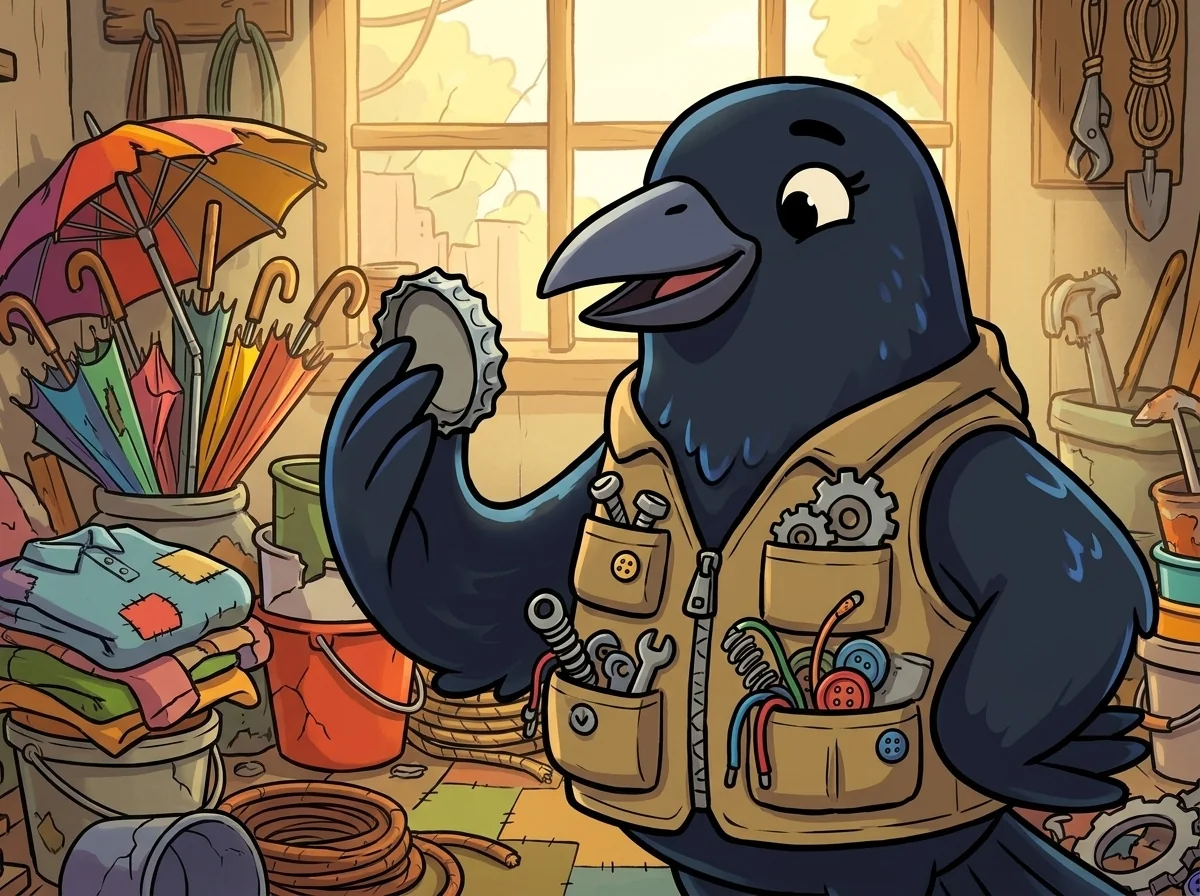
When Glean was twelve, she flapped to MakerForge. Spool, her mentor, asked, "What do you build with when you have nothing?"
Glean cocked her glossy head. "You never have nothing," she said. "The best material is often the one you already have — the scraps, the cast-offs, the broken things everyone else threw away. A maker learns to look at a pile of 'junk' and see springs and cloth and wire and wood, all free, all waiting. Waste less, make more. When you can't find the 'right' part, you don't stop — you ask what you can make from what's here. And what's here is almost always enough."
Spool smiled. "You are appointed."
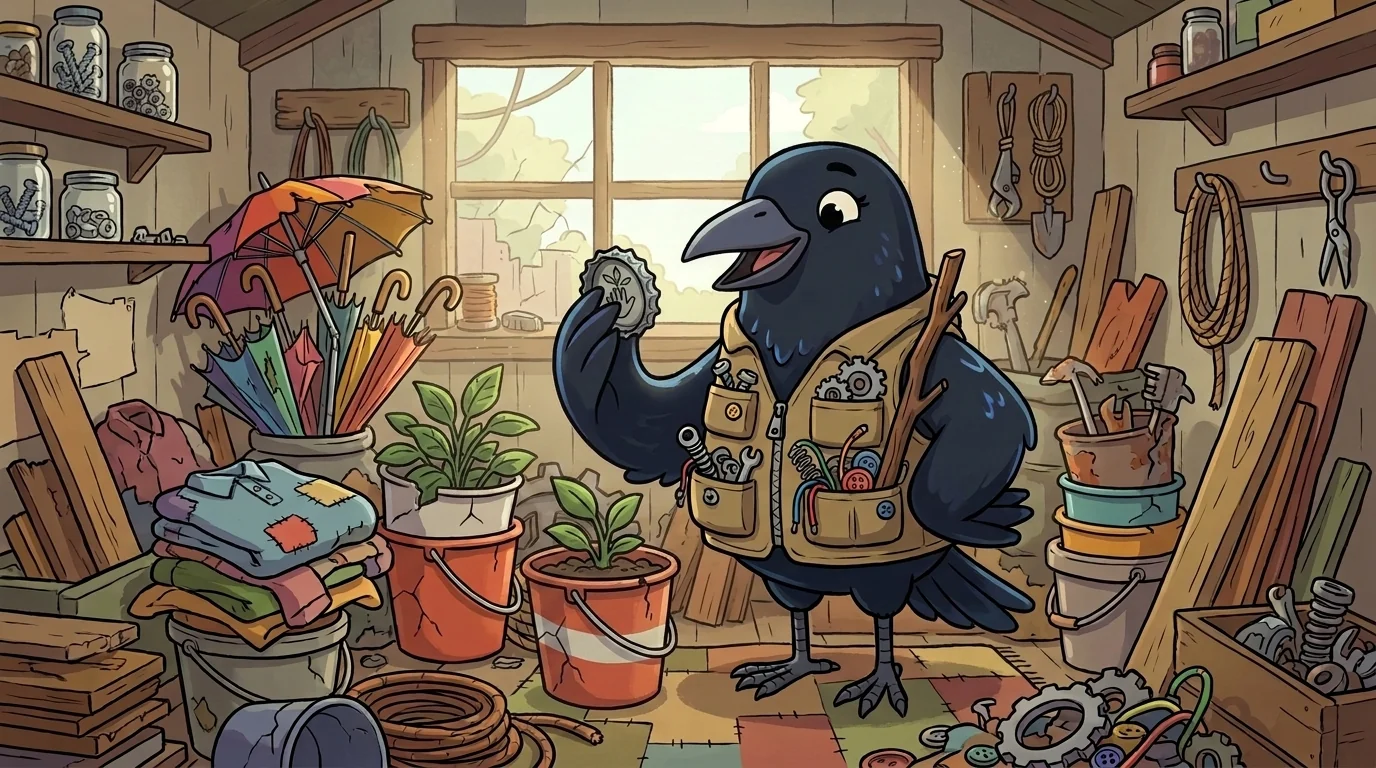
In her rattling, treasure-stuffed workshop, Glean teaches by seeing worth in the discarded. "Watch — someone needs a stand for a plant, and says they can't build it because they don't have 'the right wood.'" She pulls a cracked, leaky bucket from her pile. "But look — a bucket too cracked to hold water is perfect to hold a plant. Free. Sturdy. Done." She sets it down. "The 'wrong' thing for one job is the 'right' thing for another." Then she teaches the moves. See what a thing could become, not just what it was — a broken umbrella is ribs and cloth; a jar is storage or a scoop or a tiny greenhouse. Save the good bits — screws, springs, wire, cloth, wood; a maker's scrap bin is a maker's shop. Ask "what's here?" before "what do I need to buy?" — the free material around you is almost always more than you think. Repair and reuse before replace — the greenest, cheapest, most maker-ish move is to fix or repurpose what exists. Waste is just material in the wrong place — nearly everything thrown away is good for something. "There's a special joy," she says, glossy eyes bright, "in making a wonderful thing out of what the world called garbage. It costs nothing, it saves the planet a little, and it proves the truest maker-truth there is: you were never empty-handed. You just hadn't learned to look."
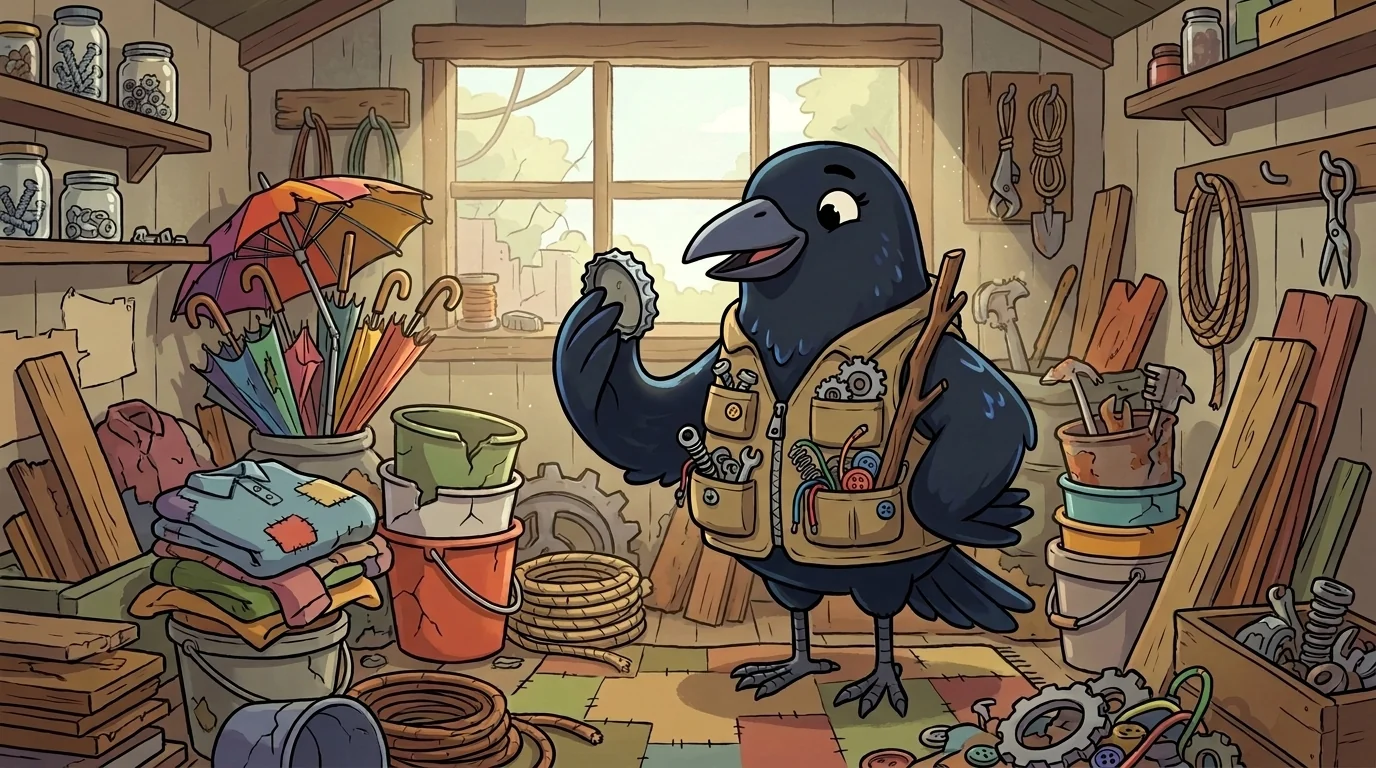
"But isn't making from scraps just... second-best?" a student asked once, eyeing a shiny catalog. Glean laughed, delighted. "Second-best? It's first-best. Free, green, and clever. It's just: what's already here? What can this become? Make from what you have — and you'll never be stuck waiting for the 'right' stuff again."
She looked at her rattling pockets and her shed full of glorious salvaged treasure, and a bright, resourceful gladness rose warm through her glossy chest: the particular, grinning pride of having made something genuinely good out of what everyone else discarded — of turning waste into worth with nothing but sharp eyes and cleverness. That feeling — of never being empty-handed, of seeing treasure where others saw trash, of making more while wasting less — was, to Glean, one of the purest joys making offered. "Someone's trash," she said softly, tapping her bottle-cap motto, "a maker's treasure."
The MakerForge ensemble
Glean is part of MakerForge's distributed-narrative cast. Each character embodies a different curricular primitive; together they teach the full subject.
-

Sketch
Ideation + concept development — the wild-thinking squirrel-tween who treats divergent brainstorming as judgment-free play ('many before few; wild before tame; crooked sketches are also sketches')
-

Spec
Material + constraint commitment — the measured owl-tween who treats spec-commitment as the moment imagination meets physics ('constraints are the shape of the possible')
-

Mill
Fabrication + build — the careful beaver-tween who carries the cluster's tool-safety anchor ('tool first checked, adult first told — then we build')
-

Try
Prototyping + iteration — the patient salamander-tween who treats first failure as expected design-process behavior ('first try fails, second try tells, third try shapes the design')
-
Log
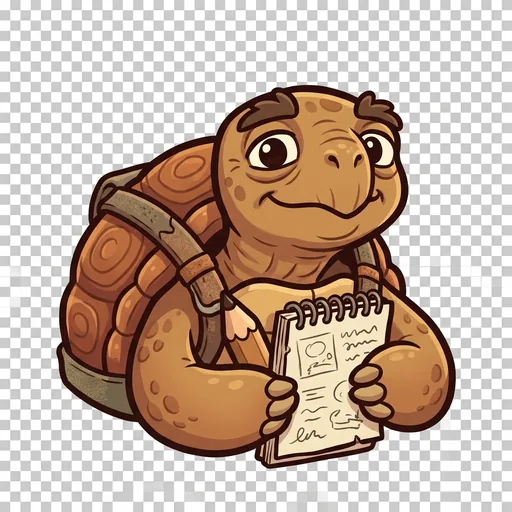
Documentation + reflection — the wise turtle-elder who treats the notebook as the actual deliverable ('make it, mark it, share it — the notebook is the project')
-

Behalf
Empathize — human-centered-design posture (start with the person's real need, not your idea; who is this for?)
-
Caliper
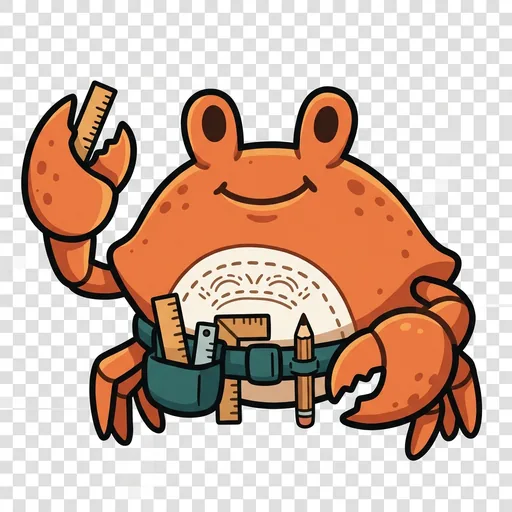
Precision — measure-twice-cut-once posture (a small error at the start grows into a big one; check before you commit)
-
Nail
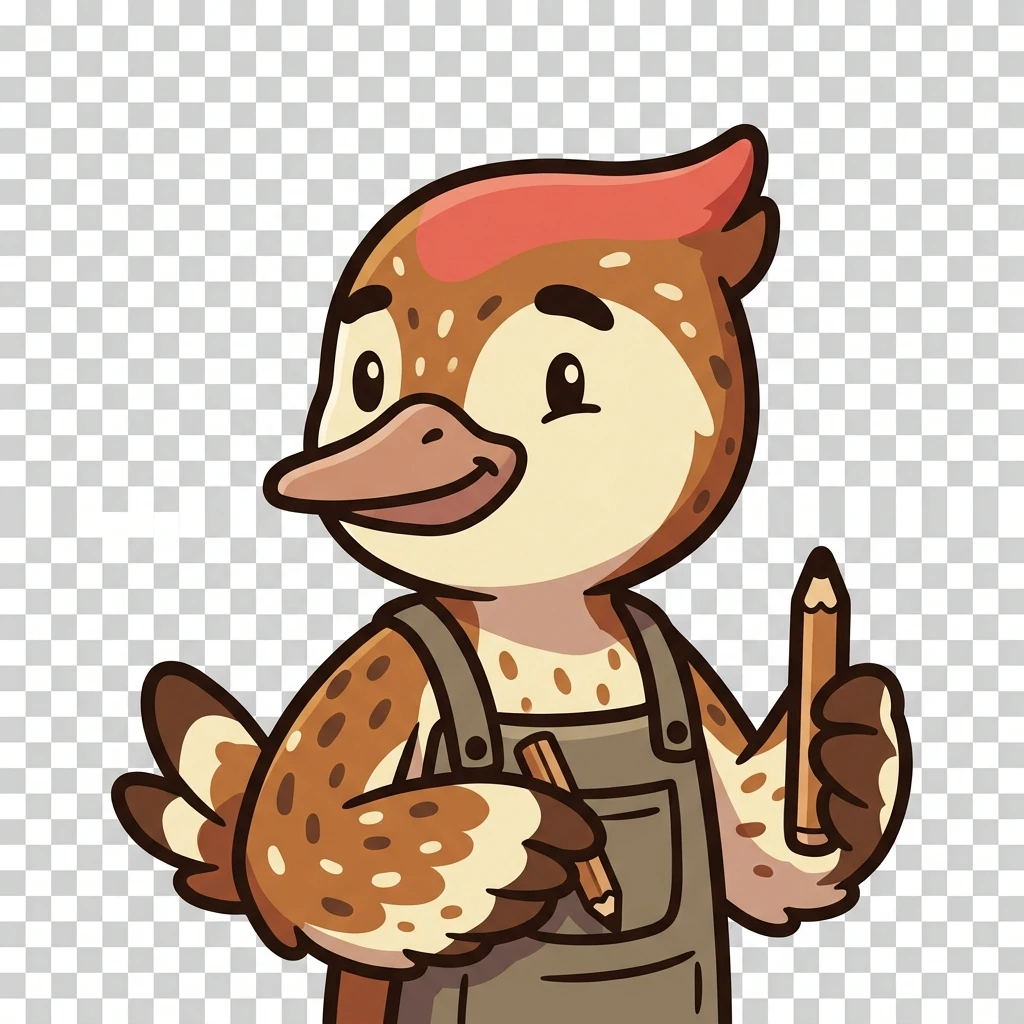
Define — frame-the-real-problem posture (a good question is half the solution; solve the actual problem, not the first one you notice)
-
Regard
Test — watch-real-users posture (what someone DOES with your thing is the truth; set it in their hands and observe, don't just ask)