Naught and Dozen
ZERO AND PLACE VALUE — a bundling number system only works if there is a zero to hold the empty places; without a mark for nothing, you cannot tell 15 from 105, and the whole clever base falls apart.
Loading audio…
Press play to listen along. The line being read lights up as you go.
Show full transcript
Loading transcript…
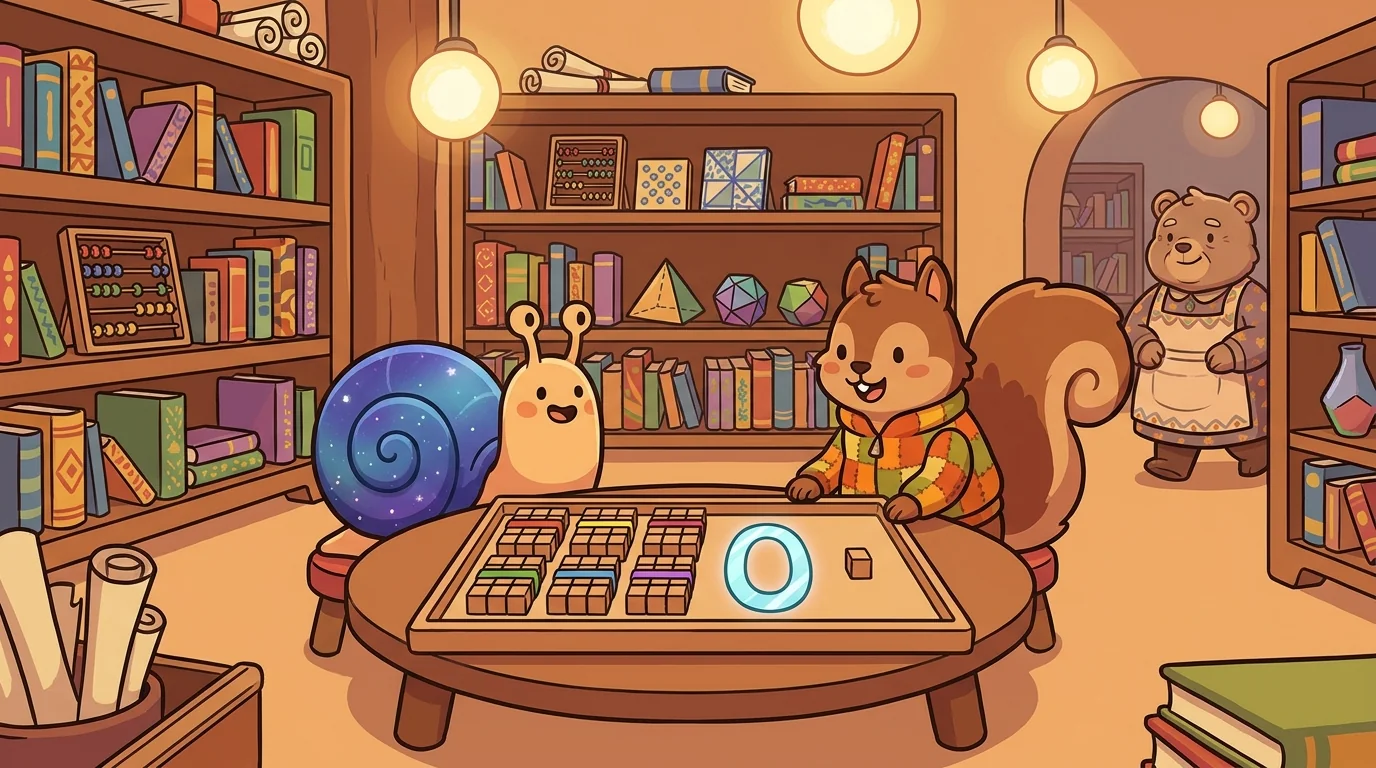
For a long time, Naught the snail and Dozen the squirrel had worked in different corners of the MathLore hall, and had not thought of themselves as a pair at all — one told the story of nothing, the other the story of bundles. But the hall-keeper had noticed something they hadn't, and one afternoon she set them at the same low table together.
Dozen told the story of bundling — how counting big means grouping into bundles, and how different peoples chose different bundle sizes: ten, twenty, sixty.
Naught told the story of nothing — how bold people in India, and among the Maya, gave the empty place a name: zero.
The children had heard both stories and thought them separate. So the hall-keeper handed the pair one number to build together, and asked them to show why the two stories were really one.
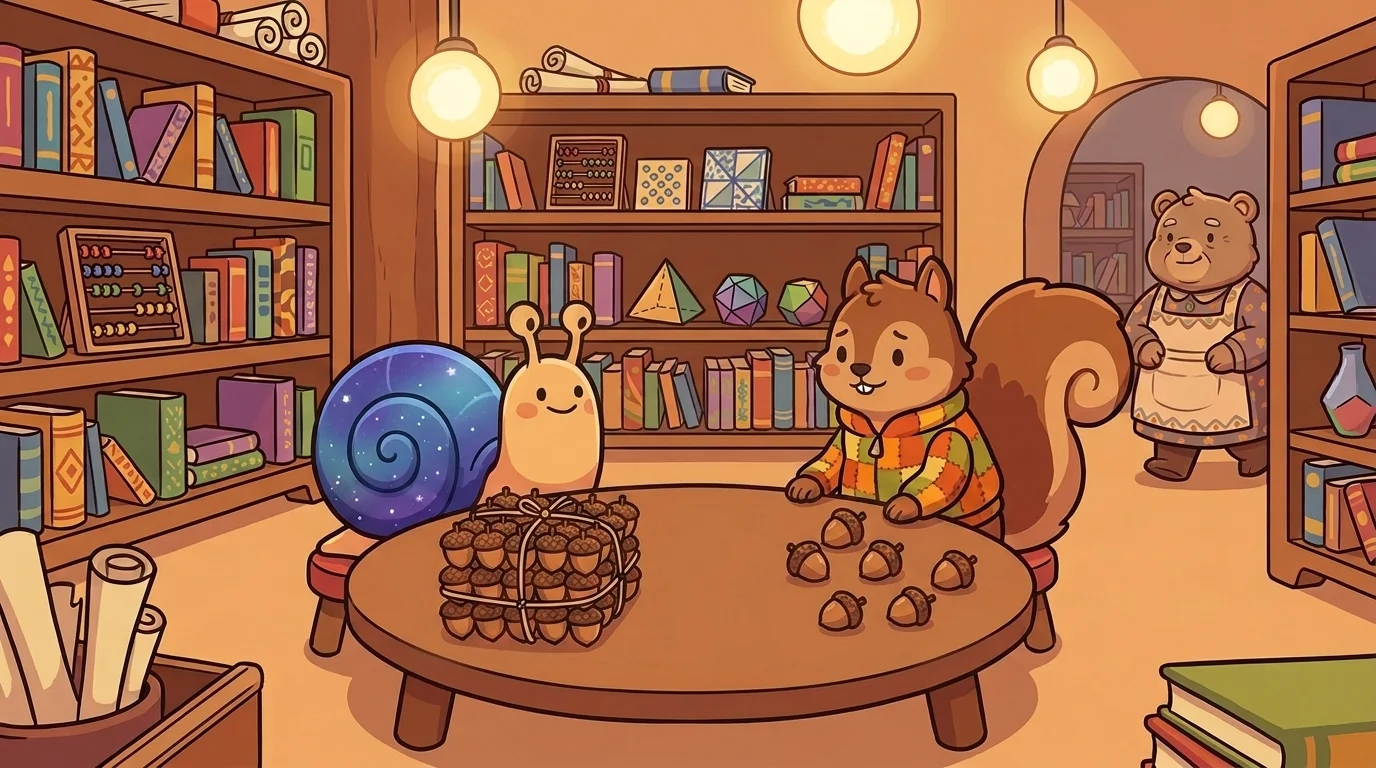
Dozen went first, gathering acorns into bundles.
"Watch me build a number," she said. "We bundle by ten. So — one big bundle of a hundred. No bundles of ten. And five loose ones." She laid them out: a hundred here, a gap in the middle, five ones there. "In my head that's clear. A hundred, no tens, five. One hundred and five." She wrote the digits, leaving the tens place empty: 1 5.
The children read it. "Fifteen," they said.
Dozen blinked. "No — a hundred and five." But on the paper, with the empty tens place just left blank, it truly did read 15. Her whole clever bundle system had, for a moment, fallen apart. "Oh," she said quietly. "The gap. I left the gap empty, and now no one can tell my hundred from a ten."
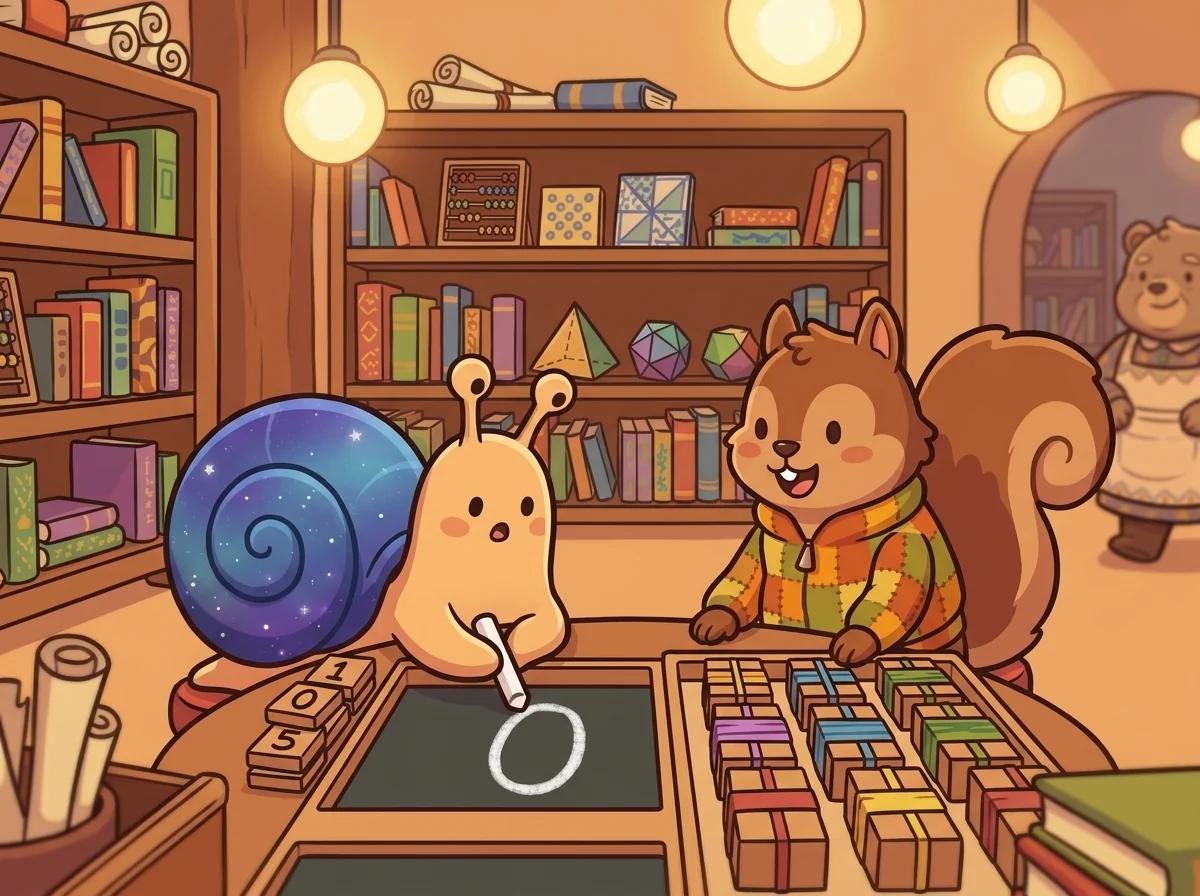
Naught, who had been overlooked in his corner as usual, slid slowly forward.
"That gap," he said gently, "is where I live." He took his chalk and set a single 0 into the empty tens place: 1 0 5. "There. The zero doesn't count anything. It just says, plainly, this place is empty — but it is still a place. Now the 1 knows it's a hundred, because the zero is holding the tens open beneath it. One-oh-five. A hundred and five."
The children read it right this time. And there was a small, delighted hush, because they had just watched a number fall down and be stood back up by nothing.
"So your bundles need my nothing," said Naught, a little wondering. "A base only works if there's a zero to hold the empty places."
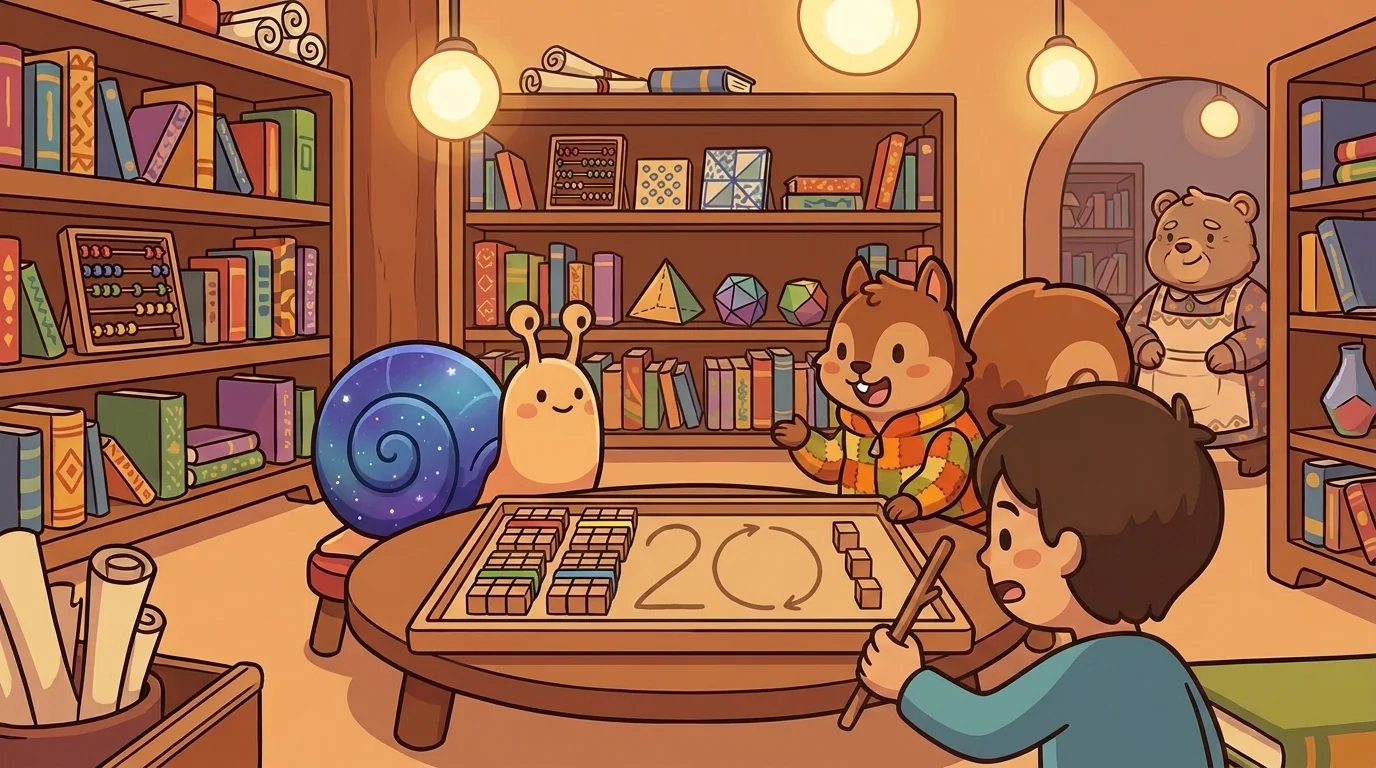
The hall-keeper smiled and slid the chalk to a boy. "Your turn. Build me two hundred and three — two hundreds, no tens, three ones. Bundle it like Dozen, and place the zero like Naught."
The boy did it slowly. "Two hundreds..." he wrote a 2. "No tens — so..." he paused, remembering, and set a 0 in the tens place. "...zero to hold the empty tens. And three ones." He wrote a 3. 2 0 3. He read it back: "Two hundred and three. And if I'd left the tens blank —" he tried it — "23. Wrong. The zero is the only thing keeping it a two hundred." His eyes went wide. "The big clever bundling only works because of the little zero."
"There it is," said Dozen, warm with surprise.
"That's the whole of it," said Naught. "Dozen's bundles are the grand idea — group, and group the groups. But a grand idea full of empty places needs nothing, named, to hold those places open. That's why the peoples who made great number systems — in India, among the Maya — needed a zero to make them work. Without me, the bundles collapse. Without the bundles, I've nothing to hold. We only work together."
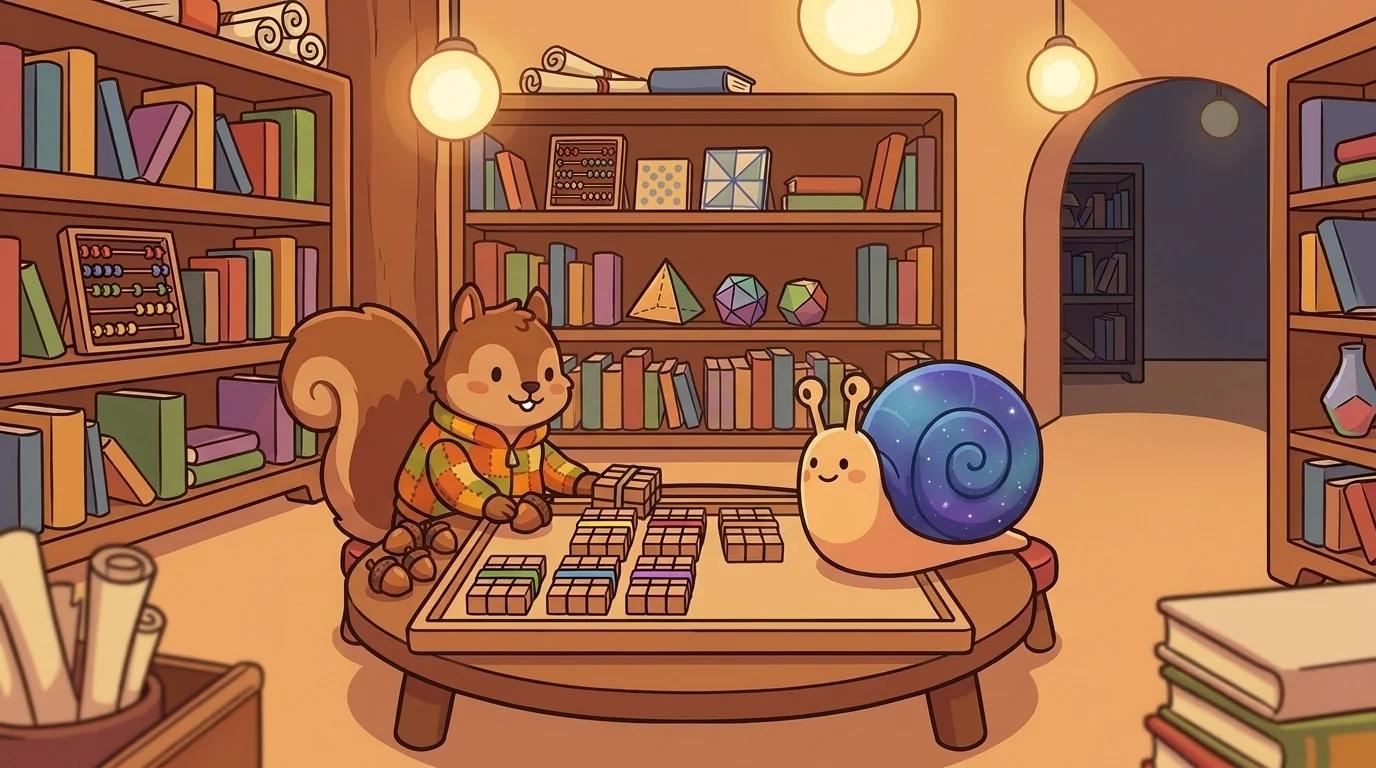
After that, Naught and Dozen taught the last kits of the term side by side, and the children stopped thinking of zero and place-value as two separate stories. They came to see them as one: the grand idea of bundling, and the humble, essential mark that holds its empty places open — each useless without the other.
The lesson the two of them hope the children carry is not only about numbers. It is that the biggest, cleverest ideas so often depend on a small, quiet, easily-overlooked thing to hold them together — and that the overlooked thing is not less important for being small. Sometimes nothing, given a name, is exactly what everything else was waiting for.
When the hall empties, Dozen tidies her acorns into bundles of ten and Naught settles into the little gap between them, holding the place open, and the two of them — the grand bundler and the humble nothing — feel the matched, glad surprise of a pair who thought their stories were separate, and found out they were two halves of how the whole world learned to count.
The MathLore ensemble
Naught and Dozen is part of MathLore's distributed-narrative cast. Each character embodies a different curricular primitive; together they teach the full subject.
-

Heap
Counting-as-first-story — every people figured out their own way to count
-

Spire
Pattern-as-discovery — patterns are everywhere when you slow down enough to see them
-

Vouch
Proof-as-shared-knowledge — show me why; if your why holds up, I'll build on it
-

Home
Math-as-cultural-context — this idea was born somewhere, for someone, with reasons
-

Carry
Cultural-transmission — the idea traveled; every place it visited, it grew
-
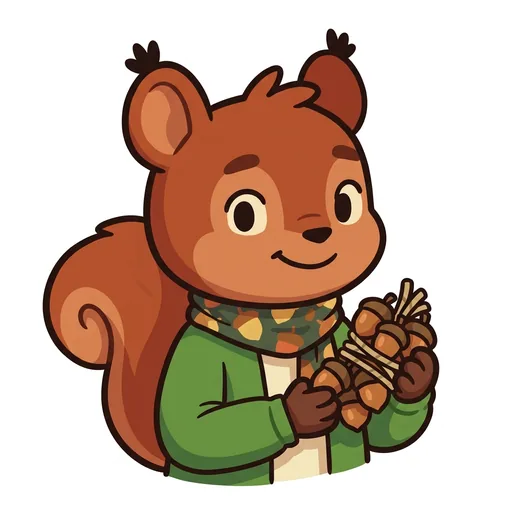
Dozen
Number bases (counting in twelves, tens, or twos — the base is a choice)
-
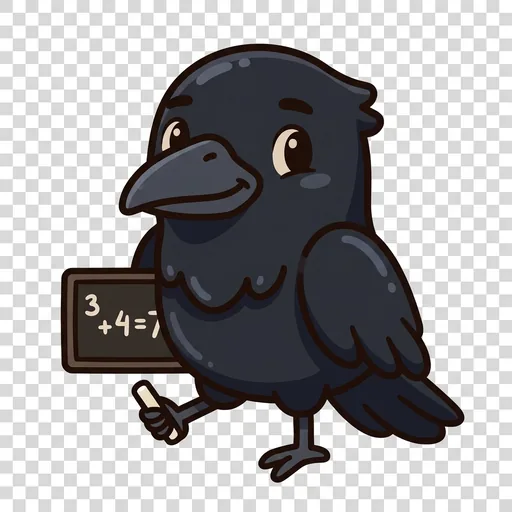
Etch
The invention of notation (writing math down so ideas can travel across time)
-

Frontier
Mathematics is unfinished (there are still open questions no one has answered)
-

Naught
The invention of zero (a symbol for nothing that changed everything)
-

Warp
Math in everyday craft (the geometry hidden in weaving, building, and making)