
Naught and Dozen
ZERO AND PLACE VALUE — a bundling base and a true zero are two halves of one invention: the base builds the columns, and zero holds the empty ones. Without zero you can't tell 15 from 105; without a base there are no columns for zero to hold. Neither works alone.
Loading audio…
Press play to listen along. The line being read lights up as you go.
Show full transcript
Loading transcript…
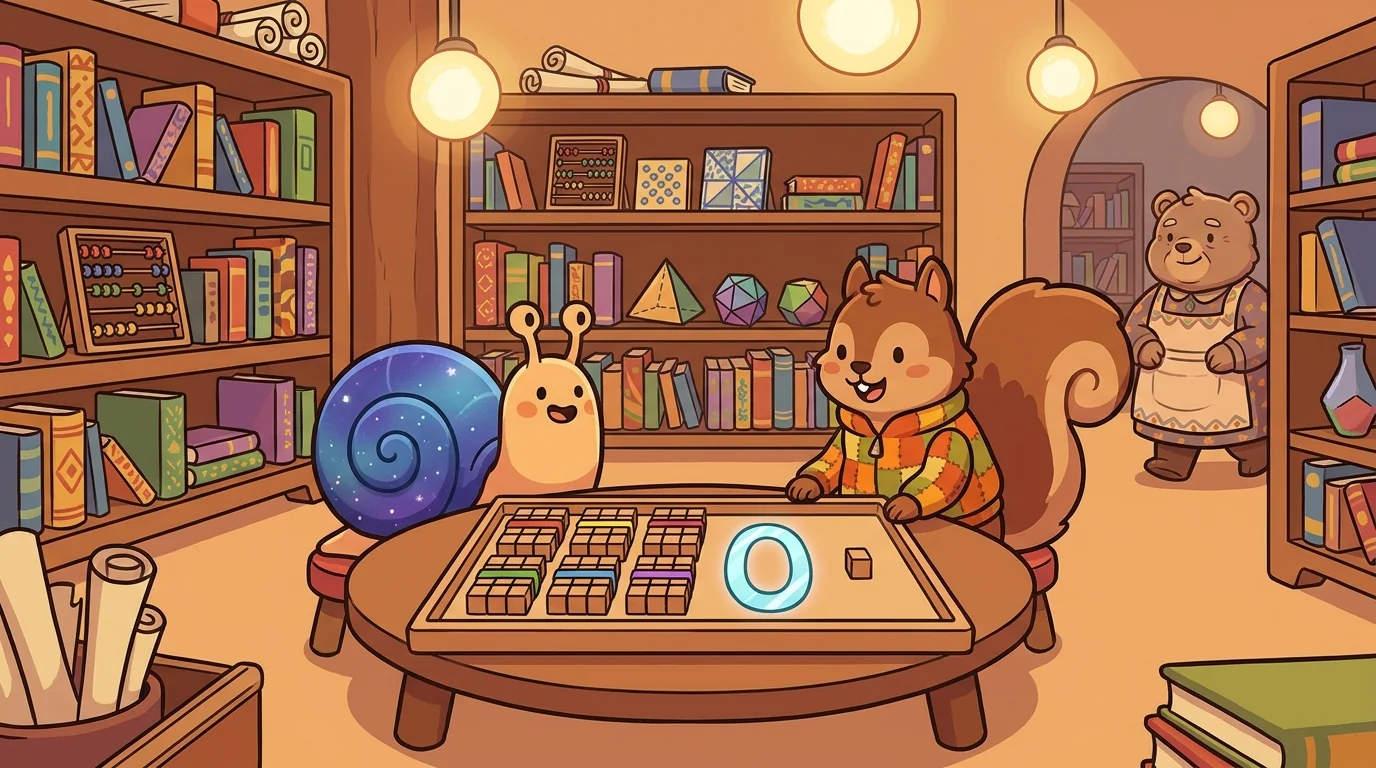
For a long time Naught the snail and Dozen the squirrel worked in different corners of the MathLore hall and did not think of themselves as a pair at all. Dozen told the story of bundles — how counting big means grouping into tens, or twenties, or sixties, and how each column to the left is worth the base times the one before. Naught told the story of nothing — how bold scholars in India, and independently the Maya, gave the empty place a name and a number: zero. The children heard both stories as separate. The hall-keeper knew better, and one afternoon she set the two at the same low table with a single instruction: build one number together, and show why your two stories were always one.
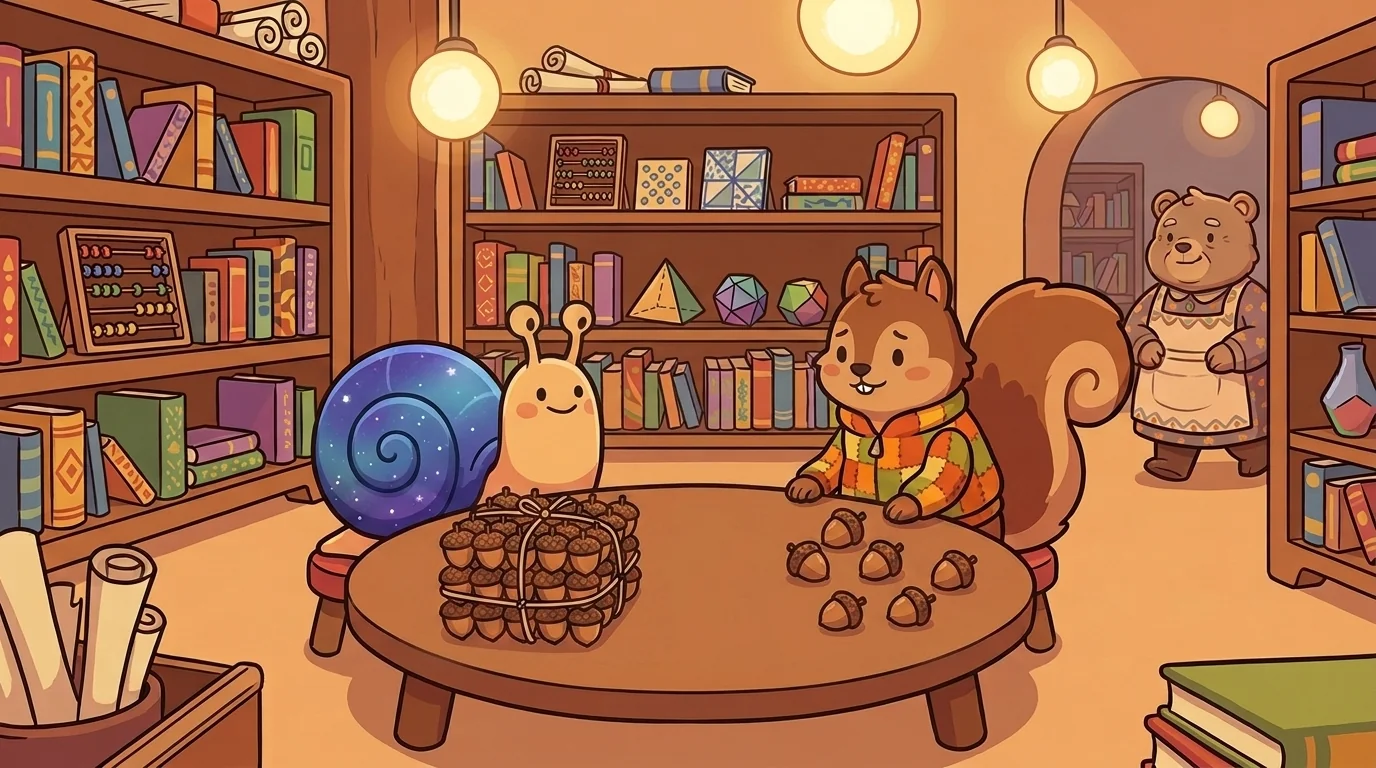
"Give me a number that needs us both," said Dozen, rubbing her paws. A young dormouse offered: one hundred and five. "Perfect — watch me try it with only my half." Dozen laid out her place-value columns: a hundreds column, a tens column, a ones column, each worth ten times the one to its right. "One hundred," she said, setting a mark in the hundreds column. "And five," setting a mark in the ones. She sat back — and the dormouse frowned, because the tens column sat empty, and with nothing to mark it, the two remaining marks slid together on the page: 15.
"There it is," said Naught quietly, from the empty column. "Your base built three beautiful seats — hundreds, tens, ones. But the middle seat is empty, and if nothing marks it, the hundreds mark and the ones mark shuffle up against each other, and your one hundred and five collapses into fifteen. Your columns are perfect. They just can't hold their places without me."

"So try it with only my half," said Naught, and set his small round zero down all by itself, with no columns at all. It sat on the bare table meaning... nothing in particular. "A zero alone is just a lonely mark," he admitted. "'Nothing' — but nothing where? Without Dozen's columns there are no places for me to hold empty. I'm a key with no lock. It's only when her base builds the seats that my zero has a job: to sit in the empty seat and say this place is vacant, but it still counts as a place." He slid his zero into Dozen's waiting tens column. At once the number steadied: 105, unmistakable, one hundred and five, the hundreds and ones now firmly apart.
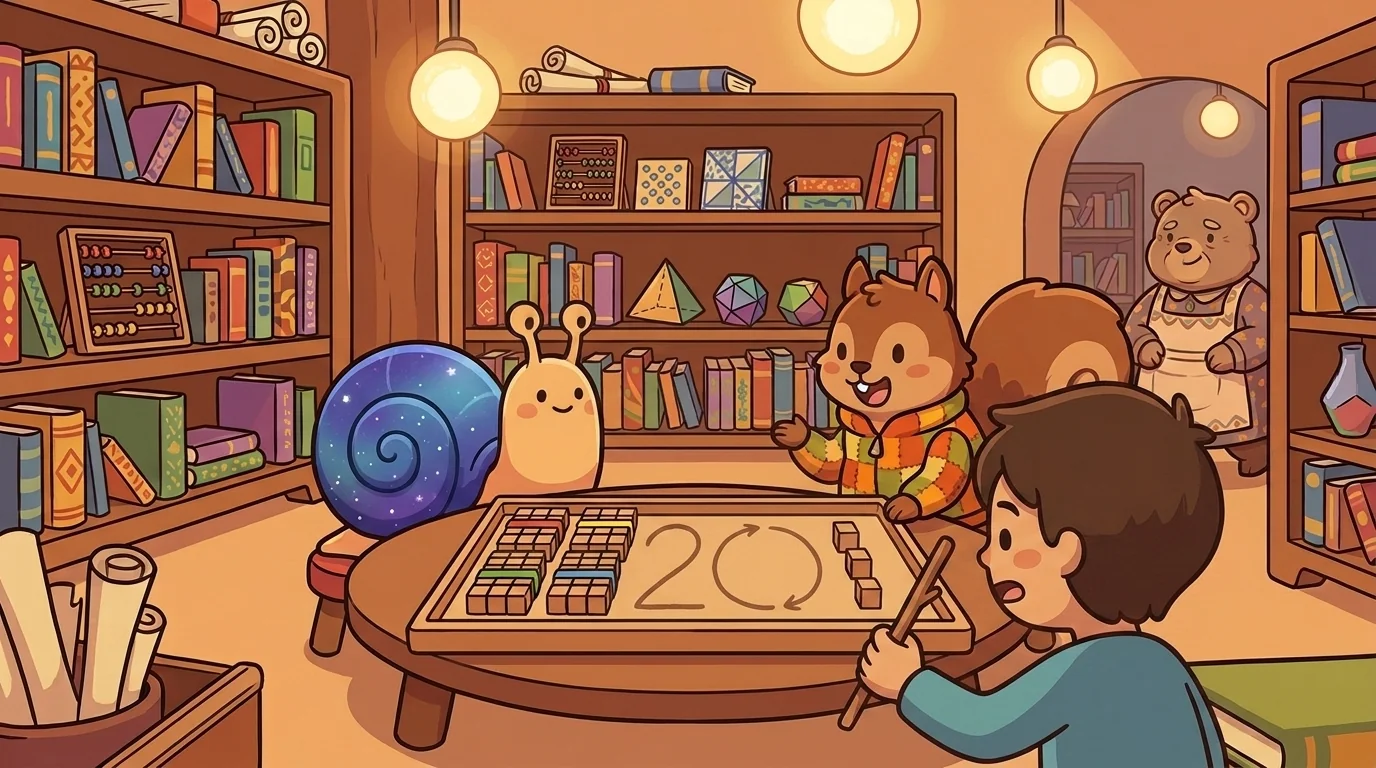
The dormouse looked from one to the other. "So neither of you is the real inventor. You're... two halves."
"Two halves of one idea," said Dozen, "and that's the part history took the longest to assemble. Lots of peoples had bundles — bases of ten, twenty, sixty. Some even had a gap or a dot to hint at an empty place. But the full pairing — a positional base and a true zero that both holds the empty column and behaves as a number you can compute with — that complete machine was rare and hard-won. India brought zero all the way to a full number with its own rules; the Maya reached a true zero on their own, an ocean away, for a base-twenty calendar. Each was joining Naught's half to Dozen's half."
"And once the two halves lock together," Naught went on, "something enormous happens. You can write any number — a hundred and five, a thousand and eight, a million — with just a handful of digits and a zero to mind the gaps. No new symbol for each bigger number, the way some older systems needed. Just columns, digits, and a nothing that keeps the columns honest. The base gives you infinite reach; the zero keeps that reach from collapsing. Together we're not two tricks. We're the engine under every big number you will ever write."
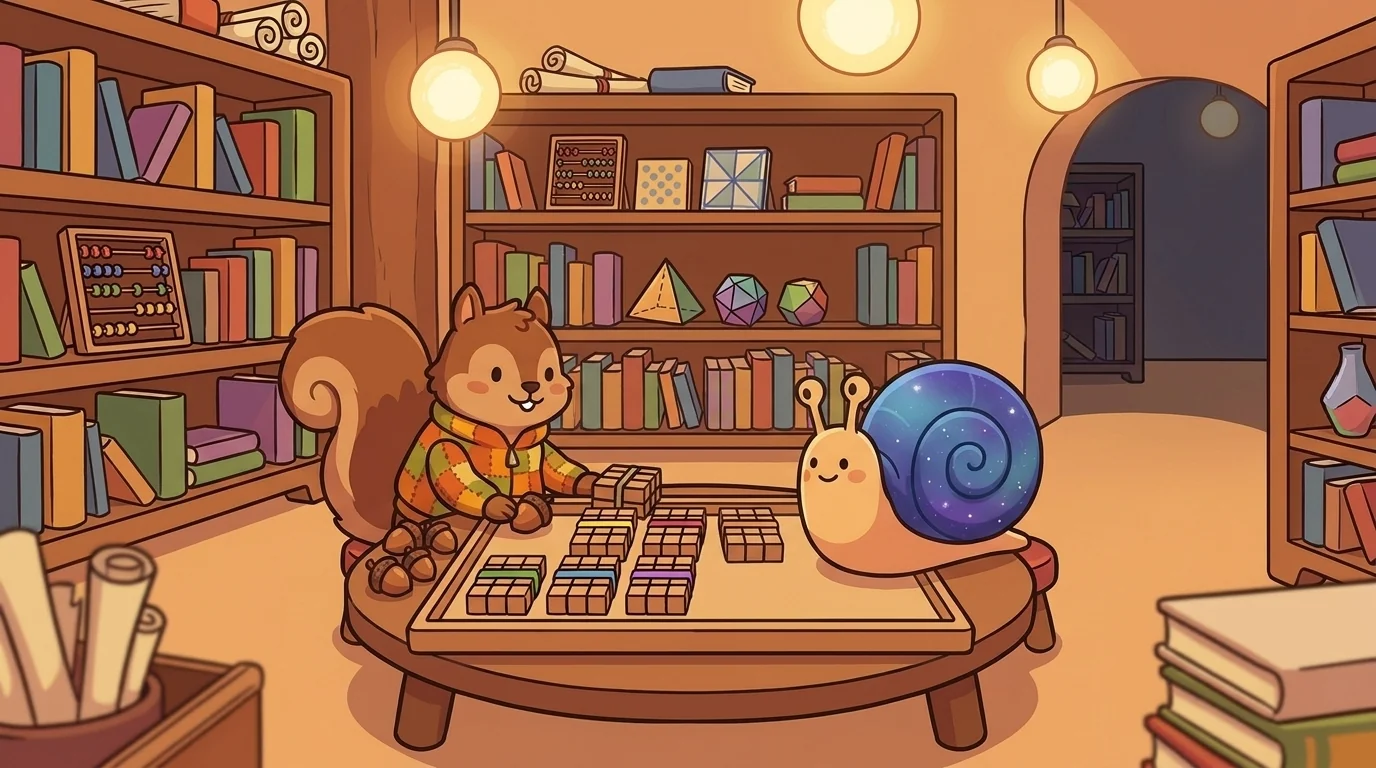
The dormouse built the next number himself — a thousand and six — laying Dozen's four columns and dropping Naught's zeroes into the two empty middle seats, and it held: 1006, clean and unambiguous. Dozen beamed at her columns; Naught glowed quietly in his empty seats. "We spent years thinking we taught separate lessons," Dozen said. "Bundles here, nothing there." "When really," said Naught, "you can't have a working place-value system with a base and no zero, or a zero and no base. Take either of us away and the whole thing falls apart." A shared, settled gladness rose between them — the plain wonder that two small quiet inventions, a bundle and a nothing, together hold up every large number in the world. "How big is your bundle," murmured Dozen. "And what holds the empty place," murmured Naught. "Ask both," they said together, "or the number won't stand."
The MathLore ensemble
Naught and Dozen is part of MathLore's distributed-narrative cast. Each character embodies a different curricular primitive; together they teach the full subject.
-

Heap
Counting-as-first-story — every people figured out their own way to count
-

Spire
Pattern-as-discovery — patterns are everywhere when you slow down enough to see them
-

Vouch
Proof-as-shared-knowledge — show me why; if your why holds up, I'll build on it
-

Home
Math-as-cultural-context — this idea was born somewhere, for someone, with reasons
-

Carry
Cultural-transmission — the idea traveled; every place it visited, it grew
-

Dozen
Number bases (counting in twelves, tens, or twos — the base is a choice)
-
Etch
The invention of notation (writing math down so ideas can travel across time)
-

Frontier
Mathematics is unfinished (there are still open questions no one has answered)
-

Naught
The invention of zero (a symbol for nothing that changed everything)
-

Warp
Math in everyday craft (the geometry hidden in weaving, building, and making)