Nest and Due
NEST & DUE — *money and time make the same math run two ways. save now (Nest) and time adds a little to your side — you end with more than you set aside. borrow now (Due) and time adds a little to what you owe — you end paying more than you took. same math; you choose which side of it to stand on.*
Loading audio…
Press play to listen along. The line being read lights up as you go.
Show full transcript
Loading transcript…
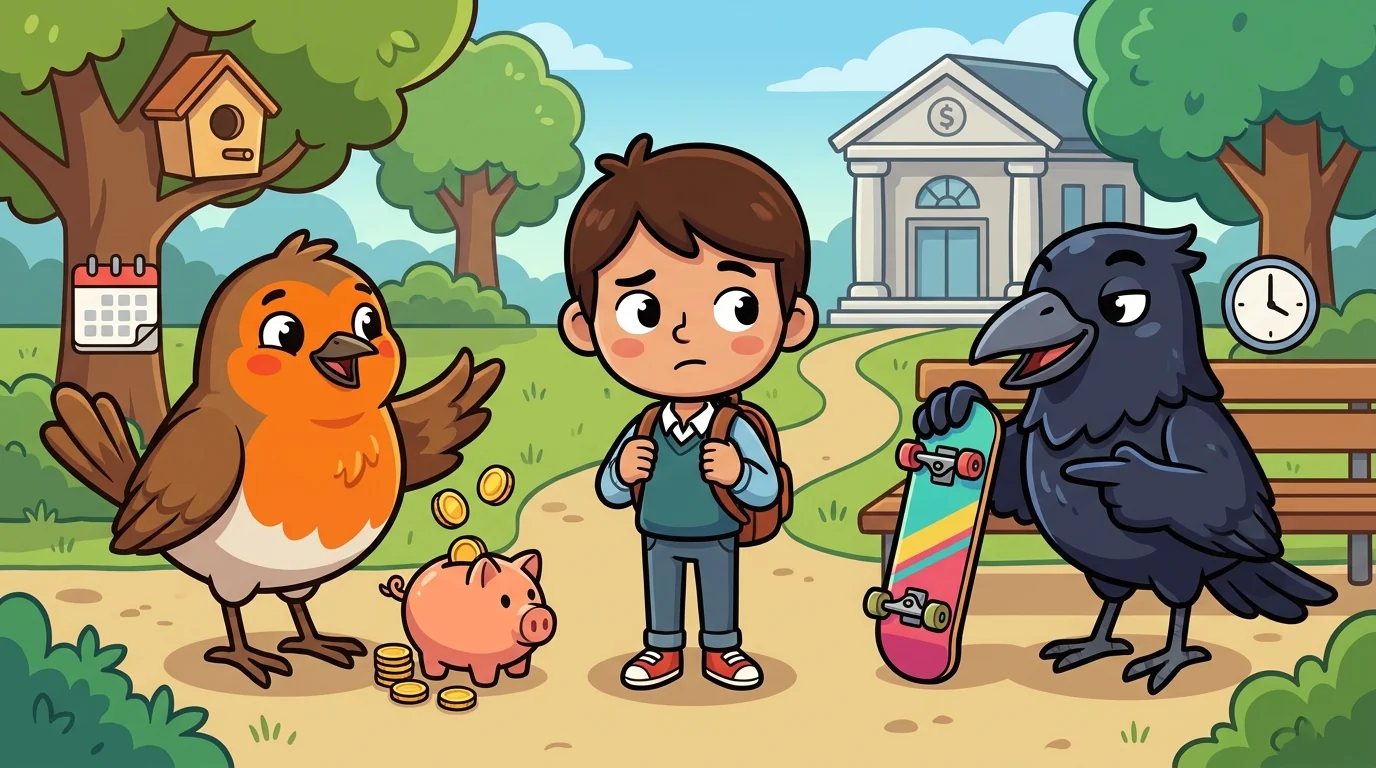
A student wanted a skateboard she couldn't afford this week, and two very different birds had two very different ideas.
"You could save for it," said Nest the robin, bright-eyed. "Set aside a little each week. Wait a bit. And when you've got enough — it's yours, free and clear."
"Or you could borrow for it," said Due the crow, low and careful. "Get it today. Pay your friend back over the next few weeks — a little extra for the wait."
The student's head swung between them. "But those are opposite! One says wait, one says now. Which one's right?"
Nest and Due looked at each other — the round bright robin and the glossy careful crow — and, oddly, both smiled.
"They're not as opposite as they look," Nest said. "We're the same math, run two ways."
"Save now, or borrow now," said Due. "Both are about money and time. The only real question is: do you want time working for you, or against you?"
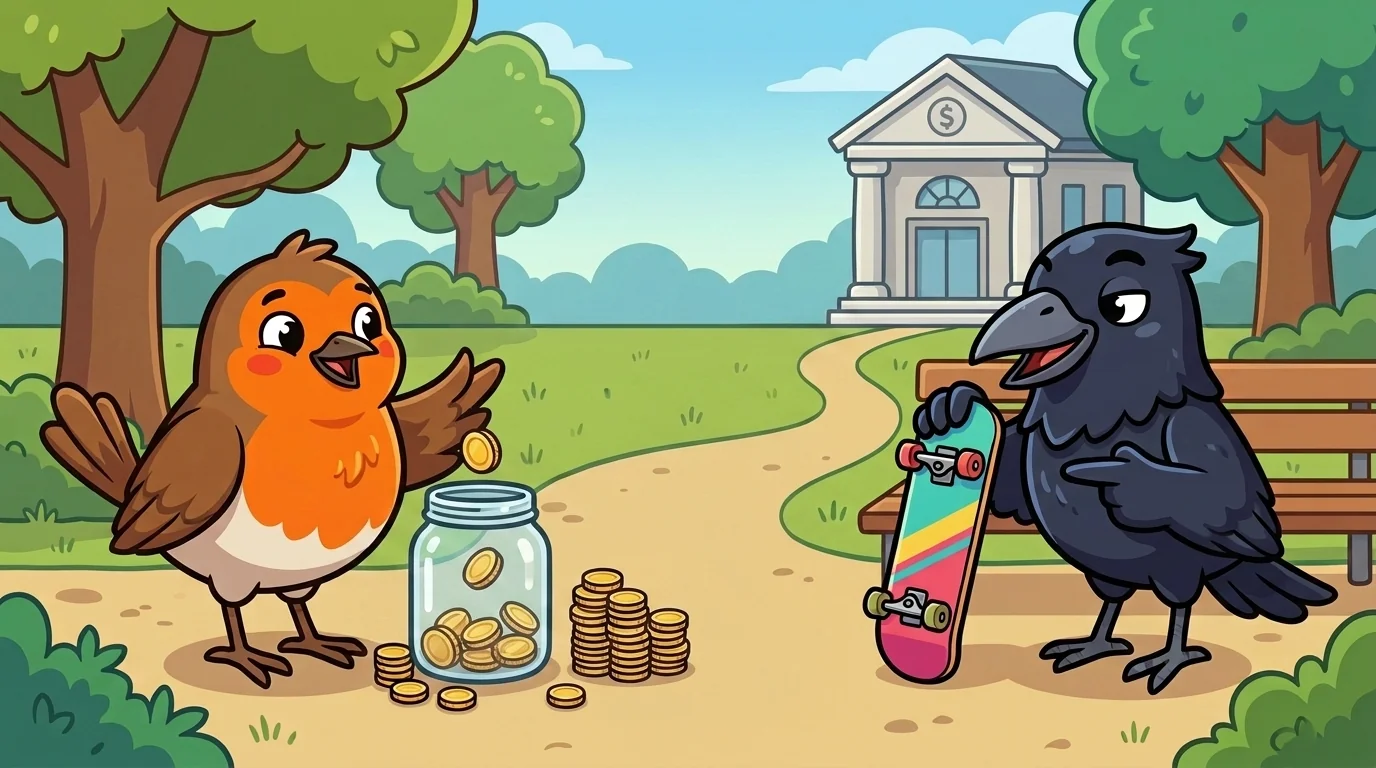
Nest went first, because saving is time on your side.
"Here's my direction," she said, hopping to a jar. "You want the skateboard. You don't have enough yet. So you set aside a little, every week, and you wait." She dropped coins in, one week at a time. "And here's the lovely part — while it sits in the jar, especially if it's somewhere that adds a little interest, time makes it grow. You put in a bit, wait, and end up with a bit more than you put in. Time is your friend. It quietly adds to your side while you're patient." She nudged the full jar. "So you wait a few weeks, and then you buy the skateboard outright — owing nobody, paying no extra, maybe even with a little left over. The board cost you exactly what it cost, or even a touch less, because time was on your side."
The student looked at the full jar. "So if I wait and save... the board might even cost me a little less than its price?"
"Time added to your pile while you waited," Nest said. "That's saving. Patience, quietly rewarded." She tilted her head at Due. "But there's the other direction — where you don't wait. Where you get the board today. And there, the very same time-and-money math runs backward."
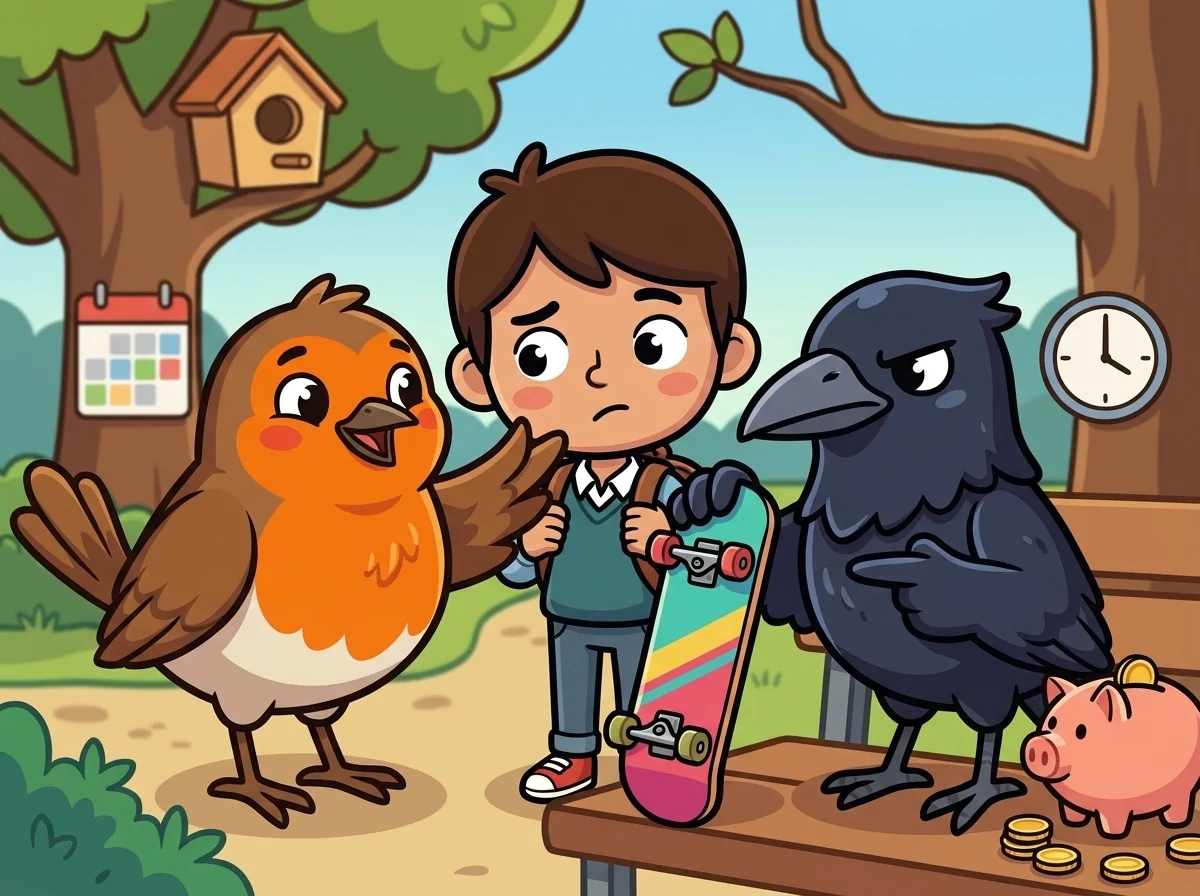
Due took over, low and honest.
"Here's my direction," she said. "You don't want to wait. You want the skateboard today. So you borrow the money — you get the board now, and you promise to pay it back over the next weeks." She tapped a claw. "And here's the part that's the exact mirror of Nest's jar: while you owe, time adds a little to what you owe — the interest, the extra for the wait. You put off paying, and the amount quietly grows against you. Time is working, same as in Nest's jar — but now it's on the other side, adding to your debt instead of your savings."
The student's eyes went wide. "So if I borrow, I end up paying more than the board costs — because time added to what I owe?"
"Exactly the mirror of Nest," Due said. "She waits, and time gives her a little extra. You hurry, and time charges you a little extra. Same math — money plus time — pointed the opposite way. Save, and you end with more than you set aside. Borrow, and you end paying more than you took." She fixed her bright eye on the student. "Neither is evil. Sometimes borrowing's the sensible choice. But you should always know which way you've pointed the math — toward your pocket, or away from it."
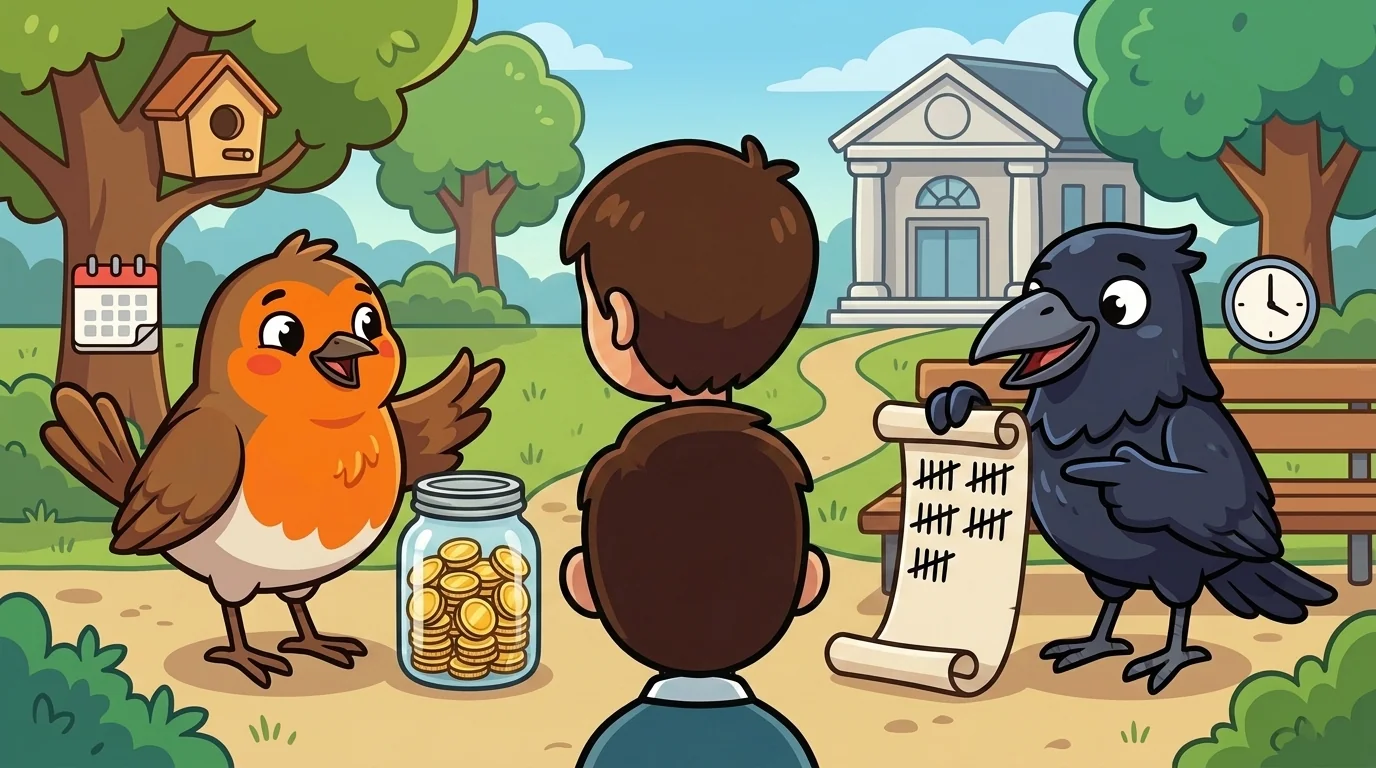
Then Nest and Due showed the two directions side by side, and the student saw the single idea under both.
"Watch us line up," Nest said, setting her full save-jar beside Due's growing debt-tally. "Same skateboard. Same starting point — you can't afford it this week. My way: wait a few weeks, saving, and time adds a little to your side. You pay the price, or a touch less."
"My way," said Due, "get it now, borrowing, and time adds a little to what you owe. You pay the price, plus a bit more."
"And here's the one truth under both of us," they said together. "Money and time make the same math — and that math is always running, on one side or the other. Save, and it runs for you. Borrow, and it runs against you. You can't stop time from adding up. You can only choose which side of it you stand on."
The student looked at the full jar and the growing debt, the two directions of the very same math. "So it's not 'saving is good, borrowing is bad,'" she said slowly. "It's — time is always adding a little. Saving points it toward me. Borrowing points it away. And I get to choose which."
"That's the whole secret of money and time," said Nest and Due together. "The math never sleeps. Patience puts it to work for you; hurry puts it to work against you. Same math, two directions — and the direction is yours to pick." Due added, gentle, "So when you want a thing you can't yet afford, ask: is it worth pointing time against me to have it a little sooner? Sometimes yes. Often — wait, save, and let time build your side instead."
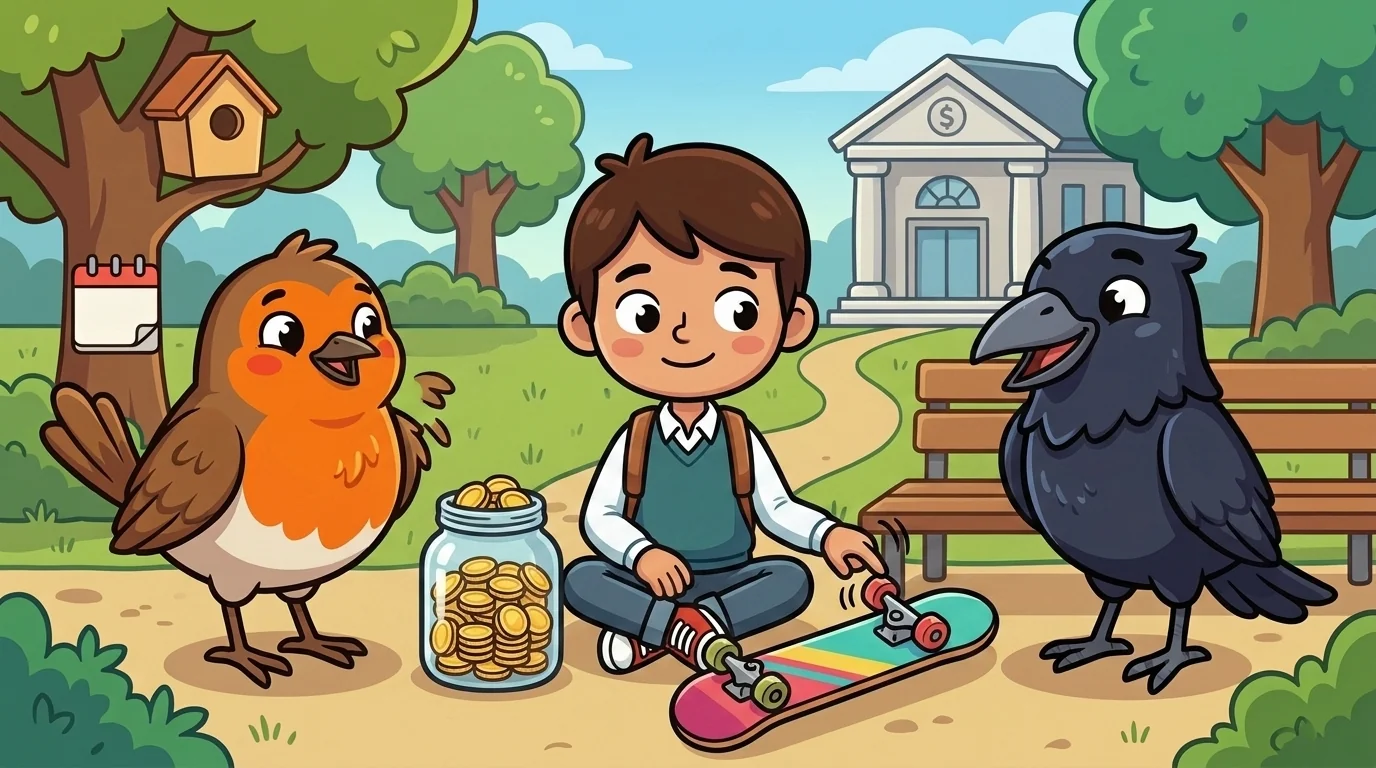
Later, the student sat between the robin and the crow with her full save-jar, the skateboard bought outright, time having quietly worked in her favor.
"I almost borrowed," she admitted. "I wanted it now so badly. Waiting felt like losing."
Nest ruffled her feathers. Due tucked her wings. Neither rushed.
"Wanting-it-now is the strongest pull there is," Nest said. "And giving in isn't shameful — borrowing has its right times. But this once, you felt the two directions, and you chose to let time build your side instead of billing it."
"Alone," Due added, "Nest might have you think saving is the only good and borrowing is always a trap — and it isn't. I might have you think borrowing's just a handy trick — and it isn't, not when time's quietly growing what you owe. Together we show you the real shape: it's one math, running two ways, and wisdom is knowing which way you've pointed it, and why."
The student spun a wheel on her paid-for skateboard, owing no one.
"So money and time are always doing math on me," she said. "And I decide whether they're doing it for me or to me."
"Every choice between saving and borrowing anyone ever made," said Nest and Due together, softly. And the three of them sat with the full jar and the paid-for board, and something in the student went quiet and settled and glad — the calm of understanding, for the first time, that patience wasn't just a virtue grown-ups nagged about; it was a quiet way of putting time itself on her side.
The MintForge ensemble
Nest and Due is part of MintForge's distributed-narrative cast. Each character embodies a different curricular primitive; together they teach the full subject.
-

Coin
Currency + exchange — what money is, what it does, what it can't measure
-

Tag
Percentage + markup — the transparent math of how prices are built
-

Grow
Compound interest — patient math of money over time
-

Plan
Budget allocation + opportunity cost — the math of choosing with limited resources
-

Tilt
Risk + variability — the math of uncertain outcomes, distributions over destinies
-
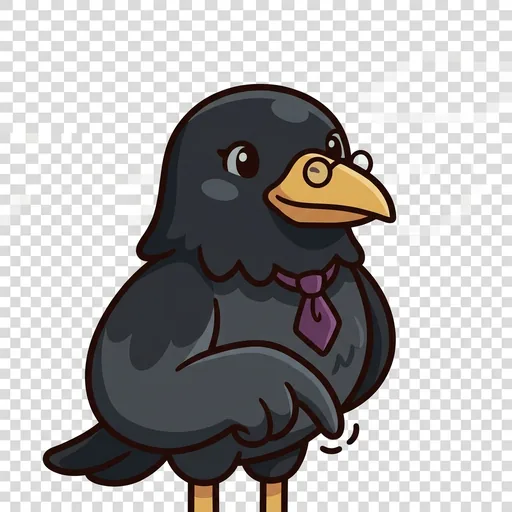
Due
Borrowing and debt — money owed carries a cost; what does it really cost to borrow?
-

Earn
Income — money comes from the value of work; earning before spending
-

Give
Generosity — giving is part of a budget; deciding what to share
-

Nest
Saving — setting money aside toward a goal, a little at a time
-

Wary
Money safety — spotting scams and keeping your money safe