
Aqua
aqua/hydro = WATER — two synonymous combining forms (Latin 'aqua', Greek 'hydro') carry the same meaning through different spellings; two morphemes can be synonyms, and one meaning can wear more than one form
Loading audio…
Press play to listen along. The line being read lights up as you go.
Show full transcript
Loading transcript…
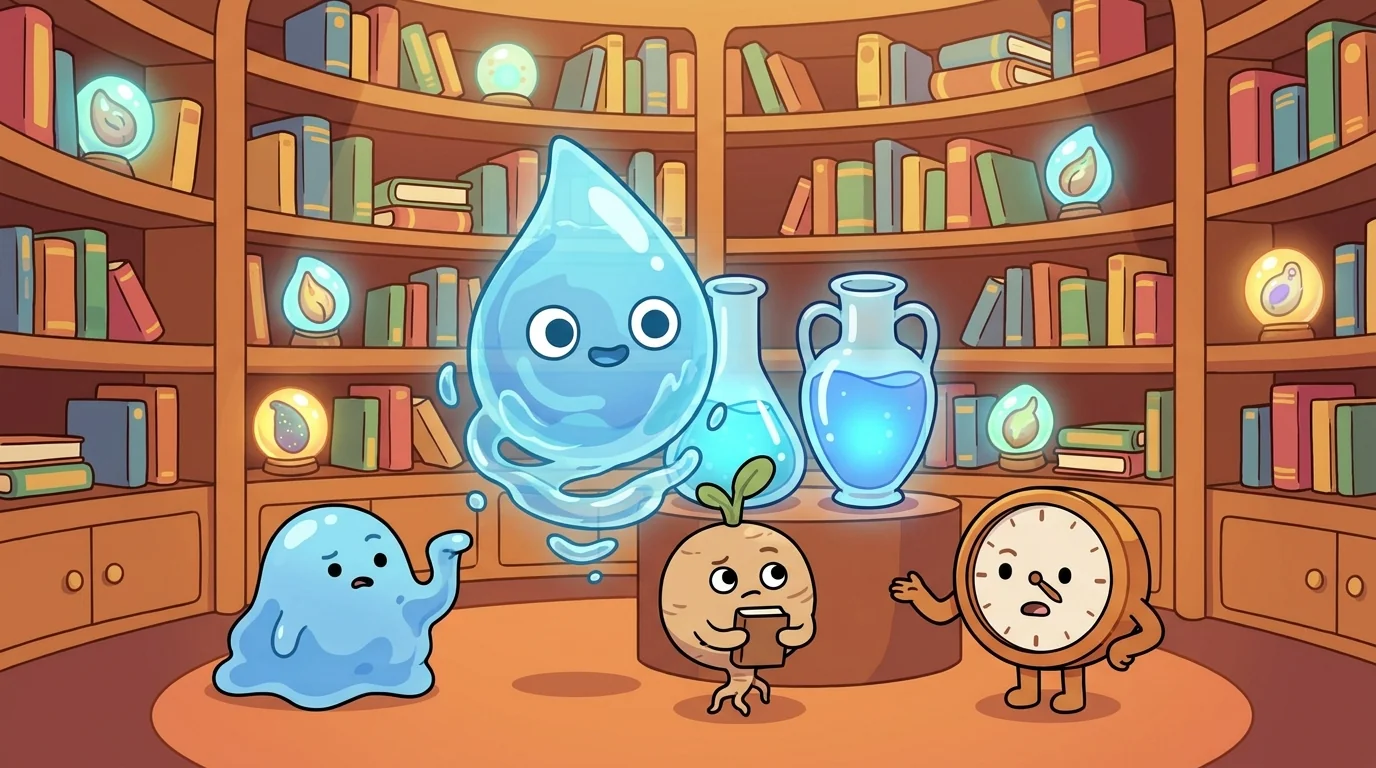
Aqua, the cool rippling creature, had always carried one meaning under two names — aqua from Latin, hydro from Greek, both meaning water. Now it wanted to teach the young creatures the deeper pattern hiding inside that fact: a meaning can wear more than one form, and two different morphemes can be synonyms.
"You already know my two coats," Aqua said. "As aqua I make aquarium (a water-tank), aquatic (living in water), aqueduct (a water-carrier). As hydro I make hydrant (a water-tap), hydrate (to add water), dehydrate (to take water out). Six words, one meaning." It rippled. "But here's the Advanced part: I'm proof that English doubled up. It borrowed a water-word from Latin and a water-word from Greek, and kept them both. So when you're hunting for 'water' in a word, you have to know two shapes, not one."
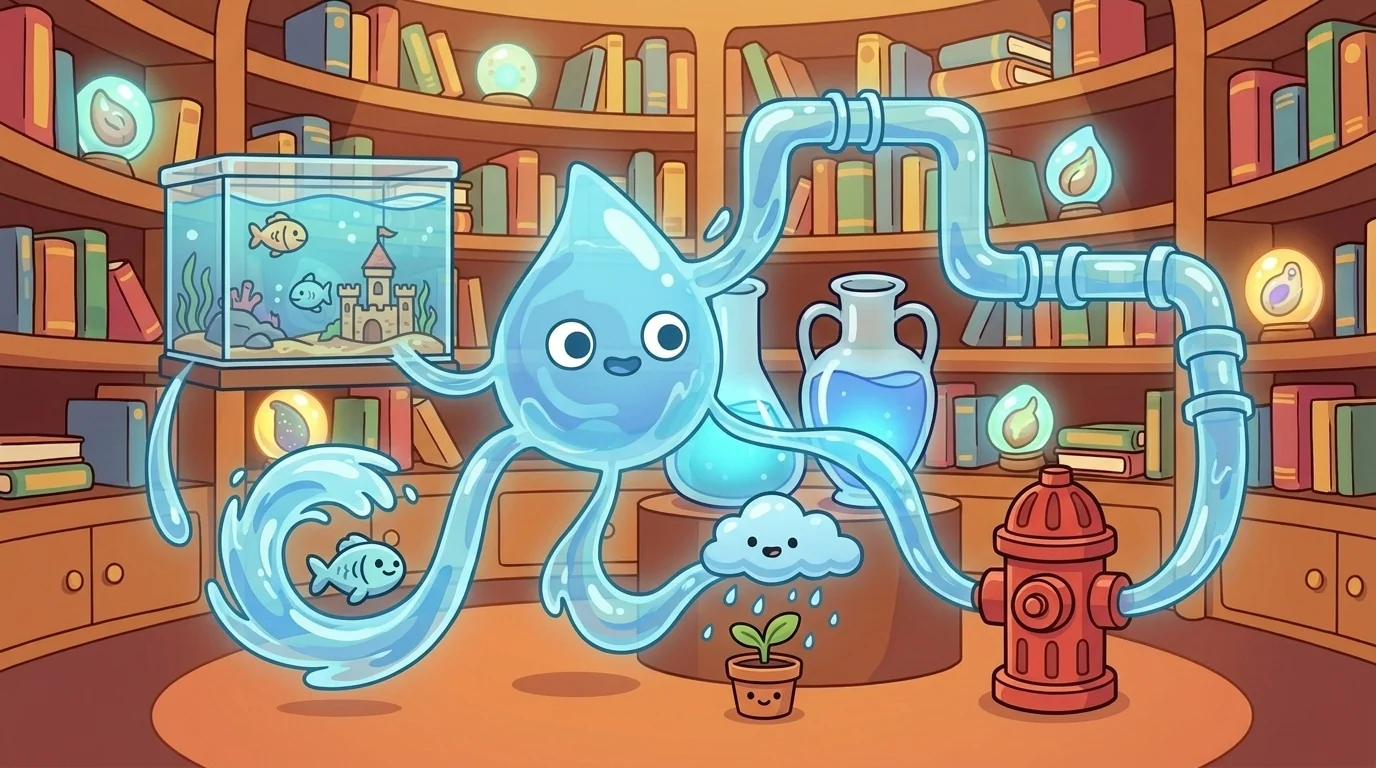
The young creatures wanted to know why English would keep two words for the same thing. Wasn't that wasteful?
"It's not waste — it's specialisation," Aqua said. "When a language has two words for one idea, it usually gives them different jobs. My Latin name, aqua, took the everyday and the artistic — aquarium, aquamarine, aqualung. My Greek name, hydro, took the technical and the scientific — hydrogen, hydroelectric, hydraulic, hydrology. Same meaning, different neighbourhoods. If you see hydro, you can bet you're in a science-y or engineering-y word. If you see aqua, you're more likely in an everyday or watery-pretty word. The doublet isn't clutter — it's two tools for two jobs."
The creatures tested it. Hydroelectric — technical, Greek. Aquamarine — a pretty sea-colour, Latin. The pattern held more often than not.

Then Aqua taught the trap, because Advanced readers deserve to know where the water isn't.
"Not every aqua is me, and not every hydro is water," Aqua warned. "Well — hydro almost always is. But be careful with look-alikes. Aquiline means like an eagle — it comes from the Latin for eagle, aquila, not from water at all. It just starts the same way. And a word like hydra — the many-headed monster — does trace back to water (it was a water-serpent), but you'd never guess its meaning from 'water' alone." Aqua rippled thoughtfully. "So do what Radix taught: check the meaning, not just the first few letters. If the word is genuinely about water, and it wears aqua or hydro, that's me. Aquiline looks like me and isn't. A morpheme is a meaning, not a spelling that happens to rhyme."

Aqua added a note about how its two names combine with the rest of the cast.
"Pair me with Tele and you get nothing useful — but pair hydro with a root about power and you get hydroelectric. Pair aqua with Bio's world and scientists talk about aquatic biology. And here's the elegant one: dehydrate. Take my Greek name hydro, add the front-part de- (meaning remove), add an ending — to remove water. A plant dehydrates. A snack is dehydrated. Even you, on a hot day, can get dehydrated. One little de- flips 'add water' into 'take water away.' The front-part decides the direction; I just supply the water."
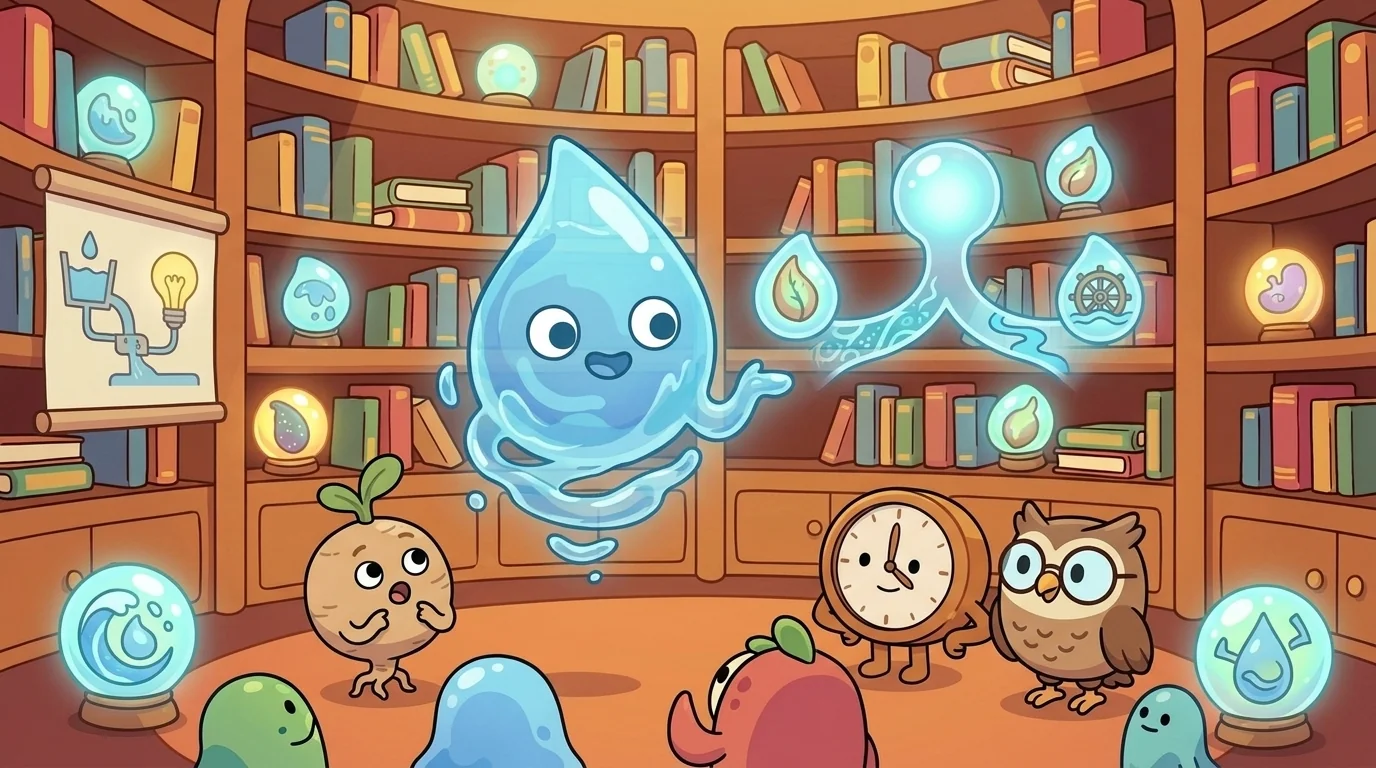
The test came with the word hydroponics, which a young creature met on a sign at a garden and couldn't parse.
"My Greek name's at the front — hydro — so it's about water," Aqua said. "And the rest, ponics, comes from a Greek word about labour or working." The creature thought about the garden, where plants grew in water instead of soil. "So — working with water? Growing things in water instead of dirt?" Exactly right — a garden-sign word cracked by knowing hydro = water.
"You read a gardening word by knowing my Greek face," Aqua said, rippling with pride. "'aqua' AND 'hydro' both mean water — two different-looking parts, one meaning. Learn both of my names, and you double the water-words you can crack. The same idea can wear two coats; a good reader knows them both."
The MorphQuest ensemble
Aqua is part of MorphQuest's distributed-narrative cast. Each character embodies a different curricular primitive; together they teach the full subject.
-

Radix
Root (radix) — every long word is built around a small root that carries its core meaning; find the root and the word tells you what it means
-

Morph
Shape / change (morph) — the shapeshifter; a morpheme changes a word's form and the job it does
-

Chrono
Time (chrono) — the time-morpheme; fuse it in and a word becomes about time
-

Phage
Eat (-phage) — the devouring suffix that turns a word into an eater of something
-

Bio
Life (bio) — the life-morpheme that makes a word about living things
-

Tele
Far / distant (tele) — stretches a word's reach across a distance
-

Scope
See / look / examine (-scope) — the seeing suffix, an instrument for looking
-

Phobia
Fear / strong dislike (-phobia) — the fear suffix, gentle and never distressing
-

Ology
The study of (-ology) — turns any topic into a field of study (the scholar)