Radix
ROOT — every long word is built around a small root that carries its core meaning, so finding the root cracks the word
Loading audio…
Press play to listen along. The line being read lights up as you go.
Show full transcript
Loading transcript…

Deep in the Codex — the living book where word-creatures are born — lived a small, round, mossy creature named Radix. Radix was not flashy. It could not breathe fire or fly. Its whole gift was this: it could look at the longest, most terrifying word-creature and find the tiny root curled up at its center, like a seed inside a fruit.
But Radix hadn't always known its gift was a gift. For a long time it felt like the smallest creature in the Codex, dwarfed by the enormous words that stomped past.
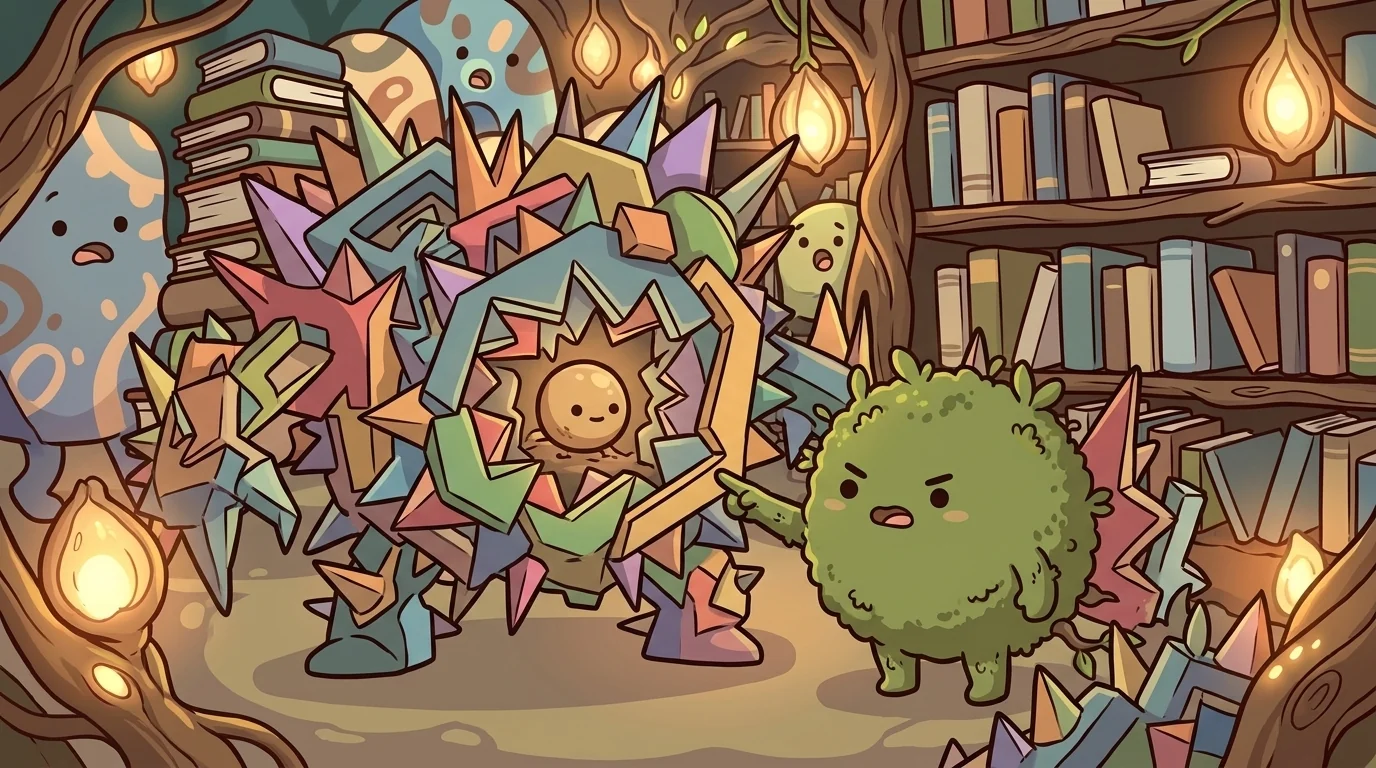
One day a truly monstrous word-creature lumbered in — long, spiky, and covered in strange parts. The other creatures shrank back. Radix wanted to shrink back too. The word was impossible to understand — it was just too big.
Then Radix remembered what the old lexicographer had taught it: don't stare at the whole beast. Find its root.
So instead of panicking at the whole long word, Radix looked for the small, sturdy piece at the center — the part all the other pieces were hanging onto. And there it was: one little root, humble and steady, holding the whole creature up.
The monster wasn't impossible after all. It was a small root wearing a very big coat.

"That's the secret of every word," Radix explained to a nervous young creature later. "A long word is almost never one big idea. It's a little root — the heart, the core meaning — with smaller parts clipped onto the front and back to change its job. Find the root, and you've found what the word is really about."
Radix showed it how. Take a scary-looking word. Peel away the front piece. Peel away the end piece. And usually, sitting in the middle, is a root you might actually recognize — one that shows up in a whole family of words. Know one root, and suddenly a dozen long words all make a little more sense, because they're cousins sharing the same heart.

Radix practiced this everywhere. A giant word about the ground? At its center, a root meaning earth. A long word about writing? A root meaning to write, wearing different coats in scribble and describe and manuscript. The roots kept turning up again and again, quietly connecting words that looked like total strangers on the outside.
Radix made one honest mistake worth keeping. It once grabbed the wrong piece — mistook a prefix for the root — and got the meaning backwards. The lexicographer didn't scold it. "The root is the part that carries the core meaning and shows up in a whole family," it said. "The little clip-on parts change that meaning; they aren't it. When you're unsure, ask: which piece do I keep seeing in cousin-words? That's the root." Radix wrote it down.

The real test came when the whole Codex faced a word-creature no one had ever seen — long, bristling, utterly unfamiliar.
"We can't read it," the creatures wailed. "It's brand new!"
Radix stepped up, small and calm. It didn't try to swallow the whole word. It found the root at the center — a root it had seen before, in a family of ordinary words — peeled back the front clip and the end clip, and read the creature's true meaning right off its core.
The unknown word became knowable. Not by magic. By roots.
"How did you read a word nobody's ever seen?" a young creature breathed.
"I didn't read the whole thing," said Radix. "I found the root. Every long word wears small words like a coat — so I found the one at the center, and the word told me what it means. New words aren't scary once you know they're all made of old, small pieces."
The MorphQuest ensemble
Radix is part of MorphQuest's distributed-narrative cast. Each character embodies a different curricular primitive; together they teach the full subject.
-

Morph
Shape / change (morph) — the shapeshifter; a morpheme changes a word's form and the job it does
-

Chrono
Time (chrono) — the time-morpheme; fuse it in and a word becomes about time
-

Phage
Eat (-phage) — the devouring suffix that turns a word into an eater of something
-

Aqua
Water (aqua / hydro) — every water-word carries this morpheme
-

Bio
Life (bio) — the life-morpheme that makes a word about living things
-

Tele
Far / distant (tele) — stretches a word's reach across a distance
-

Scope
See / look / examine (-scope) — the seeing suffix, an instrument for looking
-

Phobia
Fear / strong dislike (-phobia) — the fear suffix, gentle and never distressing
-

Ology
The study of (-ology) — turns any topic into a field of study (the scholar)