
Chrono
chrono = TIME — the Greek combining form 'chron-' carries TIME into a word wherever it sits; position and neighbours change the shade (order, sameness, wrongness in time) but never the core
Loading audio…
Press play to listen along. The line being read lights up as you go.
Show full transcript
Loading transcript…
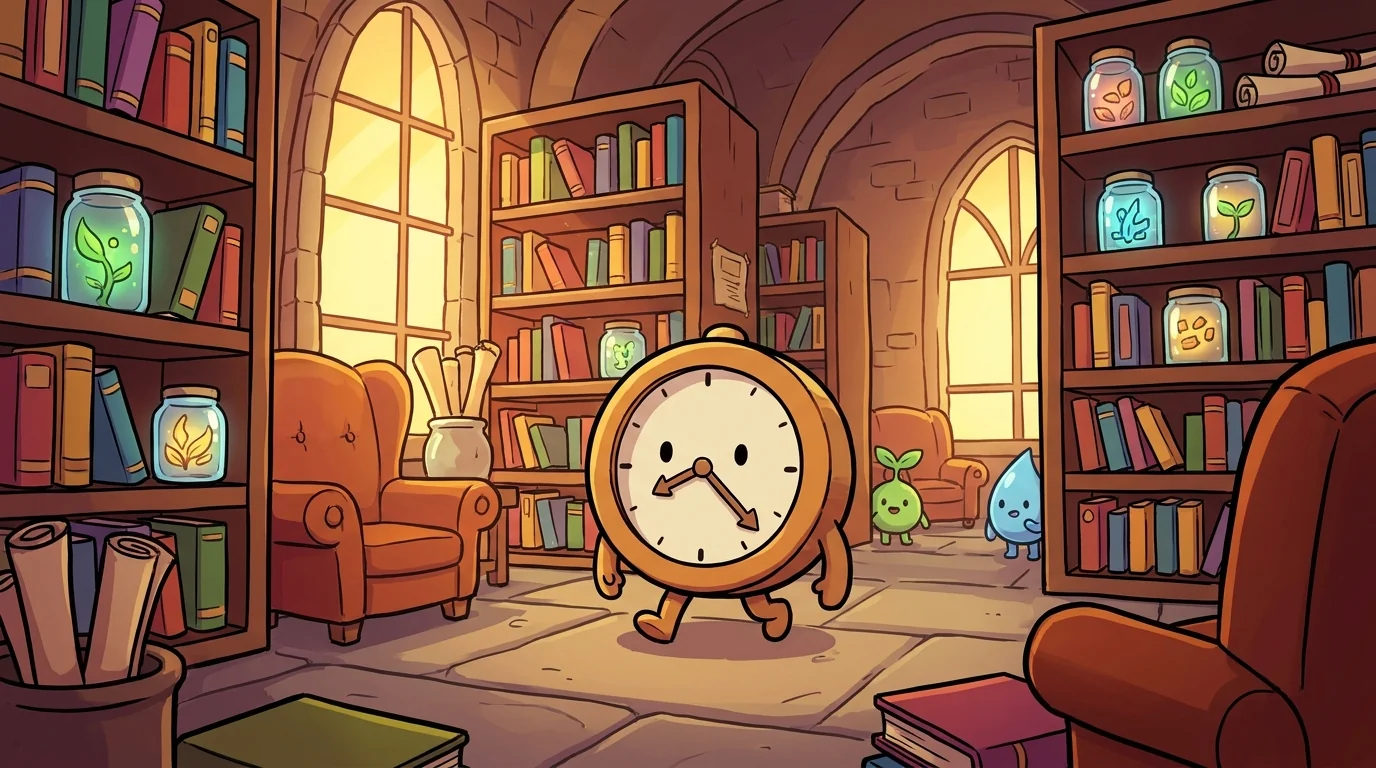
Chrono, the oldest-feeling creature in the Codex, had always told the young ones the simple truth: I carry time. Now it wanted to teach them the deeper one — that a morpheme carries a steady core, but the word around it chooses the shade.
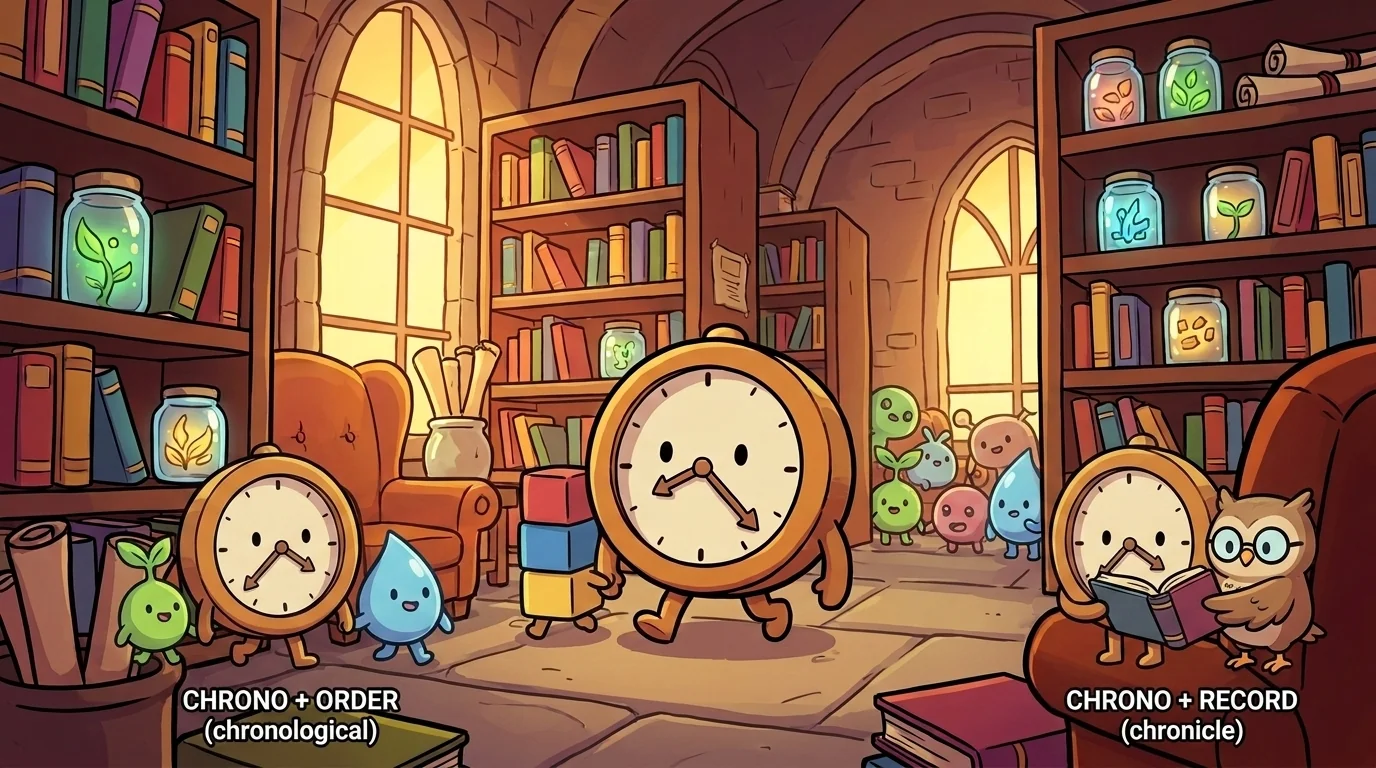
"I mean time, always," Chrono rumbled. "But watch what my neighbours do to that time." It fused with a root about order and made chronological — events in time-order. It fused with a root about together and made synchronize — bringing things to the same time. It fused with a root about against/back and made anachronism — something in the wrong time, like a knight holding a phone. "Order, sameness, wrongness," Chrono said. "Three different shades. But look closely — the time underneath never moved. My core is constant. The neighbours only tilt the light on it."
The young creatures wanted to know how they were supposed to find Chrono, since it didn't always announce itself at the front of a word.
"That's the Advanced lesson," Chrono said. "A beginner looks for a morpheme only at the front, like a doorbell. But I ride wherever the word needs me. In chronic I'm at the front — an illness that lasts a long time. In chronicle I'm at the front — a record kept over time. But in synchronize I'm buried in the middle — syn-chron-ize — and in anachronism I'm deep inside too — ana-chron-ism. A morpheme is not defined by where it sits. It's defined by the meaning it carries. Learn to hear chron anywhere in a word, front or middle, and you'll never miss me."
The creatures practised hunting for chron in the middle of words, and every time they found it, the word turned out to be about time.
Then Chrono taught them about its own family and its own spelling, because Advanced readers can handle a little Greek.
"I come from an old Greek word for time," it said. "That's why I usually wear an h after the c — chron, not cron. Most of my family keeps that spelling: chronology, chronometer (a very precise clock), chronicle, synchronous. Knowing I'm Greek tells you something useful — I like to keep company with other Greek parts. -logy (study), -meter (measure), syn- (together). So chronology is the study of time-order, and chronometer is a time-measurer. When you spot one Greek part, look for its Greek friends nearby — they travel in packs."
Chrono made an honest note about a trap, because it was old enough to have fallen into it.
"Not every cron is me," it warned. "There is a word crony — an old pal — that has nothing to do with time, and it doesn't even keep my h. And a crone is an old woman, from a completely different root. Looking a little like me is not the same as being me. The proof is always the meaning: if the word is genuinely about time, and the piece is spelled chron, that's me. If the word has nothing to do with time, it's a stranger who happens to share a few letters. Check the meaning, not just the letters." It ticked, slow and certain. "A morpheme is a sound-and-meaning pair, not just a spelling."
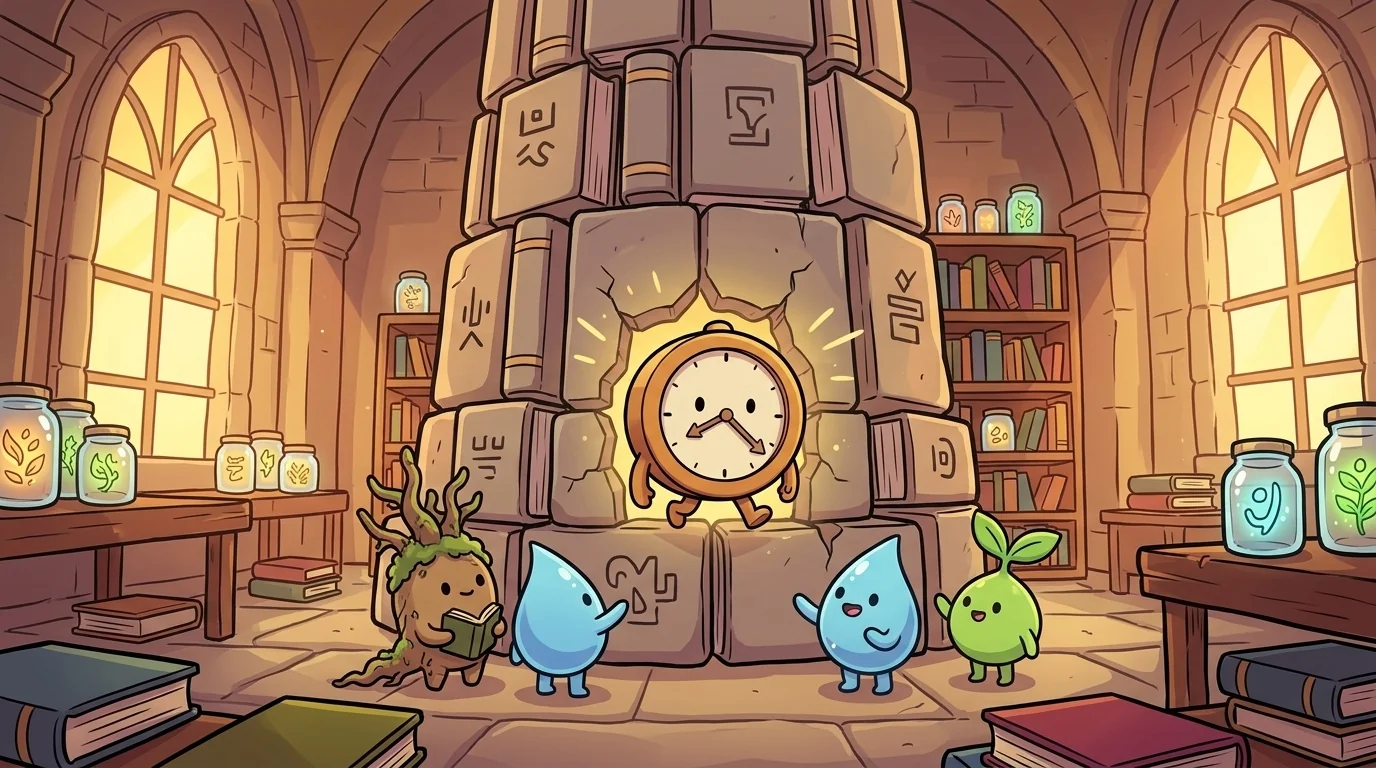
The test came with the word anachronistic, which a young creature had seen on a museum sign and never understood.
"Hunt for me," Chrono said. "I'm not at the front this time." The young creature scanned — a-na-chron-is-tic — and there, in the middle, was chron. "Found you! So it's about time. And the front part, ana-, means against or back. And the endings just make it a describing-word. So — describing something that's against its time, in the wrong time." The creature thought of the knight with the phone. "Anachronistic — belonging to the wrong time."
"You read a museum word by hunting for time in the middle of it," Chrono said, ticking with quiet pride. "See chrono, or just chron, anywhere in a word, and think time. I carry it to the front, to the middle, to the far end — but I always carry it. That is the one thing a good morpheme never stops doing: it keeps its meaning, wherever it stands."
The MorphQuest ensemble
Chrono is part of MorphQuest's distributed-narrative cast. Each character embodies a different curricular primitive; together they teach the full subject.
-

Radix
Root (radix) — every long word is built around a small root that carries its core meaning; find the root and the word tells you what it means
-

Morph
Shape / change (morph) — the shapeshifter; a morpheme changes a word's form and the job it does
-

Phage
Eat (-phage) — the devouring suffix that turns a word into an eater of something
-

Aqua
Water (aqua / hydro) — every water-word carries this morpheme
-

Bio
Life (bio) — the life-morpheme that makes a word about living things
-

Tele
Far / distant (tele) — stretches a word's reach across a distance
-

Scope
See / look / examine (-scope) — the seeing suffix, an instrument for looking
-

Phobia
Fear / strong dislike (-phobia) — the fear suffix, gentle and never distressing
-

Ology
The study of (-ology) — turns any topic into a field of study (the scholar)