
Radix
ROOT / MORPHOLOGICAL PARSING — every long word is built around a small root (a bound meaning-core) with affixes clipped to its edges; finding the root, and recognising it across a family of cousin-words, unlocks words you have never seen
Loading audio…
Press play to listen along. The line being read lights up as you go.
Show full transcript
Loading transcript…

The word that stopped the whole Codex that morning was incorruptible, and it stopped them because it was long, and long words, everyone agreed, were simply harder.
Radix — small, mossy, unhurried — did not agree. It had spent a lifetime learning that "long" and "hard" are not the same word, and that the difference between them is a skill you can practise. It walked up to incorruptible the way you walk up to a knot you intend to untie: slowly, and from the middle.
"Don't read it left to right like a sentence," Radix told the nervous young creatures. "Read it from the center out. Find the piece that carries the core meaning, and everything clipped to it is just a job-label." It set a mossy finger on the middle of the word. "rupt. That's the heart. It means break. Now the front, in-, means not. And the back, -ible, means able to be. Read them in from the edges: not able to be broken. Someone incorruptible can't be broken — bribed, bent, cracked."
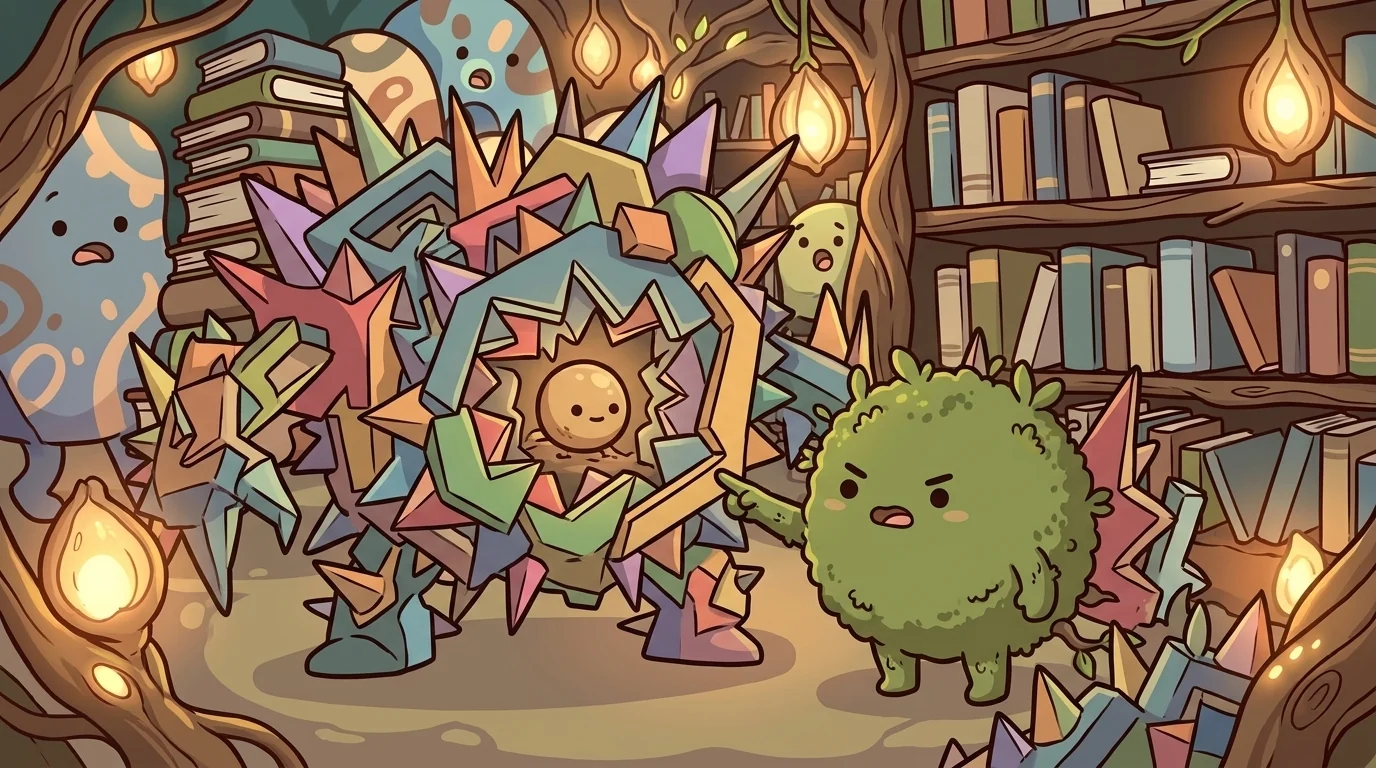
The young creatures wanted to know how Radix could be so sure that rupt was the root and not, say, cor or rupti.
"Because a root proves itself in its family," Radix said. "One appearance is a guess. A whole family is proof." It began pulling cousin after cousin off a nearby shelf. Rupture — a breaking. Erupt — to break out. Interrupt — to break between. Disrupt — to break apart. Bankrupt — broken at the bank. "See it?" Radix said. "rupt keeps turning up, always carrying break, always at the center, always with different clip-on parts changing its job but never its meaning. The piece that recurs across a family, holding one steady idea — that's the root. The parts that only change the job around it are affixes."
The creatures tested it and it held. Any time they thought they'd found a root, they asked Radix's question: does this exact piece show up in a family of cousins, all sharing one meaning? If yes, root. If no, they'd grabbed an affix by mistake.

Then Radix taught them the harder truth, the one that separates a beginner from someone who can really read.
"Some roots can stand alone as whole words," it said. "Play is a root, and play is also just a word. Those are the friendly ones — you already know them. But many of the strongest roots cannot stand alone. You will never see rupt by itself in the wild. You will never meet tain or ceive or dict walking around as their own words. They only ever appear bound — wearing other parts. Dict means say or speak, but it lives only inside dictate, predict, contradict, dictionary, verdict."
A young creature frowned. "Then how do you know dict is real, if you can never see it alone?"
"The same way you know rupt is real," Radix said, pleased by the question. "By the family. Dict is invisible on its own and unmistakable in a crowd. A bound root is like a note in a chord — you rarely hear it played by itself, but you can hear it inside every chord it belongs to. Once your ear knows dict = speak, you can crack contradict — speak against — and verdict — a true saying — without anyone handing you a definition."
Radix was careful to teach its own famous mistake, because Advanced readers deserve to know where the trap is.
"I once got greedy," it admitted. "I decided that words that look alike must share a root. So I saw father and fathom and told everyone they were cousins. They are not. Fathom has nothing to do with fathers — it once meant the span of two outstretched arms. Looking alike is not the same as sharing a root; that's a false friend. The proof is never the spelling on the surface — it's whether the pieces carry the same meaning across the family. Rupt means break in every single cousin. Fathom and father mean nothing alike. So: check the meaning, not just the letters. A root is a shared meaning that recurs, not a shared look."
The creatures wrote that on the wall of the Codex. A root is a shared meaning, not a shared look.
The real test came, as it always does, with a word no one in the Codex had ever seen — a long, bristling, scientific-looking thing that made the young ones flinch.
Radix didn't flinch. It found the center. There sat a root it had met a thousand times, curled up small under a heavy coat of affixes. It peeled the front clip. It peeled the back clip. It read the family-tested meaning straight off the core, layered the affixes' jobs back on, and spoke the whole word's meaning aloud — a word nobody had taught it, cracked from the inside out.
"How did you read a word that's brand new?" a young creature breathed.
"I didn't read a new word," Radix said. "I read an old root wearing a new coat. Find the root at the center — the piece that recurs across a whole family of cousin-words — and a giant unknown word will always tell you what it means. The word was long. It was never hard."
The MorphQuest ensemble
Radix is part of MorphQuest's distributed-narrative cast. Each character embodies a different curricular primitive; together they teach the full subject.
-

Morph
Shape / change (morph) — the shapeshifter; a morpheme changes a word's form and the job it does
-

Chrono
Time (chrono) — the time-morpheme; fuse it in and a word becomes about time
-

Phage
Eat (-phage) — the devouring suffix that turns a word into an eater of something
-

Aqua
Water (aqua / hydro) — every water-word carries this morpheme
-

Bio
Life (bio) — the life-morpheme that makes a word about living things
-

Tele
Far / distant (tele) — stretches a word's reach across a distance
-

Scope
See / look / examine (-scope) — the seeing suffix, an instrument for looking
-

Phobia
Fear / strong dislike (-phobia) — the fear suffix, gentle and never distressing
-

Ology
The study of (-ology) — turns any topic into a field of study (the scholar)