
Tele
tele = FAR/DISTANT — the Greek prefix 'tele' carries ACROSS-A-DISTANCE; its meaning stretches with technology (telephone → telecommute → telehealth), and it must not be confused with the look-alike root 'teleo-' meaning goal/end
Loading audio…
Press play to listen along. The line being read lights up as you go.
Show full transcript
Loading transcript…
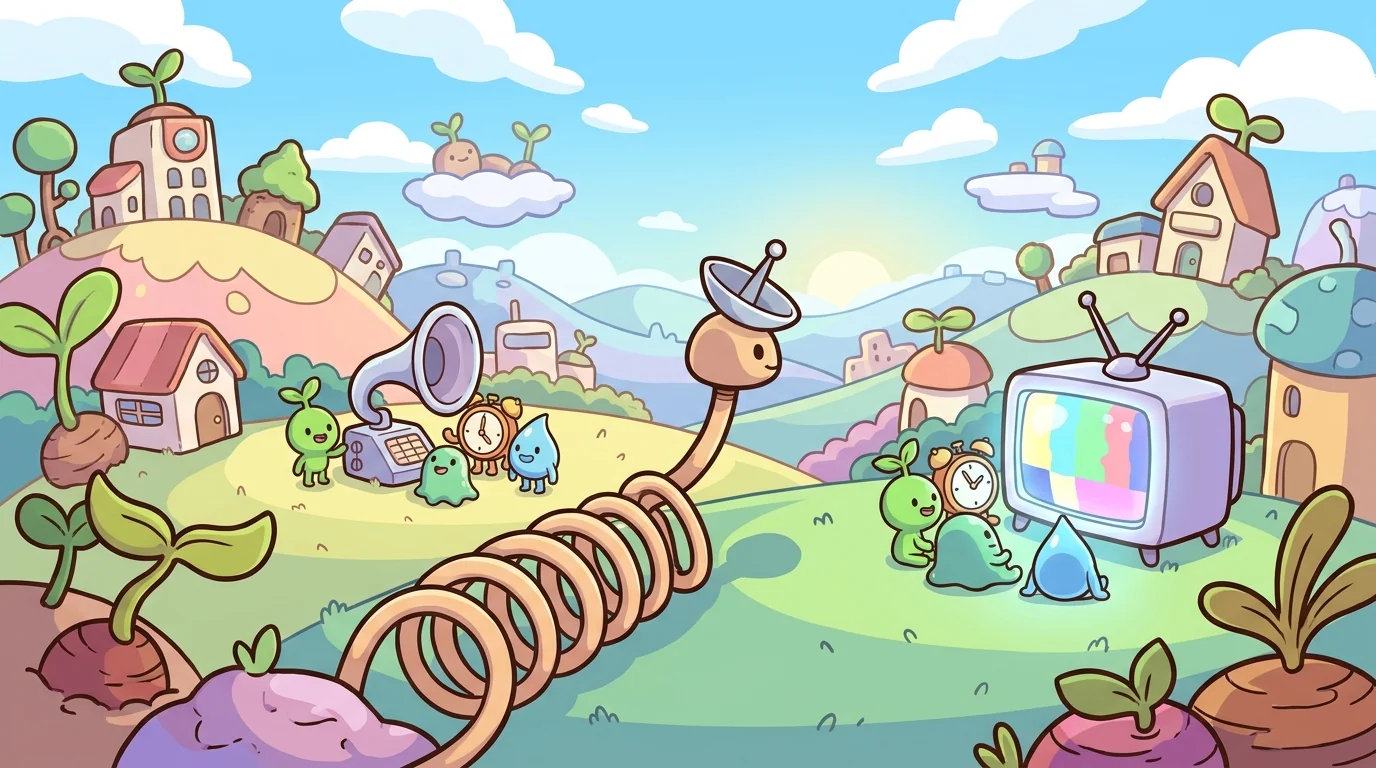
Tele, the long stretchy creature always craning toward the horizon, had watched the world invent gadget after gadget — and it had a marvel to share: its one meaning, far, had quietly stretched to cover machines nobody had dreamed of when it was young.
"I mean far — across a distance," Tele said, stretching thin. "I always have. But watch how far far has travelled." It reached into word after word, oldest first. "Telephone — a voice from far away. Telescope — a tool to see far. Television — seeing from far." Then it reached into the newer shelf. "Telecommute — working from far away, from home. Telehealth — a doctor visit from far. Teleconference — a meeting held across a distance." Tele grinned. "Same meaning, brand-new machines. A morpheme doesn't retire when technology changes — it stretches to name the new thing. My far covered wires, then airwaves, then the whole internet, without ever changing what I mean."
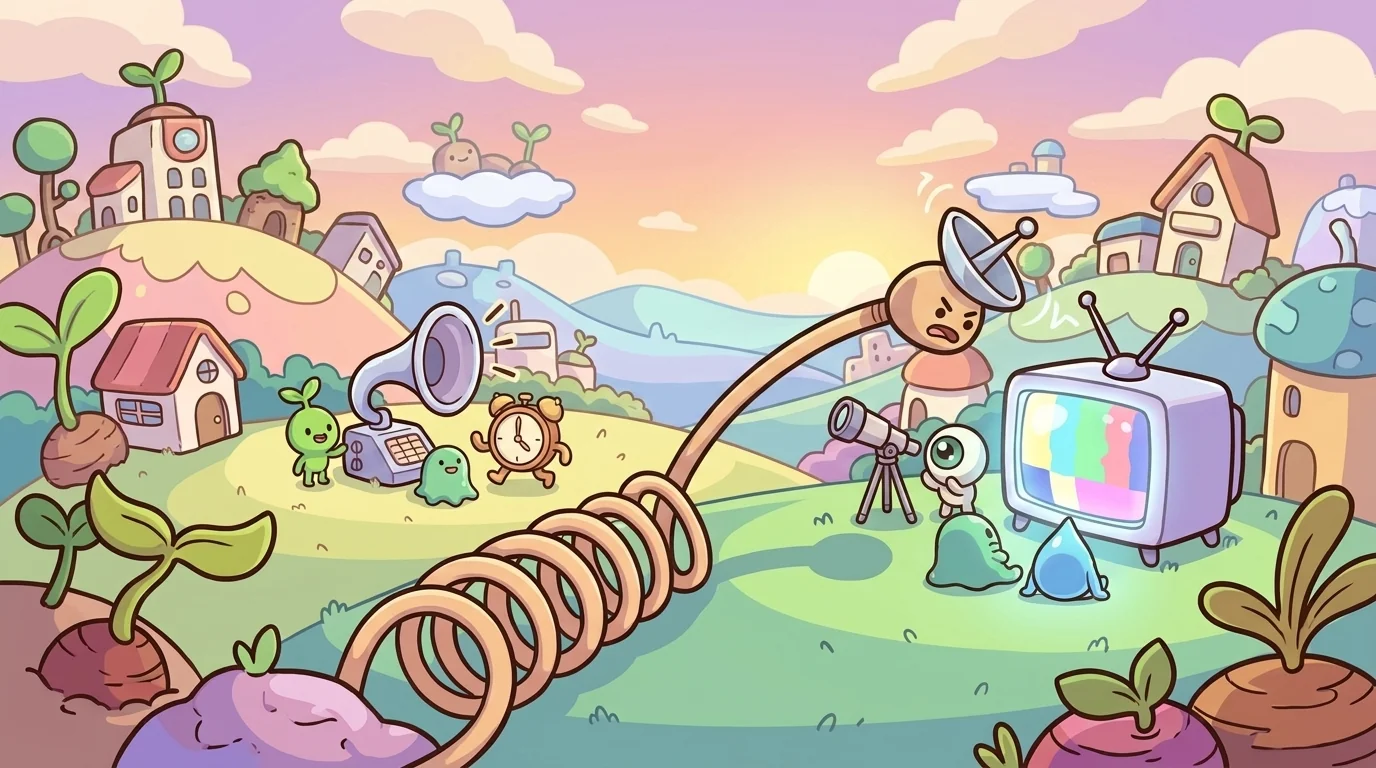
The young creatures found this thrilling — a word-part that could name the future.
"That's the power of a productive prefix," Tele said. "Give me a root about any activity, and I can make a 'do-it-from-far' word. Tele- + learning = distance learning. Tele- + a root about presence = telepresence, being 'there' from far away. You can almost invent the vocabulary of a new technology by clipping me onto whatever it does. When the next far-reaching machine arrives, I'll name it too — because far never goes out of style."
The creatures tried building their own: a tele- word for cooking from a distance, for gardening from a distance. Silly, but readable — and that was the point. If you know the prefix, you can read (and even coin) words that don't exist yet.
Then Tele taught the trap, and it was a sneaky one that fools even good readers.
"There is a look-alike that is not me," Tele warned, leaning close. "It's spelled almost the same — teleo- — but it comes from a different Greek root meaning goal or end or completion, not far. You'll meet it in a word like teleology — the study of purposes and ends, of why things exist — which has nothing to do with distance. If you read teleology as 'the study of far things,' you'll be completely lost." Tele stretched thoughtfully. "So check the meaning of the whole word. If it's about distance, I'm your prefix — tele = far. If it's about purpose or ending, that's my look-alike teleo-. Two morphemes, nearly the same spelling, opposite ideas. The only safe test is meaning, never spelling."
The creatures added it to Radix's wall: tele = far; teleo- = goal. Same look, different roots.

Tele repeated its favourite rule about teamwork.
"Two clues beat one," it said. "I give you far. Radix's root gives you far-what? Alone, either of us is a guess. Together, we're nearly a certainty. Tele + a root about sound → far-sound → telephone. Tele + a root about writing → far-writing → telegraph. Always read both pieces before you decide — and if they point the same way, trust it."
The test came with the word telemetry, which a young creature met in a book about spacecraft.
"Tele — that's far," the creature began. "And -metry is about measuring." It pictured a probe far out in space, sending numbers home. "So — measuring from far away? Reading a spacecraft's data from a distance?" Exactly — telemetry is how mission control reads a faraway machine's instruments.
"You read a space word with two clues pointing the same way," Tele said, reaching toward the horizon. "'tele' means far — it stretches a word across a distance, from an old telephone to a probe past the planets. And beware its twin teleo-, which means goal. Learn the prefix, and you can read — even invent — the words of machines that don't exist yet."
The MorphQuest ensemble
Tele is part of MorphQuest's distributed-narrative cast. Each character embodies a different curricular primitive; together they teach the full subject.
-

Radix
Root (radix) — every long word is built around a small root that carries its core meaning; find the root and the word tells you what it means
-

Morph
Shape / change (morph) — the shapeshifter; a morpheme changes a word's form and the job it does
-

Chrono
Time (chrono) — the time-morpheme; fuse it in and a word becomes about time
-

Phage
Eat (-phage) — the devouring suffix that turns a word into an eater of something
-

Aqua
Water (aqua / hydro) — every water-word carries this morpheme
-

Bio
Life (bio) — the life-morpheme that makes a word about living things
-

Scope
See / look / examine (-scope) — the seeing suffix, an instrument for looking
-

Phobia
Fear / strong dislike (-phobia) — the fear suffix, gentle and never distressing
-

Ology
The study of (-ology) — turns any topic into a field of study (the scholar)