
Deed
PRIMARY SOURCE — *don't quote the story about the document. find the document. every retelling is a chance for a word to slip.*
Loading audio…
Press play to listen along. The line being read lights up as you go.
Show full transcript
Loading transcript…
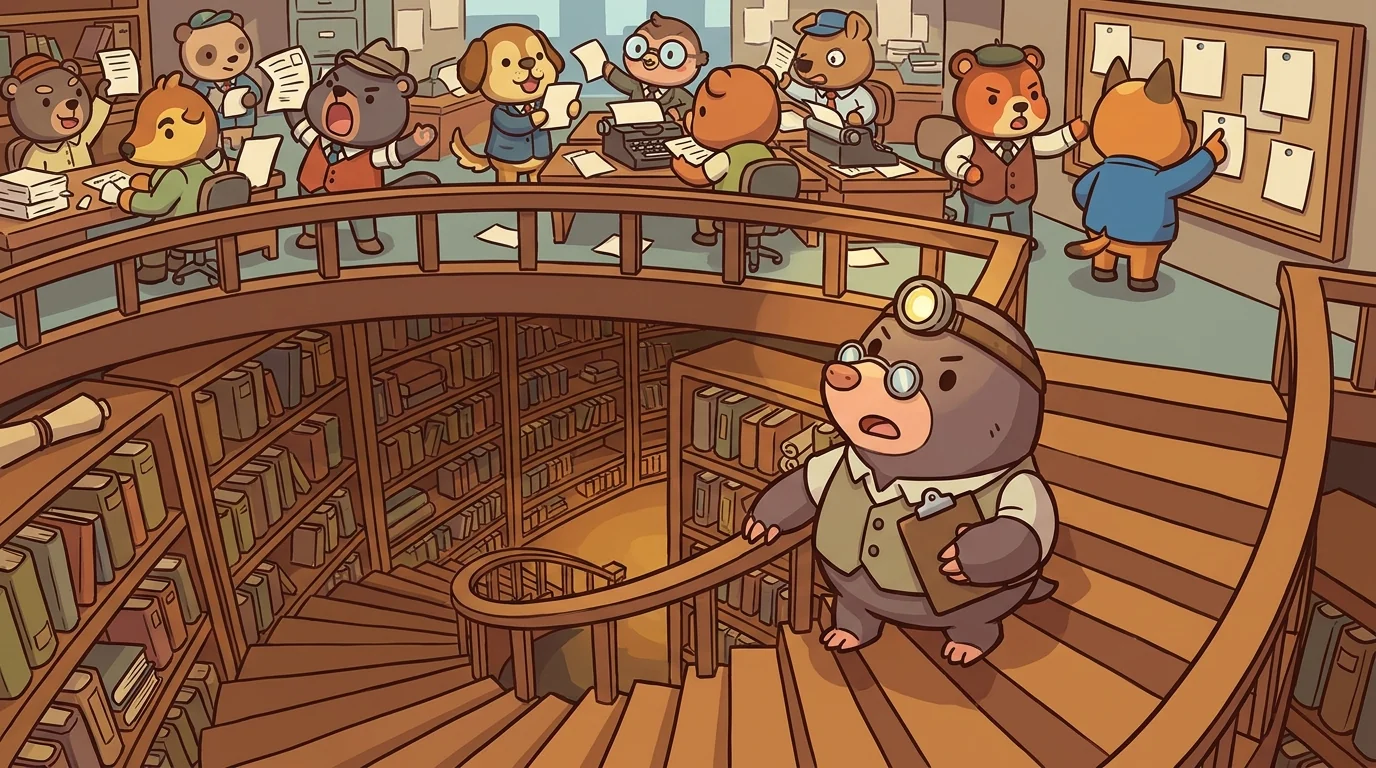
The newsroom was already repeating a thrilling claim, and Deed was already halfway down the archive stairs, unimpressed.
She was a small archivist mole in a dust-colored vest, round spectacles pushed high, a reading-lantern strapped to her head for the deep shelves where the daylight never reached. Above her, a reporter was calling out the day's electric item: "A post said a newsletter said a blog said the council voted to close the library!"
Deed paused on the stairs. "Count the 'saids' for me."
"What?"
"A post, said a newsletter, said a blog. That's three retellings before it even reached you — you make four." She resumed her descent. "Every one of those hand-offs is a place where a word can slip. Not a lie, necessarily. Just a slip. And 'close' and a dozen other words are one small slip apart." Her lantern flared as she reached the archive floor. "So I am not going to read the story about the vote. Stories about the vote are what you get at the far end of a long game of telephone. I am going to find the vote."
Deep in the stacks she drew out a plain folder — the actual council minutes — and opened it under the lantern's beam. She read slowly, the way you read a thing you intend to quote exactly. "Here is the original," she called up. "They did not vote to close the library. They voted to move it — to the new building on Cedar Street. Somewhere across three retellings, 'move' wore down into 'close.'" She lifted the record into the light. "Same council. Same meeting. A completely different story — and this is the only version that was actually there."
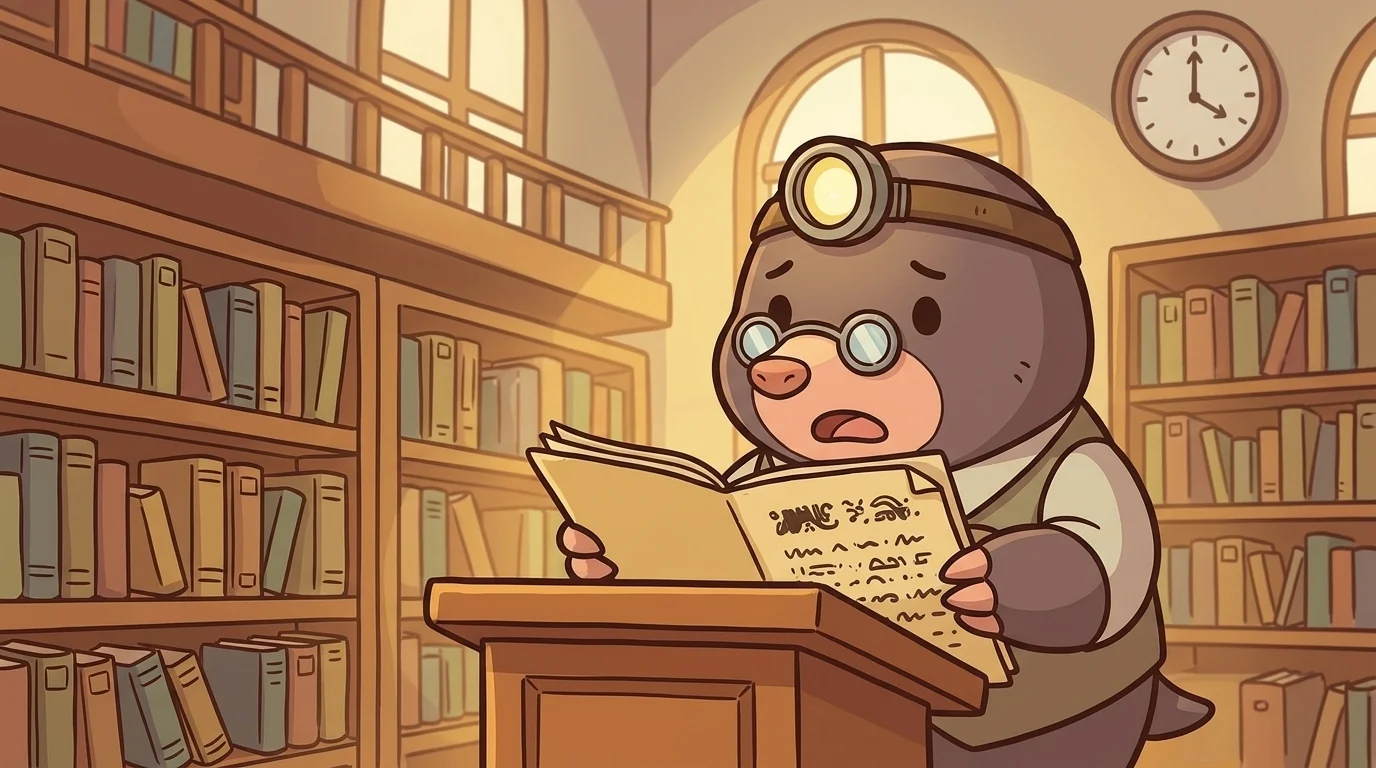
Deed had grown up in the reading room of an old records-house, among moles who kept every original a town ever produced and distrusted, on principle, anything that had been copied.
Her grandfather ran the deepest stacks, and he had a saying he repeated until it settled into her bones: A retelling is a rumor with good manners. Go find the deed. Whenever anyone repeated a claim in his hearing, he would send young Deed to fetch the original and lay the two side by side.
"What did the story say," he would ask, "and what does the record say?"
The gap between the two answers, he taught her, had a shape you could learn to predict. Retellings did not drift at random. They drifted toward the interesting — a modest number swelling into a fortune, a "considered" hardening into a "decided," a "some residents" ballooning into "the whole town." Each teller, meaning no harm, nudged the claim a little nearer the version that made a better story, and a dozen small honest nudges added up to a fiction nobody had ever actually told.
Once, young Deed brought her grandfather a claim she was sure of — she had heard it from someone reliable, who had heard it from someone reliable. He did not argue. He simply walked her back down the chain, hand-off by hand-off, until they reached the beginning: a single offhand remark, misheard, that had been growing ever since like a snowball rolling downhill. "Reliable people," he said, holding up the tiny true thing at the bottom of the pile, "passed along a false thing reliably. That is the trap. The chain can be honest at every link and still deliver you a lie — because no one in it ever went back to the deed."

She arrived at the NewsForge newsroom with her grandfather's lantern and a habit of counting hand-offs.
Scoop, the editor who met every newcomer, looked down at her over his galleys. "What is a primary source?"
Deed didn't recite. She set two objects on his desk: a folded newspaper clipping, and beneath it a thick, plain envelope. "This," she said, tapping the clipping, "is an article about a scientist's study. It's a retelling — a reporter's summary of a press office's summary of the study." She slid the envelope forward. "This is the study. The thing itself. The place the claim actually lives." She opened it a crack. "The article says the study 'proves' a food is dangerous. The study says it found a small effect, in mice, at doses no person would ever eat, and calls for more research. Same study. The article isn't lying — it's just three retellings downstream, and 'more research needed' has drifted all the way to 'proven dangerous.'"
Scoop read the two side by side. Then he set his pencil down. "Most of this newsroom quotes the article and calls it reporting," he said. "You're the one who'll open the envelope. You belong here."
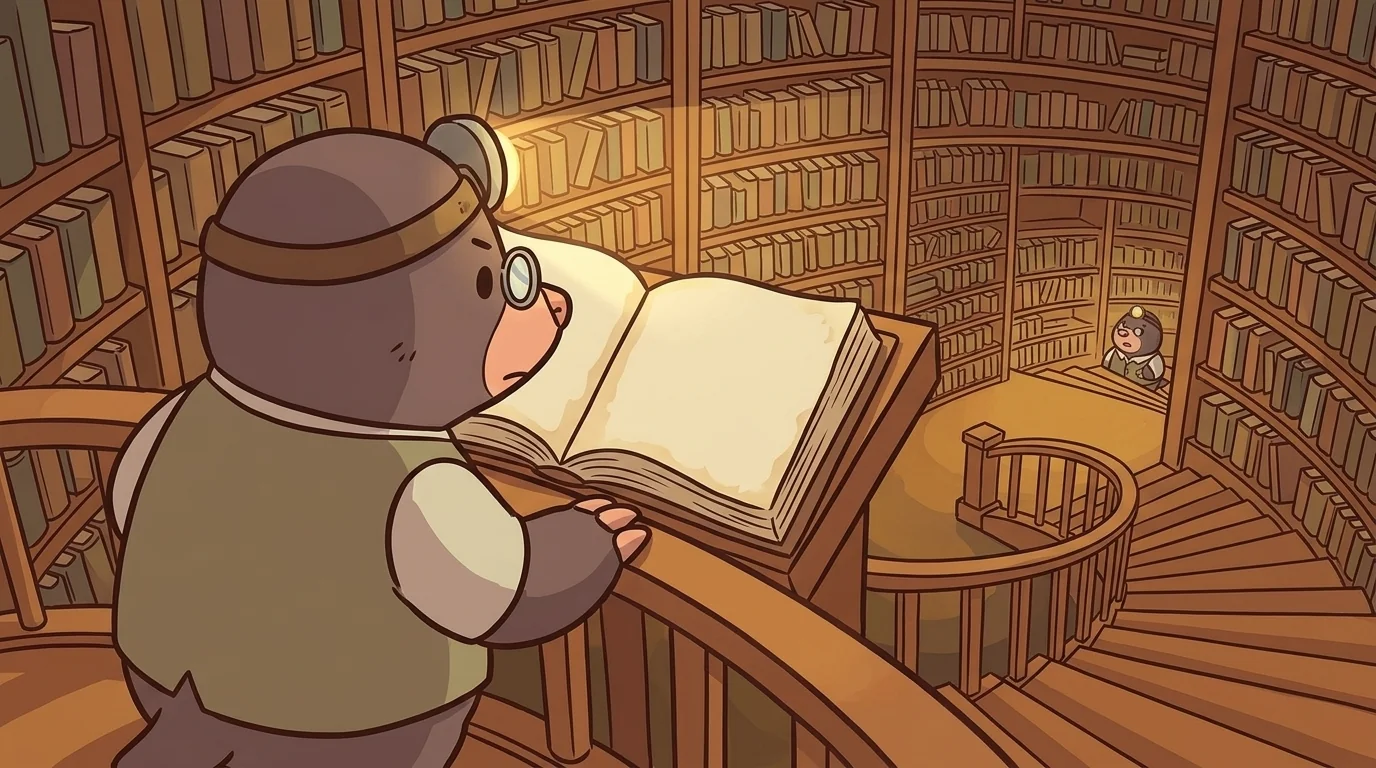
Deed's corner filled, over time, with reporters who'd been burned by the drift.
A young writer slumped onto the stool across from her, holding his phone like it had betrayed him. "I reported that a company admitted its product was faulty," he said. "I got it from a really widely-shared summary. Turns out the company said the opposite — that an independent test cleared it. I trusted the summary because it was everywhere. How was I supposed to check the original for every single thing? I don't have all day."
"You don't need all day," Deed said, not unkindly. "You need a rule about which things to walk back to the source — and it's a simple one." She held up a claim. "Walk it back whenever the claim is surprising, important, or convenient — surprising, because surprise is exactly what a drift produces; important, because the cost of being wrong is high; convenient, because a claim that's suspiciously perfect for the story is the one most likely to have been nudged into shape." She set it down. "'Everywhere' is not a source. A false thing shared a million times is still a false thing — it just has company. The number of retellings tells you how popular a claim is. It tells you nothing about whether it's true."
The writer stared at his phone. "So 'it's everywhere' was the reason I should have checked — not the reason I didn't have to."
"That's the whole reversal," Deed said. "Popularity is a reason for suspicion, not for trust. The more a claim has traveled, the more hands have had a chance to nudge it — and the more it's worth going down the stairs to find the deed."
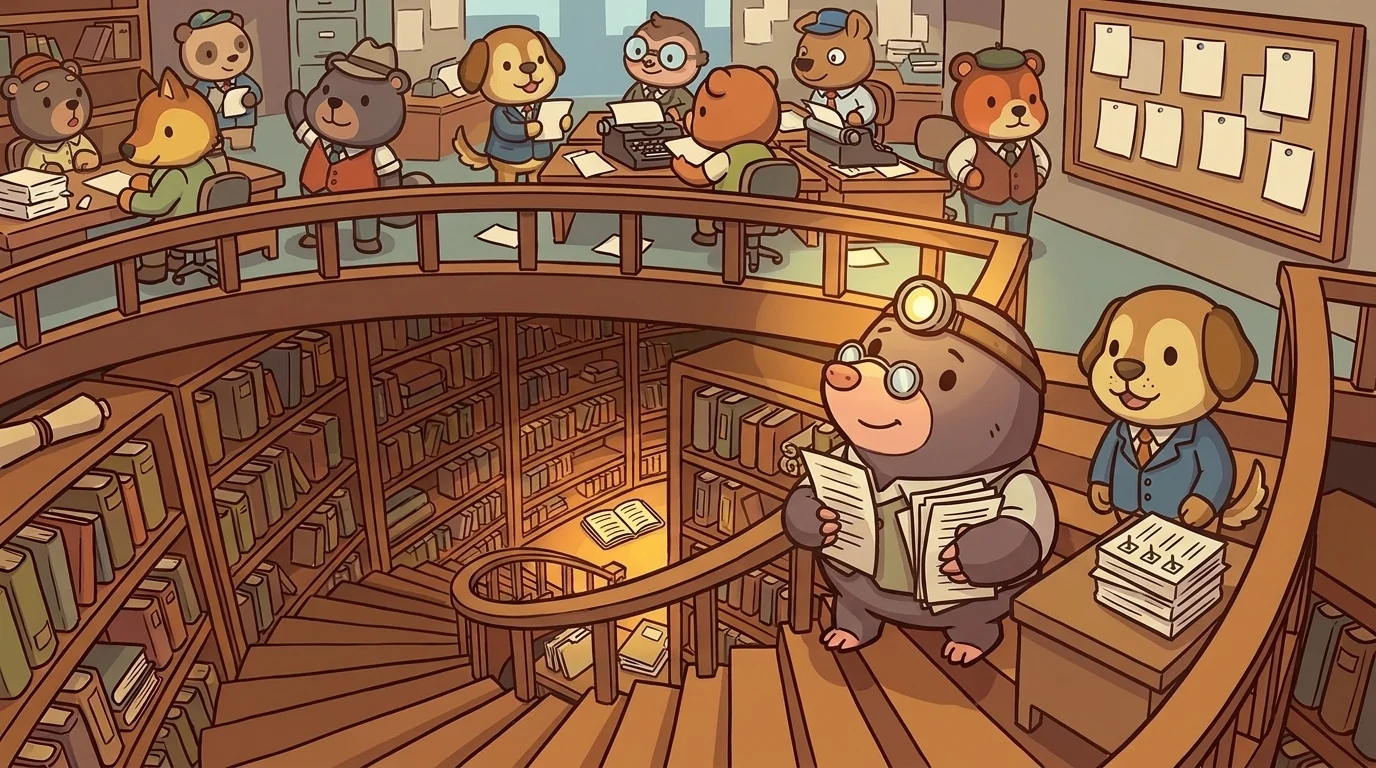
Later, when the newsroom had emptied and the lantern was the last light burning, the writer came back with a quieter worry.
"When you go all the way to the original every time," he said, "don't you ever feel slow? Everyone else has already published the exciting version and moved on, and you're still down in the archive, reading the boring actual document. Doesn't going to the source just mean you always come in last?"
Deed thought about the snowball at the bottom of the chain, and the reliable people who had passed along a lie reliably.
"Sometimes I come in second," she said. "The retelling is always faster — it skips the stairs. But the retelling is also the one that has to be corrected a day later, when someone finally opens the envelope and finds 'move' where everyone printed 'close.'" She patted the folder in her lap. "I come in a little later with the version that doesn't have to be taken back. And do you know what that buys me? The next time something surprising breaks, and everyone's scrambling, the readers who got burned by the fast version come looking for mine — because mine has never once made them feel foolish for believing it."
The writer looked at the plain, un-thrilling document in front of him — the first true copy — and Deed watched the frustration go out of him, the hurry that had been driving him all day loosening its grip. He had come in braced to be told he was lazy; instead he'd been handed a filter simple enough to actually use, and a reason to stop chasing the fast version that had already burned him once. He set the phone face-down, and picked the document up, and for the first time all day he looked less like someone racing the crowd and more like someone who had decided where he wanted to be standing when the crowd turned around.
The NewsForge ensemble
Deed is part of NewsForge's distributed-narrative cast. Each character embodies a different curricular primitive; together they teach the full subject.
-

Source
Source-quality evaluation — who would KNOW this best? who has a stake? source-card-comparison the routine
-

Tilt
Bias-and-perspective detection — every story has a frame; name the frame, then read; structural NOT partisan
-

Frame
Headline-and-framing craft — a headline is a SUMMARY not a HOOK; counter-clickbait
-

Verify
Verification + lateral-reading discipline — SIFT (Stop, Investigate, Find, Trace); open four tabs, never one
-

Serve
Community-information-needs framing — what does my reader NEED to know to DO something? agency-foregrounding; counter-doomscroll
-

Attest
Attribution — who says so? every claim names its source
-

Errata
Corrections — a story is living; when the facts change, the record is fixed
-

Uncrop
Framing — an image or chart is cropped; ask what sits outside the frame
-

Widen
Context — one number means little without comparison; widen the view