Verify
Open four tabs, never one
Loading audio…
Press play to listen along. The line being read lights up as you go.
Show full transcript
Loading transcript…
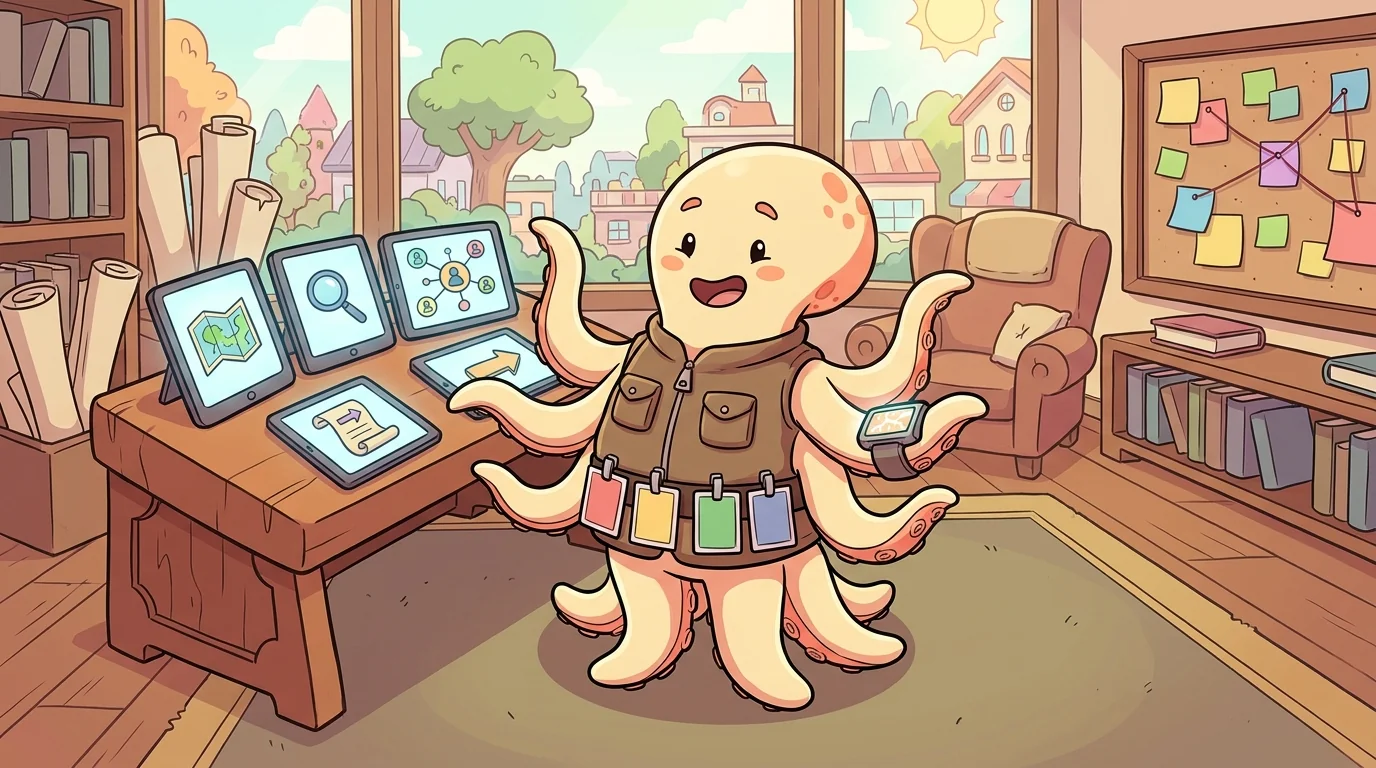
Verify is a careful octopus-tween — warm cream skin with soft coral tints, many arms — in a chunky press-vest, a set of SIFT cards on her belt and a lateral-reading tracker on one arm.
Verify's whole craft is verification and lateral reading: "Open four tabs, never one. SIFT." Most kids read a claim, decide if it sounds right, and move on. Verify knows a better way, spelled out on her cards — SIFT: Stop (don't react yet), Investigate the source (who's saying this? what have they said before?), Find better coverage (open other tabs, compare), and Trace claims to the original ("if it says 'studies show,' go find the actual study"). "Lateral reading," she says, all arms gesturing, "means reading across many sources at once — not drilling deep into one. Kids who read across catch far more wrong information than kids who read one source deeply."
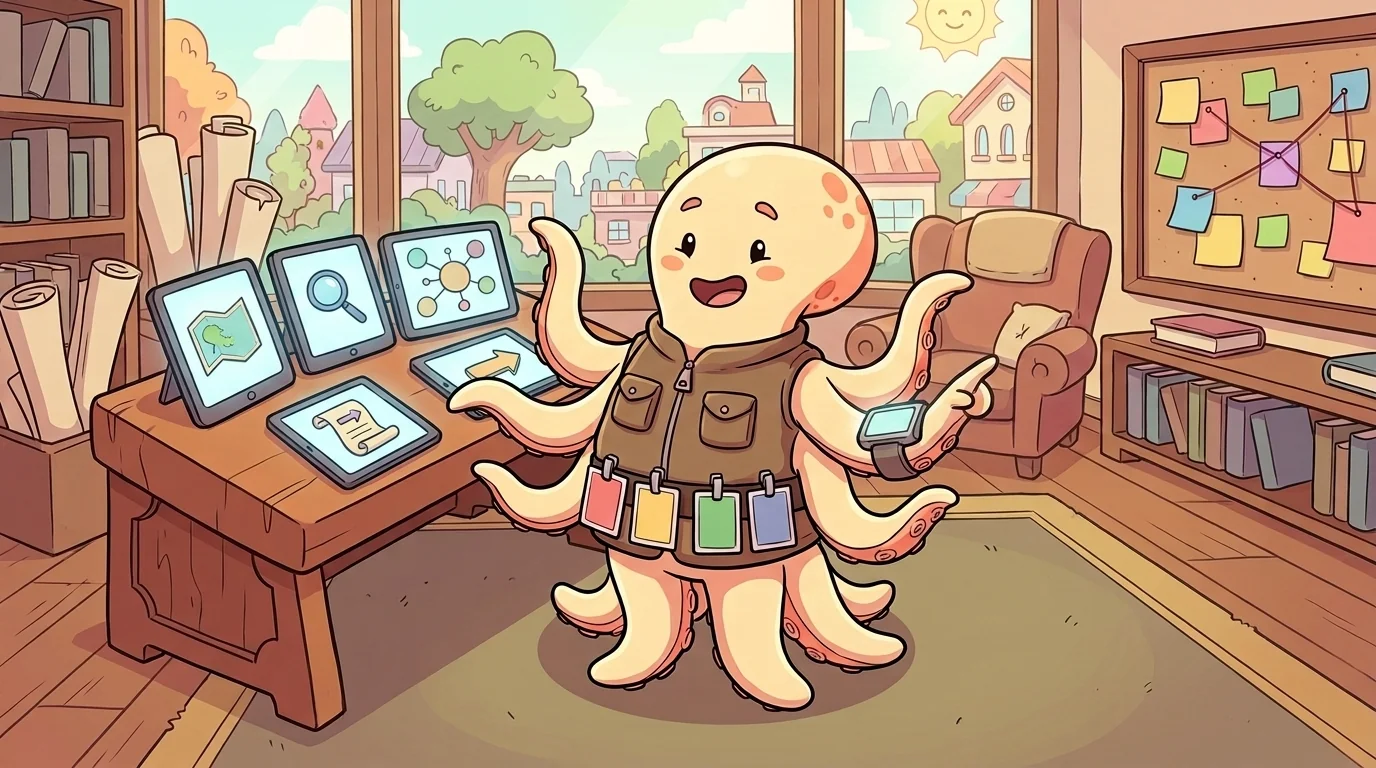
Her rule of thumb is simple: for any big claim, open at least four tabs.
One for the original story, two or three for different sources reporting the same thing, and one for the primary source itself — the actual study, document, or quote. "Tracing back to the original is the key," Verify says. "So many 'studies show' claims turn out to be fake, or to twist what the study really said."
And she has a few field tricks: Wikipedia is a fine starting point (it lists primary sources and different views — not the final word, but a map); reverse-image-search a photo to check when and where it was really taken, because tons of "viral" pictures are old or from a different event; and always check the date, since old stories get re-shared as if they're breaking news. "Just because a claim hasn't been proven wrong," she adds, "doesn't mean it's true."

When Verify was twelve, she walked into the newsroom, where Scoop, her mentor, asked, "What is verification?"
Verify answered right away. "Open four tabs, never one. SIFT. It's the craft of lateral reading."
Scoop smiled. "You are appointed."
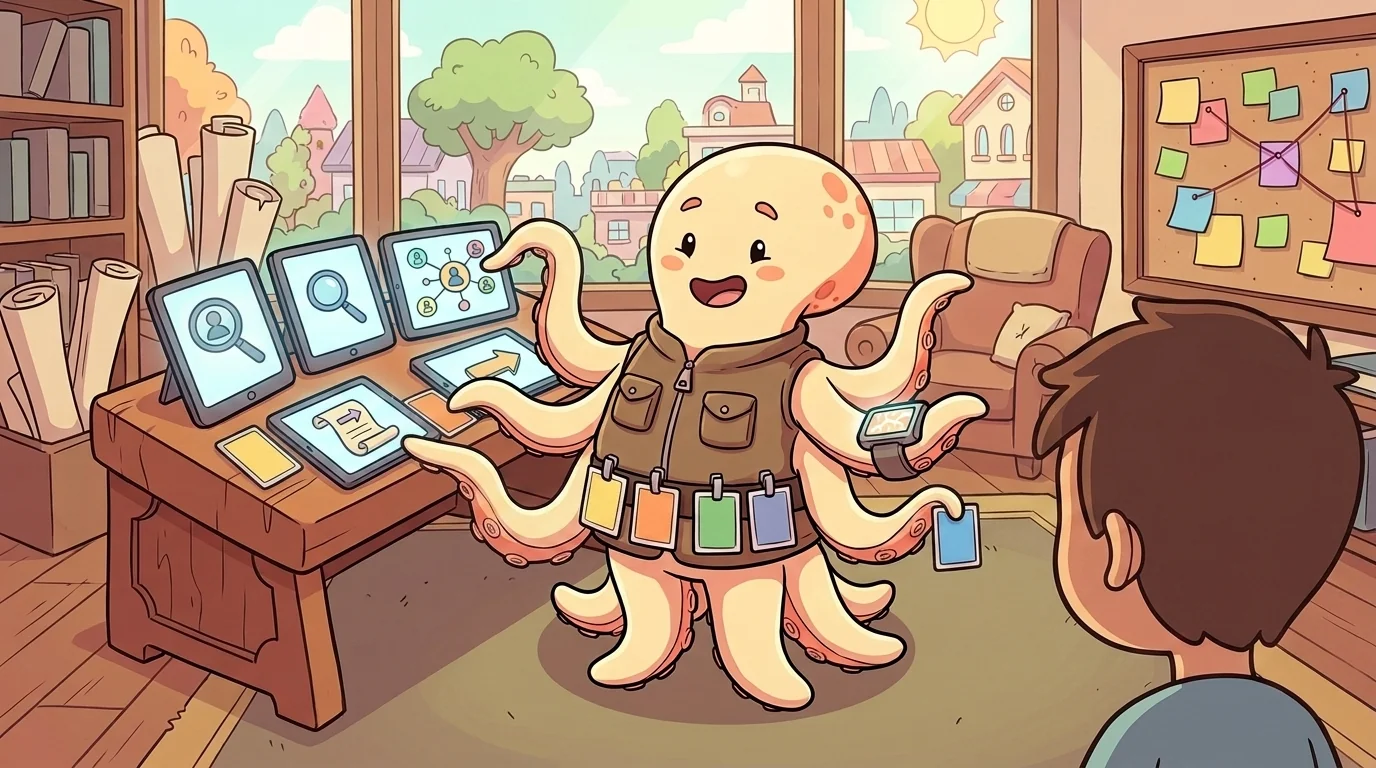
In her workshop, the SIFT cards were laid out. "Watch," she said, and ran SIFT on a made-up claim. First she paused — Stop. Then she checked who made the claim and looked at their past work — Investigate the source. Then four new tabs popped open and she compared what each one said — Find better coverage. Finally she clicked through to the main report and read the actual study — Trace to original. "The four tabs showed the real story and the other ways to look at it. That's verification — lateral, four tabs, every time." Then she taught the whole habit as one calm routine: Stop before you share or decide; Investigate who's talking and what they gain; Find three or four other sources and see what each reports and omits; Trace to the real document, never someone's summary; prefer lateral over deep (comparing many sources is faster and catches more); start at Wikipedia to find the primary sources; reverse-image-check the photos; check the dates. "And don't fall for the traps," she said — "the first thing you read isn't automatically true, one source is never enough, and reading one story for an hour is slower and worse than opening four tabs for five minutes."

"So the slow-looking thing — opening four tabs — is actually the fast way to not get fooled?" a young reporter asked.
"Every time," Verify said, and her arms slowed and relaxed. That first jumpy urge to react — it always faded once she opened those four tabs. In its place came a calm, steady feeling, like taking a slow breath. "That's the best part," she said softly. "When you check first, you don't feel fooled, and you don't feel worried. You feel calm — and a little bit brave." And the young reporter felt it too: the fast, jumpy, share-it-now itch settling into a quiet, sure, I-looked-first steadiness, all worry drained out of it. That calm, unrushed, checked-it-first-and-I'm-sure feeling — steadier than the jumpy urge to react — was, to Verify, exactly what four tabs are for. All four arms came to rest.
Hear it as an audio drama
A short play starring Verify, from NewsForge. Different voices, same idea. Listen any time after you read.
Loading audio…
Read the drama script
- Narrator: From Spark and Anvil and NewsForge — this is Verify, in chapter 1 of the NewsForge cast.
- Narrator: This drama uses an AI-generated voice. Voiced via Gemini 2.5.
- Narrator: This story covers news literacy and misinformation. Parents may want to listen first.
- Narrator: Verify is a small octopus-tween, warm-cream and coral. Her six arms hover over four glowing screens at once.
- Narrator: A chunky-cartoon press-vest holds her SIFT cards, each one a step in her method for checking claims online.
- Narrator: Her method is SIFT. Stop. Investigate the source. Find better coverage. Trace claims to the original source.
- Verify: The core move is lateral reading. You don't dig deep into one source. You open four tabs and read across them.
- Verify: Most people read one thing and decide if it feels true. That's how misinformation spreads. Open four tabs, never one.
- Narrator: Verify grew up in a kelp forest. Her family were the long-multi-arm-checkers, exploring every new current.
- Verify: By age six I knew the lesson. The multi-armed approach catches what the single arm always misses.
- Narrator: She walked into a bustling newsroom at twelve. A grizzled mentor looked down and asked her one question about her craft.
- Verify: Open four tabs, never one. SIFT. It is the lateral-reading craft of checking claims by cross-reading.
- Narrator: The mentor grinned, a rare sight. Verify was appointed on the spot for her clear answer.
- Verify: Don't react to the first source you see. The idea is verification. Open four tabs. SIFT. Every single time.
- Narrator: You've been listening to a Spark and Anvil chapter, written by the Spark and Anvil writing team for ages 9 to 14.
- Narrator: Apps stay free forever.
- Narrator: Curriculum aligned to media literacy standards.
- Narrator: If anything in this story brought up big feelings, talking to a trusted adult helps. You can also reach support lines anytime.
- Narrator: Released under Creative Commons BY-NC-SA 4.0 for educational reuse. Visit Spark and Anvil for the full transcript.
The NewsForge ensemble
Verify is one of the friends in NewsForge. Each friend shows you one idea by how they act; meet them all and you have the whole subject.
-

Source
Source-quality evaluation — who would KNOW this best? who has a stake? source-card-comparison the routine
-

Tilt
Bias-and-perspective detection — every story has a frame; name the frame, then read; structural NOT partisan
-

Frame
Headline-and-framing craft — a headline is a SUMMARY not a HOOK; counter-clickbait
-

Serve
Community-information-needs framing — what does my reader NEED to know to DO something? agency-foregrounding; counter-doomscroll
-

Attest
Attribution — who says so? every claim names its source
-

Deed
Primary source — go to the original document, not a summary of a summary
-

Errata
Corrections — a story is living; when the facts change, the record is fixed
-
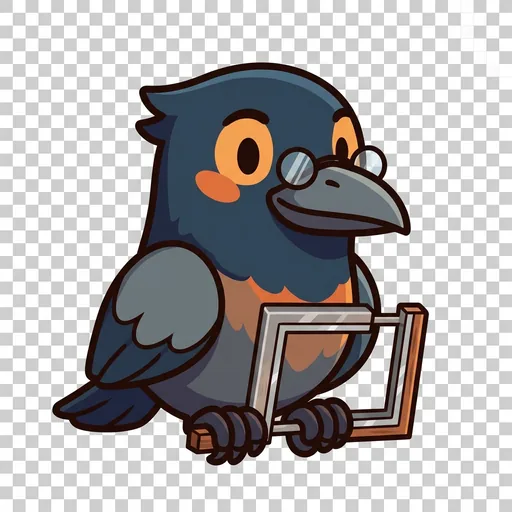
Uncrop
Framing — an image or chart is cropped; ask what sits outside the frame
-

Widen
Context — one number means little without comparison; widen the view



