
Uncrop
UNCROP — *a photo or chart can be true and still lie by what it cuts away. show me what's outside the frame — and where the axis really starts.*
Loading audio…
Press play to listen along. The line being read lights up as you go.
Show full transcript
Loading transcript…
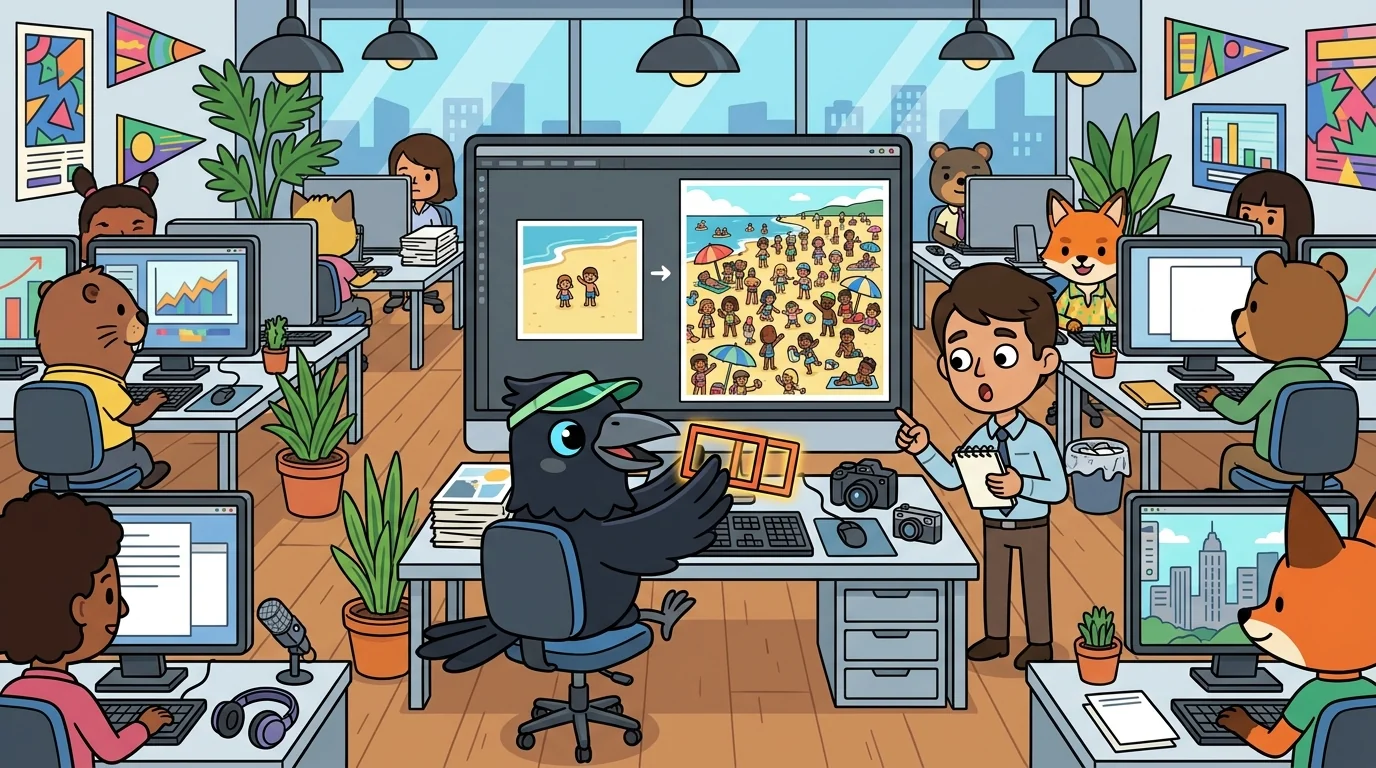
The newsroom had a devastating photo ready to run, and Uncrop was quietly prying its edges back open.
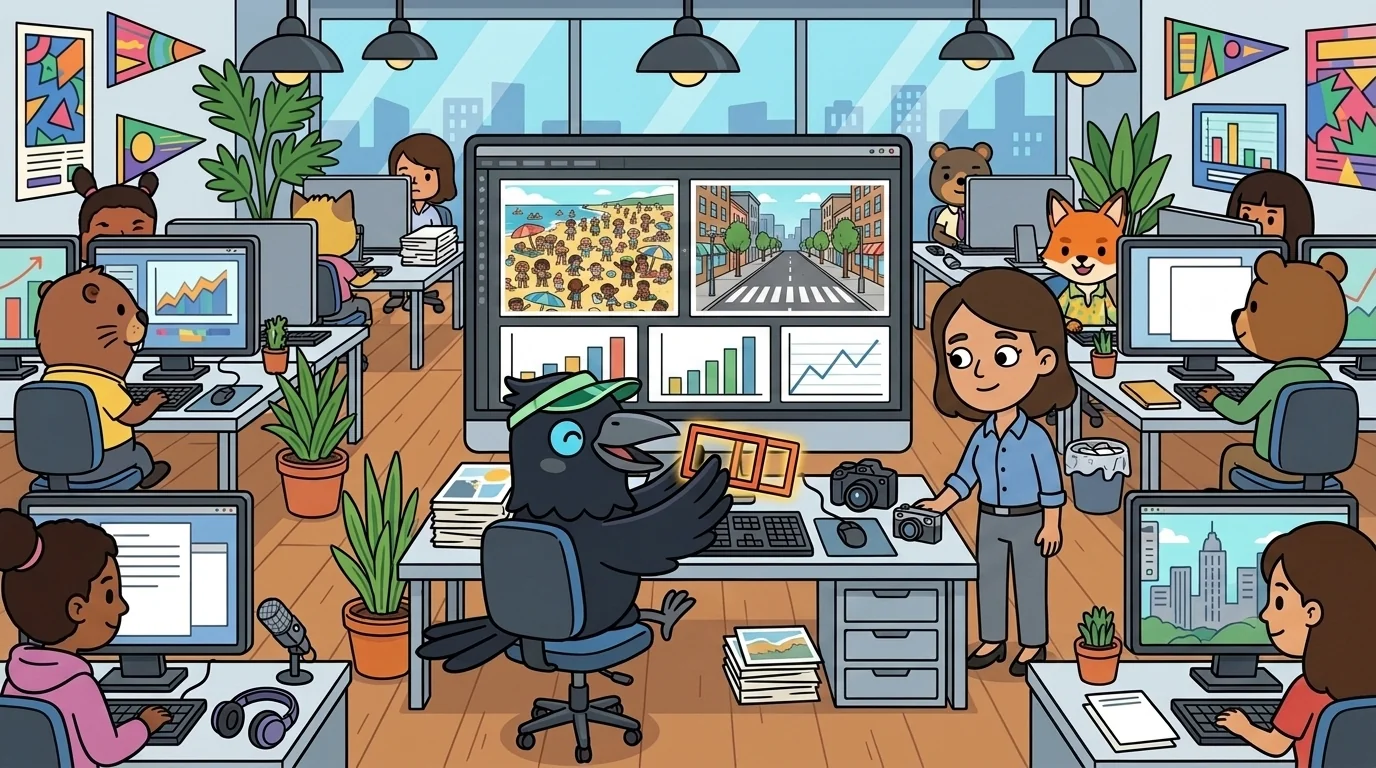
He was a bright-eyed crow at the picture desk, and in his claws he held a pair of sliding frames he could pull apart to reveal more of any image than the person who cropped it had wanted you to see. On the screen glowed a beach — two lonely figures on a wide empty sand — beneath a headline being set in bold: NOBODY CAME TO THE FESTIVAL.
"Perfect," a reporter said. "Look how dead it is."
Uncrop tilted his head and slid the frames apart. The photo kept going past its trimmed edges, and there — just outside the crop someone had chosen — was the rest of the beach: shoulder to shoulder, hundreds deep, a crowd that ran off the sides of the picture. "Every pixel of this is real," Uncrop said. "No one faked a thing. They just took the scissors to it — kept two people, threw the crowd away, and let the empty corner tell a lie the whole photo would have contradicted." He laid the full frame beside the cropped one. "Same beach. Same instant. Same camera. One says deserted. One says packed. The camera didn't lie. The cropping did."
He turned to a second item on the desk — a chart, all dramatic cliffs. "And this is the same trick done to numbers," he said. He reached in and slid the bottom of the chart's scale down, from where someone had started it at 99, all the way to zero. The terrifying cliff sank into a gentle, honest little rise. "A truncated axis is a crop for numbers. Chop the bottom off the scale and a change of one percent looks like a change of a hundred. The data's true. The floor's a fib." He tapped both, photo and chart. "We run the whole beach. We start the axis at zero. Always."
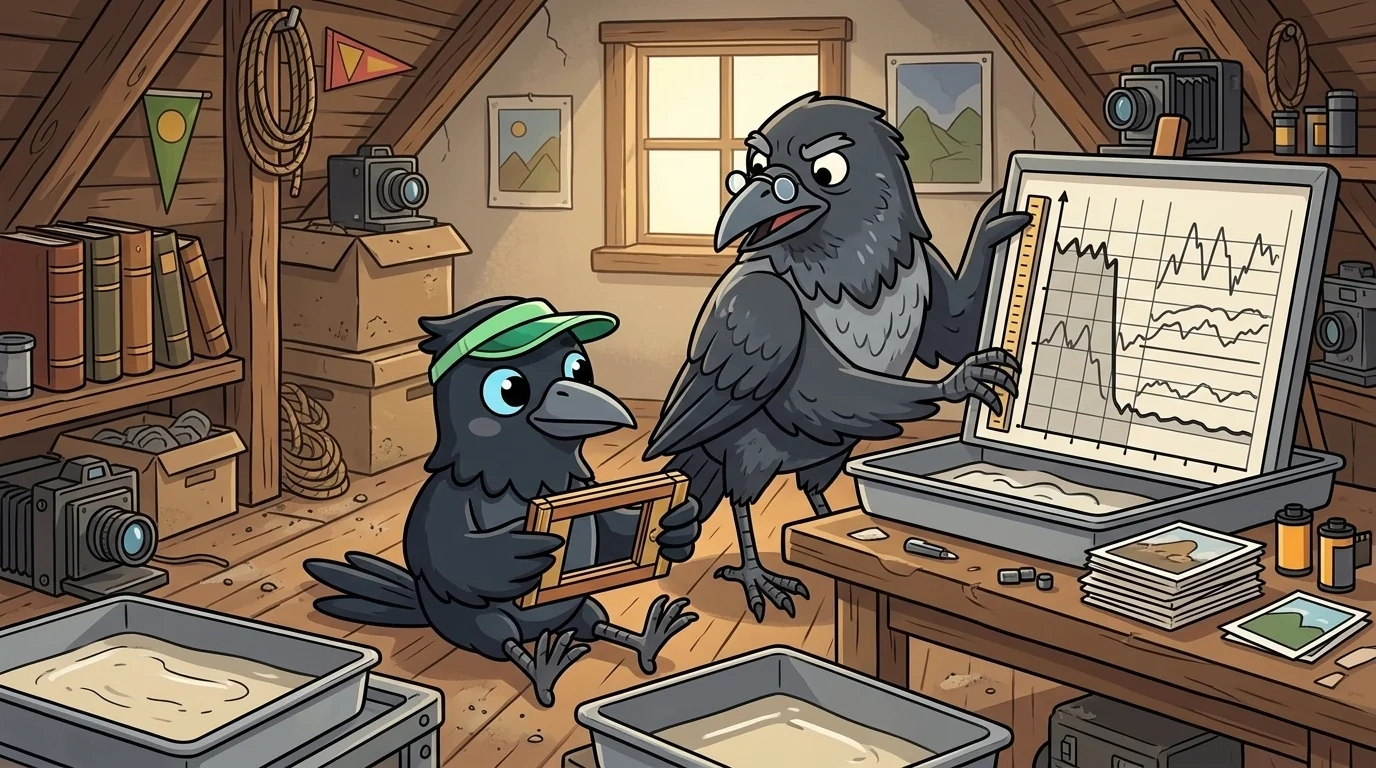
Uncrop had grown up in the rafters of an old photo studio, among crows who developed pictures and kept one unbreakable rule: never trim an image down to where it says a different thing than it did whole.
His father worked the great print trays, and he had a line young Uncrop heard a thousand times: A crop is a choice, and every choice can be a fib. Show the edges. A photograph, he taught, doesn't have to be faked to fool you. You only have to cut away the part that would have changed the viewer's mind. The camera can be perfectly honest and the picture still deceive — because the deception was never in the lens. It was in the pair of scissors that came after.
"A puddle can play a flood," his father said, "if you crop out the dry street all the way around it. The water's real. The 'flood' is a costume made of scissors." He made young Uncrop practice by pulling every cropped photo back to its full size and asking one question: did the story change when you saw the edges? If it did, the crop had been lying — and the size of the change was the size of the lie.
Once, young Uncrop was proud of a chart he'd run: a modest rise in something, drawn to look like a mountain, because he'd started the vertical scale not at zero but partway up, where the small change filled the whole page. His father slid the axis down to zero without a word, and the mountain melted into a low hill. "The numbers never moved," his father said. "You moved the floor. And moving the floor is the most respectable lie in the whole trade, because every number in it is true — which is exactly why so many honest people fall for it. Start at zero, and let the size be the real size."
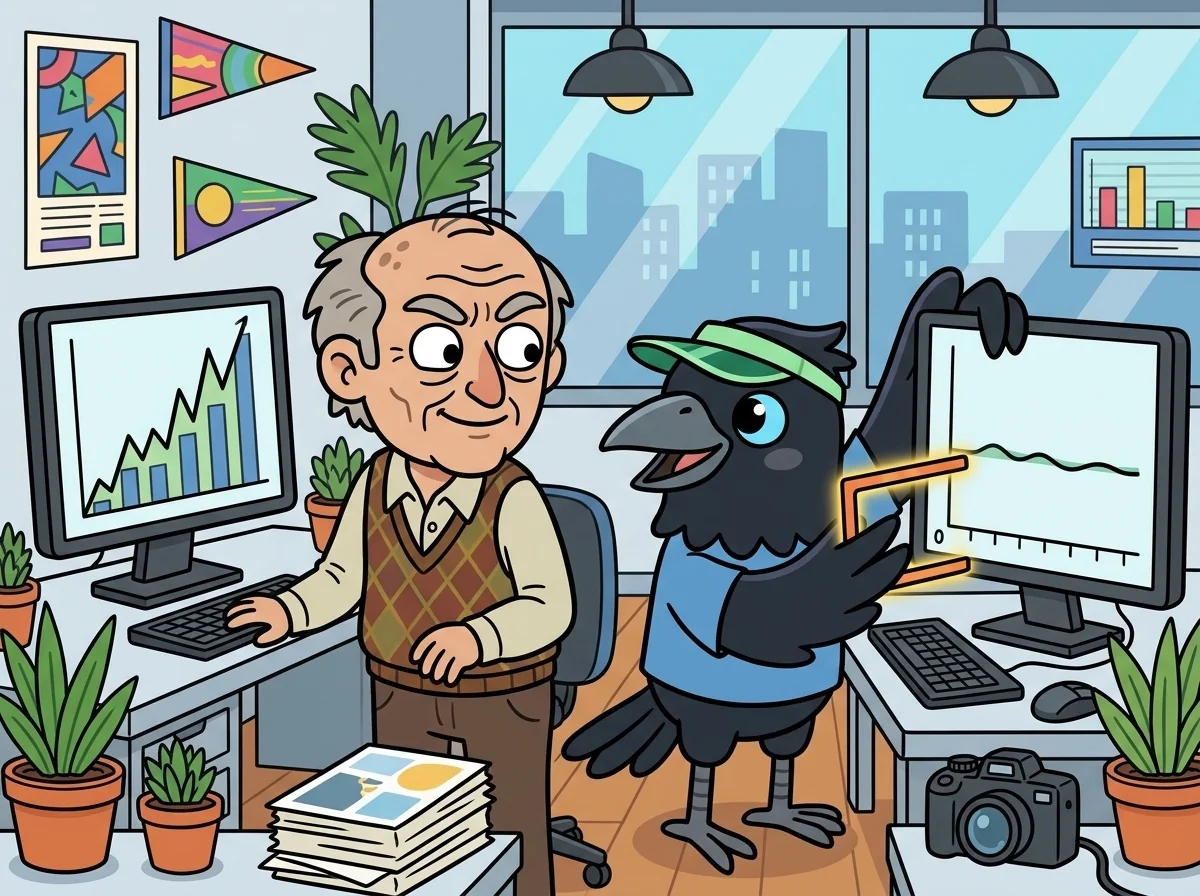
He brought his father's sliding frames to NewsForge along with a deep suspicion of any image that arrived pre-trimmed.
Scoop met him at the door. "What is visual honesty?"
Uncrop answered with two versions of one photograph. In the first, a politician-shaped badger appeared to stand alone before rows of empty chairs. In the second — the same shot, uncropped — the empty chairs were revealed to be behind the camera's chosen frame, in an overflow room, while the actual hall in front was full. "This," Uncrop said, tapping the first, "is what a picture becomes when someone crops it to fit the story they already wanted to tell." He tapped the second. "This is what the camera actually saw." He looked up. "My job isn't to decide whether the badger is good or bad. My job is to make sure the reader is looking at the whole room before they decide anything at all."
Scoop studied both frames a long moment. Then he set down his pencil. "Half this building will run whichever crop makes the better headline," he said. "You're the one who'll pull the frame back open. You belong here."
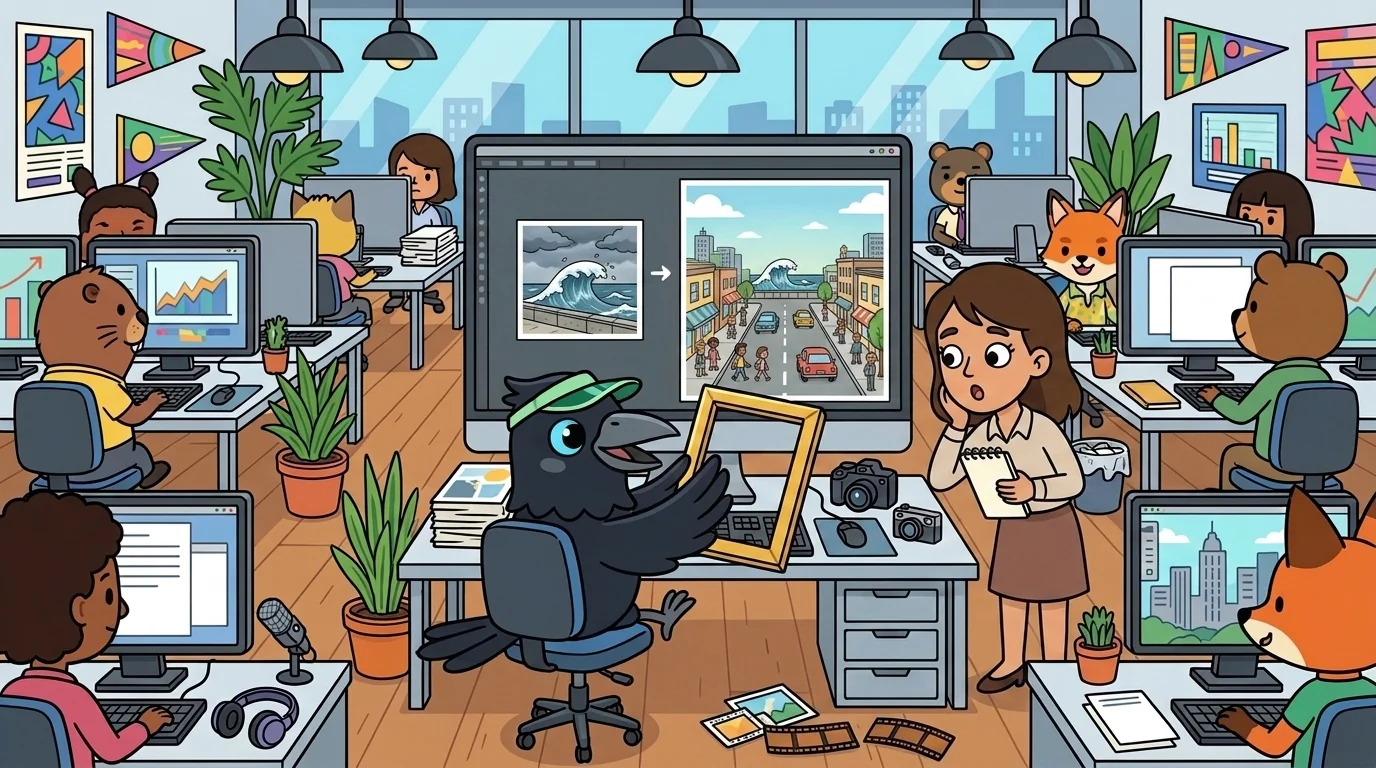
Uncrop's desk drew reporters holding images that seemed too perfect.
A young writer set down a photo, uneasy. "Someone sent me this," she said. "It shows a park absolutely trashed after a community event — garbage everywhere. It's going viral. It makes the organizers look terrible. It's a real photo; I checked it's not faked. So I can run it, right? It's true."
"It may be a true photo of a false thing," Uncrop said, and slid his frames toward it. "Let's ask the questions a viral image is built to make you skip. When was it taken — during cleanup, or the morning after a different event, or years ago somewhere else? Where exactly — is this even the park in question? And what's outside the frame — is this one bad corner, cropped tight, while the rest of the park is spotless?" He spread the frames. "A photograph proves that something looked like this, somewhere, at some moment. It does not prove the caption. The caption is a claim bolted onto the picture — and the picture, cropped tight enough, will hold up almost any caption you like."
The writer looked at the trash-strewn corner. "So 'it's a real photo' answers a much smaller question than I thought. It tells me the pixels are real. It doesn't tell me the story is."
"That's the whole gap," Uncrop said. "A real photo, a real number, a real chart — each is a true fragment. And a true fragment in a frame someone chose can carry a lie as easily as an outright fake. Easier, honestly. Because you check a fake. You trust a fragment."
Later, when the picture desk had gone dark and only Uncrop's screen still glowed, the writer came back with a tireder question.
"When you widen every photo and zero every axis," she said, "don't the images get less powerful? The tight crop, the dramatic scale — that's what makes a reader feel something, stop and look. If we always show the calm whole thing, don't we lose all the punch?"
Uncrop thought about the puddle that played a flood, and the mountain that had really been a low hill, and the respectable lie that fools the honest first.
"We lose the false punch," he said. "The punch that comes from making a small thing look huge or a full room look empty — that punch was borrowed against the reader's trust, and it always comes due." He slid his frames closed. "But a whole image has its own power, and it's a power that lasts: the reader knows we didn't trim it to trick them. So when we do show them something genuinely alarming — the whole beach really empty, the real cliff in the data — they believe it, instantly, with their whole chest. We spent no trust making small things look big. So when a big thing is truly big, we have all our credit left to spend."
The writer looked at the honest, un-cropped photo in front of her — less dramatic, entirely trustworthy — and Uncrop watched the itch go out of her, the pull toward the punchier crop loosening its hold. She had come to the desk half-hoping he'd bless the viral shot; she was leaving with a set of questions that felt less like restrictions and more like a pair of sliding frames of her own. She pulled the photo's edges wider in her mind, one last time, and set it down, and reached instead for the whole beach.
The NewsForge ensemble
Uncrop is part of NewsForge's distributed-narrative cast. Each character embodies a different curricular primitive; together they teach the full subject.
-

Source
Source-quality evaluation — who would KNOW this best? who has a stake? source-card-comparison the routine
-

Tilt
Bias-and-perspective detection — every story has a frame; name the frame, then read; structural NOT partisan
-

Frame
Headline-and-framing craft — a headline is a SUMMARY not a HOOK; counter-clickbait
-

Verify
Verification + lateral-reading discipline — SIFT (Stop, Investigate, Find, Trace); open four tabs, never one
-

Serve
Community-information-needs framing — what does my reader NEED to know to DO something? agency-foregrounding; counter-doomscroll
-

Attest
Attribution — who says so? every claim names its source
-

Deed
Primary source — go to the original document, not a summary of a summary
-

Errata
Corrections — a story is living; when the facts change, the record is fixed
-

Widen
Context — one number means little without comparison; widen the view