Skein and Renew
WHOLE + LIVING
Loading audio…
Press play to listen along. The line being read lights up as you go.
Show full transcript
Loading transcript…
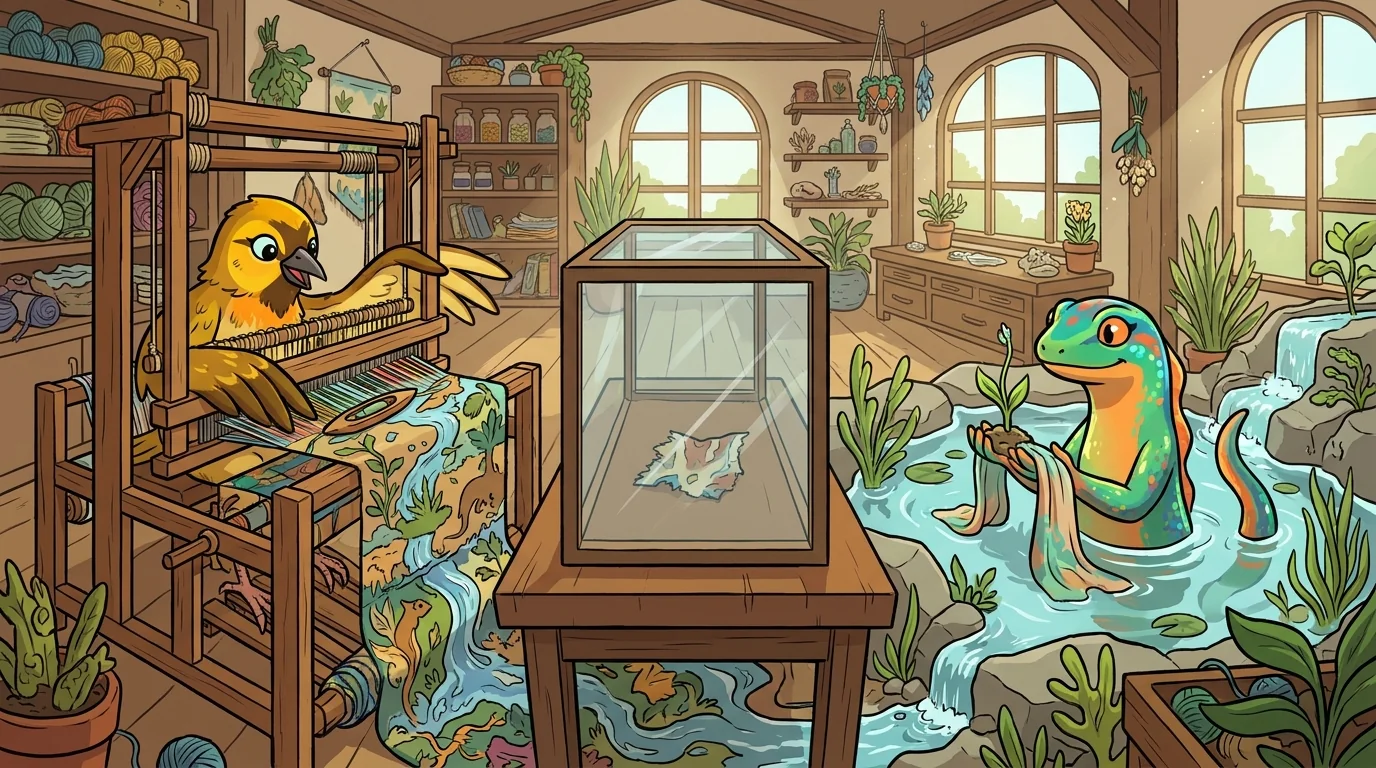
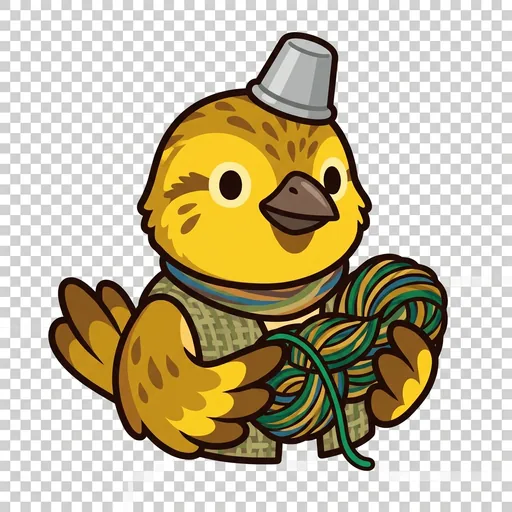
Skein the weaverbird and Renew the newt work side by side, and between them they defend a tradition against the two ways people shrink it into a lifeless thing. Skein guards the whole — she won't let a piece be snipped out of its meaning-weave. Renew guards the living — she won't let a thing be frozen in the past tense, spoken of as gone. And they discovered, working together, that these are two halves of one defense: the way you turn a living tradition into a dead relic is to cut a piece out of it (Skein's worry) and freeze that piece in the past (Renew's worry) — a single fragment, behind glass, labeled they used to. Undo both, and the relic becomes a living whole again.
"Don't tear a piece out of its meaning," Skein says, at her loom. "And don't speak of it as finished," Renew says, bright in her pool. "Whole across its parts," says Skein. "And alive across time," says Renew. "A living thing, kept whole. Not a scrap, behind glass."
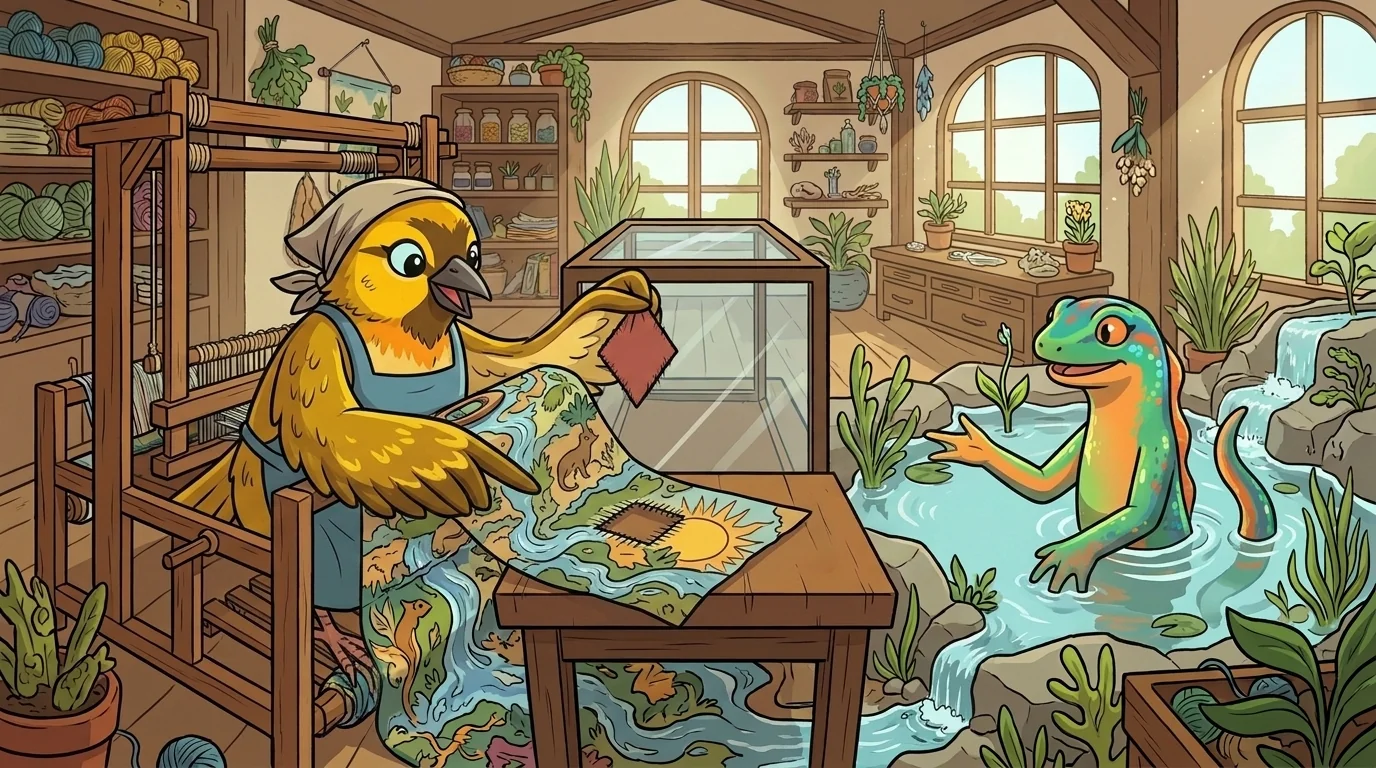
Skein guards the whole. She holds up her woven cloth and points to a single shape within it — a little rising sun, glowing because of the gold and blue around it. Then she snips it out, and in her paw it's just a dull red diamond, its sun forgotten. "See?" she says. "That shape meant sunrise — but only inside its weave. Cut it out, and it forgets what it meant. It's not a treasure now. It's a scrap that says nothing, or worse, says something false." She threads it back, and the sun rises again. "A piece of a tradition — a symbol, a song-verse, a pattern — carries its meaning from the whole it lives in and the people who keep it. So if you love it, don't pluck out the one shiny thread and stick it 'on everything.' Keep it whole enough to remember itself. The weave is the thing. Never just the thread."
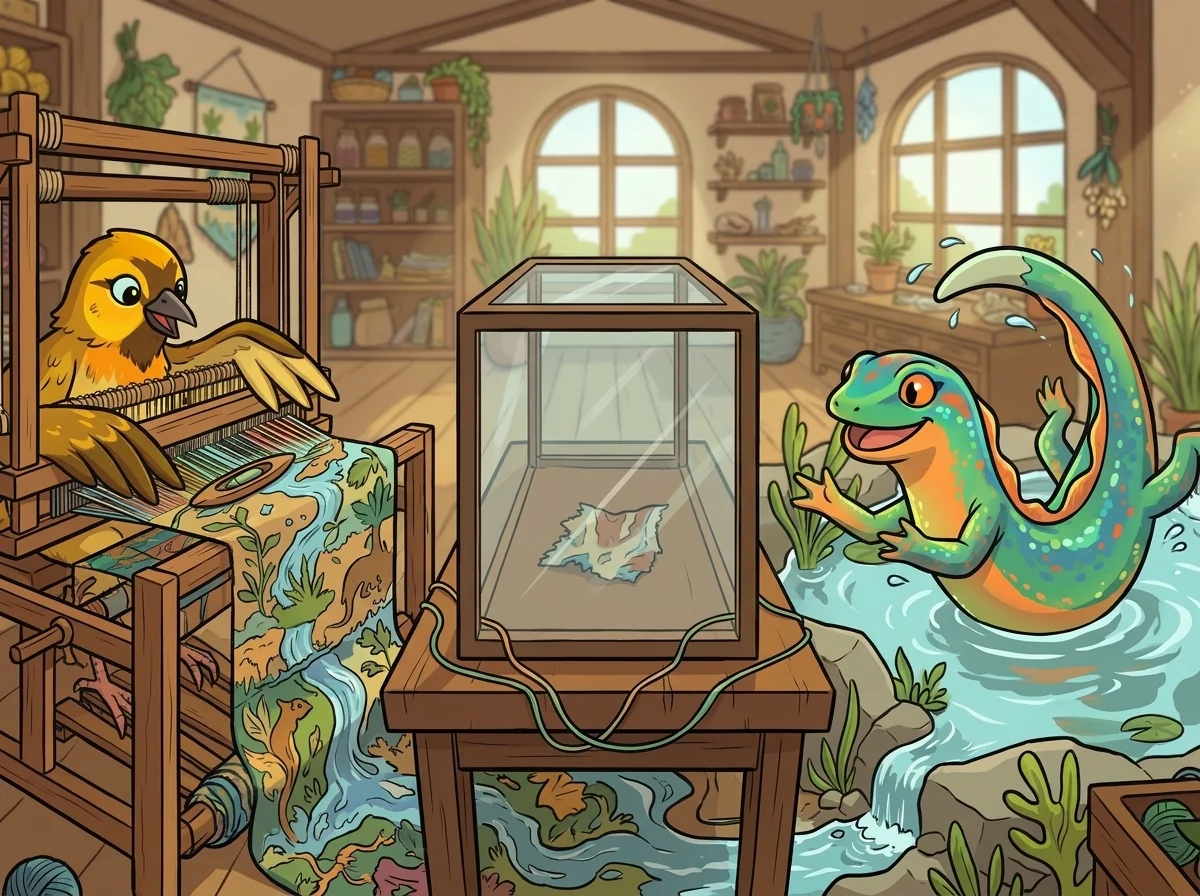
Renew guards the living. She does a bright flip in her pool and grows back the tip of a tail she lost last week — old newt, new tail, both at once. "Skein's right that you shouldn't cut a piece out," she says. "And here's the other way people kill a living thing: they freeze it. They hear a tradition is old and decide it's over — 'they used to do this,' 'a relic of the past' — and stick it behind glass, in the past tense, while the people are right here, still doing it, still changing it." She flicks her fresh tail. "But old isn't finished. A living tradition is old at the root and new at the tip, carried by people who are still here. So I never speak of a living thing in the past tense. I ask: are the people still around? are they still doing this? what do they say about it now? And then I say it in the present: they still do this — and here's how it's growing."
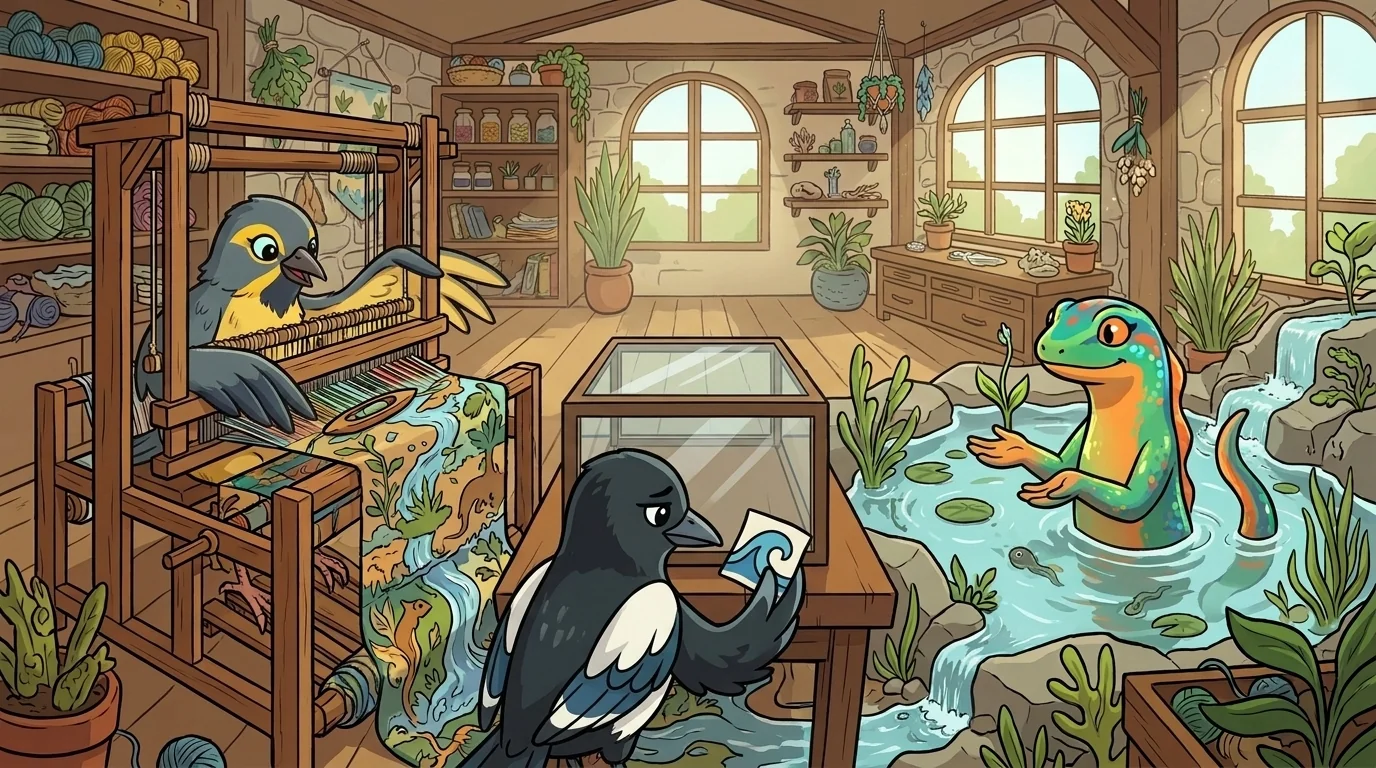
Then a young magpie came to them with something that needed both of their guardings at once — and it showed how the two halves make one whole. He arrived proud, holding a single striking symbol he'd copied from a museum display. The little placard under it had read: an ancient motif, from a people of long ago. "I'm going to use this everywhere," the magpie said. "It's from history — nobody's using it anymore, so it's free, right?" Skein and Renew looked at each other, and each caught a different half of what was wrong. Skein spoke first. "That symbol was cut out of something," she said. "In its home, it lived in a whole pattern that gave it meaning — a rising sun, a river, a story. Ripped out and stuck 'everywhere,' it's forgotten what it meant. That's my half: you've got a thread, not the weave." Then Renew, gently. "And that placard lied to you," she said. "It said a people of long ago — past tense, behind glass. But did anyone check? Very often the people whose symbol that is are right here, today, still weaving it, still holding it as theirs. The museum froze them into history so it could call their living symbol free. That's my half: it isn't a relic, and they aren't gone." The magpie's face fell as it landed. "So it's not 'an old free shape' at all," he said slowly. "It's a piece cut out of a whole — Skein's worry — and it's from people who are still here — Renew's worry. The glass case did both — cut it out, and froze it in the past." "That's exactly it," Skein said. "You need both of us to see the whole mistake," Renew said. "See only my half, and you'd keep the symbol whole but still think its people were gone. See only Skein's half, and you'd know it was a fragment but still think it was free to take because it was 'old.'" "Together," Skein said, "we see the truth: it's a living whole, cut into a dead scrap. And the honoring is to undo both — put the piece back in its whole, and speak of its people in the present, still here."
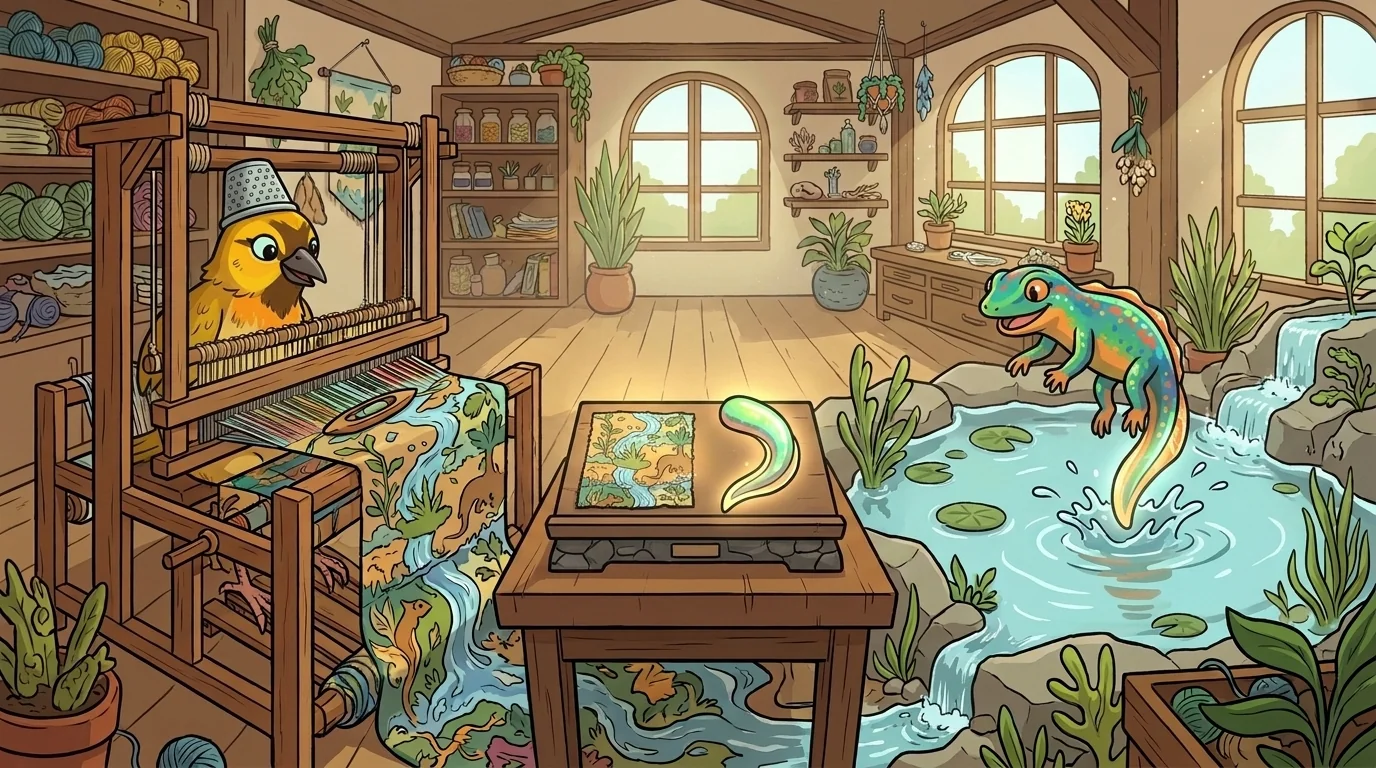
"So a tradition isn't a scrap behind glass," the magpie said, working it out, "it's a whole thing — and a living thing — and I dishonor it if I forget either?"
"That's the whole of it," Renew said, doing a small glad flip, and Skein bobbed her thimble-capped head. Skein set down her complete, glowing weave; Renew set down her fresh-grown, shining tail; and together they placed the two — the whole and the living — side by side, so no one could mistake the tradition for a fragment or for a fossil. Under the quiet, the two of them felt the same protective calm settle in: not the flat wrongness of a snipped-out scrap, not the erased ache of a they-used-to, but a warm, paired, whole-and-alive steadiness — the particular peace of two who each guard one half of a living thing, so that between them a tradition stays itself: whole across its parts, alive across its years, and never once shrunk to a dead piece behind glass. That whole-and-living, uncut-and-unfrozen, still-here-and-all-of-a-piece feeling, steadier than either wholeness or liveliness alone, was to Skein and Renew exactly why they work side by side, and never let a living whole be turned into a relic.
Hear it as an audio drama
A short play starring Skein and Renew, from OriginForge. Different voices, same idea. Listen any time after you read.
Loading audio…
Read the drama script
- Narrator: From Spark and Anvil and OriginForge — this is Skein and Renew, in chapter 1 of the OriginForge cast.
- Narrator: This drama uses an AI-generated voice. Voiced via Gemini 2.5.
- Narrator: This story covers origin stories from many cultures. Parents may want to listen first.
- Narrator: Skein the weaverbird and Renew the newt stood before an imaginary display case drawn on the wall — a single motif in a frame, with a card beneath it reading they used to weave this.
- Hare: Look what I made to honor a faraway people! Their most beautiful pattern, framed, with a nice label. Isn't it respectful?
- Skein: One piece. Cut out of its weave. On its own it's forgotten what it meant. That's my worry.
- Renew: Past tense. Used to. As if they're gone. But they're almost never gone. That's my worry.
- Hare: So... I did two wrong things, not one?
- Skein: Two. And here's what we just realized — they're not separate. They're how you make a relic. To turn a living tradition into a dead thing behind glass, you cut a piece out of it —
- Renew: — and you freeze that piece in the past. One fragment. Past tense. Framed. That's the whole recipe for a relic.
- Narrator: Renew reached up and wiped away the little card.
- Renew: First, the tense. Not they used to weave this. They weave this — present, alive, and changing. Look for the people; they're almost always still there.
- Narrator: Skein drew, around the lonely motif, the rest of its weave, until the fragment was a whole cloth telling a whole story again.
- Skein: Second, the whole. Not one piece in a frame. The pattern it lives in, meaning intact.
- Renew: There. Whole, and alive. That's a tradition honored. The other thing — a fragment behind glass, labeled used to — was never honor. It was a beautiful way of saying these people are a finished object I get to display.
- Skein: And they're not an object. They're a weave. And they're not finished — they're alive. You need both words, or you've still got a relic.
- Narrator: The hare went off to un-frame her case, having learned to defend a living tradition with both hands — one keeping the pattern whole, one keeping the tense alive.
- Narrator: You've been listening to a Spark and Anvil chapter, written by the Spark and Anvil writing team for ages 9 to 14.
- Narrator: Apps stay free forever.
- Narrator: Curriculum aligned to C3 social studies.
- Narrator: If anything in this story brought up big feelings, talking to a trusted adult helps. You can also reach support lines anytime.
- Narrator: With cultural-knowledge credit to the Indigenous, traditional, and community knowledge holders whose practice and care this story draws on.
- Narrator: Released under Creative Commons BY-NC-SA 4.0 for educational reuse. Visit Spark and Anvil for the full transcript.
The OriginForge ensemble
Skein and Renew is one of the friends in OriginForge. Each friend shows you one idea by how they act; meet them all and you have the whole subject.
-
Listen
Listening before claiming — hear how a tradition says it first, on its own terms
-
Trail
Trail-following — every origin is also a journey; honor the path itself
-
Carry
Carrying-forward — knowledge wasn't found, it was given; honor the hands that passed it
-
Honor
Honoring multiple truths — science and story answer different questions; both can be true
-

Greet
Greeting — knock before you enter; wait to be invited; ask permission before listening
-
Convey
Faithful transmission — a story crossing tongues spills a little; carry it humbly, and say what you might have lost
-
Renew
Living tradition — a tradition is still growing, not a relic behind glass; the people are still here
-
Return
Reciprocity — knowledge is a relationship, not a taking; when you receive, you also give back
-
Skein
Wholeness — don't pull one thread from the weave; a piece torn from its whole forgets what it meant
-
Spare
Respecting the closed — some knowledge is closed, and closed is not a puzzle to solve; respect the 'not for you'