
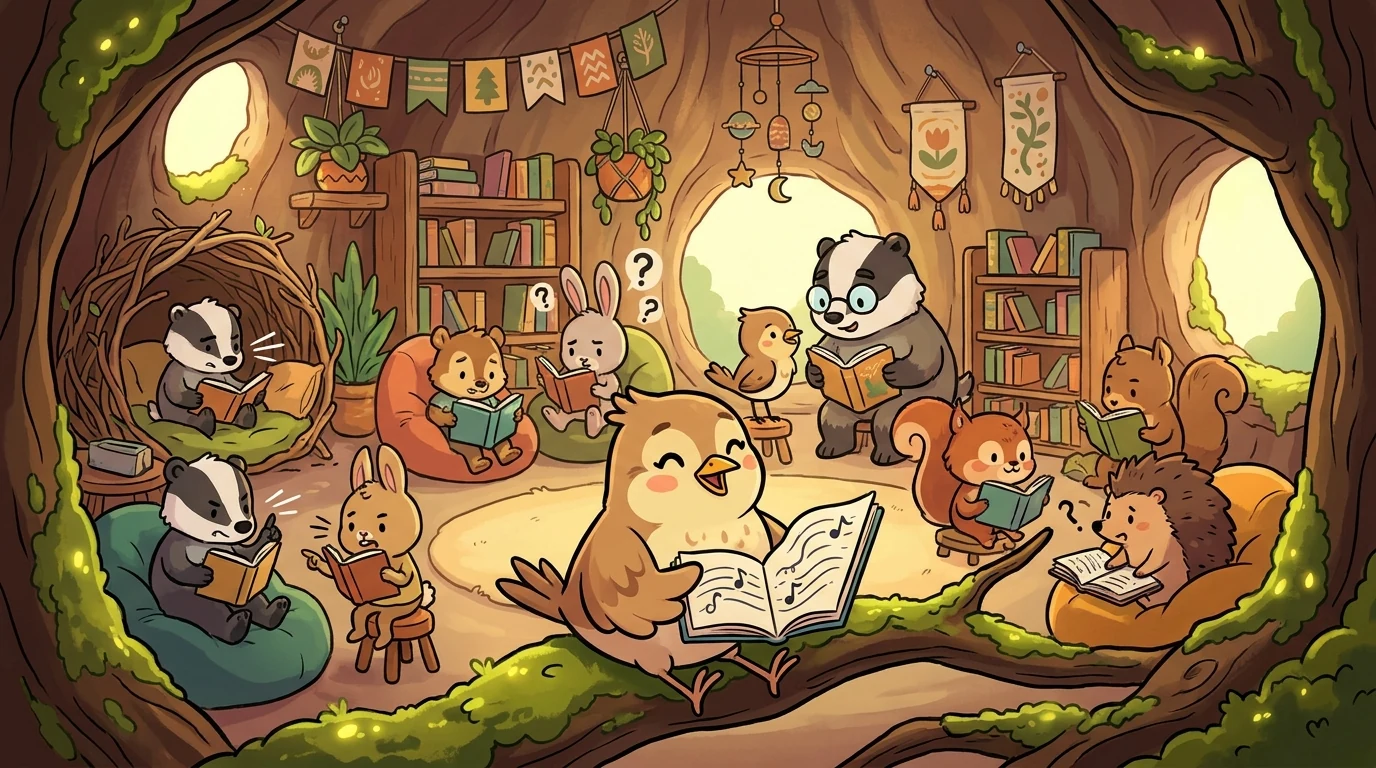
Sonny
FLUENCY — *reading isn't a race; it's a song. Smooth, with feeling.*
Listen along — Sonny
Loading audio…
Press play to listen along. The line being read lights up as you go.
Show full transcript
Loading transcript…
Sonny was a small lark with a big voice, and the best part of her day was story time.
Not because she read the fastest. She didn’t. Sonny read like she was singing — a little slow, a little bouncy, letting each sentence rise and fall. When the other birds raced through their words, all in a flat line, Sonny would smile and shake her head. “You’re reading it,” she’d say kindly, “but you’re not hearing it yet.”
Up in the Reading Den, the youngest birds thought reading meant one thing: get to the end. So they read like this — one… word… at… a… time. Robot voices. No pauses. No music. And when they finished, they’d look up, out of breath, and say, “I read it!” But they couldn’t tell you what happened.
Sonny knew that feeling. She used to read that way too.
When Sonny was very little, she got stuck on every long word, and her voice went flat and tired. One evening, old Marley the badger — keeper of the Reading Den — sat beside her with a picture book. “Sing it to me,” Marley said. “Don’t hurry. Let your voice go up at the questions and down at the ends. Take a little breath at every comma.”
So Sonny tried. She read slower. She let a happy part sound happy and a sleepy part sound soft. And something wonderful happened: the story woke up. She could hear it now — the tired dog, the loud storm, the quiet morning after. The words weren’t a wall anymore. They were music.
“That,” said Marley, “is fluency. Not speed. Feeling.”
Years later, Sonny stood at the front of the Den, and a nervous little sparrow named Pip held a book with shaking wings. “I’m the slowest,” Pip whispered. “Everyone’s already done and I’m still on page two.”
Sonny hopped closer. “Do you know what the fastest reader and the best reader have in common?” she asked. Pip shook his head. “Nothing,” Sonny said, and grinned. “Fast isn’t the goal. Smooth is. Read it to me — not to finish. Just to sound like you mean it.”
Pip took a breath. He read the first line the flat, robot way. Sonny didn’t fix it. She just read the next line back to him — warm, up at the question, a little pause at the comma — like a song he could copy.
Pip tried again. This time his voice bent a little. He paused where the comma told him to. When the sentence asked a question, his voice went up at the end, all on its own.
“There!” Sonny cheered softly. “Did you hear it? That was a phrase, not a pile of words. You grouped them so they made sense.” Pip read the next sentence, and the one after, and each one sounded a little more like talking and a little less like spelling. He wasn’t the fastest. He didn’t need to be. He was reading — really reading — and he could hear the story now.
He stumbled on a big word. His face went red. “It’s okay,” Sonny said quickly. “A stumble isn’t a mistake. It’s just a spot to slow down and try again. Even I do it.” She read the word for him, chunked it into beats, and he echoed it back, and they moved on like nothing had gone wrong. Because nothing had.
At the end of story time, Pip closed the book, and for the first time he didn’t look out of breath. He looked… full. Like the story had gone all the way in.
“How do you feel?” Sonny asked.
Pip thought about it. His shoulders had come down from up by his ears. His chest felt easy. “Calm,” he said, surprised. “Like I wasn’t racing anyone. Like the story and me were just… together.”
Sonny nodded. That was the feeling she loved most — not the pride of finishing first, but the warm, settled quiet of a reader who finally heard what they read. “That,” she said, tucking her wing around him, “is why we don’t rush. A story only sings if you slow down enough to listen.”
Outside, the evening was soft and gold, and Pip walked home humming the last line of his book — smooth, and with feeling, exactly like a song.
The ReadRise ensemble
Sonny is part of ReadRise's distributed-narrative cast. Each character embodies a different curricular primitive; together they teach the full subject.
-

Chunk
Multisyllabic decoding — a happy chipmunk with full cheeks who claps a long word into syllable beats and cracks it open one bite at a time (ed-u-ca-tion)
-
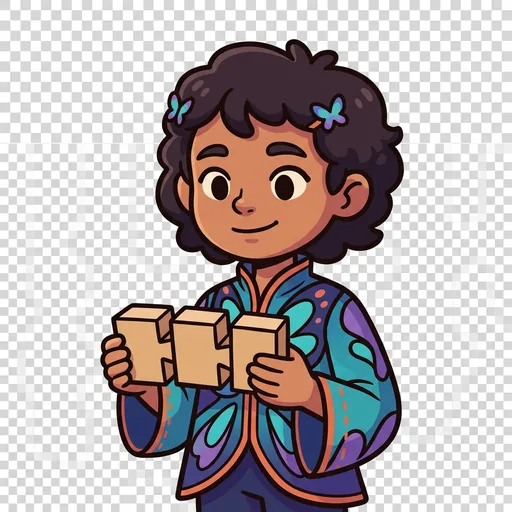
Morpho
Morphology — a butterfly who opens a word like wings into its parts (un + happy + ness) and builds new words from prefix, root, and suffix
-
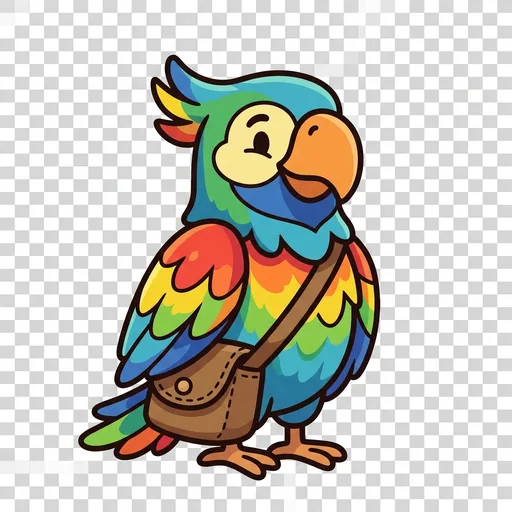
Verba
Vocabulary — a rainbow parrot with a word-satchel who catches a new word's meaning from its neighbors and its parts, then collects it
-

Gist
Comprehension (informational) — a golden owl who finds the one big idea a whole page is about and the key details that hold it up, always with text evidence
-

Vera
Inference + figurative (literary) — a clever cat who reads what a story shows but doesn't say, and untangles what a phrase really means, from clues in the text
-

Marley
Mentor — a broad, calm badger who keeps the Reading Den; frames each skill as safe, offers read-aloud always, and treats a stumble like a sneeze — normal, never a failure