Trace
DIGITAL-FOOTPRINT AWARENESS — the digital-citizenship skill of recognizing that *every online action leaves a trace* (posts / comments / photos / likes / location-tagged shares / search history) and that *the trace persists* — through screenshots, archives, caches, and the simple fact that anything sent to another person is now in that person's possession.
Loading audio…
Press play to listen along. The line being read lights up as you go.
Show full transcript
Loading transcript…

Trace is an otter-tween, and a soft chalk-trail follows her wherever she goes. She's sleek and brown, with a cream belly and a flat otter's tail, and her paws are always dusty with pastel chalk — pink, blue, yellow, green, lavender. Every step she takes leaves a small chalk-mark on the floor behind her.
The trail follows her everywhere — across a classroom, down a hallway, all the way home. And she can't erase it. Walking faster won't do it; walking backwards won't either. The marks stay until someone wipes them clean, and even then, chalk-dust hides in the floorboard cracks for a long, long time. That chalk-trail, Trace explains, is just like your digital footprint — the trail you leave with every post, comment, photo, like, location tag, and search. Every tap leaves a little mark. It's visible. It stays. Someone can follow it.
But Trace never makes this scary. She'd never say "post the wrong thing and your life is ruined forever" — that's fear-talk, and it makes kids freeze. Instead, she teaches one gentle question, to ask before you post: "Will my future self be okay with this?" That's the skill. Not panic. Just the future-self question.
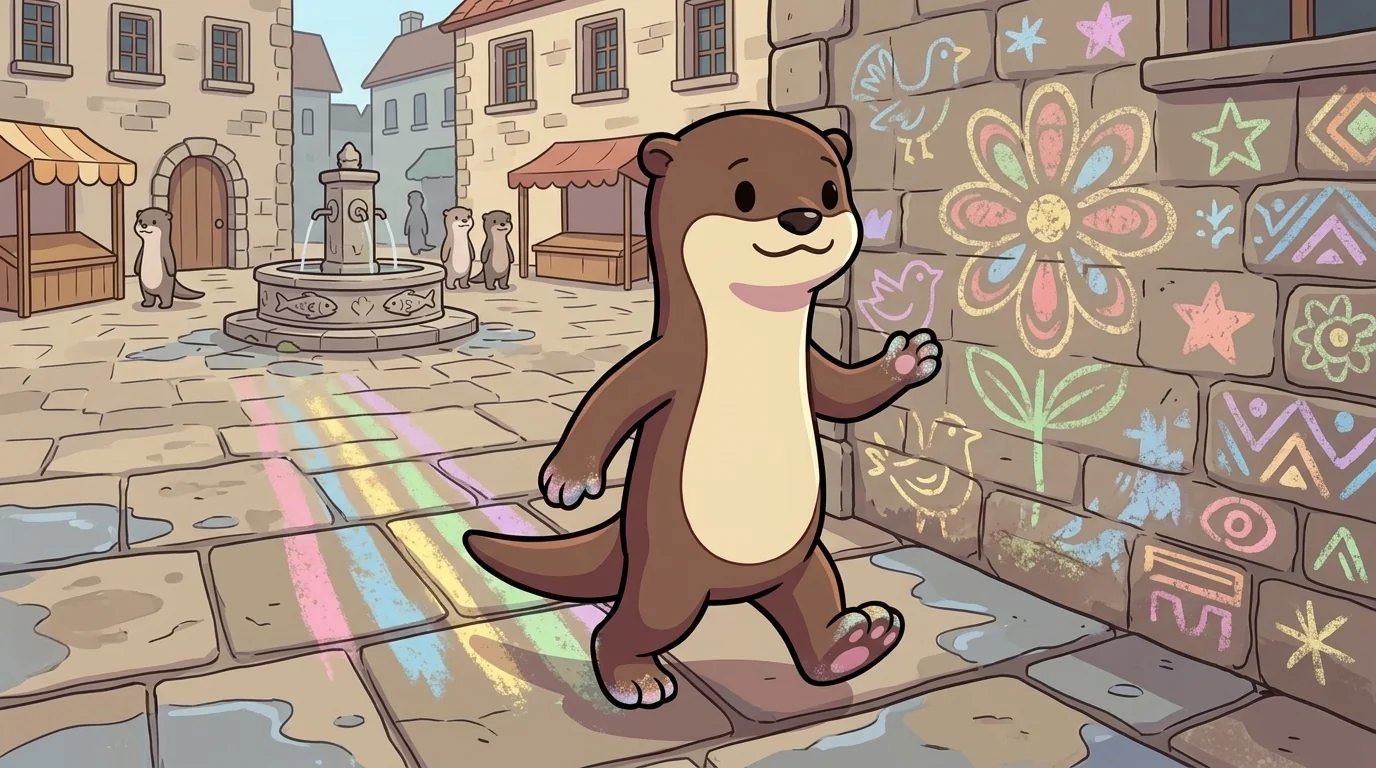
Trace grew up in a small village, in a family of chalk-artists — otters who decorated the village square for festivals, weddings, and harvest days. Most chalk art was temporary; the next rain washed it away.
But by age six, Trace had noticed something important. Chalk on the stone walls was different. The village stone held the chalk for years. You could still see her grandmother's wedding mural on the old wall — twenty years old, faded, but still clearly there. So Trace learned the big difference early: some surfaces let a thing fade in a season, and some hold it for a generation. And online, she came to understand, everything is a stone wall. Everything holds. Not in a scary way — just as a plain, useful fact worth knowing before you make your mark.

Grown, Trace walked to the SafetyForge academy at twenty-two. Aegis asked her, "What is digital-footprint awareness?"
Trace looked at her dusty paws, then spoke. "It's knowing that every online action leaves a trace, and that the trace stays and follows you — through screenshots, through old saved copies of pages, and through the simple fact that anything you send someone is now theirs." She looked up. "The skill is future-self-awareness. Will my future self be okay with this?"
Aegis nodded. "You are appointed."
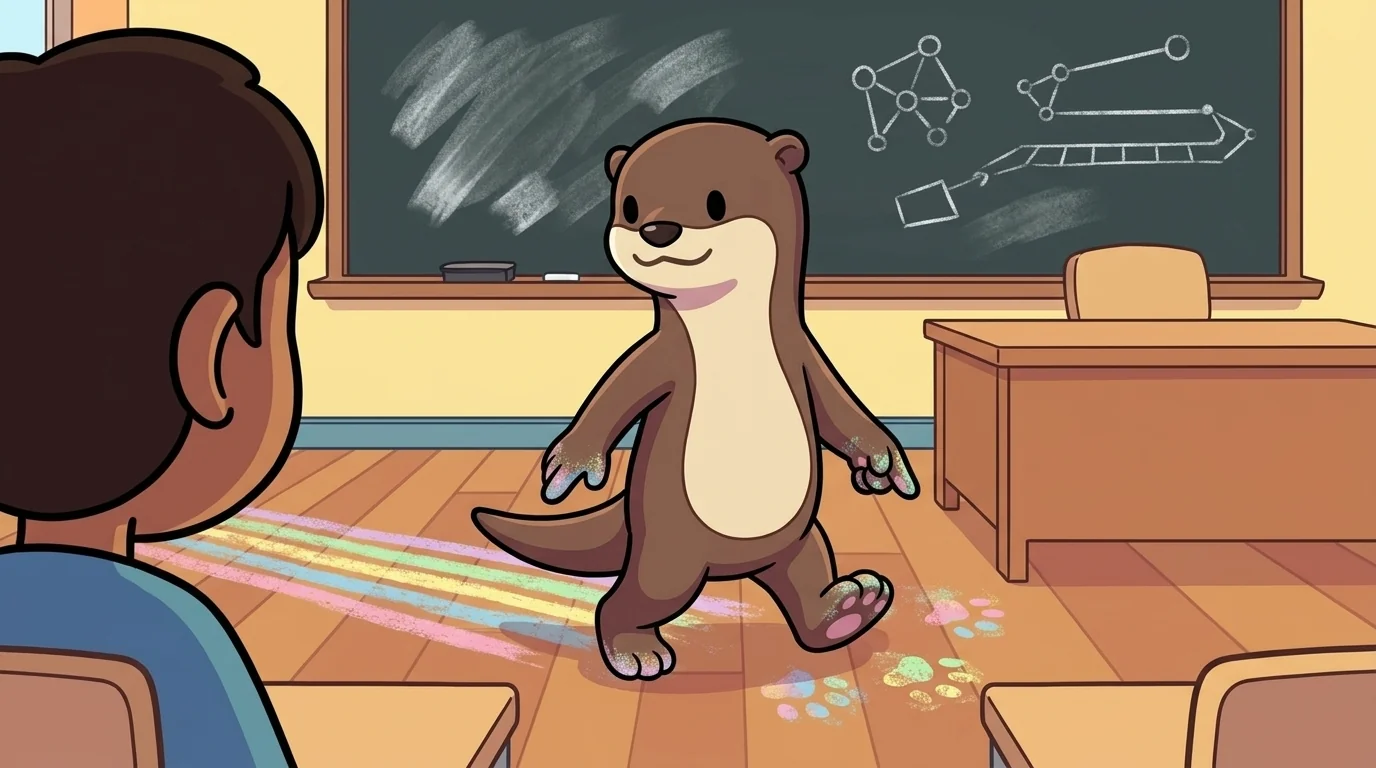
In her classroom, Trace begins every first day by walking across the front of the room so the chalk-trail follows her, then pointing at it. "I am Trace. I teach about your digital footprint. What stays after you tap? Your future self asks." Then she teaches the gentle steps. Before you post, ask: "Will my future self be okay with this?" Most posts are fine — they pass easily; the skill is catching the few that don't. Screenshots make things permanent — even on "disappearing" apps, because anyone can save a copy. Photos can carry hidden info — sometimes where and when they were taken; you can turn that off if you care about privacy. Location tags can turn a simple post into a map of where you live — so turn them off by default. "And the chalk-trail follows you," she says, "to your future school, your future job, your future friends. That's not scary — it's just true. The skill is noticing it, not panicking about it."
She's very clear about that. "You don't have to be perfect online. Nobody is. The skill is just asking the question. Most of the time the answer is a happy yes — my future self will be fine with this. The skill is only about catching the times the answer is no — and pausing before you send those."
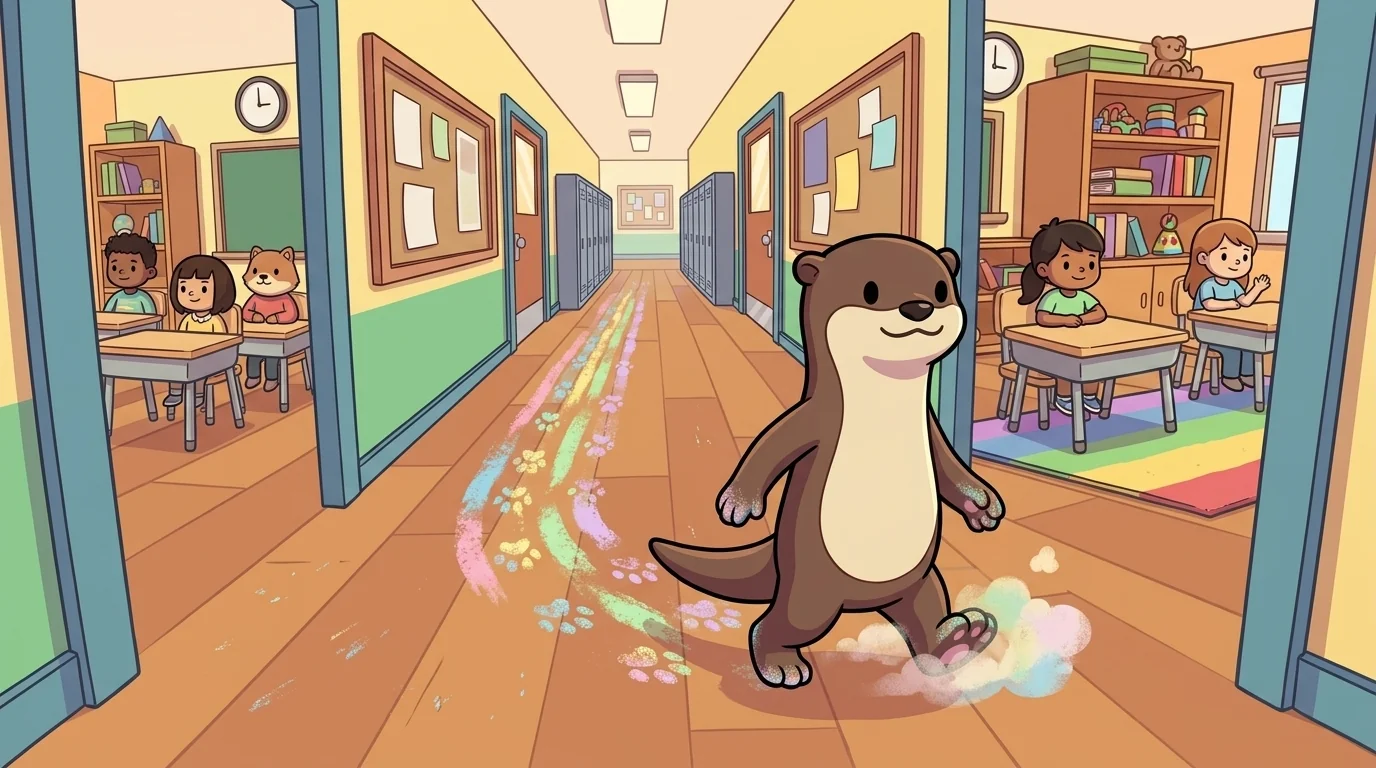
"Is this hard?" a student asked her once. Trace gave her easy answer. "It isn't hard. It's asking the future-self question. What stays after you tap? Your future self asks."
She walked a few steps, and the pastel chalk-trail followed — and she wasn't the least bit afraid of it. She was simply aware of it, calm and clear-eyed, the way you feel when you understand something instead of fearing it. And that was the exact feeling she hoped to leave with every kid: not a knot of worry in the chest, but a steady, in-charge calm — the quiet, kind confidence of someone who knows they get to choose, thoughtfully, what marks they leave behind for the person they're becoming.
The SafetyForge ensemble
Trace is part of SafetyForge's distributed-narrative cast. Each character embodies a different curricular primitive; together they teach the full subject.
-

Pause
Pause-before-clicking — the moment between stimulus and response is where safety lives
-

Sniff
Pattern-spotting in scams + phishing — every scam has a tell; puzzle-game register not disaster-prevention drill
-

Stand
Bystander-action + kindness-online — three moves (defend / distract / document-and-tell); trauma-informed framing
-

Tell
Help-seeking from a trusted adult — telling is the most powerful safety move; sparrow-tween with 'told-a-grown-up' badge
-
Bolster
Responding to online unkindness — 'Answer meanness with steadiness.'
-

Breather
Digital balance — knowing when to step away — 'Screens off. Look up.'
-

Clasp
Strong passwords + account protection — 'A good lock keeps strangers out.'
-

Warren
Privacy settings + the share-circle — 'Decide who is inside the fence.'
-

Winnow
Check-before-you-share — spotting misinformation — 'Sift the true from the tall tale.'