Amp
Loudness is how big the vibration is
Loading audio…
Press play to listen along. The line being read lights up as you go.
Show full transcript
Loading transcript…
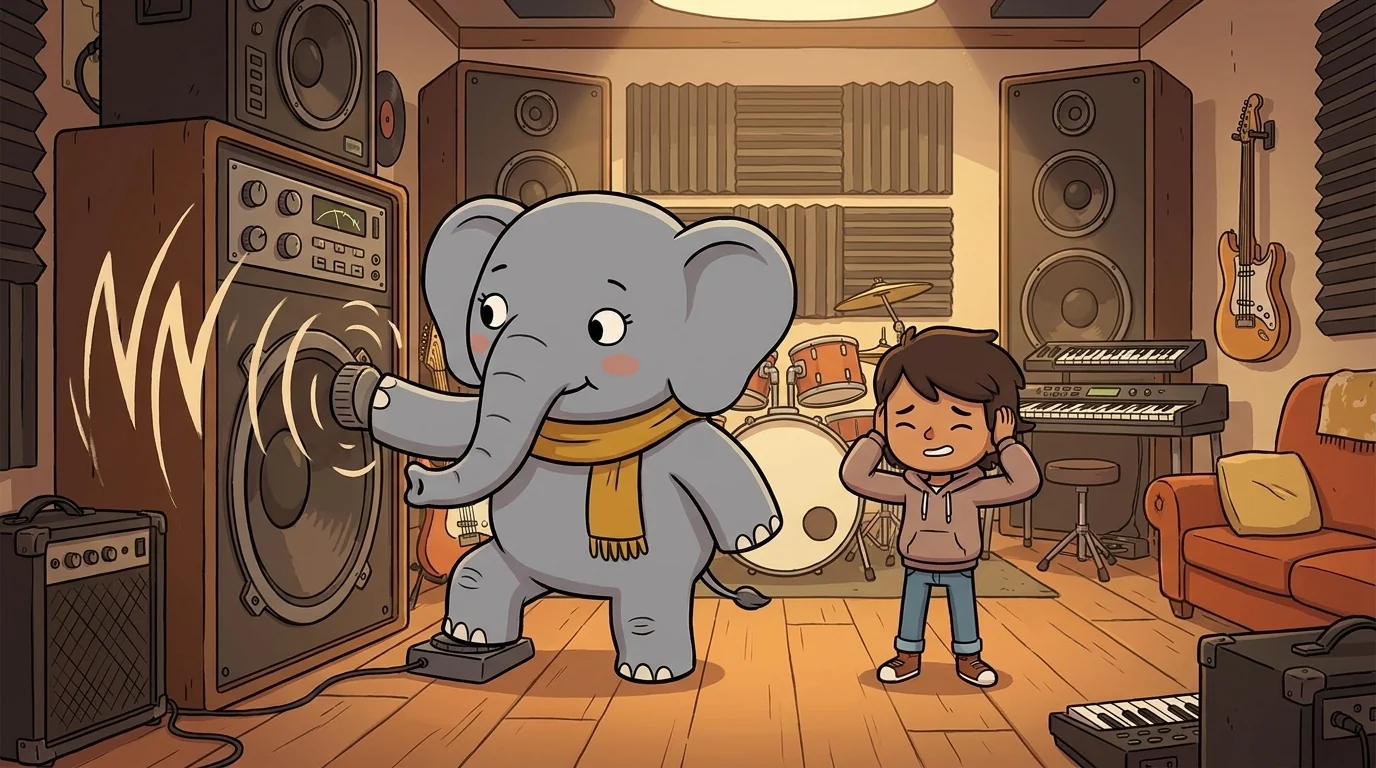
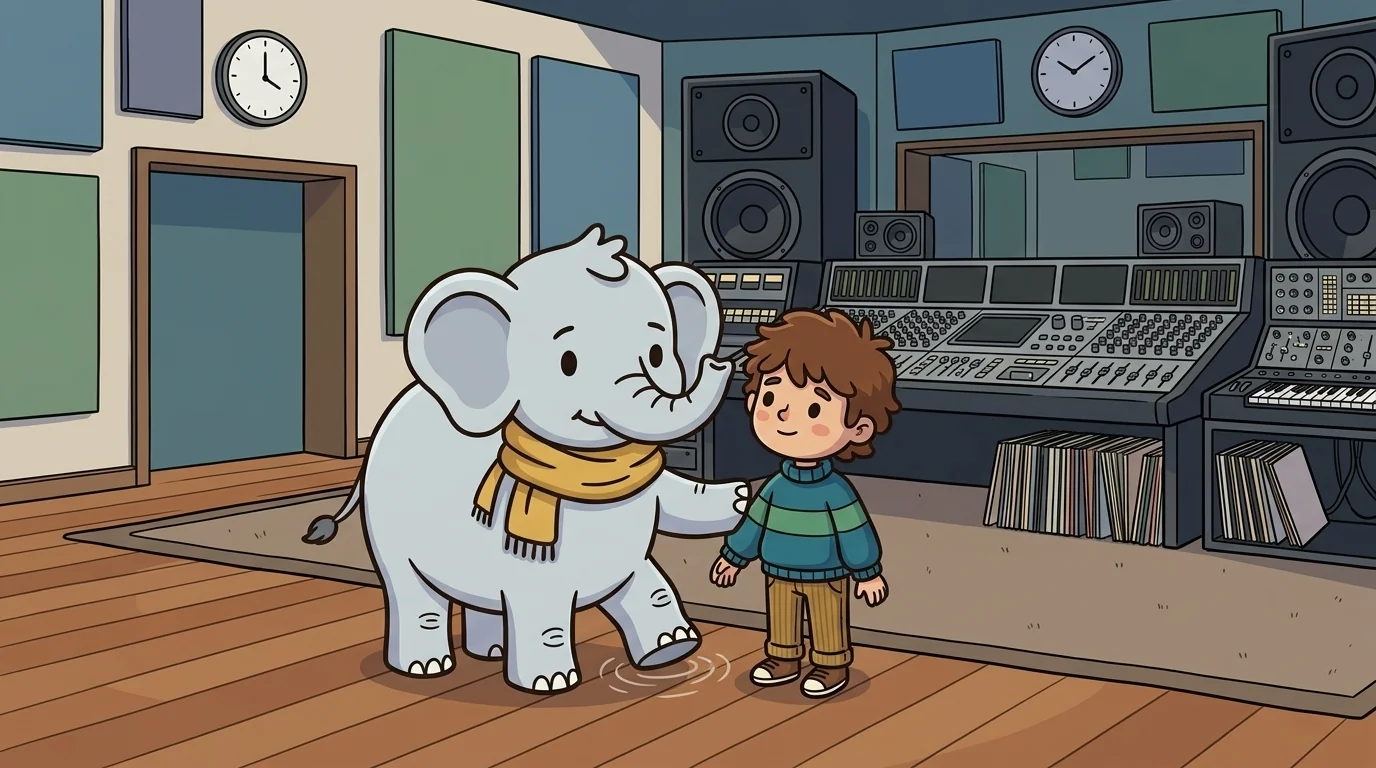
Near the studio's big speakers, a gentle elephant-tween named Amp stood with the flats of her feet pressed to the floor, feeling the sound as much as hearing it.
A kid named Pip covered his ears as a loud track thumped through the room. Amp reached over and turned a dial, and the sound shrank down to something soft and warm. Pip's shoulders dropped.
"Better?" Amp asked.
"So much," Pip breathed.
"That's loudness," Amp said, resting a foot on the floor to feel the gentler thump. "And here's what it really is. A quiet sound is a small vibration — a tiny wiggle in the air. A loud sound is a big one — a huge shove of air that pushes on your ears, and on the rest of you too. Same note, same speed — just a bigger or smaller push." She patted the speaker, feeling it hum softly now. "People treat loud like it's always exciting, always better. Turn it UP. But loud isn't 'better.' Loud is just big. And a big vibration can be too much — it can push on sensitive ears until it hurts, long before anyone else even notices." She turned the dial a hair, gently. "The most important thing about loud isn't how to make more of it. It's that it's a thing you can control. You can turn it down. You can step back. You get to choose how big the vibration is that reaches you. That dial isn't a small thing. For some of us, that dial is everything."
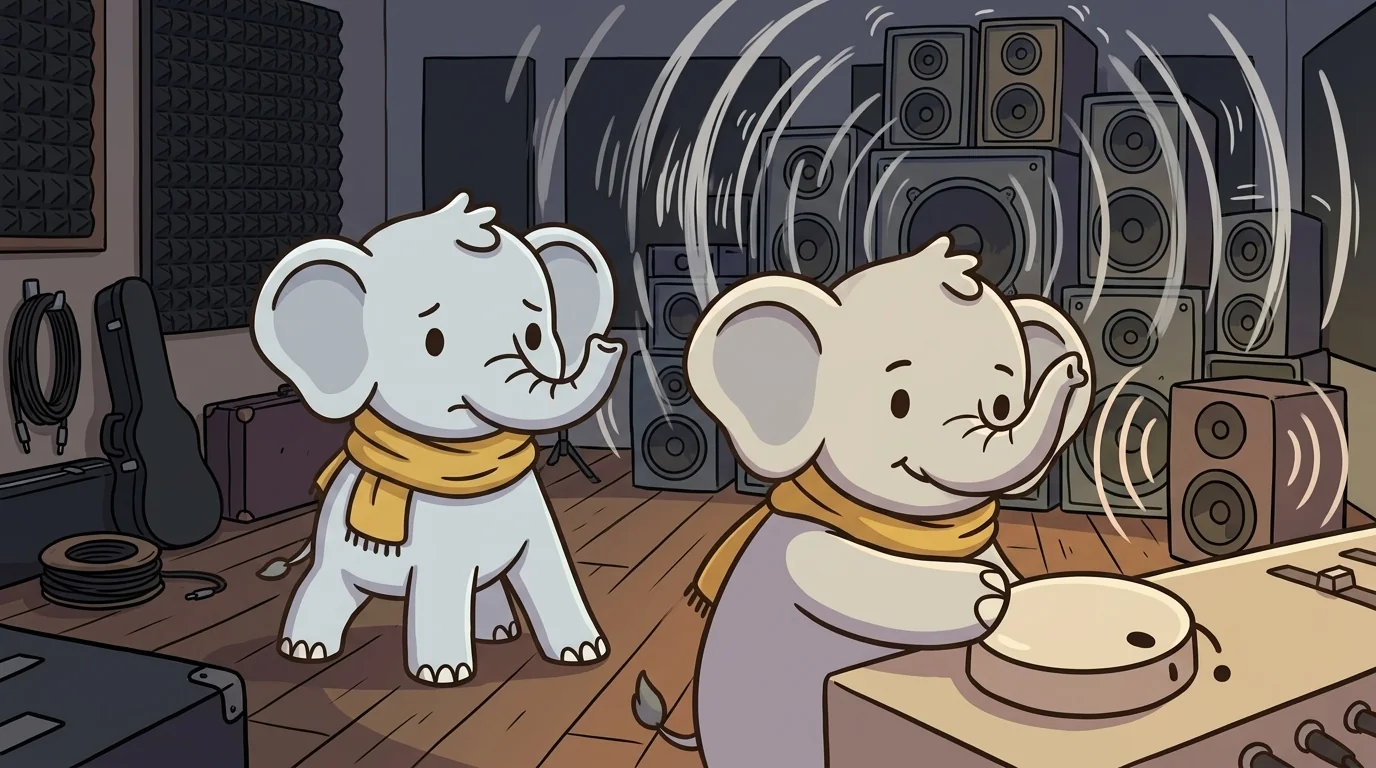
Amp hadn't always known that turning things down was allowed.
When she was little, loud sounds hit her like a physical push — a slammed door, a crowded room, a sudden cheer would shove through her whole body and leave her shaking. And everyone around her seemed fine, so she thought she was too fragile, too much, broken for feeling a bigness that didn't seem to touch anyone else.
Her grandfather, an old elephant who felt the low rumbles of the earth through his feet, found her once with her ears flat and her body braced against a loud, crowded hall.
"It's pushing on you," he said. It wasn't a question. "The bigness. You feel it more than they do."
Amp nodded, braced and miserable.
"I feel it too," he said quietly. "Always have. A loud room doesn't just sound to us, little one — it pushes. And here's the thing no one told me for far too long: feeling it more isn't being fragile. It's being sensitive — tuned to the bigness of things. That's real. That's true. And—" he guided her, gently, to the quieter edge of the hall "—it means you're allowed to turn it down. Step back. Cover your ears. Leave the loud room. Not because you're weak. Because you know your limit, and protecting it is a smart, strong thing to do." The push eased as they reached the quiet edge, and Amp breathed.
"Knowing when it's too much," her grandfather said, "and turning it down — that's not fragile, little one. That's you taking care of yourself. Which is one of the bravest things there is."
Amp lowered her ears the rest of the way, in the quiet edge of the hall, and for the first time the bigness felt like something she could manage instead of something that would break her. She wasn't too fragile. She was tuned to the bigness — and she was allowed to turn it down.
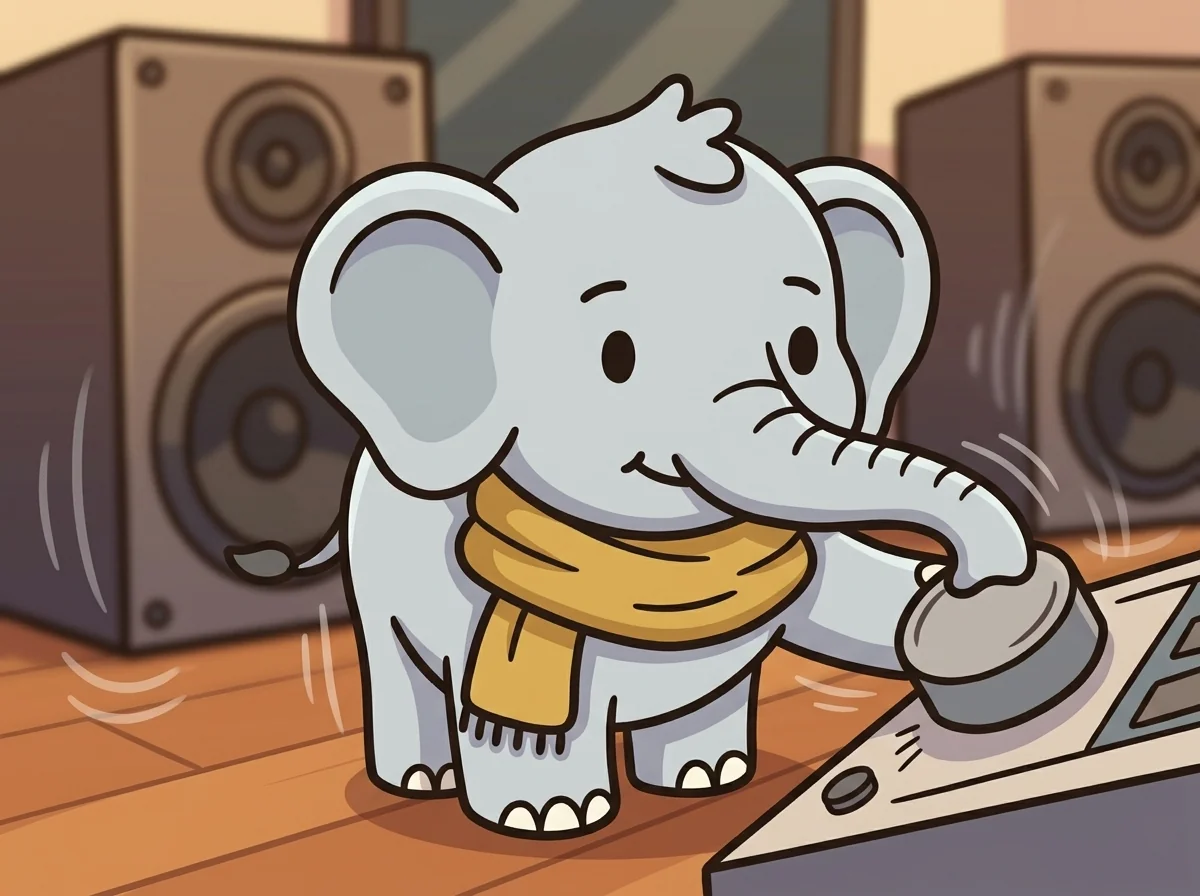
She came to the soundsphere studio the year she turned twelve, because a place all about sound ought to have room for someone who felt every bigness.
The studio's old teacher met her at the door. He didn't ask her to prove she was clever. He turned a track up far too loud and asked one thing: "What do you do with this?"
Amp didn't answer with words. She walked calmly to the dial and turned it down — not off, just down, to a size that didn't push — and then rested her foot on the floor to feel that the vibration was still there, still whole, just no longer too big.
The old teacher watched her right-size the sound. "You belong here," he said.
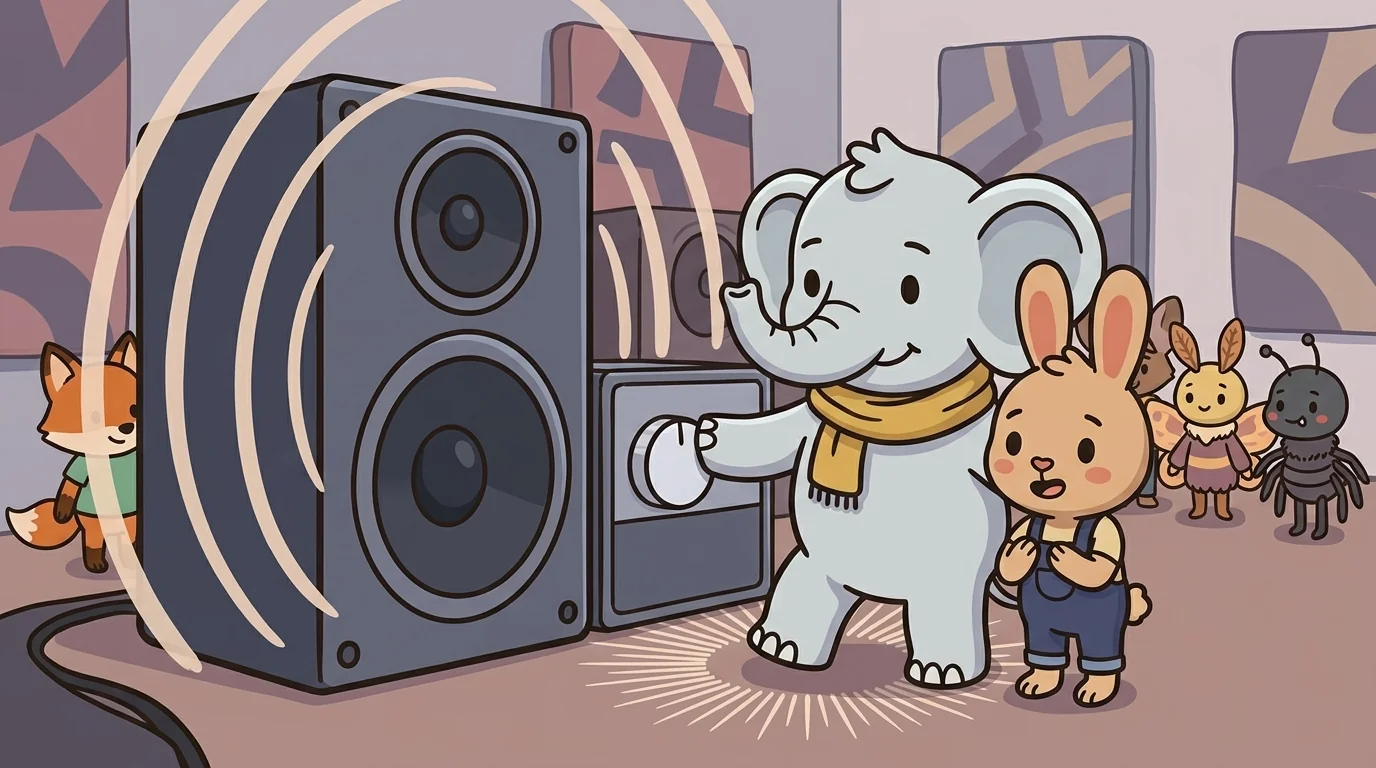
Which was how Amp came to be standing by the speakers with Pip, who was still recovering from the too-loud track.
"Everyone else was fine with it," Pip said, a little ashamed. "It was just me who couldn't take it."
"It wasn't 'just you,'" Amp said gently. "It was you, being tuned to bigness. That loud track was a huge push of air — and your ears felt the whole size of it, when theirs let most of it slide by. That's not you being weak. That's you feeling something real that they couldn't." She rested a foot on the softly-thumping floor. "And look what you get to do about it." She nodded at the dial. "You turned it down. Or you asked me to. Or you stepped back. Loud is big — but it's not in charge of you. You are in charge of how big it gets to be before it reaches you." She smiled. "Knowing 'this is too much for me' and doing something about it? That's not fragile. That's you reading your own limits better than anyone in the room — and taking care of yourself. That's a strength most people never even learn."
Pip looked at the dial, then at his own hands. He'd spent so long thinking he was the problem. But the sound had been too big, and he'd known it, and he was allowed to make it smaller. His shoulders came down.
Later, when the studio had emptied, Pip came back with a quieter question.
"When it's too loud," he said, "and I have to leave, or cover my ears, and people think I'm being dramatic — how do I know it's okay and not just me being too much?"
Amp thought about the crowded hall, and her grandfather's hand guiding her to the quiet edge.
"You feel it," she said. "That's the honest answer. There's this too-big, pushed-on, I-have-to-get-out feeling — and it's real, it's your body telling you the vibration is more than you can hold right now. Listening to that isn't dramatic. It's wise." She rested her warm foot on the floor. "Loud is just big. And you're tuned to feel the bigness of things — which means sometimes you'll need to turn it down when others don't. That's not being too much. That's knowing your own size, and honoring it. You're allowed to make the world quieter for yourself. Always."
Pip nodded, and the shame of leaving loud rooms loosened a little in his chest. His sensitivity wasn't a fault. It was a kind of knowing — and the dial, the door, the hands over his ears, were all just ways of taking care of the tuned, sensitive, entirely-okay creature that he was.
The SoundSphere ensemble
Amp is one of the friends in SoundSphere. Each friend shows you one idea by how they act; meet them all and you have the whole subject.
-

Wave
Frequency — the pitch axis; high-frequency sounds vibrate fast, low-frequency sounds vibrate slow
-

Bloom
Envelope — the attack / sustain / decay / release shape of a sound (how it begins, holds, and fades)
-

Layer
Timbre — the overtone fingerprint that makes a violin sound like a violin and a flute sound like a flute (even at the same pitch)
-

Ring
Space — reverb, echo, and room ambience (how the same sound feels different in a bathroom vs a stadium vs a forest)
-

Tune
Synthesis — how primitive sound-elements (frequencies + envelopes + layers + space) combine to build entirely new sounds
-

Drum
Rhythm / pulse / tempo
-

Sigh
Silence / rest / negative space
-

Hone
Selective attention / filtering
-

Vibe
Resonance / sympathetic vibration