Tune
TUNE — *combine frequency + envelope + timbre + space → entirely new sounds.*
Loading audio…
Press play to listen along. The line being read lights up as you go.
Show full transcript
Loading transcript…
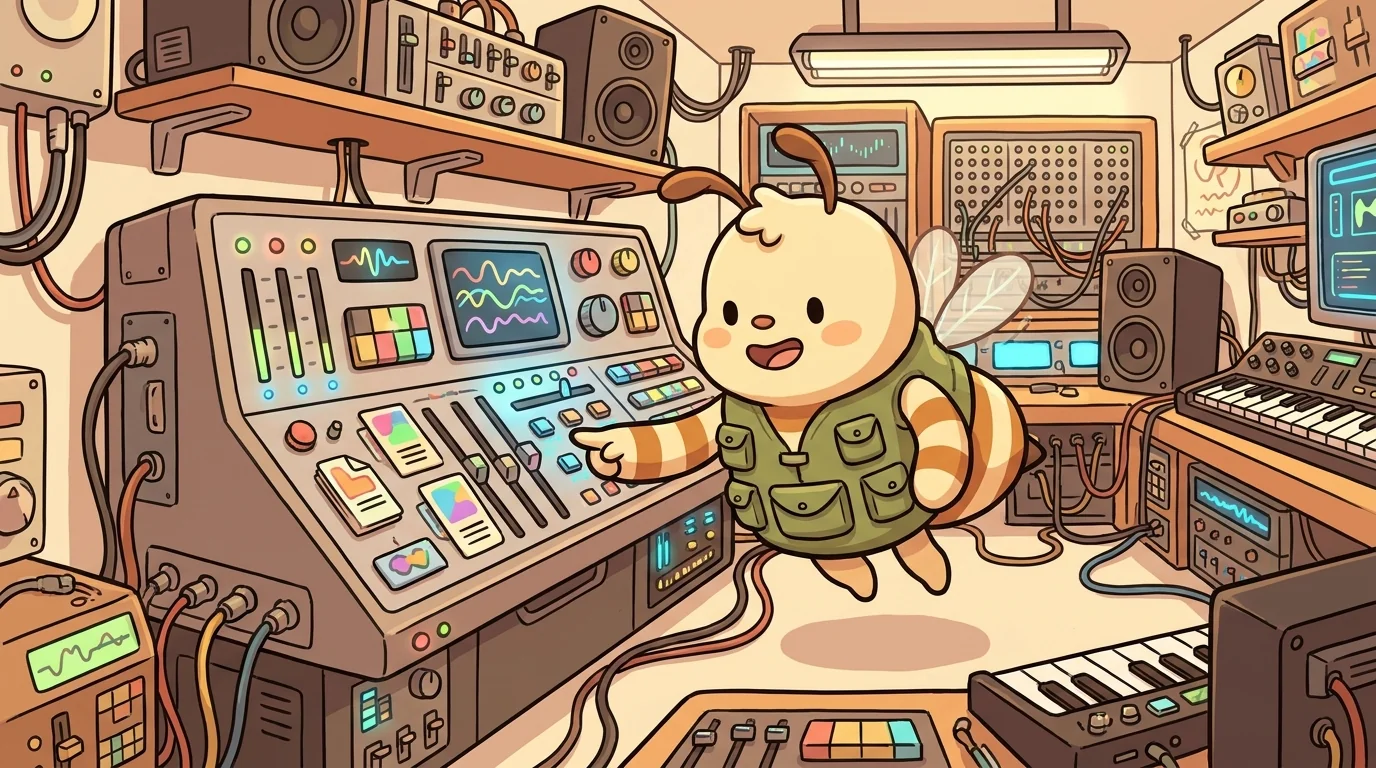
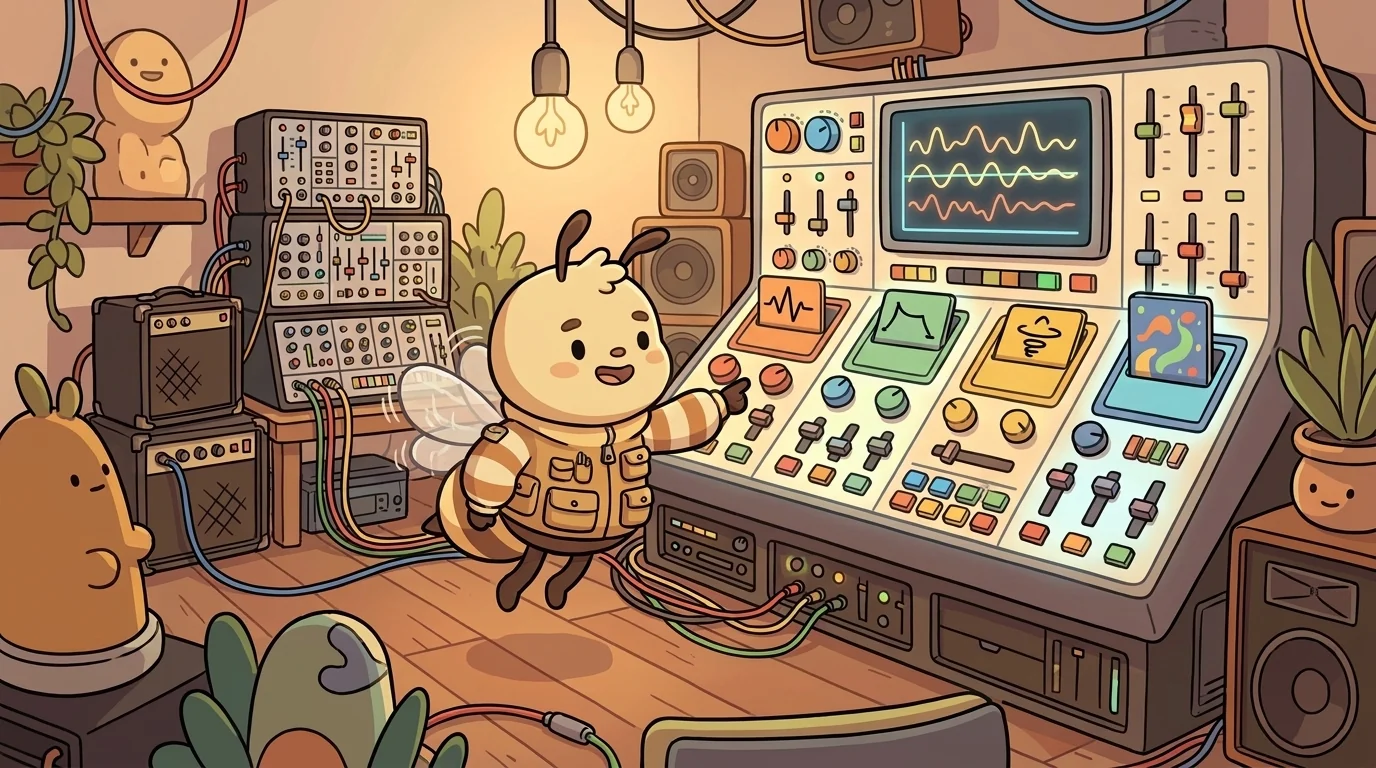
The door to Tune's studio hummed open onto a soft glow, wires snaking across the floor, knobs and buttons covering every surface. Tune hovered near a huge control panel, tiny wings buzzing softly. Tune is a honeybee-tween, warm cream with soft amber stripes, in a chunky studio tunic full of pockets.
Tune teaches synthesis — the craft of building sounds no instrument ever made before. "You combine four pillars," Tune says, pointing a striped arm at the panel: "frequency, envelope, timbre, and space." The panel blinks with slotted synthesis-cards, and a little screen — the sound-design-tracker — shows squiggly lines. "Frequency plus envelope plus timbre plus space," Tune says softly, "makes entirely new sounds."
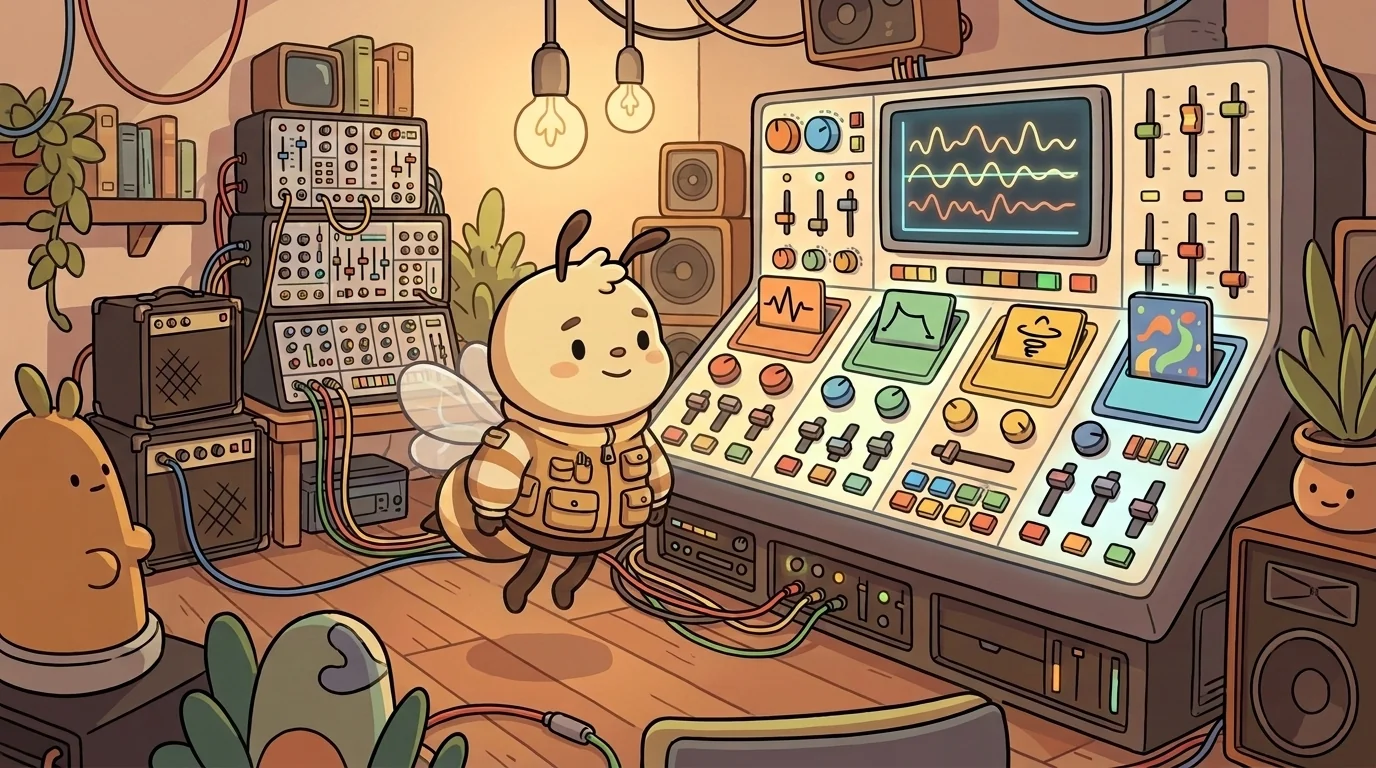
Tune's ears are very sensitive — and for a long time, that felt like a curse.
"Out in the world," Tune says quietly, "everyday sounds are often too much. Too loud. Too many at once. It could feel overwhelming — like being crowded by noise I couldn't turn down." As a young bee, Tune sometimes wanted to cover both ears and hide.
Then Tune found the studio. And here, everything was different. "In synthesis," Tune says, a small smile beginning, "my sensitive ears are a superpower. I can hear every tiny detail — every little shimmer other people miss. And here, I don't have to just endure the sound. I can shape it. Turn it up, turn it down, sculpt it exactly how I want." Tune's antennae twitched. "The very thing that felt like too much out there is the thing that lets me create in here. My ears didn't change. The place did — and once I found the place that fit them, they stopped being a problem and started being a gift."
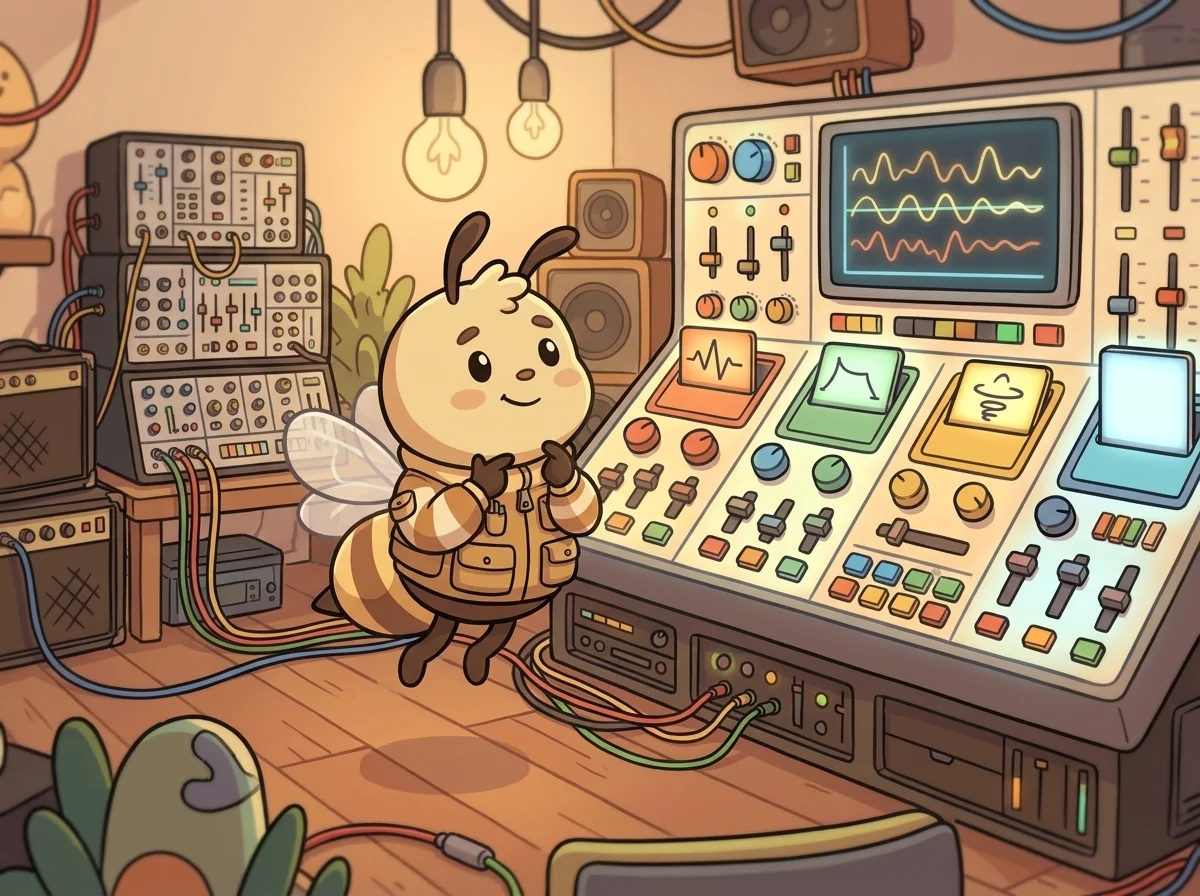
One afternoon Pip, a bright squirrel-kid in a red cap, stepped in. "Hello!" Pip called.
Tune didn't startle. They just turned their head slowly, big round eyes blinking. "Oh — hello. I didn't hear you come in." Then, brightening: "Today we'll make a sound. A very special one." Tune paused, staring at the floor a long moment, then decided: "A sound like a happy cloud. A cloud that whispers secrets."
Pip tried to imagine it. A whispering, happy cloud. It sounded impossible.
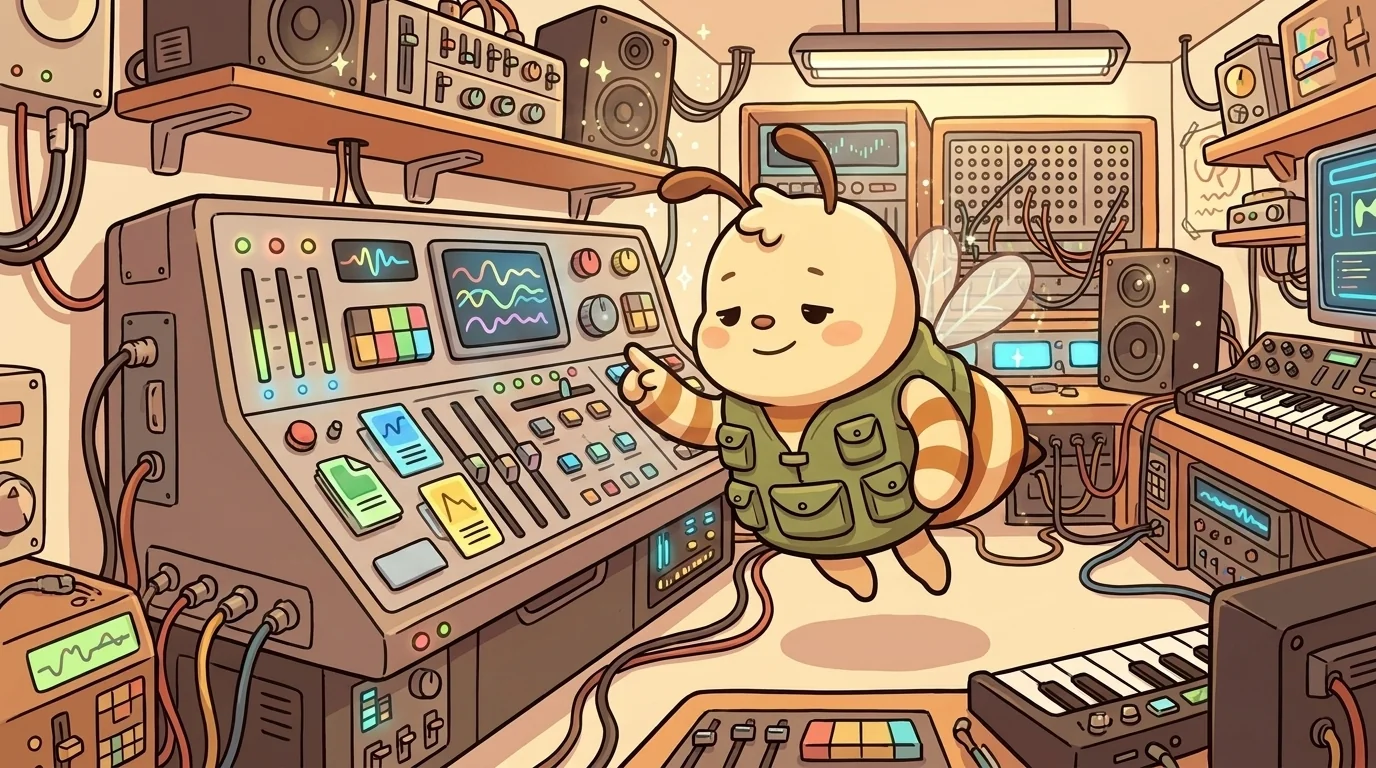
Tune floated to the panel. "To build a new sound, we combine our four pillars." First, an oscillator card — "the engine of the sound" — slid into a slot, and a low, steady hum filled the room. Then a filter card — "this shapes it, bright or dark, smooth or rough" — and Tune turned a knob until the hum softened. Then an envelope-generator — "this tells the sound's story: attack, decay, sustain, release" — giving the hum a gentle beginning and end. Now the four pillars. Frequency first: "how high or low" — Tune turned a dial from an elephant rumble up to a mouse squeak, then found a spot soft and airy. Envelope next: sliding faders so the sound started softly, held a moment, and faded like a breath. Timbre third: "the sound's color — what makes a flute different from a trumpet" — a new filter card made it warmer, rounder. And space last: "a big room, a small box, or floating in the sky" — a touch of echo, and the soft breathing sound began to drift. "Listen close," Tune whispered, closing their eyes, antennae twitching. "Do you hear the tiny shimmers?" Pip leaned in — and there they were, little sparkles around the edges, sounds Pip would never have noticed. Tune's sensitive ears had heard them all along. A last tiny adjustment, and the shimmers became clear as tiny soft bells. "There," Tune breathed. "A happy cloud that whispers secrets. It floats. It shimmers. It breathes." And it did — a sound Pip had never heard, that no instrument could make.
"That was incredible," Pip said. "Could you make any sound? Like a grumpy frog burp?"
Tune giggled, a soft buzzing sound. "Oh, yes. Any sound you can imagine, we can build right here. It's about control — total control over sound. Which is a wonderful thing, especially when the world outside can be so loud." Tune glanced at the tracker, where the happy cloud's squiggly lines still danced. "My ears used to feel overwhelmed. Now they help me create."
Watching Tune — brilliant and buzzing and calm at their glowing panel — Pip felt something warm and quiet settle inside, the same happy, floating feeling as that whispering cloud. Tune had taken the thing that once felt like too much and turned it into something calm, and powerful, and entirely their own. And somehow, Pip thought, that made the loud, too-much parts of Pip feel a little less scary too — like maybe they were just gifts still waiting for the right place to fit. That hopeful, seen, floating-cloud feeling was the very best sound of all.
The SoundSphere ensemble
Tune is part of SoundSphere's distributed-narrative cast. Each character embodies a different curricular primitive; together they teach the full subject.
-

Wave
Frequency — the pitch axis; high-frequency sounds vibrate fast, low-frequency sounds vibrate slow
-

Bloom
Envelope — the attack / sustain / decay / release shape of a sound (how it begins, holds, and fades)
-

Layer
Timbre — the overtone fingerprint that makes a violin sound like a violin and a flute sound like a flute (even at the same pitch)
-

Ring
Space — reverb, echo, and room ambience (how the same sound feels different in a bathroom vs a stadium vs a forest)