Amp and Sigh
LOUDNESS + SILENCE
Loading audio…
Press play to listen along. The line being read lights up as you go.
Show full transcript
Loading transcript…

Amp the elephant and Sigh the moth work the two ends of one truth about sound, and about days: the loud and the quiet only mean anything together. Amp holds the loud — the big vibrations, the peaks, the full moments. Sigh holds the quiet — the silences, the valleys, the rests. And they discovered, sharing the studio, that neither one is the whole of it. All loud with no quiet is an exhausting wall of noise. All quiet with no loud is an empty hush. But loud and quiet, in contrast — the peak made bigger by the valley beside it, the rest made sweeter by the sound before it — that is what gives music its shape, and a day its liveable rhythm.
"I hold the loud," Amp says, foot on the humming floor. "The peaks, the big moments." "And I hold the quiet," Sigh says, soft in the dim. "The rests, the valleys, the breath." "All loud and no quiet is a wall of noise," says Amp. "All quiet and no loud is empty," says Sigh. "The shape lives in the contrast. You need both."
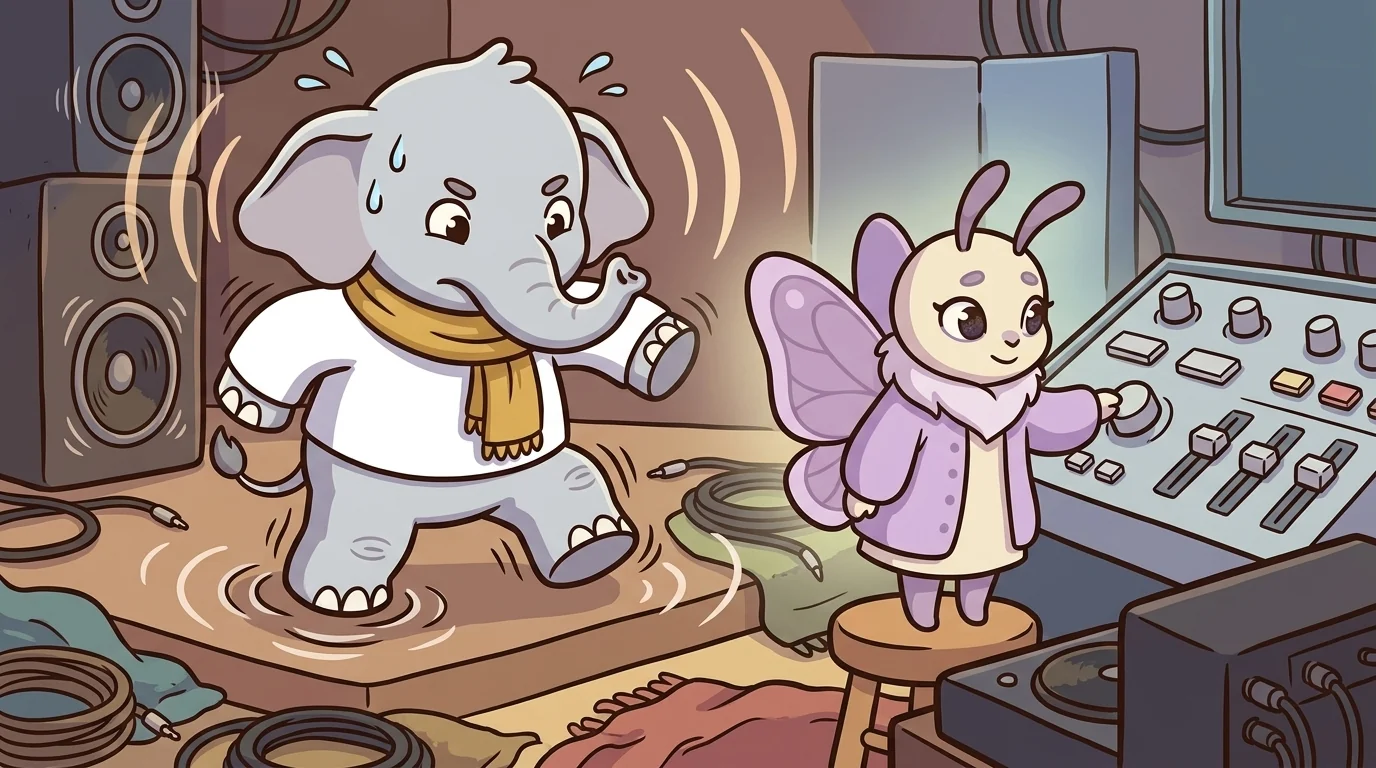
Amp holds the loud. She turns a track up and rests her foot to feel the big push of it. "This is the peak," she says. "The big vibration, the full moment — a cheer, a drum-hit, a favorite song turned up." She feels the whole size of it. "Loud isn't bad. Loud can be wonderful — a moment so full it fills your whole body. The peaks are where a lot of the joy lives." Then she lets it run and run, loud the whole time, no break — and feels herself start to brace against it. "But a peak that never ends stops being a peak. Loud with no quiet after it just becomes a wall — exhausting, numbing, too much, even the good kind." She glances at the moth. "The loud is only a peak if there's a valley to measure it against. And the valley — the quiet that makes my loud mean something — isn't mine. It's Sigh's."

Sigh holds the quiet. She opens a soft silence in the sound and lets it settle. "This is the valley," she murmurs. "The rest, the breath, the space between." She rests in it. "Quiet isn't empty. The rest is where you settle, where you hear yourself, where you get ready for the next thing." Then she lets the silence stretch on and on, nothing but quiet, forever — and it goes flat, blank. "But quiet with nothing to rest from isn't peace. It's just... nothing. A silence only feels like a beautiful rest if there was sound before it to rest from." She glances at the elephant. "My quiet is only a rest if there's a loud for it to answer. The peak that makes my valley feel like relief — the fullness that makes my silence feel earned — isn't mine. It's Amp's."

Then the two of them showed, together, the thing neither could do alone: how to make a day — or a piece of music — that you can actually live in, by honoring both the loud and the quiet. A kid named Pip was struggling. "My days are either way too loud and I get overwhelmed," he said, "or I hide in the quiet so long I feel flat and left out. I can't seem to get it right." And it took both of them. Amp spoke first. "You're not supposed to pick one and stay there," she said. "The loud parts aren't the enemy — the cheer, the music, the full moments, those are joy. You're allowed to have the peaks." "And the quiet parts aren't hiding," Sigh added softly. "The rests aren't you falling behind — they're where you settle and become yourself again. You're allowed to take the valleys." They showed him a piece of music they built together: a big, full, loud swell — and then a soft silence that let the ears rest — and then another swell, bigger now, because the quiet had made room for it. "Hear that?" Amp said. "The loud lands harder because Sigh gave it a valley to rise from." "And the quiet feels sweeter," Sigh said, "because Amp gave it a peak to rest from." Pip listened, and it wasn't overwhelming and it wasn't flat — it breathed, loud then quiet then loud, and he could live inside it. "So a good day," Pip said slowly, "is loud and quiet, on purpose — peaks I'm allowed to enjoy, and rests I'm allowed to take?" "That's the whole shape of it," they said together. "One of us alone would wear you out or leave you flat," Amp said. "The loud with no rest overwhelms; the quiet with no fullness empties." "But the two of us together," Sigh said, "make a day with a shape — full where it should be full, quiet where it should be quiet — and that's a day, and a song, and a life, you can actually live inside."

"So I don't have to choose between the loud and the quiet," Pip said slowly. "I get both — the peaks and the rests — and the contrast is what makes it good?"
"Both, in their turns," Amp said, foot warm on the floor, and Sigh nodded from the soft dim. Amp set down a big, full swell — the loud; Sigh set down a gentle silence — the quiet — side by side, the two halves of a day with a shape. Under the quiet, the two of them felt the same balanced, settled calm rise: not the numbing wall of all-loud, not the flat blank of all-quiet, but a warm, paired, breathing steadiness — the particular peace of two who each honor one half of sound, so that between them a day could rise into its full loud joys and sink into its earned quiet rests, and be, in the contrast between them, whole. That loud-and-quiet, peaks-need-valleys, a-day-with-a-shape feeling, richer than either the loud or the quiet alone, was to Amp and Sigh exactly why they work the two ends of every song — and why a life, like music, is most itself when it is allowed to be both full and still.
The SoundSphere ensemble
Amp and Sigh is one of the friends in SoundSphere. Each friend shows you one idea by how they act; meet them all and you have the whole subject.
-

Wave
Frequency — the pitch axis; high-frequency sounds vibrate fast, low-frequency sounds vibrate slow
-

Bloom
Envelope — the attack / sustain / decay / release shape of a sound (how it begins, holds, and fades)
-

Layer
Timbre — the overtone fingerprint that makes a violin sound like a violin and a flute sound like a flute (even at the same pitch)
-

Ring
Space — reverb, echo, and room ambience (how the same sound feels different in a bathroom vs a stadium vs a forest)
-

Tune
Synthesis — how primitive sound-elements (frequencies + envelopes + layers + space) combine to build entirely new sounds
-

Drum
Rhythm / pulse / tempo
-

Sigh
Silence / rest / negative space
-

Amp
Loudness / amplitude / dynamics
-

Hone
Selective attention / filtering
-

Vibe
Resonance / sympathetic vibration