
The Day Before · Grower · ages 6-8
Listen along
Loading audio…
Read by an AI-generated voice. The words on this page are the transcript.
1. The Mountain Road
The hammer rang once. A spark jumped off the anvil and did not go out. It waited. They followed.
The spark led them to the bench under the big tree on the Green. Then it simply waited there.
Warm wind blew the Green away, and the ground under their feet was somewhere else, the day before.
They were standing high up on a green mountain. The air was thin and cold and very clean. All down the mountain were long stone steps, each one as wide as a field, with potato plants growing on them. A narrow stone road zigzagged down past the steps, to a valley so far below that it looked like a map.
Beside the road was a little round stone hut with a grass roof. A llama stood beside it, chewing.
A girl their age was sitting on the hut's doorstep with a bundle of soft cotton string in her lap. The wall beside her had a crack in it, mended with a neat new stone, and somebody had scratched a tiny hammer next to the mend.
"We've finished the harvest," said the girl. "I counted every sack. Three hundred and twenty-four."
"Who needs to know?" asked Inkling.
"The storehouse, down in the valley," said the girl. "They send baskets for every sack, and porters to carry them. Tomorrow a runner takes the count down. He runs to the next hut and tells another runner, and she runs to the next. Four runners, all the way down."
2. Bzzz
Lan knew what the girl needed. She had used one that very morning, for the shopping.
"I know what that means!" said Lan. "I'll go first. What you need is a..."
She said the word before she had looked.
Bzzz.
Lan went pink. Inkling squeezed her hand.
"The door," said Inkling kindly. "Only the question."
3. A Whisper
The girl called her three cousins. They stood in a line along the road, a little way apart, like the runners' huts.
She ran to the first cousin and whispered, "Three hundred and twenty-four." He ran to the second cousin and told him. The second ran to the third.
The third cousin ran back up the road, out of breath.
"Three hundred and forty-two!" she said.
Somewhere along the line, the twenty and the four had swapped places. Nobody knew where.
4. A Bag of Pebbles
"Then they don't have to remember," said the girl. "I'll send the sacks themselves. Well, a pebble for each one."
She counted three hundred and twenty-four pebbles into a woven bag. It took a long time. The bag was very heavy.
The first cousin carried it to the second. That worked. Nobody could forget a pebble.
But when the second cousin handed it to the third, the bag tipped. Pebbles poured out and rolled away down the stone steps, bouncing, into the potato plants.
They picked up as many as they could find. Nobody knew if they had found them all.
5. What Stays the Same?
Inkling did not name anything this time. She asked questions instead.
"I noticed something," said Inkling. "What changed the count the first time?"
"They had to remember it," said the girl.
"And the second time?"
"The bag spilled."
"So what could a runner carry that he doesn't have to remember, and that can't spill?" said Inkling. Then she stopped. "Wait, I can name it. The count has to be in something that stays the same, in every hand."
6. Clouds
The clouds came down over the mountain. Everything went grey and damp. The girl wound up her string.
"The storehouse will send the wrong number of baskets," she said. "Half our potatoes will sit in the rain. And it will be my count that was wrong."
7. Knots
Lan looked at the sacks stacked by the hut. Every sack was tied shut at the top with a tight knot.
"Can I ask you something?" said Lan. "Do your knots ever come undone by themselves?"
"Never," said the girl. "Not if you tie them right."
"Then could the count be tied into a string?"
8. In Their Places
"But how?" said the girl. "Three hundred and twenty-four knots would be a tangle."
"What if the hundreds go in one place," said Lan, "and the tens a bit lower, and the ones near the end? Then they can't swap."
The girl took a long piece of string. Near the top she tied three knots, close together, for the hundreds. Lower down she tied two, for the tens. Near the end she tied four, for the ones.
The cousins passed the string down the line. Nobody had to remember anything. The last cousin held it up and counted.
"Three hundreds. Two tens. Four ones," she said. "Three hundred and twenty-four!"
9. Down the Mountain
In the morning the runner took the string and ran down the road. At the next hut he handed it on, and it was handed on again, and again.
At the storehouse in the valley, somebody counted the knots. They sent enough baskets for every sack.
Nobody would write down the girl's name. Nobody there wrote anything down at all. They tied it.
Warm wind blew the day before away, and the grass under their feet was the Green.
On the side of the anvil, under DOOR and OPEN, after the W, there was a new letter. An I.
"The count was inside the knots," said Lan. "Where nobody could change it."
The spark dimmed to a warm dot and settled back on the anvil. The Green was just the Green again.
Back on the Green
Mum gave Lan three things to get from the shop: bread, eggs and apples. Lan nearly said she would remember. Then she wrote them down, so they couldn't change on the way.
Tell the story back to someone. Why did the whisper change the number? Why was the string safer?
Saved. The next chapter will be here whenever you come back.
Who you met
-
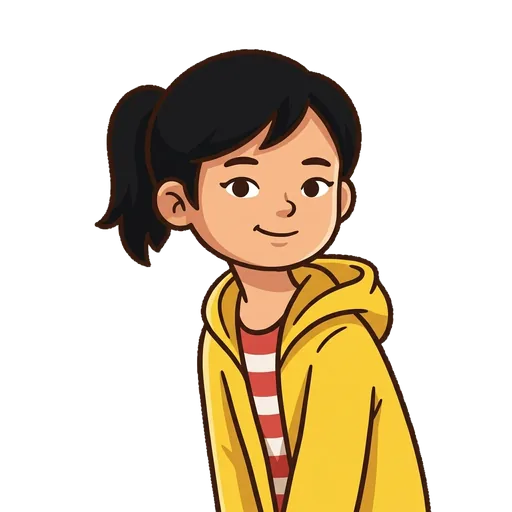 Lan a child of the Green Goes first; makes a friend in a minute
 -
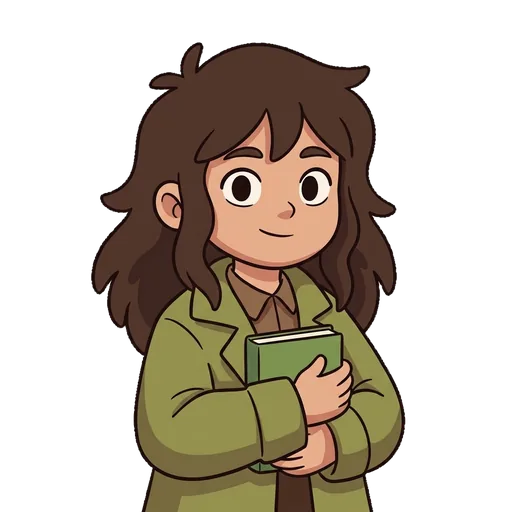 Inkling a child of the Green Names what she notices
Every recurring character has a short tune, so you can tell who is on stage before a word is said. The tunes play only when you tap, and the Reading Access sound switch turns them off.
The Honest Page
Which parts are true, stretched or made up — and what does nobody know?
True
- In the Andes mountains of South America, about five hundred years ago, runners carried messages along stone roads, each running a short way and handing the message to the next runner at a little station. Source
- People in the Andes kept counts on knotted cords called khipu. Knots tied at different places along a cord stood for ones, tens and hundreds, so a cord could carry a number without anyone having to remember it. Source
- Three hundreds, two tens and four ones make three hundred and twenty-four. If the tens and the ones are swapped, the same numbers say three hundred and forty-two.
Stretched
- In the story, the girl ties the count in a new way, the day before the runners use it. What we simplified: Knotted cords were used in the Andes for hundreds of years before these runners and their roads, and they could hold much more than one number. The story shows one simple cord so the idea is easy to see.
Made up
- Lan and Inkling, the spark, the buzzing word, the girl, her three cousins, the bag of pebbles and the three hundred and twenty-four sacks are made up.
Nobody knows
- Nobody knows who first tied a count into a cord. Some of the oldest knotted cords that survive are more than a thousand years old, and nobody can read all of what the cords say. Source