
The Day Before · Reader · ages 6-8
Listen along
Loading audio…
Read by an AI-generated voice. The words on this page are the transcript.
1. Steps as Wide as Fields
The hammer rang once. A spark jumped off the anvil and did not go out. It waited. They followed.
Inkling's green book had a new line in the back now. DOOR, then OPEN underneath, then a W, with three dashes after it. She had drawn the dashes very lightly, in pencil, so that they could be rubbed out if they turned out to be wrong.
"It might not be four letters," she said to Lan, on Saturday morning. "I'm not counting on it."
"You're always counting on things," said Lan. "That's what the book is for."
"Counting isn't the same as counting on," said Inkling, which Lan thought was the kind of thing only Inkling would say.
The spark took them to the bench under the big tree on the Green, where the old people sat in the afternoons. Then it simply waited there.
Warm wind blew the Green away, and the ground under their feet was somewhere else, the day before.
The first thing Lan noticed was that she could not get her breath. She breathed in, and breathed in again, and it was as if the air had been watered down, like squash with too much water in it. The second thing she noticed was the cold. It was a clean, bright, sharp cold, and her nose went pink at once.
"Breathe slowly," said Inkling. "I think we're very high up."
They were.
They were standing on a road made of flat stones, fitted together so neatly that you could not have pushed a leaf between them. The road ran along the side of a mountain, and the mountain went down, and down, and down, so far that Lan felt her tummy turn over when she looked. At the very bottom was a valley with a silver river in it, as thin as a thread.
And all down the mountainside, from where they stood to the valley far below, there were steps. Not steps for feet. Steps as wide as fields, each one held up by a wall of stones, each one flat and green and planted with rows of low, bushy plants. They went down the mountain like the seats in a giant's theatre.
"Potatoes," said Inkling, looking at the plants. "I think. They've dug most of them up."
People were working on the steps. Some were digging with long wooden tools. Some were carrying sacks on their backs, bent forward, walking slowly up the zigzag paths between the steps. They wore bright woven clothes, red and orange and black, and several of them were singing as they worked. Above it all the sky was a deep, dark blue, deeper than Lan had ever seen.
Beside the road was a little round hut built of the same neat stones, with a pointed roof of dry grass. A llama was standing next to it. It had a long neck and long eyelashes and a very superior expression, and it was chewing slowly, looking at Lan as if she had come to the wrong party.
"Hello," said Lan to the llama. The llama went on chewing.
A girl their age was sitting on the hut's stone doorstep. She was wearing a woven wool dress, dark red, with a wide belt round her middle, and a striped shawl over her shoulders pinned at the front with a little silver pin. In her lap was a bundle of soft white cotton string, and she was winding it round and round her hand, frowning.
The wall of the hut beside her had a crack in it, low down, where one stone had split. Somebody had fitted a new stone into the gap, cut exactly to shape, so neat you almost could not see it. Beside the mend, scratched into the old stone with something sharp, was a tiny hammer.
Lan touched it. It was the same tiny hammer as all the others. She glanced at Inkling, and Inkling nodded very slightly, and neither of them said anything.
The girl looked up. She stared at Lan's yellow raincoat and Inkling's green coat, and then, to Lan's surprise, she smiled.
"Are you runners?" she asked. "You look like you've come a long way."
"We have," said Lan. "But we don't run very well. Not up here."
"Nobody does, the first time," said the girl. "You get used to it."
2. Bzzz
"What's the string for?" asked Inkling.
The girl sighed and looked down the mountain.
"We've finished the harvest," she said. "All of it, up and down the steps. And I counted every sack, because I'm the best at counting in our house. It took me two whole days." She held up her fingers as if she could still feel the counting in them. "Three hundred and twenty-four sacks."
"That's a lot of potatoes," said Lan.
"It is," said the girl. "And they can't stay up here. The frost comes soon. So the storehouse down in the valley has to send porters, and baskets, one basket for every sack, to carry them all down before the cold. But first the storehouse has to know how many."
"Can't you just tell them?" said Lan.
"It's three days' walk down to the storehouse," said the girl. "But there are runners on the road. That's what this hut is. A runner waits here. When there's a message, he runs as fast as he can down the road, all the way to the next hut. And there's another runner waiting there, and he tells her, and she runs to the next one. Four runners, all the way down. They can get a message to the valley in one day."
Lan looked at the stone road winding away down the mountain, round corner after corner. She imagined running down it. She imagined running down it in this thin air, and her legs felt wobbly just thinking about it.
"So the runner tells the next runner," she said. "And she tells the next."
"Yes," said the girl. "Tomorrow morning. So tonight I have to make sure the count is right."
Lan knew what the girl needed. She had used one that very morning. Mum had stuck it to the fridge with a magnet. It said bread, eggs, apples on it. She didn't even have to think about it.
"I know what that means!" said Lan. "Come on, it's easy. I'll go first. What you need is a..."
She said the word before she had looked at anything at all.
Bzzz.
It was a horrible noise. It was like a wasp in a jam jar. It came out of her mouth instead of the word, and it buzzed for a moment, and then it stopped.
The llama stopped chewing. It looked at Lan with enormous disapproval.
The girl's eyebrows went right up.
Lan went pink, right up to her ponytail. She had promised herself, on the bench, that she would not go first this time. And then she had gone first anyway, without even noticing.
Inkling squeezed her hand.
"The door," said Inkling kindly. "You can't bring the answer. Only the question."
"I know," said Lan. "I promised I wouldn't."
"You promised before you counted," said Inkling. "You always do that."
"Thanks," said Lan.
"I mean it nicely," said Inkling. And she did.
3. The Whisper Game
"Are you both all right?" asked the girl. "Is it the air? It does strange things to people."
"It's not the air," said Lan. "It just happens to us sometimes. Can we help you think?"
The girl looked at them for a moment. Then she stood up, and cupped her hands round her mouth, and called up the terraces. Three children came running down the zigzag path, two boys and a girl, all smaller than her.
"My cousins," she said. "They can be the runners. We'll practise."
She stood the three cousins in a line along the road, a little way apart from each other, like the runners' huts going down the mountain. The smallest boy was first, nearest the hut. Then the other boy. Then the little girl, right at the far end, by a big rock.
"I'm the first runner," said the girl. "I'll tell the first hut. Then you run and tell the next, and so on. The last one comes back and tells me what she heard."
She ran to the smallest boy and whispered in his ear, very clearly, so that Lan could hear: "Three hundred and twenty-four."
The smallest boy nodded seriously, and set off at a run down the road. He was very fast. He reached the second boy and stopped, out of breath, and whispered in his ear. The second boy nodded and ran. He reached the little girl by the rock, and whispered to her, and she nodded too.
The little girl came running all the way back up the road, her plaits bouncing.
"Three hundred and forty-two!" she said proudly.
There was a silence.
"Three hundred and twenty-four," said the girl.
"Forty-two," said the little girl. "That's what he said."
"I said twenty-four," said the second boy.
"You said forty," said the little girl.
"I said what he said," said the second boy, pointing at the smallest.
"I said three hundred and twenty-four," said the smallest boy. "I think. Or forty. It was something and four. Or something and two."
Inkling wrote it in her green book: three hundreds, four tens, two ones. Three hundred and forty-two.
"The tens and the ones swapped," she said quietly to Lan. "Somewhere along the line. Nobody knows where."
"And that's only three runners," said the girl, "in a row, on a flat road, with no wind. The real runners are tired, and out of breath, and they run for hours. If it changes here, it'll change on the mountain."
4. The Bag of Pebbles
The girl sat down on the doorstep and put her chin in her hands.
"The trouble is remembering," she said. "They have to carry the number in their heads, and heads are leaky. So what if they didn't have to remember? What if they carried the sacks themselves?"
"You can't carry three hundred sacks of potatoes," said the smallest boy.
"Not the sacks," said the girl. "Something for each sack."
She went round to the back of the hut, where there was a heap of small round pebbles, and she brought back a woven bag with a long strap. Then she sat down and started to count pebbles into the bag. One for every sack.
It took a very long time. Lan helped. Inkling helped. Even the cousins helped. They counted in tens, making little piles of ten pebbles on the doorstep, and then counting the piles, and putting them in. The llama watched the whole thing without blinking.
At last there were three hundred and twenty-four pebbles in the bag. The bag was very, very heavy. The girl could only just lift it.
"Now," she said. "Nobody has to remember. You just carry it. The storehouse can count the pebbles."
She hung the bag round the smallest boy's neck. He staggered a little, and then set off down the road, much more slowly than before. He reached the second boy and lifted the strap over his head and gave it to him. That worked. The second boy staggered off.
But when the second boy reached the little girl by the rock, he was tired, and the bag was heavy, and as he lifted the strap off his neck it tipped.
The pebbles poured out.
They bounced on the stone road. They rolled. They tumbled over the edge of the road, and down onto the first terrace, and some of them went over the wall of that one, and on down onto the next, clicking and pattering into the potato plants.
Everybody scrambled after them. They picked up pebbles from the road and the wall and the soil. They picked up pebbles for a long time.
When they had finished, they counted again. Three hundred and nine.
"There were more," said the little girl. "Some went down there." She pointed down the mountain.
"Or maybe we've picked up some that weren't ours," said the second boy. "There are pebbles everywhere."
Nobody knew how many there really were.
"It half worked," said Lan. "Nobody forgot a pebble."
"Half isn't good enough," said the girl. "If the storehouse sends baskets for three hundred and nine, fifteen sacks stay up here in the frost."
5. What Stays the Same?
Inkling sat on the low wall at the edge of the road and looked at the bag of pebbles, and the string in the girl's lap, and the sacks of potatoes stacked by the hut.
She had a feeling she knew what the answer was. She could almost feel its name, sitting on her tongue. But Lan had already said it once and it had buzzed. And Inkling had buzzed last week, and the week before that she had nearly buzzed. So she sat on the name, and did what she was allowed to do. She asked.
"I noticed something," said Inkling. "Can I ask some questions?"
"Yes," said the girl.
"The first time, with the whisper," said Inkling. "What changed the count?"
The girl thought. "They had to remember it," she said. "In their heads. And heads get muddled."
"And the second time? With the pebbles?"
"The bag spilled," said the girl. "Pebbles can roll away. And other pebbles can get in."
"So the first one changed because it was in somebody's head," said Inkling slowly. "And the second one changed because it could fall out." She looked at the road going down the mountain, round corner after corner. "What could a runner carry that he doesn't have to remember, and that can't fall out, and that stays exactly the same, all the way down, no matter whose hand it's in?"
Nobody answered. The girl looked at her hands.
"Wait," said Inkling. "I can name it. Not the thing. The idea." She took a breath. "The count has to be in something that stays the same in every hand. Not in anyone's head. In the thing itself."
6. The Clouds Come Down
While they had been chasing pebbles, the clouds had come down over the mountain. Lan had not noticed them coming. One moment the sky was dark blue, and the next it was grey and close, and then it was all around them, cold and wet and white, like being inside a damp towel. The valley vanished. The steps below them vanished. Even the llama was only a grey shape.
The girl began to wind up her string, slowly, round and round her hand.
"It's too late to think of something new," she said. "The runner comes at first light. I'll just have to whisper it to him, and hope. And the storehouse will send the wrong number of baskets. Maybe a lot too many, so the porters climb for nothing. Or not enough, and half our potatoes sit in the frost and go black." She stopped winding. "And everyone will know it was my count."
"It wasn't your count that was wrong," said Lan. "Your count was right."
"It doesn't matter if it was right," said the girl, "if it doesn't get there right."
That was true, and nobody could think of anything to say back.
7. Knots That Hold
Lan looked at the sacks of potatoes stacked against the hut wall, fat and lumpy. They were woven from rough string, and every single one was tied shut at the top, with a tight, hard knot.
She went over to one and tried to undo the knot with her fingers. It would not move at all.
"Can I ask you something?" said Lan.
The girl looked up.
"Do your knots ever come undone by themselves?" said Lan. "When you carry the sacks down the mountain, and they bump about? Do the knots ever slip?"
"Never," said the girl, a bit offended. "Not if you tie them properly. My grandmother taught me. You could throw that sack off the mountain and the knot would still be there at the bottom."
Lan looked at the knot, and at the string in the girl's hand, and then at Inkling. Inkling was very still.
"Then," said Lan slowly, "could the count be tied into a string?"
The girl stared at her.
8. Every Knot in Its Place
"Tied?" said the girl. "One knot for each sack?" She held up the string. "Three hundred and twenty-four knots? It would be a tangle. You'd lose count halfway along. You'd never be able to count them again at the other end."
Lan thought about the counting they had done with the pebbles, in piles of ten. Then she thought about the three cousins, swapping the tens and the ones.
"What if the knots weren't all in one long row?" said Lan. "What if the hundreds went in one place, near the top of the string? And the tens a bit lower down, in their own place. And the ones near the end, in theirs. So you'd only need three knots for the three hundreds. And two for the two tens. And four for the four ones."
"And they couldn't swap," said Inkling softly. "Because they're tied in their places."
The girl did not say anything for a long moment. Then she unwound a long piece of string from her hand, and bit it off, and laid it across her knees.
Near the top of the string she tied three knots, close together, in a little bunch. "Hundreds," she said.
She moved her hand down the string, a hand's width, and tied two knots. "Tens."
She moved her hand down again, to near the end, and tied four. "Ones."
She held it up. The string hung down from her fingers, with its three little bunches of knots, a gap between each one.
"Run it," said Lan to the smallest cousin. "Don't remember anything. Just carry it."
The smallest boy took the string and ran down the road, through the grey cloud, to the second boy. He handed it over. The second boy ran with it to the little girl by the rock. She came running back up the road, with the string held high above her head like a flag.
"Count it," said the girl. Her voice had gone very small. "Count what it says."
The little girl looked at the string. She put her finger on the top bunch of knots. "One, two, three. Three hundreds." She moved her finger down to the next bunch. "One, two. Two tens." She moved her finger down to the last bunch. "One, two, three, four. Four ones."
She looked up.
"Three hundred and twenty-four," she said.
The girl let out a long breath that turned into a laugh. Her cousins whooped. The llama made a small, surprised noise in its throat, the first noise it had made all day.
"Do it again," said the girl. "Do it with a different number."
They did it with a hundred and three. They did it with two hundred and fifty. They did it with the number of potato plants on the top terrace, which the smallest boy had counted by himself and which nobody believed. Every time, the string came back up the road saying exactly what it had said going down.
"It doesn't matter how tired the runner is," said the girl. "It doesn't matter if he's out of breath, or if it's foggy, or if he's been running all day. He doesn't have to remember a thing. The count is in the knots."
9. All the Way Down
They stayed until it got dark, which happened very fast on the mountain, as if someone had pulled a dark blanket over it. The girl's grandmother came out of a house further up the terraces and gave them hot boiled potatoes, which were small and yellow and tasted better than any potato Lan had ever eaten, with a little salt and a hot green sauce. Lan burned her tongue and did not mind at all.
In the morning the cloud had lifted. The sky was deep blue again, and the mountain went down and down to the silver river. The runner came up the road while it was still cold, a young man with strong legs and a woollen cap. The girl gave him the string with its three little bunches of knots. He looked at it, and nodded, and tucked it into his belt. Then he ran.
Lan and Inkling watched him go down the zigzag road, round one corner and then the next, getting smaller and smaller, until he was only a dot. At the next hut, far below, they saw another tiny dot come out to meet him. The string was handed on. And then it was running again.
At the storehouse in the valley, somebody would count the knots, and send three hundred and twenty-four baskets.
Nobody would write down the girl's name. Nobody there wrote anything down at all. They tied it.
When the sun was high, the spark rose up from beside the little round hut, and waited.
Lan and Inkling said goodbye. The girl gave each of them a short piece of white string, and on each one she tied a single knot, very tight.
Warm wind blew the day before away, and the grass under their feet was the Green.
The bench was there, and the big tree, and the anvil, glowing faintly in the afternoon. Lan ran to it, and Inkling ran too, and they both breathed in big gulps of thick, easy air.
Under DOOR, and under OPEN, after the W, there was a new letter. It was one straight line, up and down, scratched neatly into the metal.
"I," said Lan.
Inkling wrote it in her green book, on the second dash. "W, I," she said.
"The count was inside the knots," said Lan. "That's why it got there. It wasn't inside anyone's head. It was inside the string."
"Inside," said Inkling. "With an I."
The spark dimmed to a warm dot and settled back on the anvil. The Green was just the Green again.
Back on the Green
On Monday Mum asked Lan to go to the shop on the corner for three things: bread, eggs and apples.
"I'll remember," said Lan, already at the door. "I promise."
Then she stopped. She thought about the little girl running back up the road, shouting the wrong number, so proudly. She came back, and found a pencil, and wrote the three things on the back of an envelope. She folded it and put it in her pocket, where it couldn't change on the way.
She came back with bread, eggs and apples. Not apples, eggs and bananas, which was what had happened last time.
Tell the story back to someone. Why did the whispered number change? Why did the pebbles not work? Why was a string with knots in their places safer?
Saved. The next chapter will be here whenever you come back.
Who you met
-
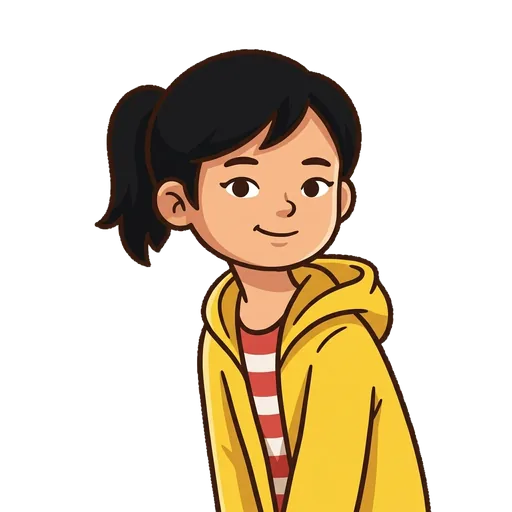 Lan a child of the Green Goes first; makes a friend in a minute
 -
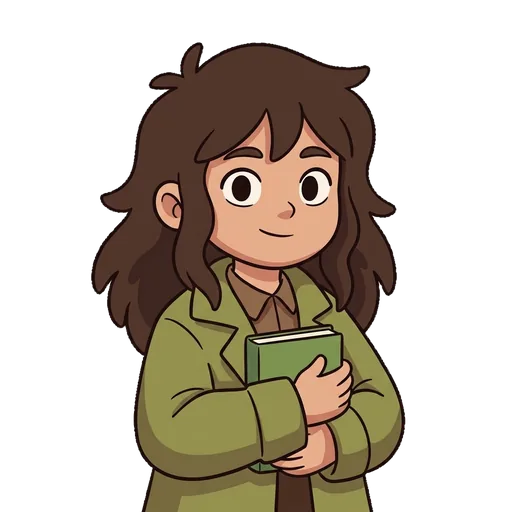 Inkling a child of the Green Names what she notices
Every recurring character has a short tune, so you can tell who is on stage before a word is said. The tunes play only when you tap, and the Reading Access sound switch turns them off.
The Honest Page
Which parts are true, stretched or made up — and what does nobody know?
True
- In the Andes mountains of South America, about five hundred years ago, runners carried messages along stone roads, each running a short way and handing the message to the next runner at a little station. Source
- People in the Andes kept counts on knotted cords called khipu. Knots tied at different places along a cord stood for ones, tens and hundreds, so a cord could carry a number without anyone having to remember it. Source
- Three hundreds, two tens and four ones make three hundred and twenty-four. If the tens and the ones are swapped, the same numbers say three hundred and forty-two.
Stretched
- In the story, the girl ties the count in a new way, the day before the runners use it. What we simplified: Knotted cords were used in the Andes for hundreds of years before these runners and their roads, and they could hold much more than one number. The story shows one simple cord so the idea is easy to see.
Made up
- Lan and Inkling, the spark, the buzzing word, the girl, her three cousins, the bag of pebbles and the three hundred and twenty-four sacks are made up.
Nobody knows
- Nobody knows who first tied a count into a cord. Some of the oldest knotted cords that survive are more than a thousand years old, and nobody can read all of what the cords say. Source