
The Day Before · Grower · ages 6-8
Listen along
Loading audio…
Read by an AI-generated voice. The words on this page are the transcript.
1. The Market
The hammer rang once. A spark jumped off the anvil and did not go out. It waited. They followed.
The spark led them to the bench under the big tree on the Green. Then it simply waited there.
Warm wind blew the Green away, and the ground under their feet was somewhere else, the day before.
They were standing in a busy market in the sunshine. There were stalls with striped cloth roofs, selling figs and pots and baskets and bright dyed wool, red and purple and saffron yellow. Beyond the stalls a river sparkled, and above it rose a hill with a great stone wall along the top.
At one stall a big bronze scale hung from a wooden frame, with a little pan on each side. A girl their age sat on a stool beside it. In her open hand were three rough little lumps of pale yellow metal.
The post of the frame had been mended once, where it had split. Somebody had bound it with tight new cord, and scratched a tiny hammer beside the cord.
"People pay my mother with these," said the girl. "Lumps of pale gold. It comes from the river. But every lump has to be weighed, to see how much it's worth."
"Is that hard?" asked Inkling.
"It's slow," said the girl. "And tomorrow is the big day. A long line of traders comes from far away to buy our wool. If paying takes all day, they'll get cross and go on to the next town."
2. Bzzz
Inkling knew what the girl needed. There was one in her coat pocket right now.
"I noticed it!" said Inkling. "I think it's called a..."
She said the word before she had looked.
Bzzz.
Inkling went pink. Lan squeezed her hand.
"The door," said Lan. "Only the question."
3. Weighing
A trader from the hills came to the stall. He wanted a bale of red wool. He held out a little bag of lumps.
The girl weighed every lump on her mother's scale, one by one. "That's enough," she said.
But the trader did not trust their scale. He got out his own little scale and weighed every lump again. His scale said something a little different.
"Your scale is wrong," he said.
"Your scale is wrong," said the girl's mother.
They argued until the sun was high. All that, for one bale of wool.
4. The Same Size
"Then we'll make them all the same," said the girl.
She helped her mother cut lumps into the same sizes. Big lumps. And small lumps, so that three small lumps weighed the same as one big one.
It half worked. The lumps looked alike now.
But the next trader picked one up and frowned. "It looks right," he said. "But it could be lighter than it looks. Or it could have too much silver in it." And he got out his scale again.
5. Whose Scale?
Lan did not have an answer. So she asked questions instead.
"Can I ask you something?" said Lan. "Why does he weigh it again?"
"Because he didn't see it weighed," said the girl.
"Whose scale would he trust?"
The girl pointed across the market, to a big scale in the middle of the square. "That one. The true scale. My grandmother looks after it for the king. Everybody trusts it."
Lan looked at the trader, not the lumps. The trader doesn't need the lump to look right, she thought. The trader needs to know somebody he trusts has already checked it.
6. Evening
The market closed for the evening. The girl helped fold up the striped roof.
"Tomorrow they'll spend all day weighing and arguing," she said. "Then they'll go on to the next town with their money. And we'll have nothing for the winter."
7. The Lion Seal
Inkling had been quiet for a long time. She did not name anything this time.
They walked past the true scale. The girl's grandmother was there, pressing a little bronze seal into the soft clay on top of a jar of oil. The seal left the shape of a lion's head.
"What does the lion mean?" asked Inkling.
"It means I've checked it," said the grandmother. "Nobody else has this seal."
Inkling looked at the lion in the clay. Then she looked at the lumps in the girl's hand.
"Can I ask a question?" said Inkling. "Could a lump have a mark too?"
8. The Lion on the Lump
"Once a lump has been weighed on the true scale," said Inkling, "could the lion be stamped on it? Then nobody would ever have to weigh it again."
The girl looked at her grandmother. Her grandmother looked at the girl.
They weighed a lump on the true scale. It was exactly right. Then the girl laid the lump on a flat stone, set the bronze lion seal on top of it, and hit it once, hard, with a little hammer.
A little lion's head looked up at them from the lump.
They did a big lump and three small ones. Then a whole pile.
9. A Deal
The next morning the traders came, in a long line. The trader from the hills came first. He picked up a lump and saw the lion.
He did not get out his scale. He just counted. "Two big ones. Three small ones." He nodded. "It's a deal."
All the wool was sold by noon.
Nobody would write down the girl's name, or her grandmother's.
Warm wind blew the day before away, and the grass under their feet was the Green.
On the side of the anvil, under DOOR and OPEN, after the W and the I, there was a new letter. A D.
"D," said Lan. "For deal."
The spark dimmed to a warm dot and settled back on the anvil. The Green was just the Green again.
Back on the Green
At the shop, Lan paid for a lolly with a coin. She looked at the pictures stamped on it. The man counted it. Nobody weighed it at all.
Tell the story back to someone. Why did the trader keep weighing? Why did the lion help?
Saved. The next chapter will be here whenever you come back.
Who you met
-
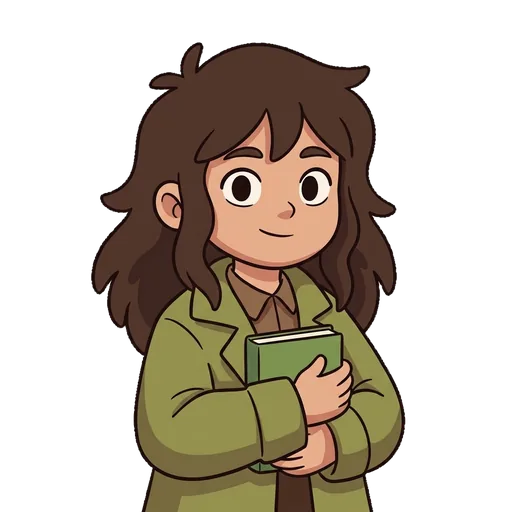 Inkling a child of the Green Names what she notices
 -
 Lan a child of the Green Goes first; makes a friend in a minute
Every recurring character has a short tune, so you can tell who is on stage before a word is said. The tunes play only when you tap, and the Reading Access sound switch turns them off.
The Honest Page
Which parts are true, stretched or made up — and what does nobody know?
True
- About two thousand six hundred years ago, in Lydia (now western Turkey), some of the first coins were made: lumps of electrum, a natural mix of gold and silver found in the river, made in set weights. Many were stamped with a lion's head, the king's sign. The city of Sardis made lion coins in thirds, sixths and twelfths. Source
- Before coins, people often paid with lumps of metal that had to be weighed on scales every time something was bought or sold. Source
- Three lumps that each weigh a third weigh the same as one whole lump. Lydian coins were made in whole weights and in smaller parts, such as thirds.
Stretched
- In the story, a girl and her grandmother press a lion seal into lumps at the market. What we simplified: Real Lydian coins were made in a workshop, with the stamp cut into metal and struck with a hammer, for the king. Even the smallest were worth a lot, so they were used for big payments, like a winter's wool, and it was some time before coins were used for everyday shopping. The story keeps the idea simple: a mark everyone trusts means a lump does not need weighing again.
Made up
- Lan and Inkling, the spark, the buzzing word, the girl, her mother and grandmother, the trader from the hills and the bale of wool are made up.
Nobody knows
- Nobody knows who first stamped a lump of metal so that people could trust its weight. Coins seem to have begun at about the same time in Lydia and in nearby Greek cities, and in China and India people found their own ways to make money that could be counted. Source