
The Day Before · Reader · ages 6-8
Listen along
Loading audio…
Read by an AI-generated voice. The words on this page are the transcript.
1. Red Wool and Pale Gold
The hammer rang once. A spark jumped off the anvil and did not go out. It waited. They followed.
In the back of Inkling's green book, under DOOR and OPEN, there was a W and an I now, and two dashes after them. Inkling had written WI in the margin and looked at it for a long time, and then crossed it out, because it did not look like the start of anything.
"Wig," said Lan helpfully. "Wish. Wind. Window."
"Window has six letters," said Inkling.
"Win," said Lan.
"Win has three," said Inkling. "And it buzzes if you guess. Probably. I'm not testing it."
The spark took them to the bench under the big tree on the Green, where the old people sat in the afternoons. Then it simply waited there.
Warm wind blew the Green away, and the ground under their feet was somewhere else, the day before.
The first thing Lan noticed was the noise. People were talking everywhere, all at once, calling and laughing and arguing, and a donkey was braying, and somewhere a man was shouting the same three words over and over like a song. The second thing she noticed was the smell. It was figs, and warm bread, and wet wool, and something sharp and sour that made her nose wrinkle.
They were standing in the middle of a market.
Stalls stretched away on every side, under roofs of striped cloth held up on poles. Some sold figs, piled up purple and split open, with wasps going round them. Some sold pots, stacked one inside another. Some sold baskets, and sandals, and little clay lamps. And a great many sold wool. Wool hung from the poles in long soft hanks, dyed every colour Lan could think of: red like a post box, a deep purple like a bruise, and a yellow like the middle of an egg.
"That's what the sour smell is," said Inkling. "The dye. It's in those big pots."
Beyond the stalls a river ran past, fast and glittering. Lan could see people standing in the shallows with big flat pans, swirling the water round and round. Above the river rose a steep hill, and along the top of the hill ran a great wall of pale stone, with towers.
At one stall, near the edge of the market, a big bronze scale hung from a wooden frame. It had a long bar across the top, and a little round pan hanging from each end on chains. A pile of red wool sat on the counter beside it.
A girl about their age was sitting on a stool next to the scale. She had a long dress of pale linen, with a woven belt in red and yellow, and her dark hair was tied back with a strip of the same red wool. In her open hand were three rough little lumps of pale yellow metal, each about the size of a bean. She was frowning at them as if they had done something wrong.
The post of the wooden frame had split once, a long crack down its side. Somebody had bound it tightly with new brown cord, round and round, to hold it together. Beside the cord, scratched into the wood with the point of a knife, was a tiny hammer.
Lan touched it. It was the same tiny hammer as all the others. Inkling saw her do it and gave her a small nod, and neither of them said a word.
The girl looked up. She stared at their coats. Then she held out her hand with the three lumps in it, as if she were glad to have somebody to show.
"Do you want to buy some wool?" she asked. "Have you got any of these?"
"No," said Lan. "What are they?"
2. Bzzz
"Pale gold," said the girl. She tipped the lumps into Lan's hand. They were surprisingly heavy for something so small, and warm from the girl's palm, and they shone a soft, buttery colour, paler than a gold ring. "It comes out of the river. Look, you can see them panning for it."
Lan looked at the people in the river, swirling their pans.
"People pay my mother with lumps like these," said the girl. "For the wool. But you can't just take a lump. It might be big or small. It might have more gold in it, or more silver. So every single lump has to be weighed on the scale, to see how much it's worth."
"Is that hard?" asked Inkling.
"It's slow," said the girl. "So slow. And people always argue." She sighed. "And tomorrow is the big day. Every year, a long line of traders comes, from the hills and from far away, with donkeys and carts. They buy wool for the whole winter. Ours is the best red in Sardis. But if paying takes all day, they get cross. Last year some of them got so cross they went on to the next town and bought wool there instead."
"And then what?" said Lan.
"Then we didn't have enough for the winter," said the girl simply.
Inkling knew what the girl needed. There was one in her coat pocket, right now, a shiny one, for the bus. She had seen thousands of them. She did not have to think at all.
"I noticed it straight away!" said Inkling. "I think it's called a..."
She said the word before she had looked at anything.
Bzzz.
It was a horrible noise, like a fly against a window. It came out of her mouth instead of the word, and buzzed for a moment, and stopped.
The girl nearly fell off her stool. A woman at the next stall dropped a fig.
Inkling went pink, right up to her hair. She had been so careful. And then the word had just come out, the way it always did when she knew something, before she had decided to say it.
Lan squeezed her hand.
"The door," said Lan. "You can't bring the answer. Only the question."
"I know," said Inkling. "I know. I was doing so well."
"You were," said Lan. "You still can."
3. Two Scales, Two Answers
"Are you ill?" said the girl. "There's a woman by the river who has a medicine for buzzing."
"It's not that kind of buzzing," said Lan. "It just happens to us. Can we help you think?"
Before the girl could answer, a man came up to the stall. He was a big man, with a sunburned face and a thick woollen cloak, even though it was warm. A donkey was waiting behind him, loaded with empty baskets.
"I'm from the hills," he said. "I want a bale of the red."
"Of course," said the girl's mother, coming out from behind the wool. She was a tall woman with dye on her hands, red up to the wrists.
The trader held out a little leather bag. The girl took it and tipped it out onto the counter. Seven lumps of pale gold rolled out, all different sizes, some round, some flat, one shaped like a tooth.
The girl put the lumps on one pan of the scale, one by one. On the other pan she put little stone weights, and took them off, and put on smaller ones, until the long bar hung level. She counted.
"That's enough," she said. "That's one bale."
But the trader did not look happy.
"How do I know your scale is true?" he said. He opened his cloak and took out a little scale of his own, a small bronze one, with tiny pans, which he hung from his finger. "I'll weigh it myself."
He put the lumps on his little scale, one by one. He put his own weights on the other side. He frowned at it.
"Too much," he said. "My scale says this is worth more than one bale. You owe me some back."
"Then your scale is wrong," said the girl's mother.
"Your scale is wrong," said the trader.
"My scale was my grandmother's," said the girl's mother.
"Then it's very old, and that's why it's wrong," said the trader.
They argued. They weighed it again. They argued some more. The girl weighed the lumps on her mother's scale while the trader weighed them on his, side by side, and the two scales still said something slightly different, and they argued about that. Lan and Inkling stood and watched, and the sun climbed higher and higher in the sky, and the shadows got shorter and shorter.
By the time they had agreed, the sun was right overhead. The trader went off with his bale, grumbling.
The girl sat down on her stool.
"All that," she said, "for one bale of wool. Tomorrow there'll be a hundred of them."
4. The Same Size
The girl thought for a long time.
"The trouble is that every lump is different," she said. "So you have to weigh every one. But what if they were all the same?"
"How?" said Lan.
"We cut them," said the girl. She got up and fetched a little bronze chisel and a block of wood from the back of the stall. "My mother has a big lump, from selling the purple. We cut it into pieces that are all the same. Big pieces, and small pieces. And we make three small pieces weigh exactly the same as one big piece. Then people can just count them."
They spent the rest of the afternoon cutting and weighing. It was fiddly work. The girl's mother helped, and so did Lan and Inkling, holding the lumps still while the girl tapped the chisel. Every piece went on the scale, and was trimmed, and weighed again, until it was just right.
At the end there was a neat little row of big pieces, all the same weight, and a row of small pieces, each weighing a third of a big one. Inkling checked it on the scale: three small pieces on one side, one big piece on the other. The bar hung perfectly level.
"Three thirds make one," said Inkling, pleased. She wrote it in her book.
It half worked. The pieces all looked alike now. You could see at a glance that this was a big one and that was a small one.
But when the next trader came, late in the afternoon, an old woman with a basket on her head, she picked up one of the big pieces and turned it over and frowned at it.
"It looks right," she said. "It looks like a big piece. But it could be a little lighter than it looks. Somebody could shave a bit off the back. Or it could have too much silver in it and not enough gold. You can't tell by looking." And she got out her scale, and weighed it, and weighed the next one too.
The girl watched her, and her face fell.
"Half isn't good enough," she said quietly, when the old woman had gone. "If they have to weigh it anyway, it's the same as before."
5. Whose Scale?
Lan sat on the edge of the counter and swung her legs and thought.
She did not have the answer. She could feel the shape of where it should be, like a gap in her teeth. But she had questions, and questions were what she was allowed to bring.
"Can I ask you something?" said Lan.
"Yes," said the girl.
"Why does the trader weigh it again? Even when it's cut the right size?"
The girl thought about it. "Because he didn't see it weighed," she said. "He doesn't know us. He doesn't know our scale. For all he knows, we cheat."
"Do you cheat?"
"No!" said the girl, offended. "Never."
"But he doesn't know that," said Lan. "So whose scale would he trust? Is there anybody's?"
The girl pointed across the market, to the middle of the big square, where there was a stone platform with a great bronze scale on it, much bigger than theirs. A grey-haired woman was standing beside it.
"That one," said the girl. "The true scale. It belongs to the king. Everybody trusts it, from everywhere. If two people argue about a weight, they take it there, and whatever the true scale says, that's what it is. Nobody argues with it." She smiled for the first time all afternoon. "That's my grandmother. She looks after it."
Lan looked at the true scale, and the grey-haired woman, and then at the girl's little row of cut pieces.
The trader didn't need the lump to look right, she thought. Looking right wasn't enough. The trader needed to know that somebody he trusted had already checked it. Then he wouldn't have to check it himself.
"I think I've got the question," said Lan. "But I don't know what comes after it."
"That's how it feels," said Inkling. "It's horrible. Wait."
6. Evening at the Market
The sun went down behind the hill with the wall on it, and the stone turned pink, and then grey. All over the market, people were folding up the striped roofs and packing away the pots. The man who had been shouting the same three words all day had stopped at last.
The girl helped her mother take the red wool down from the poles and fold it into bales for tomorrow.
"Tomorrow they'll all come," she said. "And every one of them will get out a little scale. And we'll weigh, and they'll weigh, and we'll argue, all day long. And by the afternoon they'll be so cross that half of them will go on to the next town." She put the last bale on the pile. "And we'll have nothing to buy grain with, for the winter."
Her mother put a red hand on her shoulder.
Inkling had not said anything since the buzz. Not one thing. She had been watching. She was watching now, across the emptying market, at the girl's grandmother by the true scale.
7. The Lion in the Clay
"Can we go and see the true scale?" asked Inkling.
They walked across the square. The grey-haired woman was not weighing anything now. She was standing beside a row of tall clay jars, the kind with narrow necks, full of oil. Each jar had a lump of wet clay smeared over its top, to seal it shut.
The grandmother had something small in her hand. It was a little bronze seal, about the size of a thumb, with a handle on top. She pressed its flat end into the wet clay on top of the first jar, firmly, and lifted it off.
Where she had pressed it, there was a little picture in the clay. It was a lion's head, with its mouth open and its mane all round it, very small and very fierce.
She did the next jar, and the next.
"What does the lion mean?" asked Inkling.
"It means I've checked it," said the grandmother. "I've weighed this oil on the true scale, and it's a full jar, and nobody has watered it down. The lion is the king's sign. Nobody else is allowed to have this seal." She smiled at the girl. "So anyone who sees the lion knows it's been checked, without opening the jar."
Inkling looked at the little lion in the clay. Then she looked at the cut pieces of pale gold in the girl's hand.
She had a name in her head. She had had it since the very beginning. She did not say it.
"Can I ask a question?" said Inkling instead.
The grandmother looked down at her. "Ask."
"Could a lump of gold have a mark too?" said Inkling. "Like the jar?"
8. The Lion on the Lump
Nobody said anything for a moment.
"Once a lump has been weighed on the true scale," said Inkling, slowly and carefully, "and it's the right weight, could the lion be put on it? Then anybody who saw the lion would know it had been weighed already. Then nobody would have to weigh it again. Ever."
The girl looked at her grandmother. Her grandmother looked at the girl. Then the grandmother looked at the little bronze seal in her hand, as if she had never seen it before.
"You can't press it into gold," said the grandmother. "Gold isn't clay."
"You could hit it," said the girl suddenly. "With a hammer. If you put the lump on something hard."
The grandmother thought about this. Then she nodded, very slowly.
They took one of the big cut pieces. The grandmother put it on the true scale and weighed it, carefully, twice. It was exactly right.
Then the girl laid the lump on a flat stone at the foot of the scale. She held the bronze lion seal on top of it, upright, the way her grandmother showed her. And she took the little hammer that the grandmother used for knocking the clay off old jars, and she hit the seal once, hard.
Clink.
She lifted the seal away.
In the pale gold, there was a little lion's head. Its mouth was open, and its mane went all round it, and it looked up at them, very small and very fierce.
The girl's mother came running across the square to see. The grandmother picked up the lump and held it to the last of the light and turned it this way and that.
"Well," she said. "Look at that."
They did another big piece, and three small ones. They weighed every one on the true scale first, and then the girl struck the lion into it. Then they did the whole row, piece after piece, until it was too dark to see, and the girl's arm ached, and there was a little pile of pale gold lumps on the stone, every one with a lion looking out of it.
9. It's a Deal
The girl's mother gave them bread and figs and a cup of watered milk, and they slept on a pile of soft wool behind the stall, which smelled of dye and sheep but was the warmest bed Lan had ever slept in.
In the morning the traders came.
They came in a long line, with donkeys and carts, from the hills and from far away. The trader from the hills was first, with his sunburned face and his thick cloak. He came to the stall and wanted four bales of the red.
The girl's mother did not hold out her hand for his bag of lumps. Instead she said, "Will you take these?" and put a little pile of lion lumps on the counter.
The trader frowned. He picked one up and looked at it. He turned it over. He saw the lion.
"That's the king's lion," he said. "From the true scale."
"Weighed on the true scale," said the girl. "Yesterday. Every one."
The trader looked at the lion for a long moment. Lan held her breath. Inkling held Lan's hand.
He did not get out his little scale.
He just counted. "Big one, big one, big one. Small one, small one, small one." He nodded. He counted out his own lumps in exchange, and the girl took them to her grandmother to be weighed and struck, so that they would have lions too.
"It's a deal," said the trader from the hills.
All morning the traders came, and all morning they counted instead of weighing. Nobody argued. Nobody got cross. By noon every bale of red wool was gone, and the girl's mother was laughing, and the girl was sitting on her stool with a little bag of lion lumps in her lap, heavy enough for a whole winter of grain.
Nobody would write down the girl's name, or her grandmother's.
When the shadows were short again, the spark rose up from the flat stone by the true scale, and waited.
Lan and Inkling said goodbye. The girl gave each of them a hank of red wool, the best red in Sardis.
Warm wind blew the day before away, and the grass under their feet was the Green.
The bench was there, and the big tree, and the anvil, glowing faintly in the afternoon. Lan and Inkling went to it together.
Under DOOR, and under OPEN, after the W and the I, there was a new letter. It was a straight line with a round curve on the side of it, like half of a circle.
"D," said Lan.
Inkling wrote it in her green book, on the third dash. W, I, D, and one dash left.
"You didn't name it," said Lan. "At the end. You asked about the jar."
"I named it at the beginning," said Inkling. "I always do. It's like a sneeze." She looked at the letters. "But the girl's the one who thought of the hammer. I didn't think of the hammer at all."
"It was a deal," said Lan. "That's what he said. It's a deal."
"D for deal," said Inkling. "And one more to go."
The spark dimmed to a warm dot and settled back on the anvil. The Green was just the Green again.
Back on the Green
On the way home Lan stopped at the shop on the corner and bought a lolly with a coin from her pocket.
Before she handed it over, she looked at it properly, for the first time ever. There was a head on one side, and a number, and some words round the edge, stamped into the metal very small and neat. On the other side was a picture.
The man at the counter took the coin, and glanced at it, and dropped it in the till. He did not weigh it. He did not even look twice. Nobody in the whole shop had a scale.
"Thank you," said Lan, and she meant it more than usual.
Tell the story back to someone. Why did the trader keep weighing the lumps? Why didn't cutting them the same size work? How did the lion help?
Saved. The next chapter will be here whenever you come back.
Who you met
-
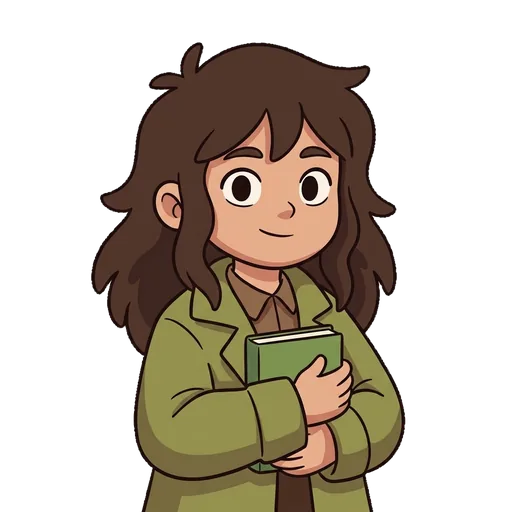 Inkling a child of the Green Names what she notices
 -
 Lan a child of the Green Goes first; makes a friend in a minute
Every recurring character has a short tune, so you can tell who is on stage before a word is said. The tunes play only when you tap, and the Reading Access sound switch turns them off.
The Honest Page
Which parts are true, stretched or made up — and what does nobody know?
True
- About two thousand six hundred years ago, in Lydia (now western Turkey), some of the first coins were made: lumps of electrum, a natural mix of gold and silver found in the river, made in set weights. Many were stamped with a lion's head, the king's sign. The city of Sardis made lion coins in thirds, sixths and twelfths. Source
- Before coins, people often paid with lumps of metal that had to be weighed on scales every time something was bought or sold. Source
- Three lumps that each weigh a third weigh the same as one whole lump. Lydian coins were made in whole weights and in smaller parts, such as thirds.
Stretched
- In the story, a girl and her grandmother press a lion seal into lumps at the market. What we simplified: Real Lydian coins were made in a workshop, with the stamp cut into metal and struck with a hammer, for the king. Even the smallest were worth a lot, so they were used for big payments, like a winter's wool, and it was some time before coins were used for everyday shopping. The story keeps the idea simple: a mark everyone trusts means a lump does not need weighing again.
Made up
- Lan and Inkling, the spark, the buzzing word, the girl, her mother and grandmother, the trader from the hills and the bale of wool are made up.
Nobody knows
- Nobody knows who first stamped a lump of metal so that people could trust its weight. Coins seem to have begun at about the same time in Lydia and in nearby Greek cities, and in China and India people found their own ways to make money that could be counted. Source