The Day Before · Grower · ages 6-8
Listen along
Loading audio…
Read by an AI-generated voice. The words on this page are the transcript.
1. The Roof
The hammer rang once. A spark jumped off the anvil and did not go out. It waited. They followed.
The spark led them to the bench under the big tree on the Green. Then it simply waited there.
Warm wind blew the Green away, and the ground under their feet was somewhere else, the day before.
They were in a narrow street of square houses made of mud bricks, the colour of toast. Beyond the houses was a wide, slow river, and beyond the river, green fields.
A boy their age was standing in the street beside a stack of baskets. Every basket was full of bricks. The blue door of the house had a new board set into its old wood, and beside the board somebody had scratched a tiny hammer.
"We're building a new room on our roof," he said, pointing up. "The bricks have to be up there tonight. Tomorrow the river flood season begins. Then everybody goes to the fields, and there is no time for building."
2. Bzzz
"I know exactly what this needs," said Lan. "It's called a..."
She stopped. She had nearly promised. Then she tried the word anyway, very quietly.
Bzzz.
"I know," she said, before Inkling could whisper it. "The door. Only the question."
3. Hand Over Hand
The boy's big sister stood on the roof. She let a rope down. They tied a basket to it.
She pulled it up, hand over hand, leaning over the edge of the roof. The rope scraped on the edge. The basket swung and bumped against the wall.
It was slow and hard. After an hour, ten baskets were on the roof. There were forty still in the street.
4. Up or Down?
Inkling watched the sister pull. She did not name anything yet.
"Which way is she pulling?" said Inkling. "Up. With just her arms."
She thought about hanging from a branch in the park. That was easy. You just hung, and all of you pulled down.
"Which way is easy to pull?" said Inkling. "Down. With all your weight."
5. The Beam
The boy's uncle came out. He pushed a smooth, round wooden beam out over the edge of the roof, so it stuck out into the air. He hung the rope over it.
Now they could stand in the street, and pull DOWN, and the basket went UP.
It was much easier. They could lean back and use their whole bodies.
But the rope rubbed on the beam. It squeaked and squealed. It got hot. Little hairs began to fray off it.
6. Rub or Roll
Inkling stood and watched the rope sliding over the beam.
"I noticed something," said Inkling. "The beam doesn't turn. The rope slides over it. It rubs, like the flat board dragging in the marsh."
She watched a little longer.
"I can name it now," she said. "A round thing that stays still rubs. A round thing that turns rolls."
7. Late Afternoon
By late afternoon, the rope was fraying badly. It burned their hands when they pulled. Twenty baskets were still in the street.
Lan sat on the doorstep. "It's hopeless," she said.
8. The Question
Then Lan remembered the wheels in the marsh, turning and turning under the board.
"Could the round thing turn WITH the rope?" said Lan. "Like the wheels turned with the ground?"
The uncle looked at the beam for a long time. Then he took his knife and a round piece of wood.
He carved a small wheel. He cut a groove all the way round its edge, like the slot in a cotton reel. He made a hole in the middle and set it on a peg at the end of the beam, so it could spin.
He laid the rope in the groove.
They pulled down. The little wheel turned. The basket went up. Nothing rubbed. Nothing squealed.
9. The Second Wheel
They lifted ten baskets that way. Then Inkling asked one more question.
"What if a second wheel rode on the basket?" said Inkling. "The rope could go down round it, and back up again."
They tried it. Now two pieces of rope held the basket up, and every pull was half as hard. They had to pull twice as far, but Lan could do it all by herself.
10. Sunset
The last basket went up as the sun set over the river. The new room had its walls.
Nobody would write down the boy's name, or his uncle's.
Warm wind blew the day before away, and the grass under their feet was the Green.
On the side of the anvil, after the D and the two Os, there was a new letter. An R.
Lan read it out. "D. O. O. R."
"Door," said Inkling.
They both looked at it for a long time.
The spark dimmed to a warm dot and settled back on the anvil. The Green was just the Green again.
Back on the Green
Lan hung a rope over a low branch in the garden and tied Tí's bucket of toys to one end. She pulled down. Up went the bucket.
Tell the story back to someone. Why was pulling down easier than pulling up? What did the little wheel stop?
Saved. The next chapter will be here whenever you come back.
Who you met
-
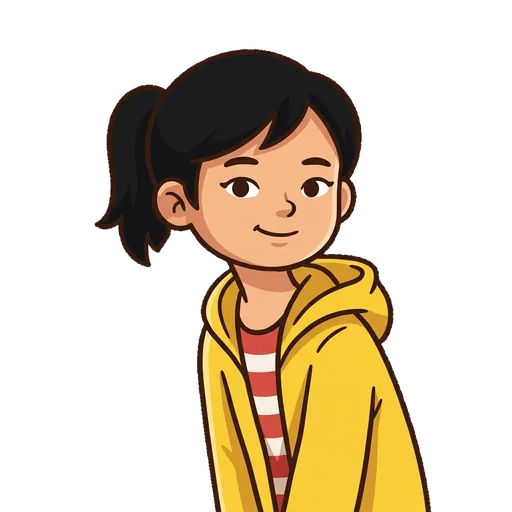 Lan a child of the Green Goes first; makes a friend in a minute
-
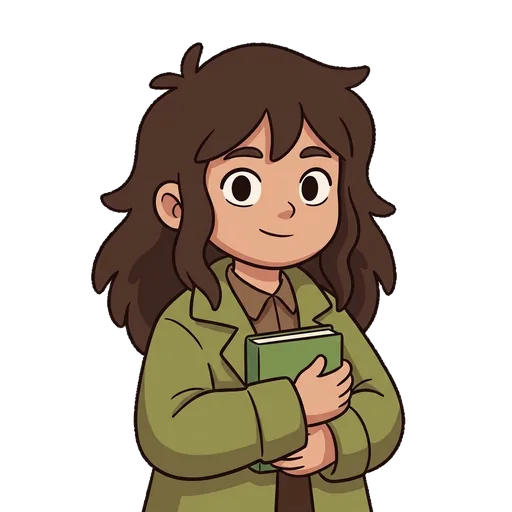 Inkling a child of the Green Names what she notices
Every recurring character has a short tune, so you can tell who is on stage before a word is said. The tunes play only when you tap, and the Reading Access sound switch turns them off.
The Honest Page
Which parts are true, stretched or made up — and what does nobody know?
True
- The oldest evidence of pulleys comes from Egypt, about three thousand nine hundred years ago, and from Mesopotamia at about the same time. Source
- A wheel fixed in one place with a rope over it changes the way you pull: you pull down, and the load goes up. Source
- A wheel that rides on the load itself, so two parts of the rope hold it up, halves the pull you need. You have to pull the rope twice as far. Source
Stretched
- In the story the pulley and the second wheel are both worked out in one afternoon, on one roof. What we simplified: Pulleys were probably improved slowly, by many people, over a long time. The famous stories about pulleys with several wheels, told about the Greek thinker Archimedes, come from more than a thousand years later.
Made up
- Lan and Inkling, the spark, the buzzing word, the boy, his sister, his uncle and the new room on the roof are made up.
Nobody knows
- Nobody knows who made the first pulley. The earliest evidence does not come with a name. Source