The Day Before · Reader · ages 6-8
Listen along
Loading audio…
Read by an AI-generated voice. The words on this page are the transcript.
1. The Toast-Coloured Town
The hammer rang once. A spark jumped off the anvil and did not go out. It waited. They followed.
There were three letters on the side of the anvil now. A D, from the sledge on the sand road. A round O, from the wheels in the marsh. Another O, from the long stick by the canal. D, O, O. Lan had been staring at them all week, trying to guess the last one.
"DOOM," she said on Monday.
"That's horrible," said Inkling.
"DOOR," said Lan on Tuesday. "Or DOON. Or DOOT. Is DOOT a word?"
"No," said Inkling. "And you can't guess it. You have to find it."
The spark took them to the bench under the big tree on the Green, where the old people sat in the afternoons. Then it simply waited there.
Warm wind blew the Green away, and the ground under their feet was somewhere else, the day before.
The light was golden and warm, and the air smelled of river and dust and bread. They were standing in a narrow street between square houses with flat tops. Every house was made of bricks the colour of toast, with little windows high up in the walls and wooden doors painted blue or green or not at all. Some of the houses had a second room built on their flat roof. Some had a sort of shade made of palm leaves on poles, where washing hung and a dog lay asleep.
At the end of the street the houses stopped, and there was the river. It was wide and brown and slow, so wide that the far side was a green smudge. Boats with tall triangular sails moved along it without seeming to move at all. Beyond the far bank, fields went out in green squares as far as Lan could see.
The street was very busy. A woman went past with a tray of round flat loaves on her head. Two men were carrying a long pole between them with a basket of fish hanging from the middle. A small girl was chasing a goose. Everybody seemed to be in a hurry, the kind of hurry people are in before a holiday, or before a storm.
Halfway along the street, a boy about Lan's age was standing beside a stack of baskets. Every basket was full of mud bricks, the same toast colour as the houses, square and neat. There were a great many baskets.
He saw them, and stared. They were in their own clothes, trainers and jumpers, much too hot. But he did not seem to mind. He only looked at the baskets, and then up at his house, and then at the sky, where the sun was already past the middle.
"Are you builders?" he said hopefully.
"Not really," said Inkling. "What are you building?"
The boy pointed straight up. On the flat roof of his house, the walls of a new room were half built, like a box with no top and only half its sides. A girl, older than him, was standing up there with her hands on her hips, looking down.
"A new room," said the boy. "For my grandmother, so she can live with us. My uncle made the bricks. He is the best brickmaker in the street." He said it proudly. "But they all have to be up on the roof by tonight."
"Why tonight?" said Lan.
"Because tomorrow the flood season begins," said the boy, as though everyone knew that. "The river comes up over the fields. And when the river comes up, every person in the town goes to the fields to help with the water and the dykes and the planting. There is no time for building until it is all over. My grandmother is coming before then." He looked at the baskets again. "My uncle has to finish the walls tomorrow at dawn, before he goes. So the bricks must be up there tonight."
Lan counted the baskets. She got to fifty and stopped.
2. The Almost-Promise
Lan knew what this needed. Of course she did. She had seen it on building sites at home, and in a picture book, and on the side of every crane she had ever looked at. A rope, going over a little wheel at the top. You pulled, and up it went.
She opened her mouth. "I know exactly what this needs," she said. "I promise, it's called a..."
She stopped.
She had nearly done it again. She had nearly promised before she counted, and nearly carried the answer in through the door, and she knew exactly what would happen if she did.
But the word was right there on the tip of her tongue, and she wanted to see. Just once more. She said it very, very quietly.
Bzzz.
It came out as a buzz, of course. A little one, like a fly against a window.
The boy blinked at her.
"I know," said Lan, before Inkling could whisper anything at all. "I know. The door. You can't bring the answer. You can only bring the question."
Inkling smiled at her. "You stopped halfway," she said. "That's new."
"Halfway doesn't count," said Lan, but she was pleased.
3. Hand Over Hand
The boy's sister let a rope down from the roof. It was a thick rope, made of twisted fibres from palm trees, rough and hairy. The boy tied the end of it round the handles of the first basket, with a knot he did very fast, without looking.
"Pull!" he called.
The sister began to pull. She stood at the edge of the roof and pulled the rope up hand over hand, leaning out over the street to keep the basket from banging against the wall. The basket rose slowly, swinging, scraping on the bricks. The rope rubbed on the sharp edge of the roof and made a rasping sound.
At the top, she grabbed the basket handle and swung it onto the roof, and tipped out the bricks, and let the rope down again. Then she rubbed her arms.
The boy tied on the second basket. The sister pulled it up. Then the third.
Lan and Inkling took turns tying the knots, which the boy showed them, and steadying the baskets at the bottom so they did not swing. It was hard work just doing that. Pulling them up must be harder.
After a while, the sister came down the ladder at the back of the house, red in the face, and her brother went up instead. He pulled too, hand over hand, leaning out, his arms shaking. Then the sister went up again.
After an hour, ten baskets were on the roof.
Lan counted the stack in the street. Forty to go. Fifty take away ten. Forty.
The sun was sliding lower over the river. Their shadows were getting longer.
4. Up or Down?
Inkling did not tie the next knot. She stood in the street with her head on one side and watched the sister pulling.
Lan could tell she was asking questions again. She did it with her whole face, the way some people chew.
"Which way is she pulling?" said Inkling.
"Up," said Lan. "Obviously. The basket's going up."
"No, I mean her," said Inkling. "Which way are her arms going? Up. She's pulling the rope up towards her, with just her arms. Her arms are doing all of it."
Lan looked. It was true. The sister was standing still and pulling with her arms, up, up, up, like lifting something off a high shelf over and over again.
"Do you remember the climbing frame in the park?" said Inkling. "When you hang from the top bar?"
"Yes," said Lan.
"Is it hard?"
Lan thought. Hanging from the bar was easy. You just let go of your feet and hung, and all of you pulled down on your hands, and you did not have to do anything. It was pulling yourself UP that was hard.
"Hanging is easy," said Lan.
"Because all of you is pulling down," said Inkling. "Your whole weight." She looked at the sister, pulling up with just her arms. "Which way is easy to pull? Down. With all your weight."
"But the basket has to go up," said Lan.
"I know," said Inkling. "That's the question."
5. The Beam
The boy's uncle came home. He was a broad man with clay on his hands and arms up to the elbows, and the boy ran to him at once, and talked very fast, pointing at the baskets and the roof and the sun.
The uncle looked at the baskets. He looked at the roof. He looked at his niece rubbing her arms. He said something short, and went up the ladder at the back of the house.
A moment later, he pushed a long wooden beam out over the edge of the roof. It was smooth and round, a pole that had been part of an old roof, polished by years of hands. He weighed the inside end of it down with a pile of bricks so it stuck out firmly into the air above the street, like a fishing rod.
Then he took the rope and hung it over the end of the beam, so that both ends of the rope hung down into the street.
"Tie the basket on one end," the boy explained, listening to his uncle. "Then we pull the other end. Down."
They tied on the basket. Then Lan, Inkling and the boy took hold of the other end of the rope, all together, and leaned back.
The basket went up.
It went up much faster than before. They were not lifting with their arms any more. They were leaning back with their whole bodies, like hanging from the climbing frame, and the rope went down through their hands, and the basket went up the wall. The sister on the roof caught it and swung it in.
"Down here, up there!" said the boy, delighted.
They did another. And another.
But on the fourth basket, the rope began to squeak. It was rubbing on the round beam as it slid over it. It squeaked, and then it squealed, a horrible high squeal like a gate that needs oiling. Lan put her hand on the rope after the basket had gone up, and it was hot. Little brown hairs were fraying off it where it rubbed, and floating down into the street.
On the sixth basket, they had to stop and let the rope cool.
While they waited, the sister sat on the edge of the roof with her legs dangling, and the boy fetched them all a drink of water from a big clay jar by the door, cool and tasting faintly of earth. The door was painted blue, and Lan saw that one of its boards was newer than the rest, set neatly into the old wood. Beside the new board somebody had scratched a tiny hammer. Lan drank hers slowly. She was thinking about the beam.
It was so much better than pulling hand over hand. That was true. You could use your whole body. You could lean. You could even, if you were small, hang right off the rope with your feet in the air and let your weight do the work, and the boy had tried that, and the basket had gone up a whole arm's length before he came down. But the rope did not like it. Every basket, it got hotter and hairier and squeakier, as if it were complaining.
"How many more before it breaks?" said Lan.
The uncle, up on the roof, looked at the fraying rope and shrugged, and said something.
"He says not many," said the boy.
6. Rub or Roll
Inkling went and stood right under the end of the beam, looking up.
She watched the next basket go up. She watched the rope slide over the round wooden beam, and the beam did not move at all. It stayed exactly where it was, stuck fast under the bricks. The rope slid and scraped across the top of it.
"I noticed something," said Inkling. "The beam doesn't turn. Look. The rope just slides over it."
Lan looked. It was true.
"It's like the flat board in the marsh," said Inkling. "Do you remember? It dragged, because all of it rubbed. The rope's rubbing on the beam the same way." She frowned. "But the beam's round. Round things are supposed to roll."
"Not if they're stuck," said Lan.
Inkling looked at her quickly.
"Yes," she said slowly. "That's it. I can name it now." She thought for one more moment, to be sure. "A round thing that stays still rubs. A round thing that turns rolls."
The boy was listening. He did not know about the marsh, or the board, or the boy with the wheels. But he repeated it under his breath, the way the boy in the marsh had done. "Stays still, rubs. Turns, rolls." He looked up at the beam.
7. Late Afternoon
They kept going, because there was nothing else to do. Pull down, basket up. Wait for the rope to cool. Pull down, basket up.
By late afternoon, the rope was fraying badly where it went over the beam. One whole strand had broken, and the uncle had tied a knot in it, and the knot caught on the beam every time and jerked the basket. The rope burned their hands when it slid. Lan's palms were red and sore. The boy had wrapped a cloth round his.
The sun was low over the river now, turning the water orange. The boats with triangular sails were coming in to tie up for the night. Up and down the street, people were finishing things, and calling to each other, and lighting little lamps.
Twenty baskets were still standing in the street. Twenty.
Lan sat down on the doorstep of the house. She looked at her red hands.
"It's hopeless," she said. "The rope's going to break. And there's not enough time. And everybody's going to the fields tomorrow, and his grandmother won't have a room."
The boy sat down beside her and did not say anything. Inkling leaned against the wall with her arms folded, looking up at the beam.
8. The Question
Lan looked up at the beam too. The rope going over it. Squeak. Stuck. Rubbing.
She thought about the marsh. The two round slices of log, with the square holes, on the stick. How they had stayed under the board and turned, and turned, all the way to the village, and never once rubbed. Round things that turned with the ground.
Then she remembered the door. She could not bring the answer. She had tried that already today, and buzzed. But she could bring a question. She always could.
She stood up.
"Could the round thing turn WITH the rope?" said Lan to the boy's uncle. "Instead of staying still? Like wheels turn with the ground?"
The boy explained to his uncle what she had said. He had to say it twice.
The uncle did not answer straight away. He stood in the street with his clay-covered arms folded, looking up at the beam and the rope for a long, long time. Lan could see him thinking, the way the girl by the canal had thought, and the boy in the marsh. He was a man who made things with his hands. He was thinking with them too; his fingers were moving, turning something invisible.
Then he went inside, and came back with a sharp copper knife and a round piece of hard wood, cut from the end of a branch.
He sat on the doorstep and began to carve. He did not need any help. He knew exactly what to do with a knife, much better than Lan did. He made the wood into a smooth round wheel, about as big as Lan's hand. Then, very carefully, he cut a groove all the way round its edge, deep and curved, like the slot round the middle of a cotton reel. Then he made a hole right through the middle.
"Why the groove?" said Inkling.
The uncle answered, and the boy explained. "So the rope sits in it and does not fall off."
The uncle climbed up the ladder. He fixed a strong wooden peg through the end of the beam, and slid the little wheel onto the peg, so that it could spin freely. He spun it with one finger, to show them. It turned round and round.
Then he laid the rope in the groove.
Lan, Inkling and the boy took hold of the rope in the street. They tied the next basket on.
"Pull," said the uncle, from the roof.
They pulled.
The little wheel turned. The rope went over it, sitting snug in its groove, and the wheel turned with it, round and round, so that the rope did not slide over anything at all. It did not squeak. It did not squeal. It did not get hot. The basket went up the wall, smooth and steady, and the sister caught it.
Pull down here. Up it goes there. And nothing rubs.
The boy gave a shout that made the goose run away down the street.
9. The Second Wheel
They lifted ten baskets that way, fast, one after another. Their sore hands did not get any sorer, because the rope did not burn any more. The little wheel went round and round on its peg and made a soft clicking sound.
Ten baskets left.
Then Inkling, who had been watching the wheel go round for a long time, asked one more question.
"What if there was a second wheel?" said Inkling. "On the basket. What if the rope went down from the beam, round a wheel on the basket, and back up again to the beam?"
The uncle looked at her. Then he went and carved another one.
This time he did not put it on the beam. He tied it to the handles of the basket, with its own peg, so it hung there with its groove facing up. He tied the end of the rope to the beam itself. Then he took the rope down from there, round under the wheel on the basket, back up over the wheel on the beam, and down into the street.
Now there were two pieces of rope holding the basket up. One on each side of its little wheel.
"Pull," said the uncle.
Lan pulled. Just Lan, on her own.
The basket went up. It went up slowly, more slowly than before, and Lan had to pull a lot of rope through her hands, twice as much as before. But it was not heavy. It was half as heavy. She did not have to lean back with all her weight. She could pull it hand over hand, standing up straight.
"Two ropes hold it," said Inkling. "So each one only has to hold half."
"Half as hard," said Lan, pulling. "But twice as far."
The sister on the roof was laughing. The boy took the rope next, and then Inkling, and the uncle stood with his hands on his hips and watched them, and did not say anything. But he was smiling.
10. Sunset
The last basket went up as the sun set over the river, round and red, sitting on the far bank like a coin on a table.
The new room had its bricks. Tomorrow at dawn, the uncle would finish the walls before he went to the fields. The grandmother would have her room.
The boy's mother brought out bread and a bowl of dates, and they all sat on the roof in the last light, among the stacks of bricks, and ate. Down in the street, people were stopping to look up at the beam with its two little wheels, and pointing, and asking questions. A neighbour called up something, and the uncle called back, and the neighbour went home and came back with a knife and a piece of wood.
"He wants one for his roof," said the boy, grinning.
Nobody would ever write down the boy's name. Nobody would write down his uncle's name, or his sister's, or his grandmother's. But all along the street, as the lamps came on, people were looking at the little wheel and thinking about their own roofs.
Warm wind blew the day before away, and the grass under their feet was the Green.
The old people had gone home from the bench under the big tree. The Green was quiet and blue with evening. Lan's hands were not red any more, but she could still feel the rope in them.
She went to the anvil. Inkling came with her.
On the side of the anvil, after the D and the round O and the second O, there was a new letter. An R.
Lan read them out, one at a time, slowly, with her finger.
"D. O. O. R."
"Door," said Inkling.
They looked at it for a long time. Four letters, from four places, from four days before. The sand road. The marsh. The canal. The roof.
"You can't bring the answer," said Lan quietly. "You can only bring the question."
"Through the door," said Inkling.
The spark dimmed to a warm dot and settled back on the anvil. The Green was just the Green again.
Back on the Green
At home, Lan's little brother Tí wanted his bucket of toys up in the apple tree in the garden, where he had made a den. He could not climb with it.
Lan hung a rope over a low branch. She tied the bucket to one end, and gave Tí the other end, and showed him how to pull it down. Up went the bucket, bumping through the leaves.
Then she found an old cotton reel and a pencil, and they spent the rest of the evening trying to make a wheel for the branch.
Tell the story back to someone. Why was pulling down easier than pulling up? What did the little wheel stop the rope doing? And what did the second wheel change?
Saved. The next chapter will be here whenever you come back.
Who you met
-
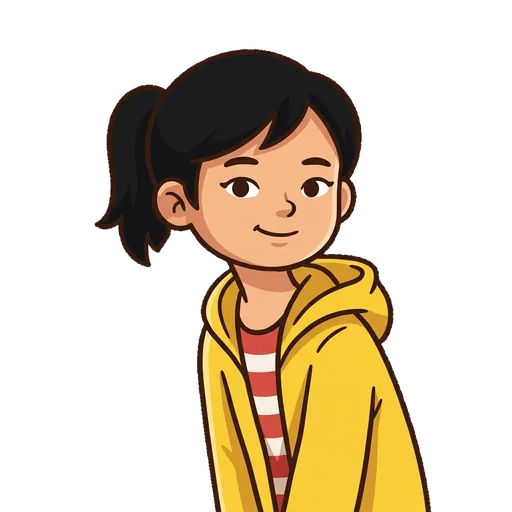 Lan a child of the Green Goes first; makes a friend in a minute
-
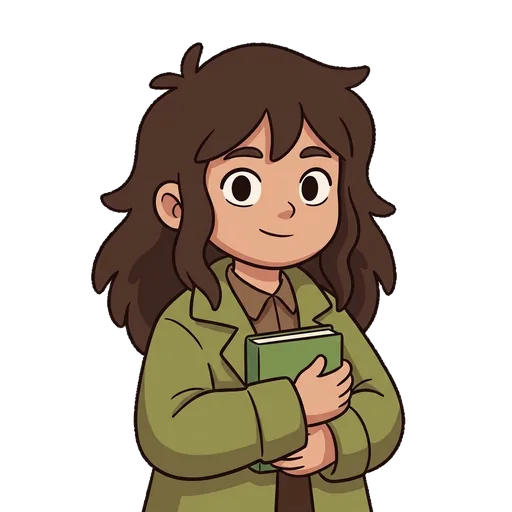 Inkling a child of the Green Names what she notices
Every recurring character has a short tune, so you can tell who is on stage before a word is said. The tunes play only when you tap, and the Reading Access sound switch turns them off.
The Honest Page
Which parts are true, stretched or made up — and what does nobody know?
True
- The oldest evidence of pulleys comes from Egypt, about three thousand nine hundred years ago, and from Mesopotamia at about the same time. Source
- A wheel fixed in one place with a rope over it changes the way you pull: you pull down, and the load goes up. Source
- A wheel that rides on the load itself, so two parts of the rope hold it up, halves the pull you need. You have to pull the rope twice as far. Source
Stretched
- In the story the pulley and the second wheel are both worked out in one afternoon, on one roof. What we simplified: Pulleys were probably improved slowly, by many people, over a long time. The famous stories about pulleys with several wheels, told about the Greek thinker Archimedes, come from more than a thousand years later.
Made up
- Lan and Inkling, the spark, the buzzing word, the boy, his sister, his uncle and the new room on the roof are made up.
Nobody knows
- Nobody knows who made the first pulley. The earliest evidence does not come with a name. Source