
The Day Before · Grower · ages 6-8
Listen along
Loading audio…
Read by an AI-generated voice. The words on this page are the transcript.
1. The Island in the Sea
The hammer rang once. A spark jumped off the anvil and did not go out. It waited. They followed.
The spark led them to the bench under the big tree on the Green. Then it simply waited there.
Warm wind blew the Green away, and the ground under their feet was somewhere else, the day before.
They were standing on white sand. Tall palm trees leaned over them. On one side was a calm green lagoon. On the other side, past a line of white breaking waves, was the deep blue sea, going on and on to the edge of the sky. There was no other land anywhere.
A boy their age was helping his family get a big canoe ready. It had a long float on one side and a sail made of woven leaves. On its side was an old mended patch, and beside the patch somebody had scratched a tiny hammer.
"Tomorrow we sail to the next island," said the boy, when he saw them looking. "My father says this time I must tell everyone when it is near. Before anyone can see it."
"Where is it?" asked Inkling.
"Out there," said the boy. "Too far to see."
2. Bzzz
Lan was sure she knew what the boy needed. She had one at home, on the kitchen wall.
"I know what that means!" said Lan. "I'll go first. What you need is a..."
She said the word before anyone else could.
Bzzz.
Lan went pink. Inkling squeezed her hand.
"The door," said Inkling kindly. "Only the question."
3. That Way
"Can you show us which way the island is?" asked Lan.
The boy pointed across the sea. "That way."
They pushed a little canoe out past the reef to try. They paddled round a big rock, and the canoe turned and turned. When the boy pointed again, his arm was facing a different way.
"I'm not sure any more," he said. "There's nothing out here to point from."
4. Lines in the Sand
Back on the beach, the boy picked up a stick. He drew long lines in the wet sand, all coming from one side.
"The big waves always come from there," he said. "My father showed me." He drew a circle for the far island.
It was a picture of the sea. They could all see it.
Then the water came up the beach, and up again. The lines went soft. Then they were gone.
"And you can't take sand to sea anyway," said the boy sadly.
5. What Stays the Same?
Inkling did not name anything yet. She asked questions instead.
"I noticed something," said Inkling. "Out there, what stays the same?"
"The big waves," said the boy. "They come from the same side, day after day."
"And what happens to them near an island?"
"They bend," said the boy. "They curl round it, on both sides."
"Wait, I can name it," said Inkling. "It's a picture of where things are. You keep it where you can see it. Then you know the way, even when you can't see the island."
6. Red Sun
The sun went down red over the sea. The sand picture was gone.
The boy sat by the canoe with his chin on his knees. "I'll get it wrong," he said. "And everyone will be lost."
7. Sticks
Lan looked at the palm leaves lying on the sand. Down the middle of each leaf ran a thin, stiff rib.
"Could the waves be made of something that stays?" said Lan. "Like sticks?"
The boy's father came over. He did not say anything. He brought a bundle of thin ribs from the palm leaves, some twine and two shells, and put them in the boy's hands.
The boy tied three straight sticks for the big waves. He tied two bent sticks for the waves that curl round the far island. He tied on one shell for home and one shell for the island.
They counted the sticks together. Five. They counted the shells. Two.
8. Where They Cross
"Can I ask one more thing?" said Lan. "Where do the two bent sticks cross?"
The boy looked. The bent sticks went round each side of the island shell, and on the far side, they crossed.
"The waves meet there," he said slowly. "From both sides. So if the canoe gets to that place, it will rock two ways at once!"
He tied a tiny shell where the sticks crossed.
Then he looked at the map for a long time, until he could see it with his eyes shut. In the morning, he left it on the beach.
9. Two Ways at Once
The canoe sailed out of sight of land. There was nothing but blue all round.
The boy lay down in the bottom of the canoe, very still, to feel the waves. Up and down. Up and down.
Late in the day the canoe began to rock a different way. Up and down, and side to side, both at once.
The boy sat up. "It's near," he said. "The island is near."
A while later, the tops of palm trees came up out of the sea.
Nobody would write down the boy's name, or his father's.
Warm wind blew the day before away, and the grass under their feet was the Green.
On the side of the anvil, under the word DOOR, after the O, there was a new letter. A P.
"O, P," said Inkling. "I'm still not guessing."
The spark dimmed to a warm dot and settled back on the anvil. The Green was just the Green again.
Back on the Green
Lan made a map of the Green out of sticks and stones on the kitchen table. Inkling looked at it, shut her eyes, and walked all the way to the bench without peeking.
Tell the story back to someone. Why did the sticks work when the sand did not? Why did the boy leave his map on the beach?
Saved. The next chapter will be here whenever you come back.
Who you met
-
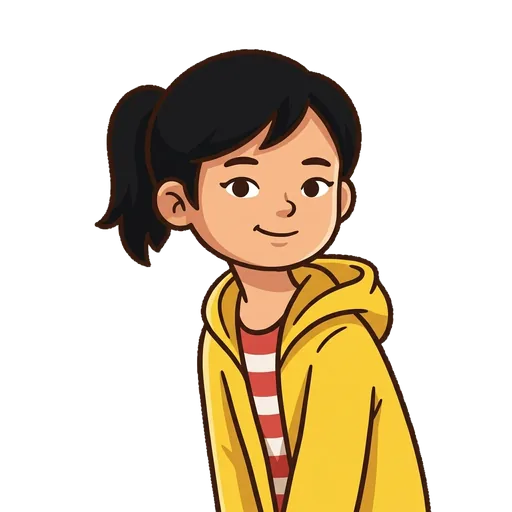 Lan a child of the Green Goes first; makes a friend in a minute
 -
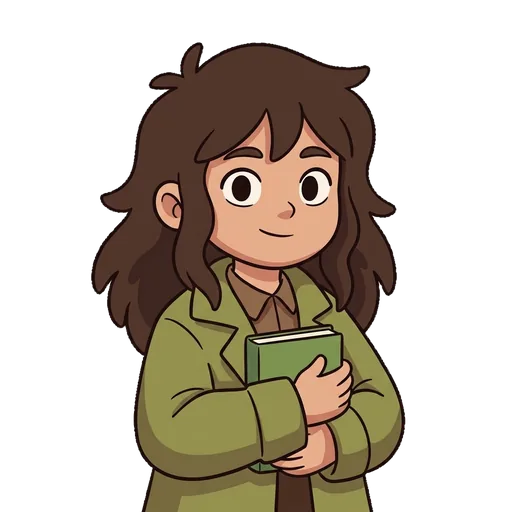 Inkling a child of the Green Names what she notices
Every recurring character has a short tune, so you can tell who is on stage before a word is said. The tunes play only when you tap, and the Reading Access sound switch turns them off.
The Honest Page
Which parts are true, stretched or made up — and what does nobody know?
True
- People of the Marshall Islands, in the Pacific Ocean, made maps out of sticks. Most were made from the middle ribs of coconut leaves tied together, with shells tied on to show where the islands were. Source
- The sticks showed the big ocean waves, called swells, and how they curved round islands and crossed each other. A navigator studied a chart and remembered it before a voyage, and did not look at it at sea. Source
- At sea, Marshallese navigators crouched or lay down in the canoe to feel how the swells were rocking it. Source
Stretched
- In the story a boy learns to make a stick chart in one afternoon and finds an island the next day. What we simplified: Only a few people knew how to make the charts, and the knowledge was passed down in families over many years. Learning to feel the swells took a long time.
Made up
- Lan and Inkling, the spark, the buzzing word, the boy, his father and this voyage are made up.
Nobody knows
- Nobody knows when the first stick chart was made. Visitors from far away first wrote about them in 1862, but the people of the Marshall Islands had been sailing between their islands for a very long time before that. Source