
The Day Before · Reader · ages 6-8
Listen along
Loading audio…
Read by an AI-generated voice. The words on this page are the transcript.
1. The Ring of Sand
The hammer rang once. A spark jumped off the anvil and did not go out. It waited. They followed.
There were five letters on the side of the anvil now. Four in a row, D, O, O, R, and one underneath on its own, round and small: O. Inkling had copied them into her green book, with DOOR at the top in a box and the O on the line below. She had left the rest of the line empty, with little dashes, the way you do in a word game when you don't know the letters yet.
"How many dashes did you leave?" Lan asked on the way past on Saturday morning.
"Three," said Inkling. "But I'm only guessing how long it is. I'm not guessing what it says."
"You could guess a bit," said Lan.
"I could," said Inkling. "But it buzzes when I guess." She said it cheerfully, but she went a little pink, because she remembered the lake.
The spark took them to the bench under the big tree on the Green, where the old people sat in the afternoons. Then it simply waited there.
Warm wind blew the Green away, and the ground under their feet was somewhere else, the day before.
The first thing Lan noticed was that her feet were sinking. She looked down. She was standing in sand so white that it hurt to look at, soft and fine, warm on top and cool underneath. The second thing she noticed was the sound. It was a low, steady roar, like a crowd a long way off, and it never stopped.
She looked up.
They were on a strip of sand with tall palm trees leaning over it, their long leaves rattling in the wind. On one side of the strip was water so calm and green and clear that she could see small fish over the sand at the bottom. On the other side, not far away, a line of white waves was crashing onto a reef, over and over, and that was where the roar came from. And beyond the reef was the sea. Deep, dark blue, going on and on, all the way to the edge of the sky.
Lan turned round slowly. The strip of sand curved away on both sides, like an arm, and came back round to meet itself a long way off. It was a ring, she realised, a ring of sand and palm trees with the calm green water in the middle and the whole wide ocean on the outside. There was no other land anywhere. Not a hill. Not a cliff. Not a smudge. Just blue, all the way round.
"Inkling," said Lan. "Where's everything else?"
"I think this is everything," said Inkling, in a small voice.
A little way along the beach, people were busy. A big canoe had been pulled up on the sand, with a long float tied out to one side on poles, so that it would not tip over, and a tall triangle of sail made from woven leaves. Two women were sewing a tear in the sail with fine twine, quick and neat. A man was coiling rope made of twisted fibres. Children were carrying bundles down to the canoe: rolled-up mats, baskets of food wrapped in leaves, coconuts tied together in pairs. On the side of the canoe was an old patch where a crack had been mended, and next to the patch somebody had scratched a tiny hammer into the wood.
Lan touched it. It was the same tiny hammer she had seen on the blue door, and on the sledge, and the wheel. She did not say anything. She just touched it.
At the edge of the busy group, a boy about their age was kneeling on the sand, holding a coconut in his lap and not doing anything with it. He was looking out at the open sea, past the reef, with a frown so deep that it pulled his whole face down.
He saw them, and stared at their clothes. Lan was in her yellow raincoat, buttoned up, and Inkling was in her green coat, and both of them were already much too hot. But the boy did not seem to mind. He looked them up and down, and then looked back at the sea.
"Are you from the far island?" he said.
"No," said Inkling. "We're just visiting. What far island?"
The boy pointed out to sea, past the reef. There was nothing there but blue.
"Tomorrow we sail there," he said. "My whole family. My aunt is there, and her new baby. We go every year, when the wind is right." He put down the coconut. "And my father says this time I must be the one who says when the island is near. Before anyone can see it. Before even the birds come."
"Before anyone can see it?" said Lan. "How?"
"That's what I don't know," said the boy. "That's what I'm supposed to know. My father knows. His father knew. Now it's my turn." He looked down at his hands. "And I don't."
2. Too Soon
Lan knew what this was. She was absolutely sure.
There was one on the kitchen wall at home, between the calendar and the clock. There was one in the front of her school atlas, with little blue lines for rivers. There was one on her mum's phone, with a blue dot that moved when you walked. It was a short word, and it was right there in her mouth, and Lan, as Inkling knew perfectly well, always went first. She liked going first more than almost anything. She went first down slides and first into cold swimming pools and first to put her hand up, sometimes before she knew what she was going to say.
"I know what that means!" said Lan. "I'll go first. What you need is a..."
She said the word.
Bzzz.
It came out as a buzz, sharp and silly, like a fly bumping against a window.
The boy blinked at her.
Lan went pink from her neck to her ears. She had done it at the river, and with the wheel, and with the long stick, and with the rope. Last time it had been Inkling's turn to buzz, and Lan had squeezed her hand and felt very wise. And now she had done it again, straight away, before she had even looked at the sea properly.
Inkling did not laugh. She took Lan's hand and squeezed it.
"The door," Inkling said softly. "You can't bring the answer. You can only bring the question."
"I know," said Lan. "I went first again."
"You always go first," said Inkling. "It's all right. Just go first with a question."
Lan breathed out. Then she nodded, and turned to the boy.
3. That Way
"Can you show us which way the island is?" Lan asked. It was a question, so it came out as words.
"Of course," said the boy. He stood up and pointed, straight out past the reef, a little to the left of the place where the sun was. "That way."
"How do you know?" said Inkling.
"Because it's always that way," said the boy. "From here."
"Can we try it?" said Lan. "Out there?"
The boy thought about it. Then he ran and asked his father, who was tying a rope to the big canoe, and his father nodded without stopping, and the boy came back with a small canoe of his own, just big enough for three, with a little float on one side. They pushed it into the green water together and climbed in, and the boy paddled them across the calm lagoon, through a gap in the reef where the water was rough and white and slapped the sides, and out onto the open sea.
It was very different out there. The calm green water was gone. Now the sea was dark blue and alive. Big, smooth hills of water came rolling towards them, lifting the little canoe up, up, and then letting it down again. Lan held on tight. Inkling held on tighter.
"Point again," said Lan, when they were well past the reef.
The boy pointed. "That way."
Then a lump of coral rose out of the water ahead of them, black and sharp, and the boy had to paddle round it, first one way and then the other, and the canoe turned, and turned again, and the waves pushed them sideways. When they were clear of it, the island of palm trees was a little way behind them, and the sun had gone behind a cloud.
"Point again," said Lan.
The boy lifted his arm. He pointed. Then he looked at his arm, and frowned, and moved it a little. Then a little more.
"That's not the same as before," said Inkling gently. "Is it?"
"I don't know," said the boy. He put his arm down. "On land I can point from the big palm tree, or from the rock by our house. Out here there's nothing to point from. It's all the same. Everything moves. Even the sun has gone."
They paddled back to the island in silence. It was easy to find, because they could see it. But Lan kept thinking about tomorrow, when they would be so far out that they could not see it any more, or the far island either, or anything at all.
4. Lines in the Sand
Back on the beach, the boy sat down hard on the wet sand by the edge of the lagoon. Then, after a while, he picked up a stick.
"My father showed me something once," he said. "On the canoe, last year. He made me lie down and feel it." He began to draw in the wet sand with the stick. A long line, then another, then another, all side by side, all coming from the same side. "The big waves out there. The slow ones, the deep ones, not the little choppy ones. They always come from that side, from the east, where the sun comes up. Day after day. Even when the wind changes, they keep coming."
"They lifted us up," said Lan. "Like hills."
"Those," said the boy. He drew more lines. Then, a long way along, he drew a circle. "And that's the far island. Here. And this is us." He drew a little circle at the other end.
Lan and Inkling knelt down beside him and looked.
It was a picture. It was a picture of the sea, with the waves in it, and the two islands, and the whole thing small enough to see at once. Lan felt her heart jump. She could see it. She could see where the far island was, compared with the waves, compared with home.
"Oh," said the boy. He was looking at it too. His frown had gone a bit. "Oh, that helps. If I go across the waves, like this..." He ran his finger from the home circle towards the far circle, cutting across the lines.
"Draw it bigger," said Lan. "Draw everything."
So he did. He drew more waves, and a little reef, and the gap in the reef. He was just starting to draw the far island bigger, with palm trees, when the first wave of the tide came sliding up the sand and ran over the bottom of the picture.
"No!" said Lan.
The boy drew it again, further up. The next wave came a little higher. The lines went soft and blurry at the edges. The wave after that came higher still, and the home circle melted, and the waves he had drawn melted into real water, and then the whole picture was just smooth wet sand with a few bubbles on it.
The boy stood up and threw the stick into the lagoon.
"It doesn't matter anyway," he said. "You can't take sand to sea. Even if it stayed, I couldn't take it with me."
5. What Stays the Same?
They sat on the dry sand, away from the tide.
Inkling had not said anything for a long time. She had been watching the sea. Now she took a breath and spoke carefully, so that every word was a question.
"I noticed something," said Inkling. "Can I ask you about the waves? Out there, past the reef. What stays the same?"
The boy thought about it. "The big waves," he said. "The deep ones. They always come from the same side. The little waves on top go all over the place when the wind changes. But the big ones underneath keep coming."
"Even when you can't see the island?"
"Even then," said the boy. "Even at night."
"And what happens to the big waves when they get near an island?" said Inkling. "Do they just stop?"
The boy shook his head. "They bend," he said. He made a shape with his two hands, curving them round an invisible ball. "They hit the island and curl round it. On both sides. My father says you can feel them bending, if you know how."
"So the sand picture was right," said Inkling slowly. "The waves were right. The islands were right. That part worked. What went wrong?"
"The tide came," said Lan. "And sand doesn't stay."
"And you can't take it to sea," said the boy.
Inkling looked at the place where the picture had been. Then she looked at Lan, and Lan could see her trying very hard not to say anything too soon.
"Wait," said Inkling. "I think I can name it now. I looked first."
"Go on," said Lan.
"It's a picture of where things are," said Inkling. "Where the islands are, and where the waves are, all at once, small enough to see. You keep it somewhere you can look at it. And then you know the way, even when you can't see the island at all."
It came out as words. Not a buzz.
"A picture of where things are," said the boy, trying it out. "But a picture that stays."
6. Red Sun
But the sun was going down.
It sank towards the sea, and the sky went orange and then red, and the whole lagoon turned the colour of fire. The people on the beach were finishing their work. The sail was mended. The bundles were in the canoe. Someone had lit a fire, and the smell of fish cooking in leaves drifted along the sand.
Tomorrow morning, early, they would go.
The boy sat by the big canoe with his chin on his knees and his arms round his legs.
"I'll get it wrong," he said. "I'll say it's near when it isn't, or I won't say it at all, and we'll sail right past it, and everyone will be lost on the sea." He pressed his forehead onto his knees. "My father will be ashamed."
Lan sat down beside him. She did not know what to say. She picked up one of the long palm leaves that had fallen from the trees and pulled at it, the way you pull at grass when you're thinking. The leaf was made of lots of thin green strips, but the strips came off, and down the middle of each one there was a stiff, pale rib. It was as thin as a pencil and almost as straight, and when Lan bent it, it bent, and when she let go, it sprang back.
She looked at the rib for a long moment. Then she looked at the coil of twine by the canoe, the twine the women had used to sew the sail.
7. Sticks
"Can I ask something?" said Lan.
The boy lifted his head.
"The sand picture didn't stay," said Lan, slowly, feeling her way. "But this does." She held up the rib from the palm leaf. "It bends, and it springs back. And that string stays tied. Could the waves be made of something that stays? Like sticks, tied together?"
It came out as words, every one.
The boy stared at the rib in her hand.
Then he jumped up and ran to his father. His father was sitting by the fire, checking the end of a rope. The boy spoke to him fast, and pointed at Lan, and at the palm leaves, and at the place where the sand picture had been.
His father listened. He did not say anything at all. He looked at Lan for a long moment, as though she had said something very interesting. Then he got up, and went to the canoe, and came back with a bundle of thin ribs from palm leaves, already stripped and dried, and a coil of fine twine, and two shells. He put them in the boy's hands, and went back to the fire, and sat down again.
The boy knelt on the sand by the firelight. Lan and Inkling knelt beside him.
First he laid down three straight sticks, side by side, all pointing the same way. "The big waves," he said. "From the side where the sun comes up." He tied them together where they touched, with little loops of twine, tight and neat.
Then he took a shell, a small white one, and tied it at one end. "Home," he said.
Then he took the other shell and tied it at the far end, a little to one side. "The far island."
He sat back and looked at it. Then he frowned.
"The waves bend round the island," he said. "My father said so. On both sides."
He took two more sticks. These ones he soaked in the lagoon for a moment, and then bent, slowly and carefully, so that they curved, and he tied them so that one curved round one side of the island shell, and the other curved round the other side.
"Count them," said Inkling.
They counted the sticks together, touching each one. Three straight sticks. Two bent sticks.
"Five," said Lan.
They counted the shells. One for home. One for the far island.
"Two," said the boy.
He held it up to the firelight. It was a little square of pale sticks and twine and shells, light enough to hold in one hand. It did not wash away. It did not blur. It would not melt when the tide came.
"It stays," said the boy. "It just stays."
8. Where They Cross
But Lan was frowning at it.
"Can I ask one more thing?" said Lan.
The boy's father, by the fire, turned his head a little to listen.
"Where do the two bent sticks cross?" said Lan.
The boy looked. The two bent sticks went round the island shell, one on each side. And on the far side of it, past the island, they came together and crossed over, making a little X.
"There," he said. Then he went very still.
"What is it?" said Inkling.
"The waves meet there," said the boy slowly. "The ones that bent round this side, and the ones that bent round that side. They come together in the same place. So if our canoe gets to that place..." He put his hands out flat and tipped them, one way and then the other, both at once. "It will rock two ways at once. Up and down, and side to side. Not just one way, like the big waves. Both."
"And that place is near the island," said Lan.
"Near the island," said the boy. "Before you can see it!"
He took a tiny shell, smaller than his fingernail, and tied it carefully onto the sticks at the very place where they crossed.
Then he did something that surprised Lan. He looked at the map. He looked at it for a long, long time, by the light of the fire, without saying anything. He traced the straight sticks with his finger, and the bent ones, and the shells. Then he shut his eyes and traced them again in the air, with his finger, without looking. Then he opened his eyes and checked. Then he shut them again.
He did this until the fire had burned low.
"Aren't you going to take it?" said Lan.
"No," said the boy. "It's in here now." He tapped his head. "Out there, I won't be able to see it in the dark anyway. I'll need to feel it. So it has to be in here." He laid the map carefully on a mat by the canoe. "I'll leave it here. For next time."
His father, by the fire, nodded once, and smiled into the flames.
9. Two Ways at Once
In the morning, very early, before the sun was up, everyone pushed the big canoe into the lagoon. Lan and Inkling were allowed to come, squashed in among the bundles and the coconuts. The sail went up and filled with wind with a sound like a sheet being shaken, and the canoe slipped through the gap in the reef and out onto the open sea.
Soon the ring of sand and palm trees was a line. Then a smudge. Then nothing.
There was blue all round. Blue sea, blue sky, and a few white clouds. Lan turned round and round and could not find anything at all that was not blue. Her tummy felt funny, and it was not only the waves.
The boy did not look at the sea at all. He lay down flat in the bottom of the canoe, with his arms by his sides and his eyes shut, very still, the way his father had shown him. Lan watched the boy's face. Every time the canoe rose and fell on a big wave, his eyebrows moved a little, as though he were listening.
Up and down. Up and down. Slow and deep, the big waves rolled under them, all from the same side, all day.
The sun climbed and crossed the sky. They ate fish wrapped in leaves and drank from coconuts. Inkling fell asleep against a basket. Lan tried lying down like the boy, and felt the slow up and down of the big waves, and then felt sick, and sat up again.
The sun was getting low when the boy opened his eyes.
Something had changed. Lan felt it too, a moment later. The canoe was still going up and down with the big waves. But now there was something else as well. It was tipping a little from side to side, at the same time. Up and down, and side to side, both at once, in a funny, jumbled way, like a seesaw on a roundabout.
The boy sat up.
He did not look at the sea. He looked at his father.
"It's near," he said. His voice shook, but only a little. "The island is near. We're where the bent waves cross."
His father did not say anything. He changed the sail a little, and steered the way the boy pointed.
Everybody watched the edge of the sea. For a long time there was nothing. Lan's heart thumped. Then Inkling, who had woken up, grabbed Lan's arm and pointed.
Over the edge of the sea, very small, there were tops of palm trees.
Then more. Then a line of white sand. Then a crowd of people running down the beach, waving, and a woman holding up a baby.
The boy's father put one hand on the boy's head, and kept it there, and did not say anything at all. He did not need to.
That night there was a feast on the far island, with fish and breadfruit and songs that went on and on. The boy told the story of the bent waves to his aunt, and then to his cousins, and then to an old man who listened very carefully and asked him to draw it in the sand. The boy drew it. This time he did not mind when the tide came.
Nobody would write down the boy's name, or his father's.
When the stars were out over the sea, so many that they looked like sand themselves, the spark rose out of the fire and waited.
Lan and Inkling said goodbye. The boy gave each of them a tiny white shell, the kind he had tied where the waves cross.
Warm wind blew the day before away, and the grass under their feet was the Green.
The bench was there, and the big tree, and the anvil, glowing faintly in the dusk.
Lan ran straight to it.
Under the word DOOR, next to the round O, so small that she had to kneel down on the grass to see it, there was a new letter. It had a straight back and a round head, scratched in neatly, like all the others.
"P," said Lan.
Inkling took out her green book and wrote P in the second dash, after the O. Then she looked at the two dashes that were still empty.
"O, P," she said. "It's not a word yet."
"Are you going to guess?" said Lan.
"No," said Inkling. "But I've got a feeling." She shut the book. "And I'm keeping the feeling in here." She tapped her head, the way the boy had.
The spark dimmed to a warm dot and settled back on the anvil. The Green was just the Green again.
Back on the Green
On Sunday Lan made a map of the Green on the kitchen table, out of lolly sticks and pebbles. A long stick for the path. A pebble for the bench, a pebble for the anvil, a pebble for the café, and a bottle top for the big tree.
Inkling looked at it for a long time. Then she went out onto the Green, shut her eyes, and walked from the café door all the way to the bench without peeking. She only bumped into the bin once.
Tell the story back to someone. Why did the sticks work when the sand did not? Why did the boy leave his map on the beach, and how did he find the island without it?
Saved. The next chapter will be here whenever you come back.
Who you met
-
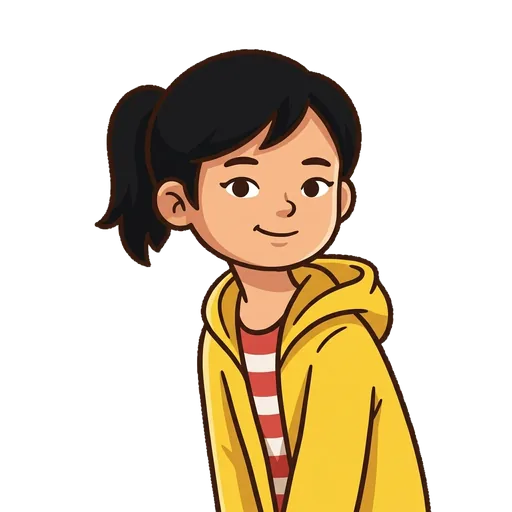 Lan a child of the Green Goes first; makes a friend in a minute
 -
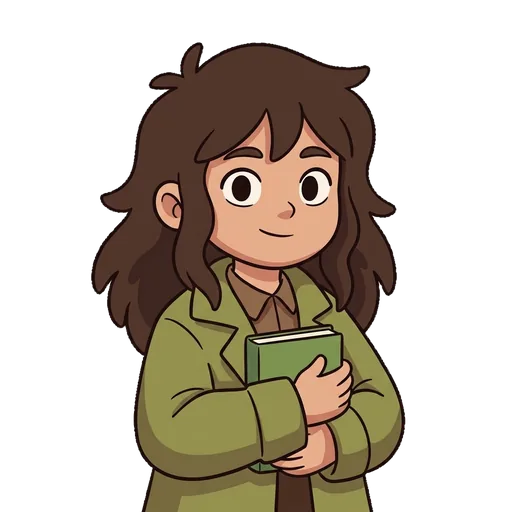 Inkling a child of the Green Names what she notices
Every recurring character has a short tune, so you can tell who is on stage before a word is said. The tunes play only when you tap, and the Reading Access sound switch turns them off.
The Honest Page
Which parts are true, stretched or made up — and what does nobody know?
True
- People of the Marshall Islands, in the Pacific Ocean, made maps out of sticks. Most were made from the middle ribs of coconut leaves tied together, with shells tied on to show where the islands were. Source
- The sticks showed the big ocean waves, called swells, and how they curved round islands and crossed each other. A navigator studied a chart and remembered it before a voyage, and did not look at it at sea. Source
- At sea, Marshallese navigators crouched or lay down in the canoe to feel how the swells were rocking it. Source
Stretched
- In the story a boy learns to make a stick chart in one afternoon and finds an island the next day. What we simplified: Only a few people knew how to make the charts, and the knowledge was passed down in families over many years. Learning to feel the swells took a long time.
Made up
- Lan and Inkling, the spark, the buzzing word, the boy, his father and this voyage are made up.
Nobody knows
- Nobody knows when the first stick chart was made. Visitors from far away first wrote about them in 1862, but the people of the Marshall Islands had been sailing between their islands for a very long time before that. Source