
The Day Before · Grower · ages 6-8
Listen along
Loading audio…
Read by an AI-generated voice. The words on this page are the transcript.
1. The Fork in the Path
The hammer rang once. A spark jumped off the anvil and did not go out. It waited. They followed.
The spark led them to the bench under the big tree on the Green. Then it simply waited there.
Warm wind blew the Green away, and the ground under their feet was somewhere else, the day before.
They were standing on a hot, rocky hill. The rocks were red and orange and pink. Below them was a dry valley, and in the cliff beside them was the dark mouth of a mine. Little chips of blue-green stone lay in the dust. They glittered.
A path came up the valley and split in two at a big flat rock. One way went up the hill. The other way went down into a gully. But the low way was blocked. A heap of fallen rocks lay right across it.
A girl their age was kneeling by the flat rock. Beside the rock, an old crack had been filled in with mud and pebbles, and somebody had scratched a tiny hammer next to it.
"The rocks fell this morning," said the girl. "At dawn the water carriers come up the valley with the donkeys. They always take the low path. My father and everyone will be down in the mine. Nobody will be here to tell them."
"Can they read?" asked Inkling.
"The scribes' writing? No," said the girl. "That's for the Egyptian scribes. It has hundreds of pictures. We speak a different language anyway."
2. Bzzz
Inkling knew what the girl needed. She had seen it every day of her life.
"I noticed it!" said Inkling. "I think it's called an..."
She said the word before she had looked.
Bzzz.
Inkling went pink. Lan squeezed her hand.
"The door," said Lan. "Only the question."
3. A Picture
The girl took a sharp stone and scratched a picture on the flat rock. It was a path, with rocks lying across it.
Her cousin was helping carry baskets. "Pretend you're the water carriers," the girl told him. "What does it say?"
Her cousin looked at it. "Rocks this way," he said. And he walked straight down the low path, towards the rockfall.
"No!" said the girl. "It means don't go that way!"
4. Lots of Pictures
The girl tried again. This time she drew a picture for every word. A path. Rocks. A hand saying no. A hill. An arrow pointing up.
It took up the whole side of the rock.
Her cousin read it slowly. "Path. Rocks. Hill. Up," he said. "Is that a hand? Does it mean stop and wait here?"
He had guessed two of the five pictures right. And the hand could mean anything.
"Too many pictures," said the girl. "And they can all mean different things."
5. What Does It Start With?
Lan did not have an answer. So she asked questions instead.
"Can I ask you something?" said Lan. "In your language, what's the word for house?"
The girl said it.
"What sound does it start with?"
"A 'b' sound," said the girl.
"And water?"
"An 'm' sound."
Lan looked at the pictures on the rock. Every word starts with a sound, she thought. And there aren't very many sounds.
6. Red Sun
The sun went red behind the hill. The girl rubbed the pictures off the rock with her sleeve.
"They'll go the low way," she said. "A donkey will fall in the rocks. All its water will spill. And it will be because nobody could read my rock."
7. Just the Sound
Inkling had been quiet for a long time. She did not name anything this time.
"Wait," said Inkling. "Can I ask a question? Could the house picture mean just the 'b' sound? Not a house at all?"
The girl stared at her. "The scribes do that sometimes," she said slowly. "A picture for a sound."
8. Up
"Then which pictures start with the sounds of your word for 'up'?" asked Inkling.
The girl thought hard, saying the word under her breath. Then she scratched two little pictures on the rock, side by side. An eye. And a shepherd's crook.
"Say them," said Inkling. "Just the first sounds."
Her cousin said the first sound of eye. Then the first sound of crook. He said them again, faster.
"Up!" he said. "It says up!"
9. Dawn
At dawn the water carriers came up the valley with their donkeys. The leader stopped at the fork and looked at the rock. She said the two sounds out loud. Then she turned, and took the high path, and every donkey and every jar of water came safely up the hill.
Nobody would write down the girl's name.
Warm wind blew the day before away, and the grass under their feet was the Green.
On the side of the anvil, under the words DOOR and OPEN, there was a new letter. A W.
The spark dimmed to a warm dot and settled back on the anvil. The Green was just the Green again.
Back on the Green
Lan wrote her name on a card for Granny. L, A, N. Three letters, one for each sound, so Granny could read it from across the room.
Tell the story back to someone. Why did lots of pictures not work? How did two pictures say "up"?
Saved. The next chapter will be here whenever you come back.
Who you met
-
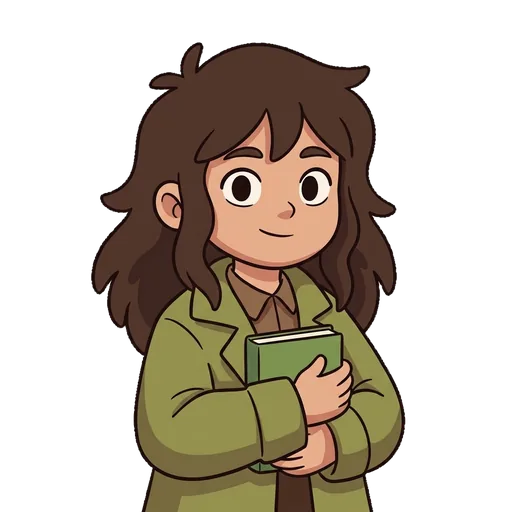 Inkling a child of the Green Names what she notices
 -
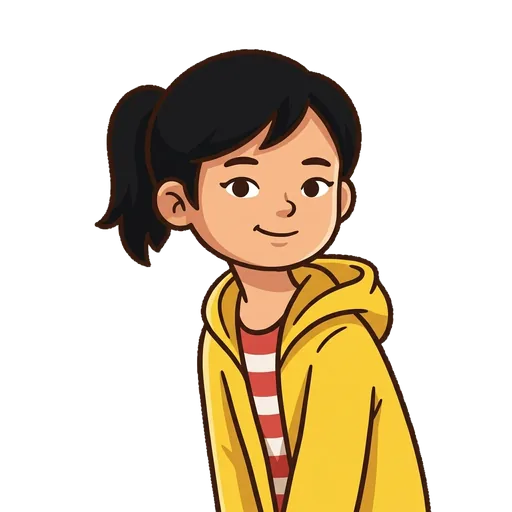 Lan a child of the Green Goes first; makes a friend in a minute
Every recurring character has a short tune, so you can tell who is on stage before a word is said. The tunes play only when you tap, and the Reading Access sound switch turns them off.
The Honest Page
Which parts are true, stretched or made up — and what does nobody know?
True
- About 3,800 years ago, at the turquoise mines of Serabit el-Khadim in the Sinai desert, workers who spoke a language that was not Egyptian scratched short messages using a small set of pictures borrowed from Egyptian writing. Source
- Each picture stood for the first sound of its name in the workers' own language. The picture of a house, whose name began with a 'b' sound, stood for 'b'. This way of writing is thought to be the ancestor of most alphabets used today, including the one in this book. Source
- In the story, the girl's cousin guesses two of her five pictures right and three wrong.
Stretched
- In the story, the girl writes the word for 'up' with an eye and a shepherd's crook, to warn a caravan. What we simplified: The real messages found at the mines are short, and most seem to be gifts or thanks; scholars can read only a few words of them. No warning like hers has been found. Her two signs are the kind of signs they used, not a copy of a real message.
Made up
- Lan and Inkling, the spark, the buzzing word, the girl, her cousin, the rockfall and the water caravan are made up.
Nobody knows
- Nobody knows who first let a picture stand for just one sound, or who wrote the first message this way. The people who did it left no names that anyone has found. Source