The Paper Door · Reader · ages 6-8
Listen along
Loading audio…
Read by an AI-generated voice. The words on this page are the transcript.
1. A Spark and a Paper Cup
The hammer rang once. A spark jumped off the anvil and did not go out. It waited. They followed.
It was windy on the Green, the gusty kind of wind that turns umbrellas inside out and sends leaves skittering along the path like small brown mice. Lan chased the leaves for a bit, because they were there. Inkling walked straight, with her hands in her coat pockets, watching the spark so she would not lose it.
The spark went where it always went. Past the mending shed, past the bench with the loose plank, right up to the door of the print shop. It bobbed there in the wind, glowing orange, until they opened the door and let it in.
Inside it was still and quiet and smelled of ink and old paper. The spark crossed the long table and settled beside a square of paper, orange on one side and cream on the other.
The square sat up.
"Fold me, I won't mind," said Kami.
"Somewhere cosy this time," said Inkling, rubbing her cold hands together. "With a radiator. Or a fire."
"I can't promise a fire," said Kami. "But start with something warm to hold. Start with a cup."
The cup began with a triangle, so Inkling folded Kami corner to corner first. Then she folded the left corner across, so its point touched the far edge. She folded the right corner across the same way, so the two flaps crossed in the middle like folded arms. She folded the top front flap down into the cup, and turned it over, and folded the back flap down too. When she squeezed the sides, the top opened, and there it was, a little paper cup.
The last crease went flat, and the paper opened like a door.
2. A Room of Old Books
The cup opened wider and wider, until the inside of it was full of soft yellow light.
Lan stepped through first, as usual. Inkling came after her, holding Kami carefully by one corner.
It was cold. That was the first thing, before anything else. Not freezing cold, but the kind of chilly that creeps up your sleeves. Lan pulled her yellow raincoat tighter. Then something hissed and clanked in the corner, and a wave of warm air rolled over them.
"A radiator," said Inkling, pleased. "You see? I asked for one."
They were standing in a long room with dark wooden walls that went right up to a high ceiling. Shelves of books with faded gold letters on their spines ran along one side. Tall windows filled the other side, and each window was made of dozens of tiny diamond-shaped panes held together by strips of lead. Through them, Lan could see a lawn and a stone path and trees whose leaves had turned yellow and orange. Every few seconds a gust shook a handful of leaves loose, and they floated past the glass.
In the nearest window, one little pane sat in a strip of lead that was brighter than the rest, where somebody had mended a broken diamond of glass. On the wooden frame beside it, too small to notice unless you were looking, a tiny hammer had been scratched.
"It looks like a castle," said Lan. "A castle that's also a library."
"A college," said Kami softly. "Students live and study here. This is Princeton, in New Jersey, in America. The year is 1939."
Somewhere down a corridor, a door closed and footsteps went away up a staircase. A clock ticked slowly on the wall. Nobody seemed to be in a hurry.
3. Rosa and the Three Pictures
At a long table by the windows sat a girl in a brown wool coat and a red knitted hat. She looked about eight. In front of her lay three small drawings done in crayon, and next to them a card folded in half, the kind you give at a birthday.
The girl was frowning at the drawings as if they had done something wrong.
"Hello," said Lan. "Are those yours?"
The girl looked up. She did not seem very surprised to see two strangers holding a paper square, which Lan thought was polite of her.
"I'm Rosa," she said. "My mother works in the kitchens here, and I wait for her after school. I'm making a card for my little brother, Teo. It's his birthday tomorrow. He's five."
She pushed the drawings toward them. One was a round yellow moon with a sleepy face. One was a blue fish with stripes. The last was a big gold star, coloured so hard the crayon had gone shiny.
"Those are good," said Inkling, and she meant it.
"I want him to find one as a surprise," said Rosa. "Something he has to look for. The star is the best one. But look." She opened the card and closed it again. "A card has a front and a back. Inside is just the front and the back again, really. There's nowhere to hide anything. Two sides, and I have three pictures."
Lan picked up the card and turned it over. Front. Back. Front. Back. Rosa was right.
"You could put two on the front," said Lan.
"Then it isn't a surprise," said Rosa.
That was also right. They all looked at the three pictures, and nobody had an answer.
"You could make two cards," said Inkling.
Rosa shook her head. "Then he'd open the second one and know straight away. A surprise has to be hiding somewhere you didn't think it could be." She put her chin in her hands. "I've been sitting here since lunch."
Lan looked at the folded card again, and at the three pictures, and at the windy lawn outside, as if the answer might be out there among the leaves.
4. Every Line
At the far end of the table sat a young man in a grey sweater with holes at the elbows. He was so quiet that Lan had not noticed him at first. Beside him lay an open notebook and a neat stack of long, thin strips of paper, all the same width, about as wide as two fingers.
He was folding one of the strips. His hands moved slowly, and he did not look up.
"He's a student," whispered Rosa. "From England. He cuts the edges off his notebook paper every week. He told me American paper is too big for his English binder, so it won't fit unless he trims it. He saves the strips. He says they're good for thinking with."
The young man finished his folding. Then, without a word, he slid a fresh strip down the table toward them, and went back to his notebook.
Lan picked it up. Ten triangles had been drawn on it in pencil, side by side, pointing up, down, up, down, like a row of little roofs and upside-down roofs. The two ends of the strip were cut on a slant to fit the triangles.
"I know what to do," said Lan. "It's a folding strip. I'll do it! I promise. I'll fold every line."
She folded the first line. She folded the next line the other way. Back and forth, back and forth, quick as anything, the way you fold a paper fan. In half a minute every line was folded. Lan squeezed it tight and held it up.
It was a stiff little stick of paper, ten layers thick. When she let go, it sprang open into a zigzag and lay there, crooked, on the table. There was no shape. There was no secret. There was nowhere for a star to hide.
"Oh," said Lan.
"Just guessing makes a mess of good paper," said Mark. He had been standing behind them, reading the book spines, but now he came over. Mark always noticed lines before he noticed anything else. "You didn't read it. Read the drawing before your hands move. Look at the young man's notebook. Not every line is the same kind of line."
Lan looked at her zigzag. Then she looked at Rosa.
"I said I'd do it before I checked," she said. "That's what I always do. Sorry, Rosa. I've used up one of his strips."
"He has lots," said Rosa kindly. "He has a whole stack."
Lan smoothed the zigzag flat and put it to one side. She would use it later for something, she decided. Good paper should not be wasted.
Inkling picked up the zigzag and held it to the light from the window. Every line had a crease in it now, all nine of them, some folded one way and some the other. It looked busy and muddled, like a page where someone had underlined every single word.
"If you mark everything," said Inkling, "you haven't really marked anything."
Lan made a face at her, but she did not argue. She knew it was true. When her teacher at home said a word was important, it was because the other words were not as important. If every word was important, you could not tell which one to remember.
5. What the Lines Say
Mark leaned over the open notebook. The young man moved his elbow a little to let him see, but he still did not speak. He did not explain anything. He just went on with his own folding.
On the page was a careful drawing of the same strip, with its ten triangles. But on the drawing, most of the lines were plain pencil lines. Only three were different.
"Look," said Mark, pointing without touching. "There's a dashed line after the third triangle. And another dashed line after the sixth triangle. And here, before the very last triangle, the line is dashes and dots. Dash, dot, dot, dash."
"What does that mean?" asked Rosa.
"Every line on the drawing has a job," said Mark. "Dashes mean fold toward you, so the paper comes up and over. Dashes and dots mean fold away from you, behind the paper. The plain lines just tell you where the triangles are. You don't fold those yet."
He counted on his fingers. "So that's three folds, not nine. Two folds toward us. Then the last triangle goes behind."
Lan looked at the drawing for a long time. It was such a small difference, dashes or no dashes, and she had not even noticed.
"Read the drawing before your hands move," she said slowly, as if she were trying the words out.
"That's it," said Mark, and he looked pleased.
6. Three, and Three More
Rosa took a fresh strip from the end of the stack. The young man nodded very slightly, which seemed to mean yes, go on. She laid the strip flat on the table and smoothed it with both hands.
"Corners first, always," said Cornelia, who had appeared at Rosa's elbow the way Cornelia always did, right at the moment when something needed lining up. "Count three triangles from the left end. One, two, three. Now the line just after them is your first fold."
Rosa put her finger on the line.
"Bring the rest of the strip over, toward you," said Cornelia. "Make the edges meet exactly. Not near enough. Exactly."
Rosa lifted the long end of the strip and swung it over. It was a strange fold. The strip did not lie back along itself, the way it would if you folded a ribbon in half. It bent off at a slant and crossed over the first three triangles, so that the long end now pointed down and to the left.
"That looks wrong," said Rosa.
"Look at the edges," said Cornelia. "Do they meet the lines of the triangles underneath?"
Rosa looked. Where the strip crossed over, its top edge lay exactly along the edge of a triangle underneath. Everything lined up, like tiles on a floor.
"They meet," she said.
"Then it's right," said Cornelia. "Point to point, then hold. Now count three more triangles, starting from the fold you just made."
Rosa counted. Four, five, six. She found the second dashed line on the drawing, and the line on her strip that matched it. She lifted the long end again and swung it over, toward her, making the edges meet exactly.
This time something happened that made all of them lean in. The strip came round and closed up into a shape with six straight sides, like a cell in a honeycomb. Six triangles met in the middle, their points touching. Only one triangle was left over, sticking out at the side like a little flag.
"A hexagon," said Inkling. "That's a shape with six sides."
"Three triangles, three more, three more underneath, and one left over," said Lan, counting carefully this time. "That's ten. That's all of them."
Cornelia nodded. "Bring it all the way over, every time. That's why it closed up."
7. The Wrong Way Round
"I'll do the last one," said Inkling. "It's easy. It's just one little triangle."
She took the hexagon and folded the loose triangle over the front, toward her, the same way as the other two folds. It landed on top of the hexagon with a soft pat.
Rosa had a pot of glue with a little brush in it. She dabbed some on the triangle and pressed it down. But when she let go, the triangle lifted up again. It was not lying on the first triangle at all. It was lying on top of a different triangle, the ninth one, high up on the front, and there was nothing underneath it that it belonged to.
Rosa tried to open the hexagon. It would not open. It was just a flat, sticky lump with a corner sticking up.
"It's ruined," said Rosa, and her voice wobbled.
"It isn't ruined," said Crinkle quickly. Crinkle was round and soft and always cheerful about things going wrong, which sometimes annoyed people, but was usually helpful. "Crooked is just a first go. We can fix this one. Smooth it out and try again. The crease remembers."
Inkling peeled the triangle back up. The glue had not dried yet, so it came away easily. She opened the last fold, and there on the paper was the line where it had been folded, a soft crease like a footprint.
"Now look at the drawing again," said Mark. "What kind of line was the last one?"
"Dashes and dots," said Inkling. "Oh. Fold away. Behind the paper. I folded it the wrong way round."
"Open it up gently," said Crinkle. "Then try the other way."
This time Inkling folded the last triangle backwards, behind the hexagon, around its outside edge. It slid neatly underneath. When she turned the hexagon over to look, the loose triangle was lying flat against the back of the very first triangle of all, the one at the very start of the strip. The two of them fitted together exactly, one on top of the other, with nothing in between.
"It fits," said Rosa, wiping her eyes with her sleeve. "It fits like it was meant to."
"It was meant to," said Mark. "That's why the line was different."
8. Hold It Still
"Hold it still," said Presso. Presso was the slowest of all of them and the strongest, and everything Presso did was calm. "Now press it flat. Every fold. Run your thumbnail along each one."
Rosa held the hexagon steady with one hand. With the other, she ran her thumbnail along each folded edge, slowly, all the way round. The paper went sharp and crisp under her nail.
"Press slowly, press firmly," said Presso. "A fold you press is a fold that stays."
Then Rosa put a small dab of glue on the loose triangle, just a little in the middle, and pressed it against the back of the first triangle.
"Now hold it," said Presso. "Don't peek. Glue needs time."
They counted to thirty together, out loud, while Rosa held it. Lan wanted to peek at twenty. Inkling held her hand to stop her. At thirty, Rosa let go.
The triangle stayed.
9. Pinch, Push, Open
"Every fold makes me something new," said Kami, who had been watching the whole time from the edge of the table. "And this fold has a secret in it. Shall I show you how to find it?"
Rosa held the hexagon out on her palm.
"Pinch two triangles that are next to each other," said Kami. "Just two, between your finger and thumb, so they fold up together like a little mountain."
Rosa pinched.
"Now push the corner on the opposite side in toward the middle," said Kami. "Gently. And look in the middle. It wants to open."
Rosa pushed. The middle of the hexagon split open into a small dark star-shaped hole. She pushed a little more, and the hole opened wider and wider, like a flower opening in a hurry. Then, all at once, the whole hexagon turned itself inside out and lay flat again.
But it was a different face. The triangles that showed now were triangles none of them had seen when it was folded. They had been inside the whole time, hidden.
Rosa gasped. Lan said "WHOA" so loudly that the young man at the end of the table looked up, for the first time, and smiled.
"How many faces does it have?" asked Rosa.
Inkling was already counting. "There were nine triangles, not counting the one we glued. Every triangle has two sides, a front and a back. So that's eighteen sides altogether. And every face of the hexagon uses six triangles." She did it on her fingers. "Eighteen sides, six on each face. That makes three faces."
"Three faces," said Rosa slowly. "A front, a back, and one hiding inside."
She flexed it again, pinch, push, open, and the first face came back round. Again, and the hidden one came out. It went round and round, always in the same order.
"Three pictures," said Rosa. "And a hexagon with three faces."
She picked up her crayons. On the front face she drew the sleepy yellow moon, one little piece in each triangle, so the moon was made of six slices. On the back face she drew the striped blue fish. Then she flexed it until the hidden face came out, and on that one she drew the big gold star, coloured so hard it went shiny. Then she flexed it once more, and the star disappeared.
10. The Birthday
They were invited to the party the next afternoon, in a small warm kitchen that smelled of cinnamon and oranges. Rosa's mother had made a cake with five candles. Teo wore a paper crown that was slightly too big for him.
Rosa gave him the hexagon. "It's a moon," she said, very seriously. "And if you turn it over, it's a fish."
Teo turned it over. Fish. He turned it back. Moon. He turned it over and over, giggling.
"Is that all?" he said at last.
"Maybe," said Rosa, and she looked at Lan, and Lan had to press her lips together hard to keep from saying anything.
Teo poked it. He squeezed it. Then, by accident, he pinched two triangles and pressed the opposite corner, and the middle opened. He froze. He pushed a little more. The hexagon turned itself inside out in his hands, and there was the star.
Teo shouted so loudly that the cat jumped off the windowsill.
Everybody at the party wanted a turn after that. Rosa's mother flexed it and laughed. An old man from upstairs, who had come down for a slice of cake, flexed it three times and then turned it over and flexed it the other way, and the faces came round backwards, star, fish, moon.
"Look at that," he said. "It goes round the other way when you turn it over. Like a clock looked at in a mirror."
Inkling watched carefully. Front, back, hidden, and back to the start. Three flexes and you were home again. Turn it over, and the same three faces came round in the opposite order. She thought that if she drew it, it would look like a little circle with three stops on it, like a bus that only ever went round one block.
"How did it get inside?" he demanded. "How did the star get inside?"
"It was folded in," said Rosa proudly. "You just have to know how to look."
11. Home Through a Square
Later, when the cake was finished and Teo was flexing his hexagon round and round to show everybody, Lan felt in her coat pocket and found a plain square of paper.
"Time to go," said Kami.
Rosa walked them to the door of the kitchen. "Thank you," she said. "I thought there was nowhere to hide a star."
"There was," said Inkling. "It just needed the right folds."
They unfolded the paper flat, and the door closed behind them.
They were back in the print shop, with the wind still rattling the window. The hexagon was not in Lan's hand any more, but her zigzag strip was, the one she had folded on every line. She smoothed it out on the table and looked at it. She could see every crease. Only three of them were the ones that mattered.
The spark dimmed to a warm dot and settled back on the anvil. The Green was just the Green again.
Back on the Green
The next week, Lan wanted to make a secret card for Inkling's birthday. She found a strip of paper and drew ten triangles on it. Then she stopped, before she folded anything at all, and drew in the dashes first.
Tell the story back to someone. Why did the last triangle have to go behind, and not in front?
Saved. The next chapter will be here whenever you come back.
Who you met
-
 Kami Paper becomes a new shape with every fold, and it only cuts where it is told from CreaseTots
-
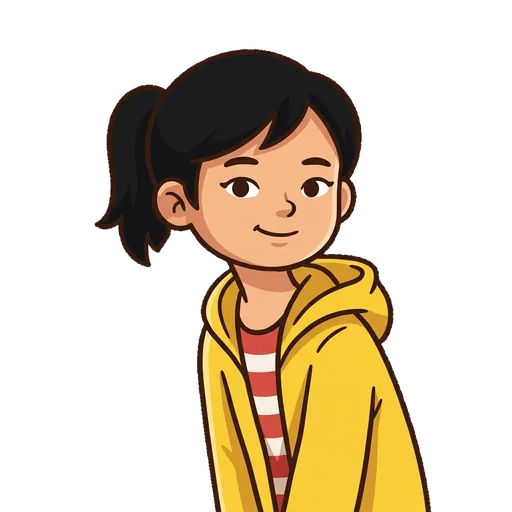 Lan a child of the Green Goes first; makes a friend in a minute
-
 Mark The lines tell you what to do — dashes fold, solid lines cut from CreasePals
-
 Cornelia Bring one corner to meet the other corner, exactly from CreaseTots
-
 Crinkle Smooth a crooked fold out and try again; the crease remembers from CreaseTots
-
 Presso Hold the paper still and press the fold flat so it stays from CreaseTots
-
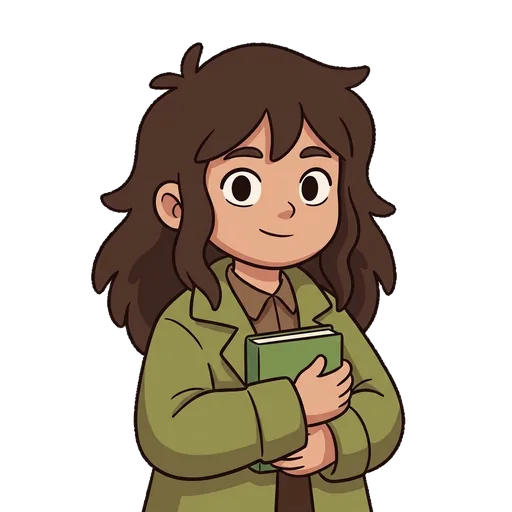 Inkling a child of the Green Names what she notices
Every recurring character has a short tune, so you can tell who is on stage before a word is said. The tunes play only when you tap, and the Reading Access sound switch turns them off.
The Honest Page
Which parts of this story are true, stretched or made up?
True
- In 1939 Arthur Stone, a student from England at Princeton University, found the first flexagon. His new American paper did not fit his English binder, so he cut the ends off and started folding the strips. Source
- Three of his friends, Bryant Tuckerman, Richard Feynman and John Tukey, joined him. They called themselves the Flexagon Committee. Source
- Martin Gardner wrote about flexagons in Scientific American in December 1956. People liked it so much that it started his long-running column of mathematical games. Source
- The three-face flexagon is made from nine triangles in a strip, plus one more to glue. Nine triangles have eighteen sides, and they show as three faces of six triangles each.
Stretched
- The young man folding strips in our story never says his name. What we simplified: We kept the real Arthur Stone in the background so the children and the cast solve the problem themselves; nobody knows exactly where he sat to fold.
- In our story his notebook shows the folding drawing for the strip. What we simplified: We drew our own simple folding drawing; we do not know what his own notes looked like.
Made up
- Rosa, her little brother and the paper door are made up. Kami, Mark, Cornelia, Presso and Crinkle are our own characters.