
Berth
MAKING SPACE — leave room in the sound and the plan so every part fits — quiet the loud, invite the quiet — nobody drowned out, nobody forced to shout.
Loading audio…
Press play to listen along. The line being read lights up as you go.
Show full transcript
Loading transcript…

The little pelican spread her big wings wide across the practice circle, then folded them halfway — not to take up space, but to make it — nudging the loud birds a step back and leaving a clear, open gap in the middle of the sound.
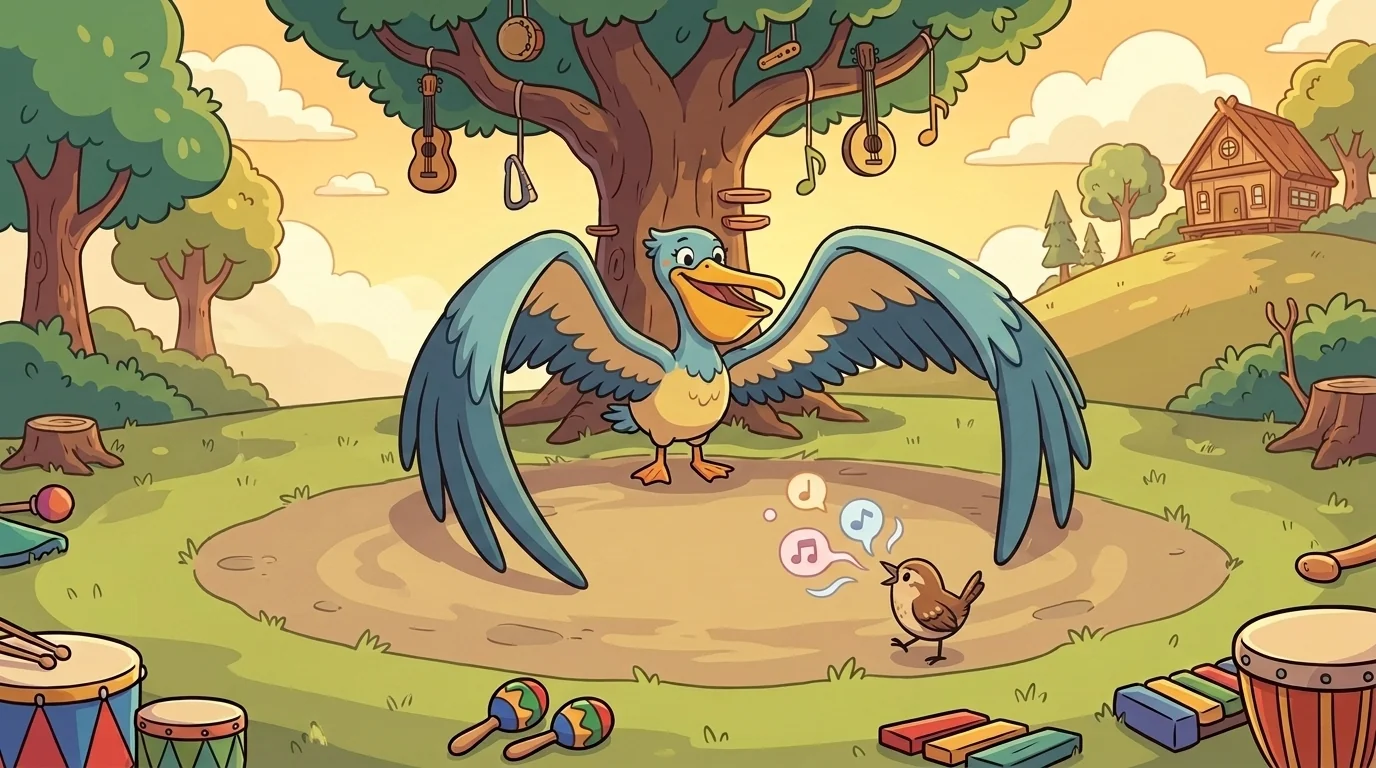
"There," Berth said. "Room. Whose part goes in the quiet?" A tiny wren in the corner had a soft, lovely idea and no way to fit it in — every time she'd opened her beak the sound had already been full, fast drumming, loud singing, no gap anywhere, and her small voice had nowhere to land. She'd felt herself shrinking, a quiet giving-up settling in her chest: there's just no room for me. But now there was a gap, held open on purpose. She sang into it, and her soft idea was heard — because there was space for it to be heard in. "That's the whole craft," Berth said. "A part isn't heard by being louder. It's heard by having room."

Berth learned that space, in music, is a real instrument — as real as any drum. "Everyone thinks the parts are the music," she told the wren. "But the music lives just as much in the gaps — the rests, the quiet places, the moments one part drops out so another can breathe." She had the loud birds play everything, all at once, all the time — a solid wall of noise where no single part could be told from another. "Full," she said, "and empty at the same time — because when everything sounds at once, nothing is heard." Then she thinned it: drums rest here, the singers drop out there, a gap held open on purpose. Suddenly each part stood out, clear and distinct, exactly because it had air around it. "The space between the notes isn't nothing," Berth said. "It's the frame that lets each note be seen. A player who never rests buries everyone — including themselves."

When she was young, Berth thought her job as the biggest bird was to fill every silence — silence felt like failure, like the music had stalled. An old marsh-heron taught her otherwise. "A gap isn't a hole to plug," he said. "It's a doorway. Every quiet you leave is an invitation — someone smaller, someone slower, someone who needs a moment to gather their part, can finally step through." Berth felt the whole shape of it turn over: making space wasn't holding back, it was hospitality. She learned to listen for who wasn't in the sound yet and to open a gap exactly their size — to quiet the loud not to punish them but to invite the quiet, so the fast confident parts and the soft careful parts could all fit in one piece without anyone shouting or shrinking. "The loudest room," she'd say, "is often the emptiest of voices. Leave a doorway, and watch who walks in."
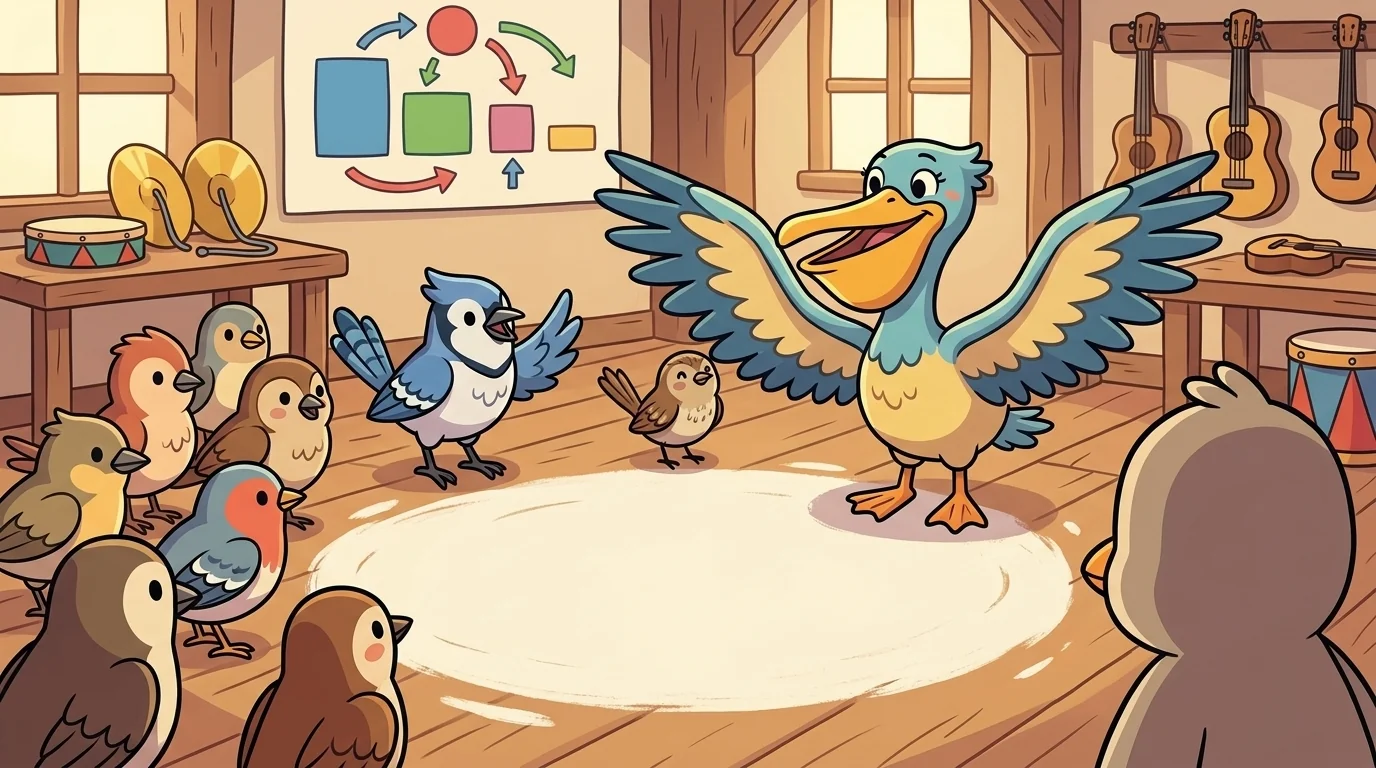
At the academy a group had a piece that was technically perfect and somehow exhausting — every bird playing full-tilt the whole time, a relentless wall. And one careful vireo with a beautiful line had gone silent, unable to find a single crack to fit into. "Nobody's wrong here," Berth said. "You're all just playing at once, forever, so it's all wall and no window." She built the arrangement with rooms in it: had the drums lay out for the verse, the loud singers soften under the chorus, a whole bar of near-silence held open right before the end. The exhausting wall became a shape — loud places and quiet places, each part clear because it had air. And into the held-open bar, the careful vireo finally placed her line, and it landed like a bell in a quiet room. "Hear that?" Berth said. "Same birds. We didn't add a thing. We made room — and a part that had vanished came home. That's dynamics. That's arrangement. That's leaving a doorway on purpose."
"So making space isn't the music stopping," the vireo said softly. "It's the music leaving room — so every part, even a quiet one, has somewhere to land?"
"That's the whole of it," Berth said, and folded her great wings to hold one more gap open, just to feel the quiet do its work. Under it she felt the calm that always came from a room made on purpose: not the suffocating fullness of a wall of sound where nothing could be told apart, not the old anxiety that silence meant failure, but a spacious, hospitable, everyone-fits ease. It was the ease of someone who had learned that space is an instrument, that the gap between the notes is the frame that lets each note be heard, and that the kindest, most musical thing a big loud bird can do is fold her wings and leave a doorway exactly the size of the quietest part. That roomy, doorway-left, nobody-drowned-out feeling, steadier than any wall of sound, was to Berth exactly why she made space wherever she went.
The EnsembleQuest ensemble
Berth is part of EnsembleQuest's distributed-narrative cast. Each character embodies a different curricular primitive; together they teach the full subject.
-

Part
Role-holding — knowing what MY part is, separate from but supporting the whole
-

Turn
Turn-taking — the rhythm of give-and-receive across an ensemble
-

Ear
Active listening — receiving the other person's contribution before adding your own
-

Welcome
Invitation + repair — bringing back someone who's drifted out of the ensemble
-

Share
Synthesis-in-performance — the moment many parts become one piece
-

Bravo
Specific appreciation — notice one exact thing a partner did well and name it out loud, so they know their part landed
-

Dovetail
Dovetailing ideas — when two ideas differ, find the shape where both fit and interlock; neither cut away, neither swallowed
-

Nod
Non-verbal signals — a clear wordless cue (a nod, a raised wing, a card) for ready, done, my-turn, or pause
-

Outline
Co-planning — before anyone makes anything, sketch the shared shape together, so nobody has to guess where it's going