Dovetail
DOVETAIL — *when two ideas differ, find the shape where both fit and interlock — neither idea cut away, neither swallowed, both holding.*
Loading audio…
Press play to listen along. The line being read lights up as you go.
Show full transcript
Loading transcript…
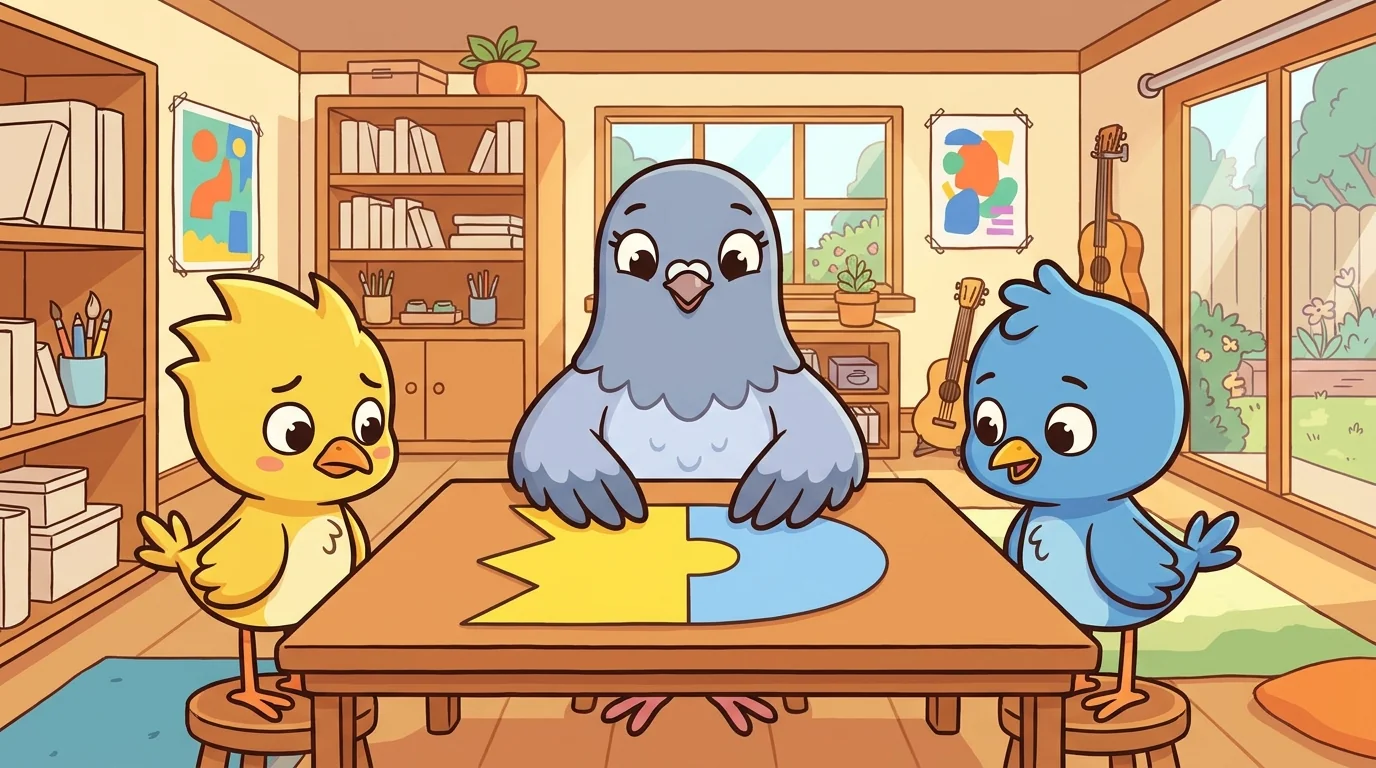
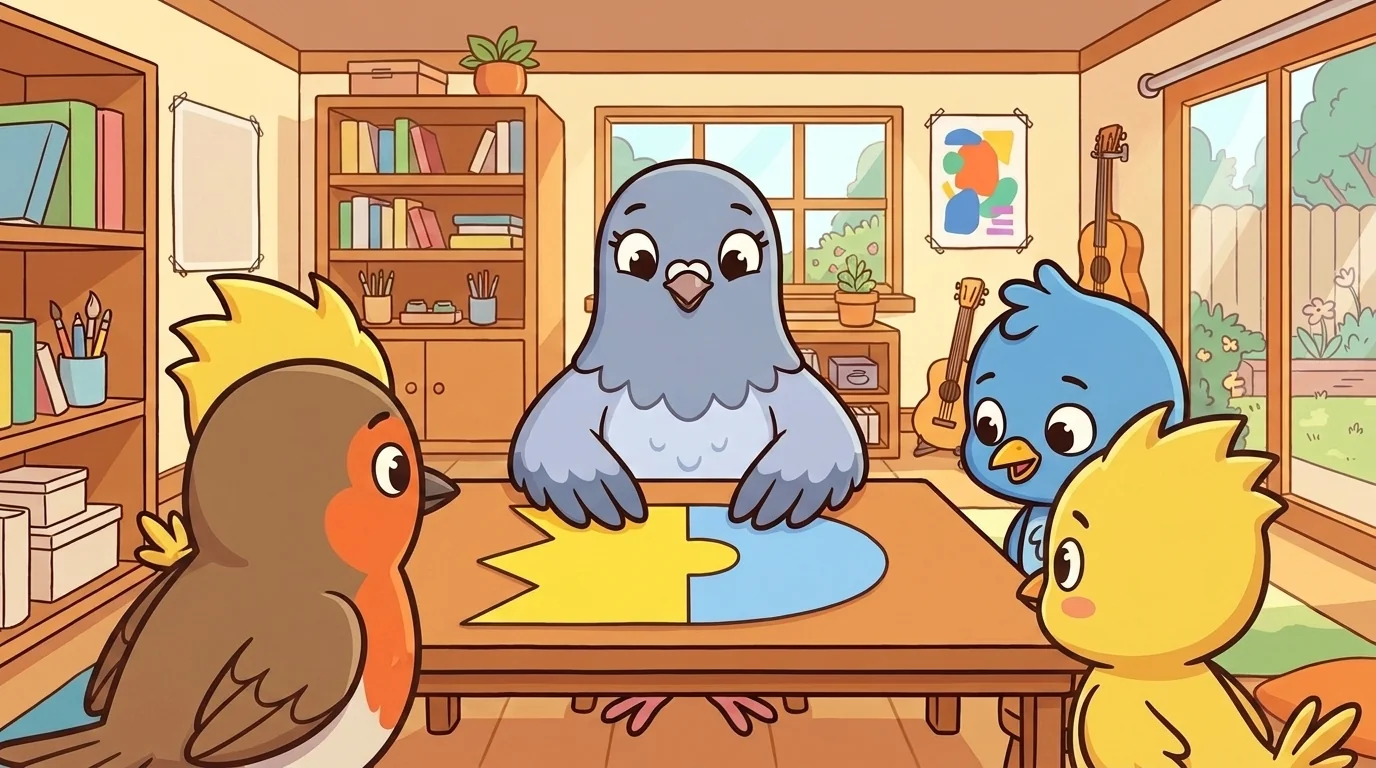
The little dove tipped her head over two paper shapes on the table — one a fast, bright zig-zag, the other a slow, round curve — and instead of choosing one, she slid them slowly toward each other until their edges interlocked, zig into curve, and neither shape lost a single line.
"See?" Dovetail said softly. "Nobody's idea got thrown away. They fit."
Two young birds had been standing stiff on either side of the table. One had wanted the song fast; the other, slow. They'd braced for the usual thing — a vote, a loser, an idea in the bin — and the bracing sat hard in both their chests, a tight my-idea's-about-to-die clench. But now the fast part and the slow part were locked together on the paper, taking turns, holding each other up. The fast bird blinked. "That's... still my part." "And still mine," said the slow one. And the clench in both chests eased.
"Compromise isn't giving in," Dovetail said. "Giving in is when one idea disappears. This — this is finding the shape where both of them get to stay."
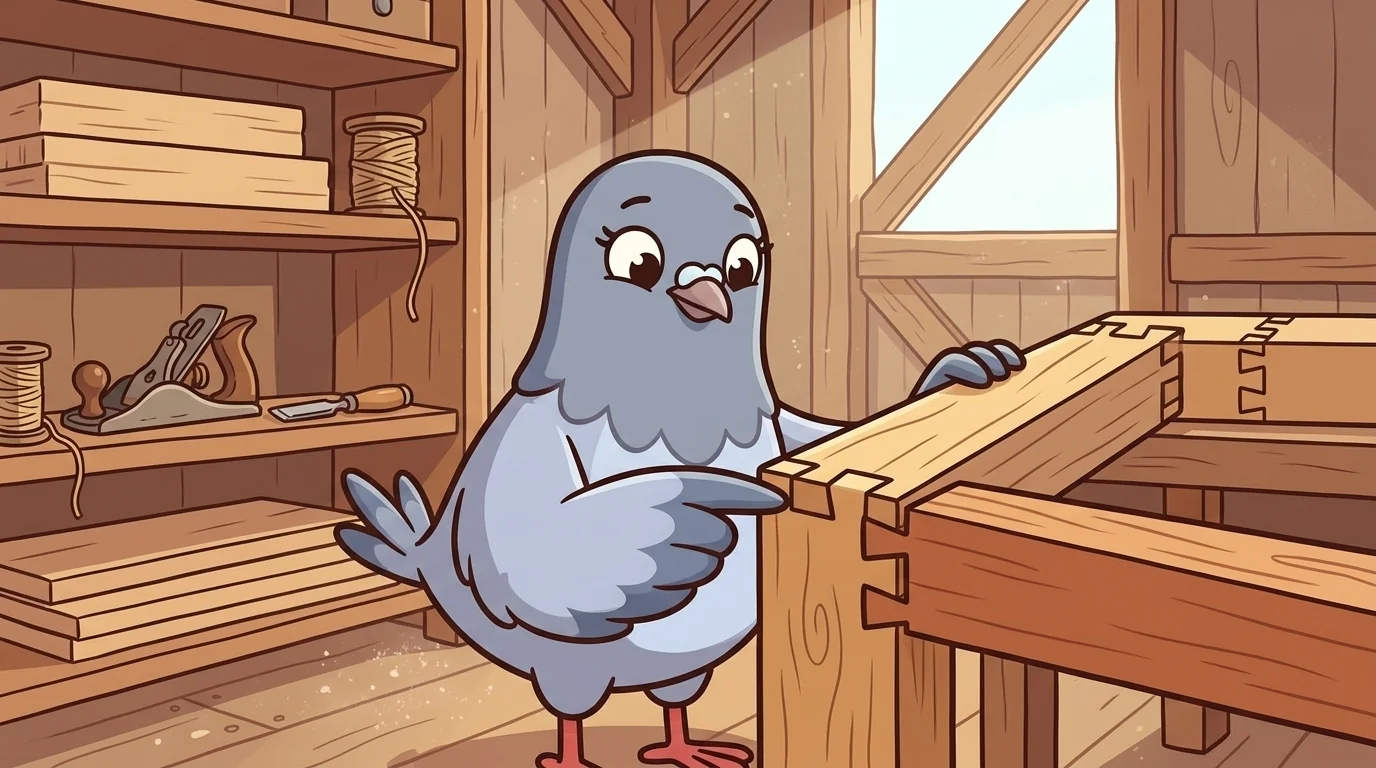
Dovetail grew up among doves in an old carpenter's barn, in a family who nested in the joints of the woodwork.
Her family lived in the dovetail joints — the interlocking wooden fingers where two boards lock together without a single nail. Her grandfather loved to explain it: "Two separate boards. Neither one gets cut short. You just shape their edges so they hold each other. That's the strongest joint there is — not because one board won, but because both fit." Their lesson: the sturdiest things in the world are made of two different pieces that were shaped to interlock, not one piece that beat the other.
Dovetail carried it into every disagreement she ever saw. The question was never which idea wins. It was what shape lets both hold?
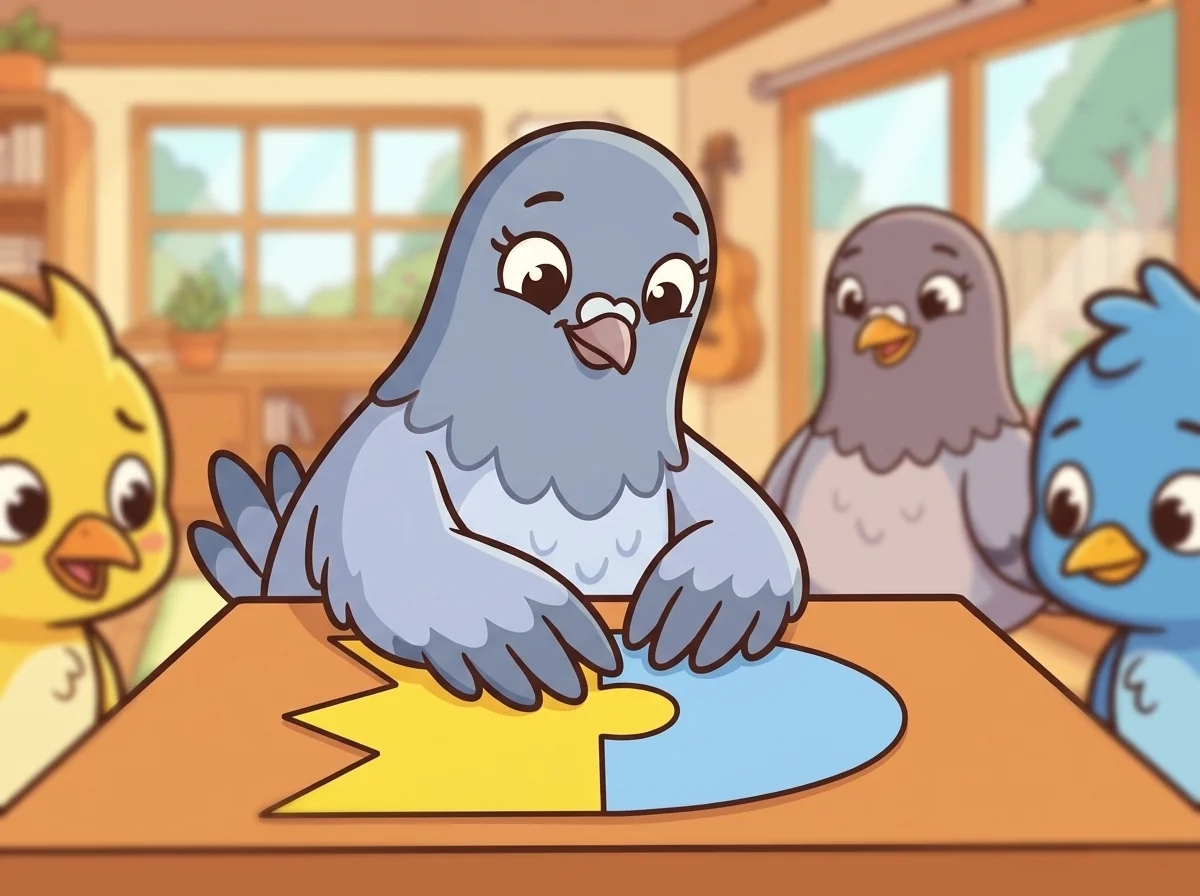
She came to EnsembleQuest when she was twelve, on a day when a duet had frozen solid.
Two birds, two ideas for one song, and a long unhappy standoff — each one quieter and more hurt, each sure that agreeing meant erasing themselves. They weren't shouting. They were just stuck, and sinking. Choir, the teacher, caught Dovetail's eye.
"They both have a good idea," Choir said, "and they think only one can survive. Can you help?"
Dovetail didn't pick a winner. She laid both ideas on the table and asked, "What if we don't choose? What if the fast one goes here and the slow one goes right after, and they hand off to each other?" She showed how the bright part could open the song and the round part could answer it — two different things, taking turns, each making the other sound better. The two birds looked at their ideas, still whole, now interlocked, and something unclenched in the room. Choir smiled. "Stay," she said.
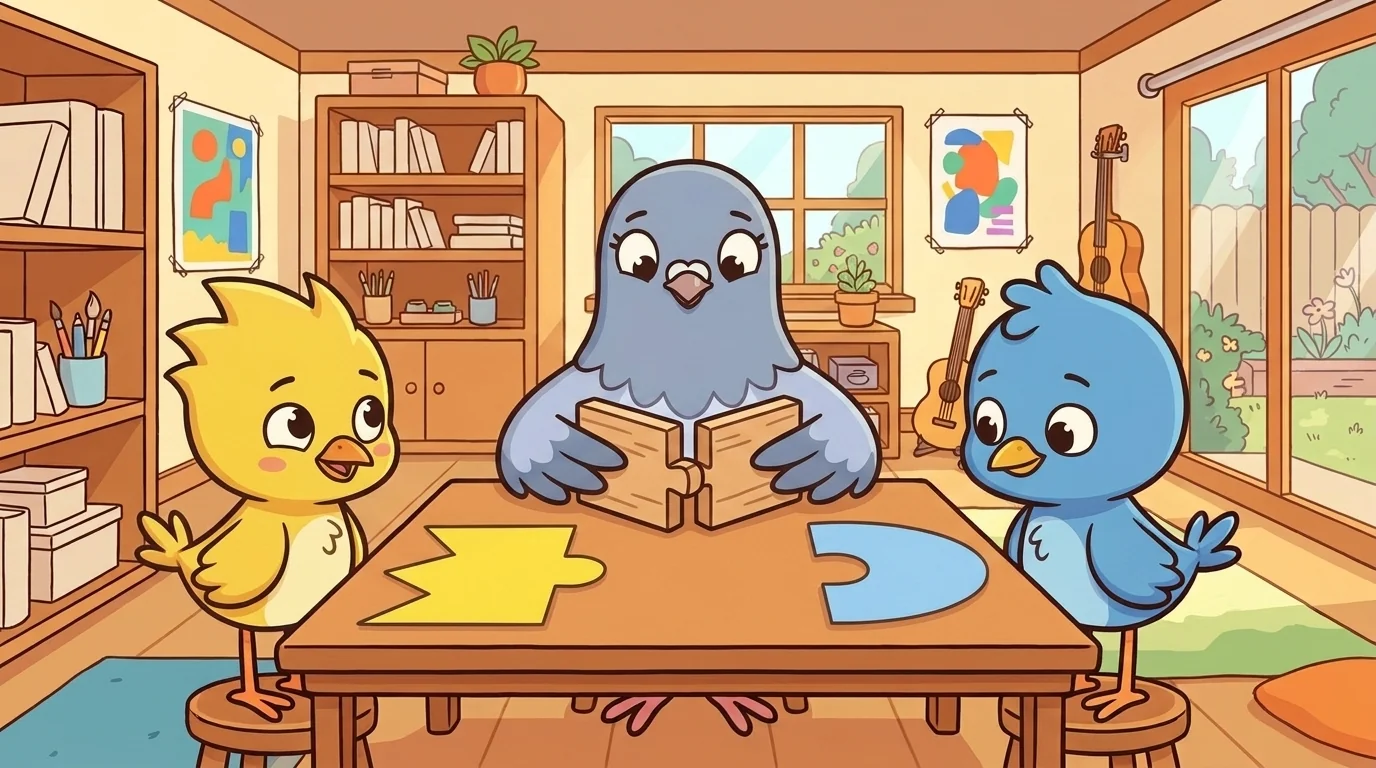
Dovetail's workshop had two wooden blocks on the table, joined at the corner, that anyone could pull apart and fit back together.
"When your idea and someone else's don't match," she told a cluster of new birds, "we don't rush to a vote. First we ask: is there a shape where both fit? Take turns? Layer them? One leads, one answers?" She locked the two blocks together. "Sometimes there really is a choice to make, and that's okay too — but we look for the fit first, because a fit keeps two birds whole instead of one."
A young robin raised a wing. "What if there's really no way to fit them?"
"Then we choose — kindly, out loud, and we remember the one we set aside for next time," Dovetail said. "Setting an idea aside for later isn't the same as throwing it away."
"And what if I hate compromising?" the robin asked, smaller. "It always feels like losing."
Dovetail nodded, gentle. "It feels like losing when you think one idea has to die. So we stop making them fight. We shape their edges instead — and then it's not losing. It's two things holding each other up."
The robin looked at the two locked blocks, and its stiff shoulders softened.
Later, when the others had flown off, the fast-song bird from that morning lingered by the table.
"I always brace for it," she said, not quite looking up. "That feeling — like my ribs go tight and hard — because in every group, sooner or later, someone says my idea has to go. So I stopped offering ideas at all."
Dovetail didn't rush to fix her. She just slid the two wooden blocks gently together between them.
"I know that brace," she said. "I grew up watching boards get cut short to make one piece win." She locked the joint. "But watch what happens when we stop choosing and start fitting. Your idea stays. Their idea stays. That braced, about-to-lose feeling —" she tapped the interlocked wood, "— it lets go. And underneath it, you find you can offer an idea again, because offering doesn't mean risking losing it anymore."
The bird looked at the two boards holding each other, neither one cut. Her ribs loosened. And she found, to her own surprise, that she had an idea she wanted to offer.
The EnsembleQuest ensemble
Dovetail is part of EnsembleQuest's distributed-narrative cast. Each character embodies a different curricular primitive; together they teach the full subject.
-
Part
Role-holding — knowing what MY part is, separate from but supporting the whole
-
Turn
Turn-taking — the rhythm of give-and-receive across an ensemble
-
Ear
Active listening — receiving the other person's contribution before adding your own
-
Welcome
Invitation + repair — bringing back someone who's drifted out of the ensemble
-
Share
Synthesis-in-performance — the moment many parts become one piece
-
Berth
Making space — leave room in the sound and the plan so every part fits; quiet the loud, invite the quiet, nobody drowned out
-
Bravo
Specific appreciation — notice one exact thing a partner did well and name it out loud, so they know their part landed
-
Nod
Non-verbal signals — a clear wordless cue (a nod, a raised wing, a card) for ready, done, my-turn, or pause
-
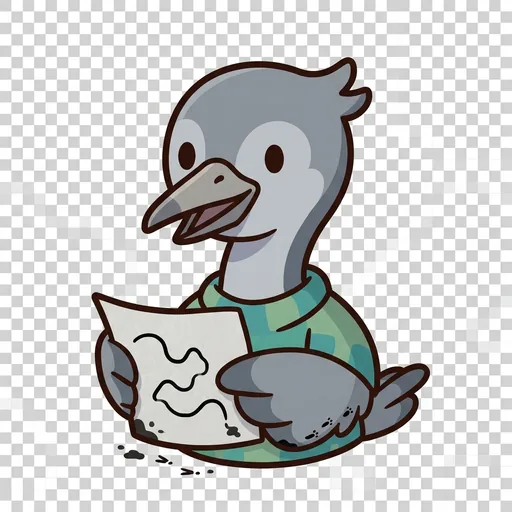
Outline
Co-planning — before anyone makes anything, sketch the shared shape together, so nobody has to guess where it's going