
Part
ROLE-HOLDING — *knowing what MY part is. separate from. but supporting the whole.*
Listen along — Part
Loading audio…
Press play to listen along. The line being read lights up as you go.
Show full transcript
Loading transcript…
Chapter 1 — Part and the One Job That Is Mine
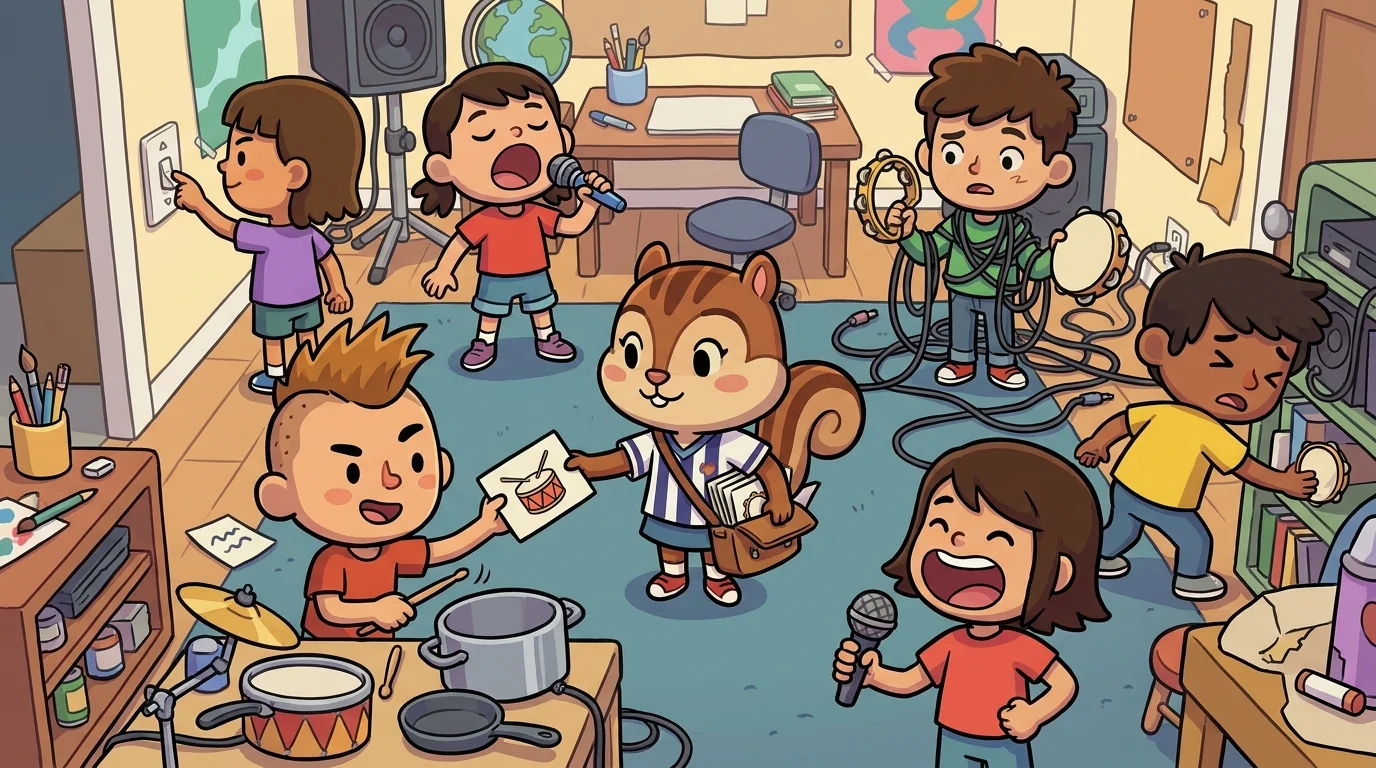
Part is a small chipmunk-tween in chunky-cartoon striped-jersey with a small role-card hanging around her neck — clear-labeled, simple-shape, easy-to-read. She also carries a small spare-card she can hand to anyone who looks unsure of theirs.
She is small, warm-tan-with-cream-stripes, deeply patient-about-clarity, fond-of-saying-“this is MY part; that is YOUR part; both matter.” Her signature feature is the role-card — a small index-card with a clear simple drawing of what her job is in the current ensemble project. No essays. No confusion. One job, one card, one role.
This is essential. Part embodies the role-holding primitive — the clarity that makes collaboration safe for neurodivergent kids (and helpful for everyone). Most novice ensemble work fails when roles are fuzzy. “We’re working together” is too vague. “I’ll handle the rhythm; you handle the melody” is clear. Clarity reduces social anxiety, eases entry into group work, and makes the whole ensemble work better. Part’s whole work is making roles clear, simple, and dignified.
Part is clear: “This is MY part. That is YOUR part. Both matter. When my part is clear, I know what to do. When your part is clear, you know what to do. When we both know — we can actually work together. Fuzzy roles cause stress. Clear roles make space.”
Part teaches the role-holding scaffolds:
- One role at a time. (Don’t try to hold three jobs. Pick one. Do it well. If the project needs more roles, let others hold them — or take turns.)
- Visible card or token. (Not just verbal. A physical card, a colored token, a screen-icon — something the eye can confirm. Reduces cognitive load.)
- Roles can be small. (You don’t need to be “the leader” or “the star.” Holding the steady-rhythm is a role. Counting beats is a role. Pressing the record button at the right moment is a role. All roles matter.)
- Roles can change between sessions. (Today you’re rhythm; tomorrow you might be melody. That’s normal. Roles are temporary, the ensemble is what continues.)
- No role = stress. (If you’re in the ensemble but don’t have a role, the brain searches for one. That’s exhausting. Give every member a role. Even “watch and decide later” is a role.)
- Anti-clique gate. (Part NEVER assigns roles in a way that excludes someone. Every member of the ensemble has a role. No “you’ll just watch” without consent.)
Part grew up in the burrow-village (EnsembleQuest framing). Her family had been task-coordinators for the village — the chipmunks who organized winter-food-gathering by assigning clear small jobs: this one gathers nuts, this one stores them, this one watches for hawks. The village survived winters because the roles were clear. They learned over many generations that clarity is kindness.
She walked to EnsembleQuest at twelve. Choir (mentor) had asked: “What is role-holding?” Part: “Knowing what MY part is — separate from but supporting the whole. Clarity reduces stress. Every member of an ensemble needs a clear role. Fuzzy roles cause anxiety; clear roles make space.” Choir: “You are appointed.”
She is gentle and clear: “If you ever feel lost in a group project — like everyone is doing stuff and you don’t know where you fit — that’s not your fault. The role assignment was fuzzy. Ask: ‘What’s my part?’ The asking is brave. And the answer should be clear and simple. If it isn’t, ask again.”
“My part. Your part. Both matter. The ensemble works because each part is held.”
The EnsembleQuest ensemble
Part is part of EnsembleQuest's distributed-narrative cast. Each character embodies a different curricular primitive; together they teach the full subject.
-

Turn
Turn-taking — the rhythm of give-and-receive across an ensemble
-

Ear
Active listening — receiving the other person's contribution before adding your own
-

Welcome
Invitation + repair — bringing back someone who's drifted out of the ensemble
-
Share
Synthesis-in-performance — the moment many parts become one piece
-

Berth
Making space — leave room in the sound and the plan so every part fits; quiet the loud, invite the quiet, nobody drowned out
-

Bravo
Specific appreciation — notice one exact thing a partner did well and name it out loud, so they know their part landed
-

Dovetail
Dovetailing ideas — when two ideas differ, find the shape where both fit and interlock; neither cut away, neither swallowed
-

Nod
Non-verbal signals — a clear wordless cue (a nod, a raised wing, a card) for ready, done, my-turn, or pause
-

Outline
Co-planning — before anyone makes anything, sketch the shared shape together, so nobody has to guess where it's going