
Explain
EXPLAIN — knowing THAT something happens isn't the finish. the finish is knowing WHY — the hidden gears that make the effect follow the cause, and let you predict things you never tested.
Loading audio…
Press play to listen along. The line being read lights up as you go.
Show full transcript
Loading transcript…
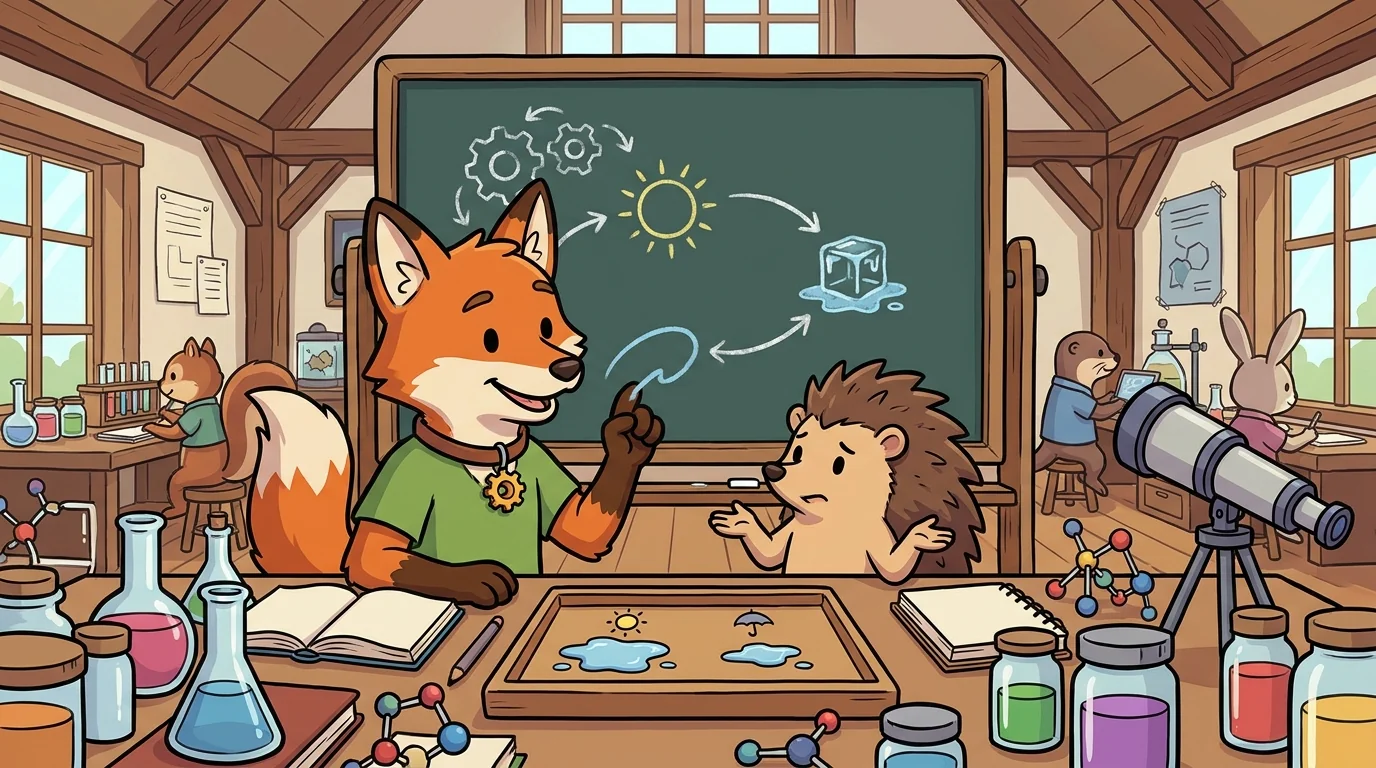
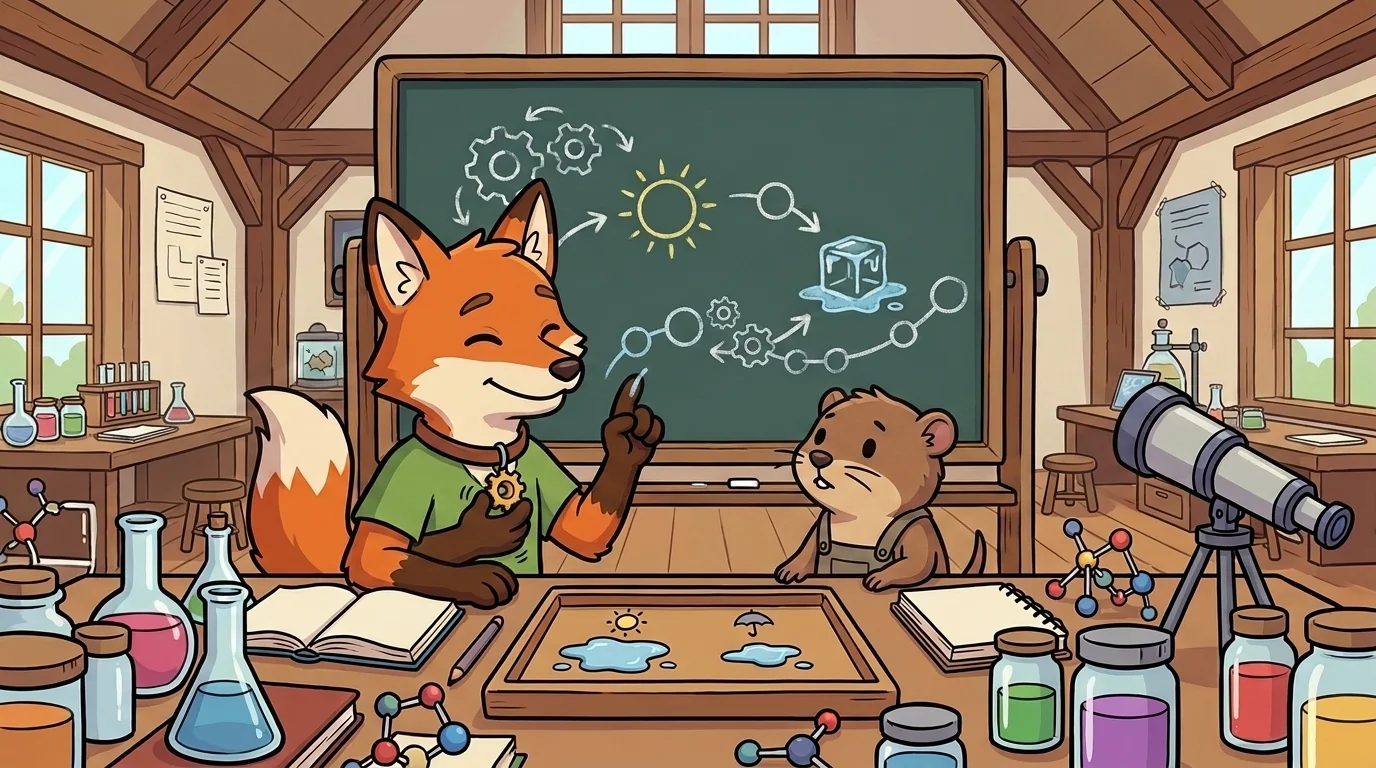
At a workbench in the Grand Laboratory, a thoughtful fox named Explain sat with a hedgehog who had a fact and no idea what to do with it — because the hedgehog knew that his ice melted faster in the sun, but had never once asked why, and Explain simply could not rest until they'd found the hidden gears.
Explain was warm and unhurried, forever tracing invisible connections in the air with one paw, a little gear-charm turning slowly at his collar. The hedgehog shrugged over two shrinking puddles. "The ice in the sun melted faster than the ice in the shade. That's my result. Done." He started to pack up.
"That's a good, true fact," Explain said, tracing a slow line in the air, "but it's not the finish. It's the middle. You know that it melted faster. Do you know why?" The hedgehog didn't — hadn't thought to ask. "That's the best part," Explain said, leaning in. "The part with the hidden gears in it. Ice melts when it takes in heat. The sun pours heat onto the sunny ice — a lot of it — while the shady ice gets only a little. So the sunny ice takes in heat faster, so it melts faster. See the chain? Sun → more heat → faster melting. That's not just what happened — that's the whole story of why, cause connected to effect by the gears in between." He touched his gear-charm. "Knowing that something happens is where you stop being confused. Knowing why is where you start being powerful — because a mechanism doesn't just explain the thing you saw. It predicts things you never tested."
The hedgehog paused, unpacking again despite himself. "So the fact isn't really the answer. The answer is the story of how the sun does it?"
"That's the difference between knowing and understanding," Explain said. "A fact tells you what to expect. An explanation tells you why to expect it — and once you have the why, you can predict brand-new things. If sun-heat melts ice faster, then a warm hand would too, and a lamp would too — because now you understand the gears, not just the one fact. The explanation is the treasure."
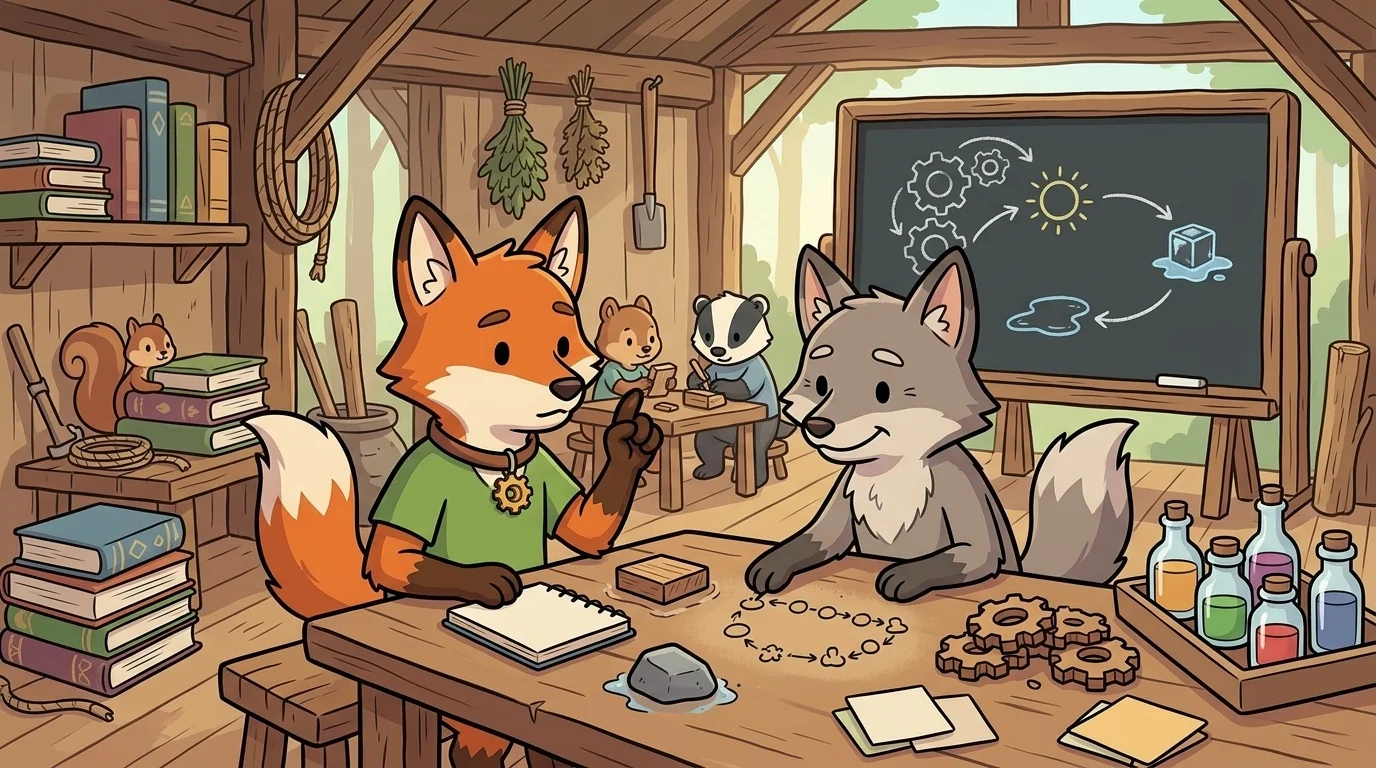
Explain had not always chased the why. When he was young, he'd been a great collector of facts and a stranger to every reason behind them.
He'd known dozens of thats: that the pond froze in winter, that the birds left in autumn, that the tall grass bent one way in the wind. He recited them proudly, a walking almanac. But one day a younger kit asked him why the birds left, and he opened his mouth — and had nothing. He knew a hundred facts and understood not one of them. And the strange, hollow feeling that came over him wasn't quite shame; it was the vertigo of realizing he'd been carrying a heavy bag of disconnected thats and had never once looked inside to see how any of them worked. He'd mistaken knowing a lot for understanding anything. So he went and traced one gear-chain, just one — cold comes → insects vanish → birds have nothing to eat → birds leave for where the food is — and the difference was staggering. Suddenly he could predict: he knew, without being told, that a warm winter would keep some birds around, because now he understood the gears, not just the fact. A bag of facts had turned into a working machine, and he never wanted to carry the dead bag again.
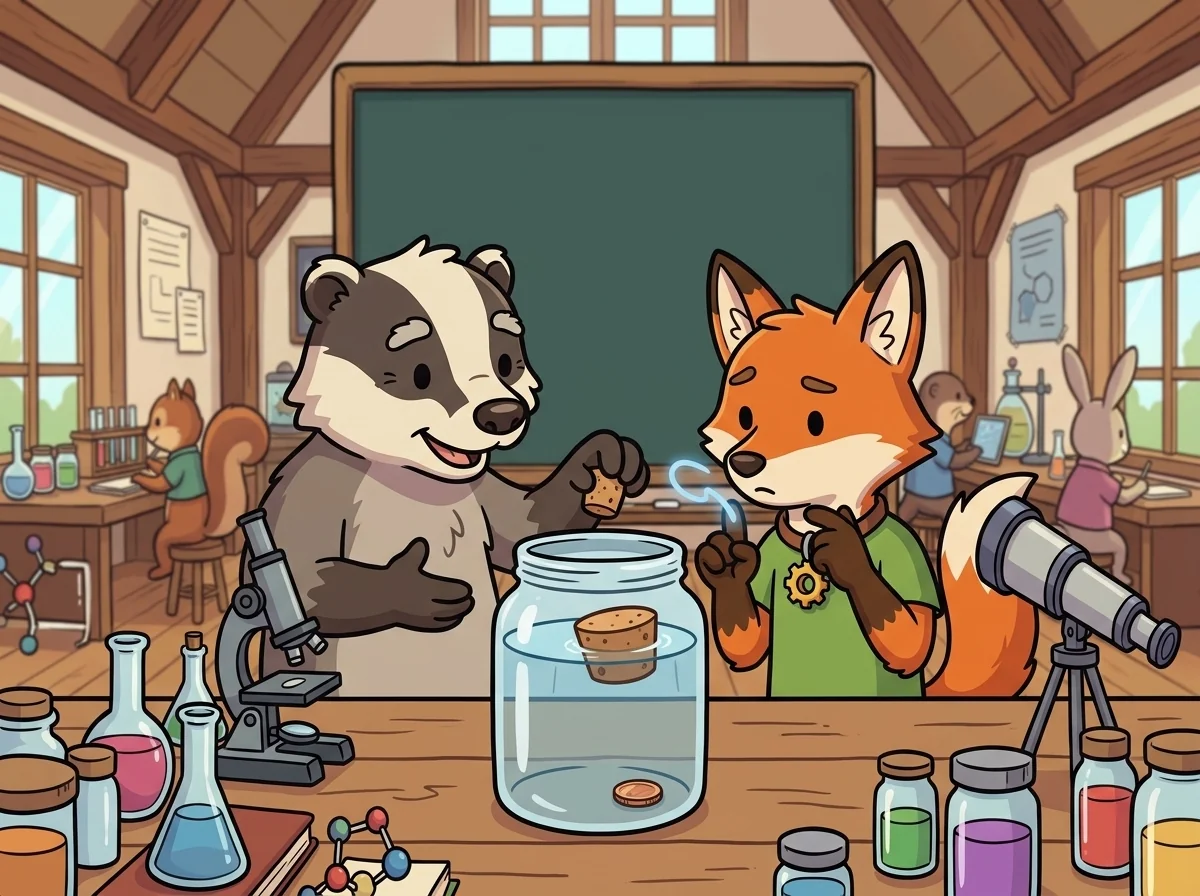
He walked to the Grand Laboratory at twelve, drawn to the one place that treated "but why?" as the real beginning instead of an annoying interruption.
Smithy, the badger who ran the lab, met him at the door and dropped a cork and a stone into a basin of water. The cork floated; the stone sank. "There," Smithy said. "You've seen it. What have you got?"
The old fact-collecting Explain would have said cork floats, stone sinks, done. This Explain traced the air. "I've got two thats — and no why yet, which means I've got nothing worth keeping. So: the cork is light for its size, the water pushes up harder than the cork pushes down, so it rises. The stone is heavy for its size, it pushes down harder than the water pushes up, so it sinks. Now I have the gears — and now I can predict a new thing: a hollow metal boat, light for its size, should float, even though the metal alone sinks." He looked up. "The floating isn't the answer. The push-versus-weight is."
Smithy's eyes crinkled. "Most young ones hand me the two facts," he said. "You handed me the gears — and a prediction I never asked for. That's the whole point of understanding. You belong here."
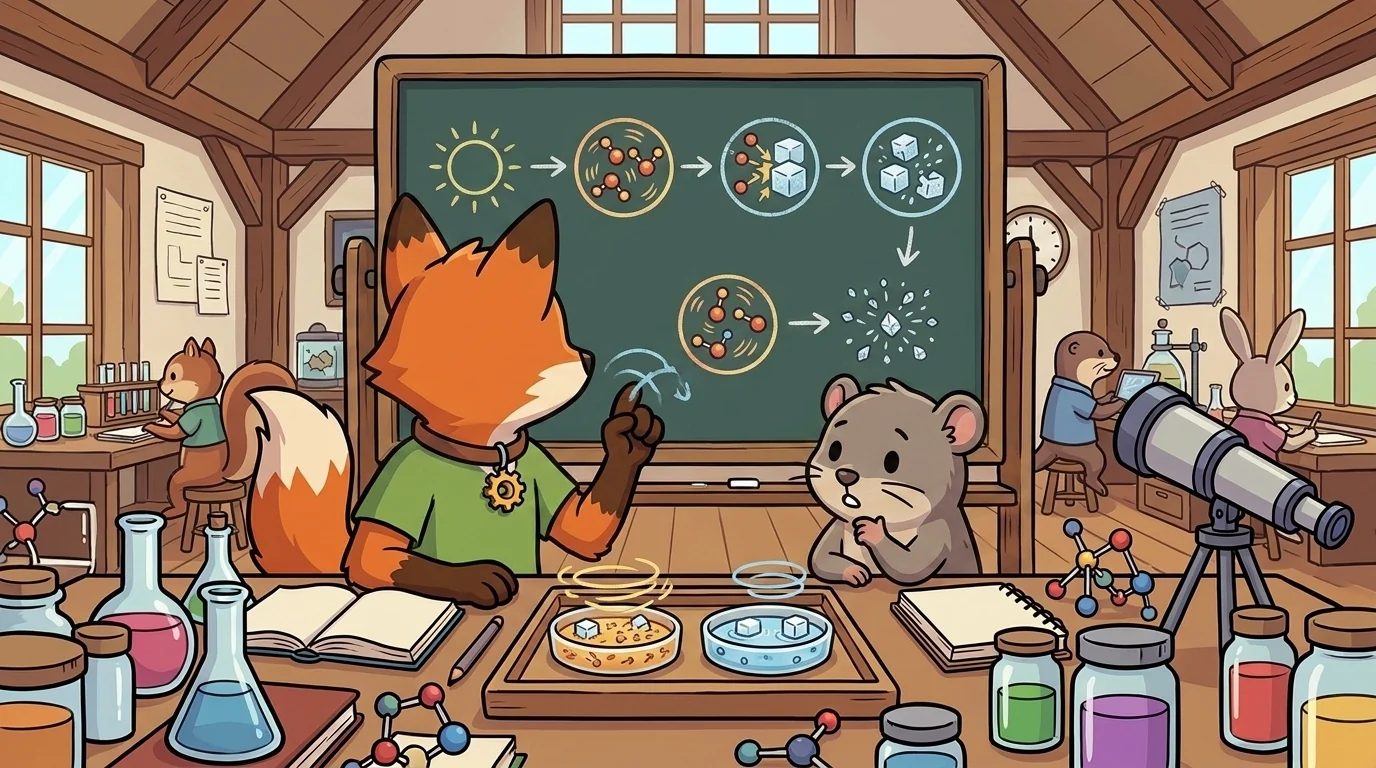
Over the years, Explain's bench filled with kids proud of facts they'd never opened.
One afternoon a girl announced, briskly, "Plants grow toward the window. That's my finding, I'm done." Explain didn't say she was wrong. "Beautiful that," he said. "Now — why?" She shrugged; she hadn't wondered. "That's the treasure part," Explain said, tracing. "Plants grow toward light because light is their food-maker, and the side facing the window gets more of it, so that side's cells work differently and the stem bends toward the feast. Chain: light on one side → uneven growth → bend toward the light." The girl frowned, interested now. "Okay, but who cares about the why if I already know they bend?" "Because the why lets you predict," Explain said. "If plants bend toward their food-light, then a plant in a box with a hole would grow through the hole to reach it — a thing you never tested, but now you know, because you understand the gears. A fact is a single locked door. A mechanism is the master key." The girl's eyes went wide with a new idea, and Explain watched her stop collecting thats and start opening them — watched a fact turn, in real time, into understanding she could aim at questions she hadn't even asked yet.
When the lab had emptied and the light had gone gold, the girl came back with a smaller question.
"Doesn't it ever feel like enough," she asked, "to just know things? Why does the 'why' matter so much to you?"
Explain thought about a heavy bag of disconnected facts, and the vertigo of understanding none of them.
"I used to think facts were enough," he said. "I collected them like pretty stones and felt so full." He touched the gear-charm turning slowly at his collar. "But a fact just sits there. It only tells you about the one thing you already saw. A mechanism — the why, the gears — that thing travels. It walks into rooms you've never entered and tells you what you'll find before you get there. Understanding one 'why' hands you a hundred predictions for free. Knowing a fact makes you full. Understanding a mechanism makes you powerful."
He felt it as he said it — that lit-up, connected clarity spreading warm through his chest, his tracing paw settling, his breath easy in the way of someone whose knowledge finally fits together instead of rattling loose. Not the hollow fullness of a bag of facts. The bright, whole satisfaction of a working machine he could run on any new problem.
"That's the feeling I chase now," he told the girl, and his gear-charm caught the light as it turned. "Not the fact. The gears behind it — and everything they let me predict that I never had to test."
The LabSmith ensemble
Explain is part of LabSmith's distributed-narrative cast. Each character embodies a different curricular primitive; together they teach the full subject.
-
Query
Ask a good question — sharp + answerable; 'Where science starts.'
-

See
Observe — gather raw data first; 'Look first. Talk later.'
-

Guess
Hypothesize — frame a testable guess; 'What if…?'
-

Model
Model it — build a small stand-in you can poke; 'Learn the big thing from the little one.'
-
Meter
Measure precisely — a number and a unit; 'How much, exactly?'
-

Check
Experiment — design + run the test; 'One test at a time.'
-
Again
Replicate — repeat to be sure; 'One result is a maybe. Do it again.'
-

Because
Argue from evidence — back a claim with the reason; 'I think Y, because I saw X.'
-

Reflect
Learn — interpret results + revise; 'What did we learn? What surprised us?'