
Meter
METER — "a lot" and "a little" aren't science. how much, exactly? measure it, with a number and a unit.
Loading audio…
Press play to listen along. The line being read lights up as you go.
Show full transcript
Loading transcript…
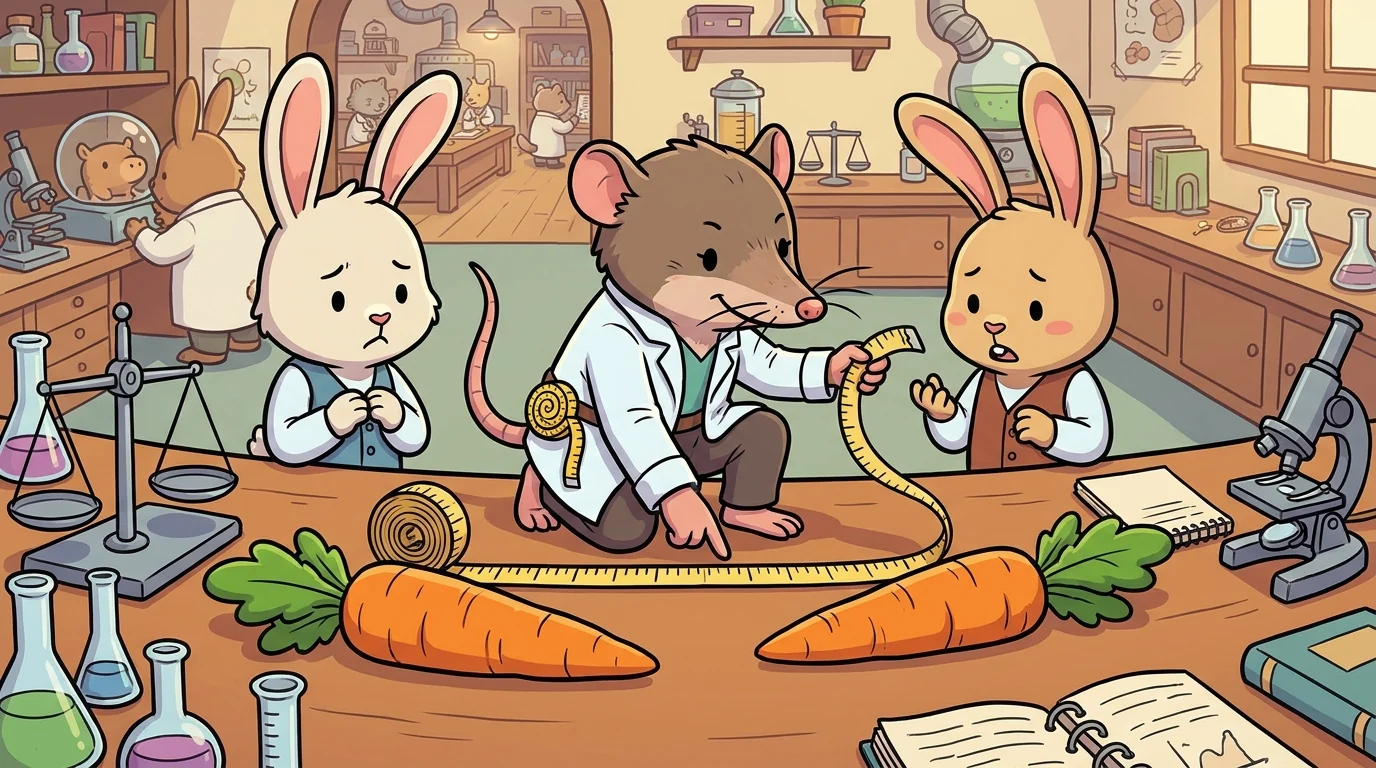
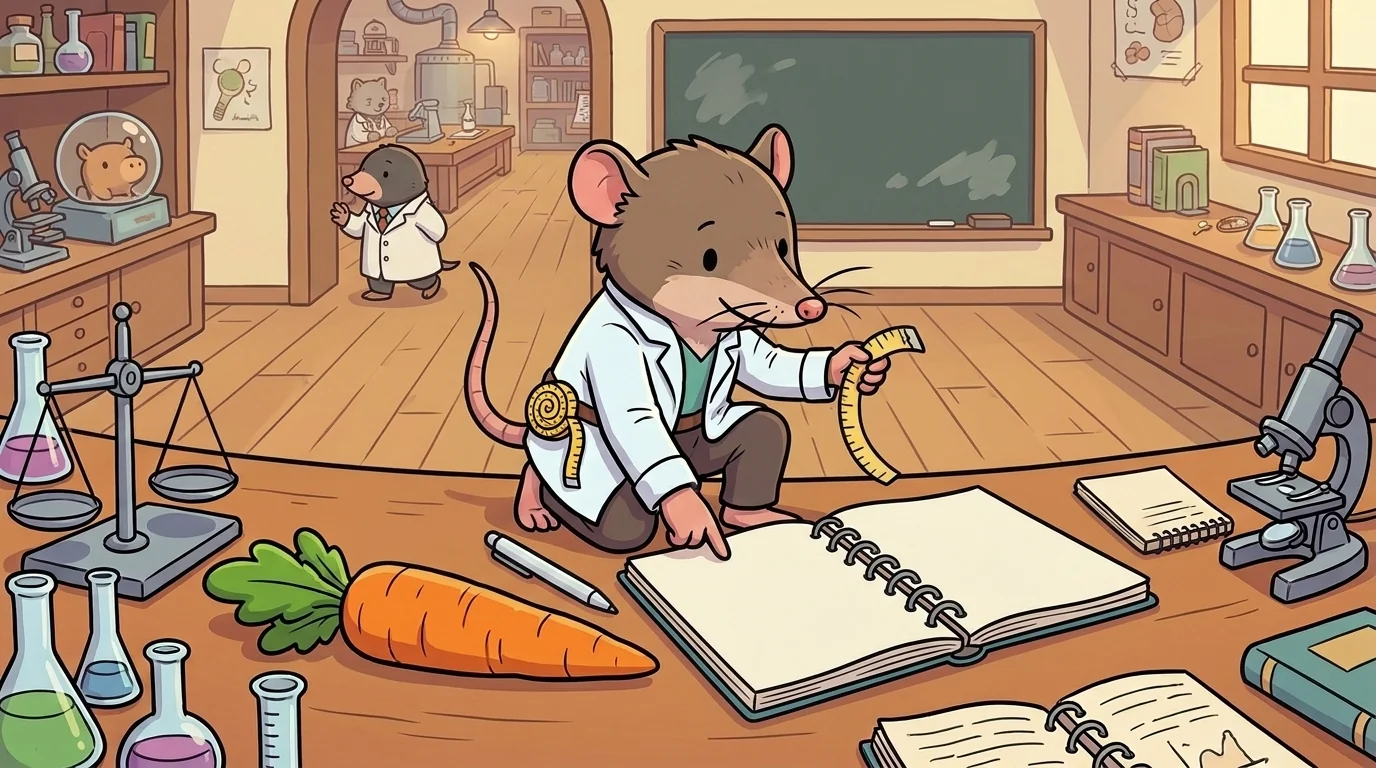
At a workbench in the Grand Laboratory, a small precise shrew named Meter was settling an argument that two young rabbits had been having for ten loud minutes — not by shouting louder, but by pulling out a ruler.
Meter was tidy and exact, whiskers always twitching over the fine details, a little measuring-tape charm coiled at her belt. The two rabbits were red-faced. "This carrot is WAY bigger than that one!" one insisted. "No it ISN'T, they're basically the SAME!" the other shot back. "It's SO much bigger!" "Barely!" Back and forth, louder and louder, getting nowhere.
Meter set down her measuring tape between them without a word. She laid it along the first carrot. "This one is fourteen centimeters." She laid it along the second. "This one is fifteen and a half." She coiled the tape back up. "So the SECOND one is bigger — by one and a half centimeters. Not 'way.' Not 'barely.' Exactly one and a half." The rabbits went quiet, the whole argument suddenly deflated. "That's the thing about 'a lot' and 'a little,'" Meter said, twitching her whiskers. "They're not science — they're feelings. Two people can feel completely opposite things about the same carrots and shout forever. But a NUMBER doesn't argue. Fourteen and fifteen-and-a-half. Now we all know, and there's nothing left to fight about." She touched her tape-charm. "How much, EXACTLY? That's the question. Measure it — with a number and a unit — and the fuzzy feeling becomes a fact everyone can see."
One rabbit blinked. "So instead of ARGUING about 'bigger,' we just... measured it, and now we know for sure?"
"A guess says 'a lot,'" Meter said. "A measurement says 'one and a half centimeters.' One of those you can argue with forever. The other one settles it. Whenever you catch yourself saying 'so much' or 'hardly any' or 'way faster' — stop, and ask HOW MUCH exactly. Then go get the number. Feelings are where you start. Measurements are how you KNOW."
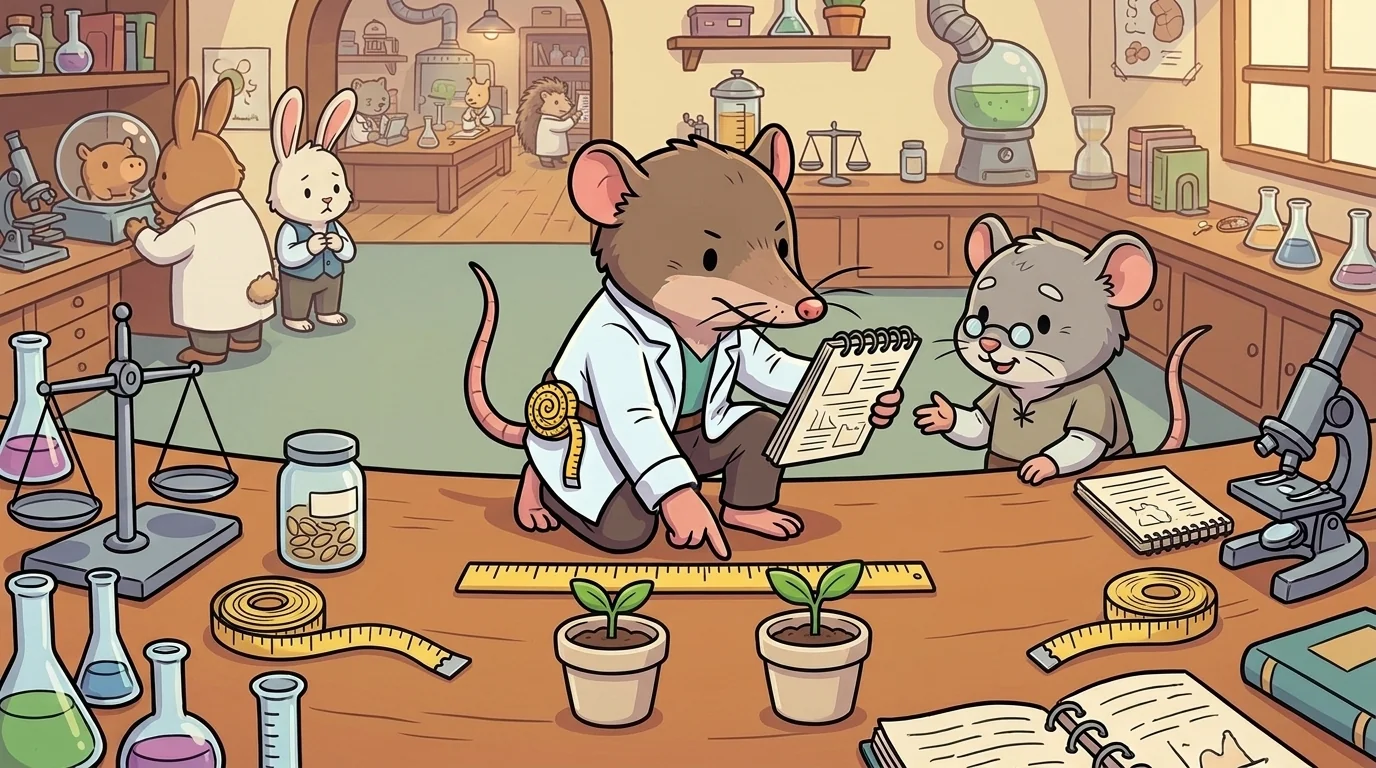
Meter had once trusted her feelings over her ruler.
When she was young, she judged everything by eye — this rock felt heavier, that plant looked taller, this cup seemed fuller — and again and again her confident eyeball fooled her. She'd be SURE one seed had sprouted more than another, and be wrong; certain one string was longer, and be wrong. Her strong feelings kept turning out false, and she'd shrink down, sure she just had bad instincts, that she couldn't trust her own eyes.
An old dormouse, small and exact, laid a ruler beside her one evening. "Your eyes aren't bad," she said. "They're just EYES — they guess, they get fooled by which thing is closer or brighter or which one you WANT to be bigger. Everybody's eyes do that." She measured two seedlings that looked identical; one was noticeably taller by the number. "See? You'd have sworn they were the same. The ruler doesn't care what you hoped. It just tells you: this one, thirty millimeters; that one, thirty-four. Stop trusting the feeling of 'bigger.' Go get the NUMBER. A measurement can't be fooled by what you wish were true."
Meter learned to measure — to replace every 'a lot' and 'a little' with an exact number and a unit — and her fooled-by-feelings mistakes simply stopped. The uncertain, can't-trust-my-eyes feeling steadied into a calm, exact confidence. She'd never had bad instincts. She'd only been trusting the guess of her eyes when a ruler was right there.
She walked to the Grand Laboratory when she was older, because a place that studied how things really worked ought to understand the difference between "a lot" and a NUMBER.
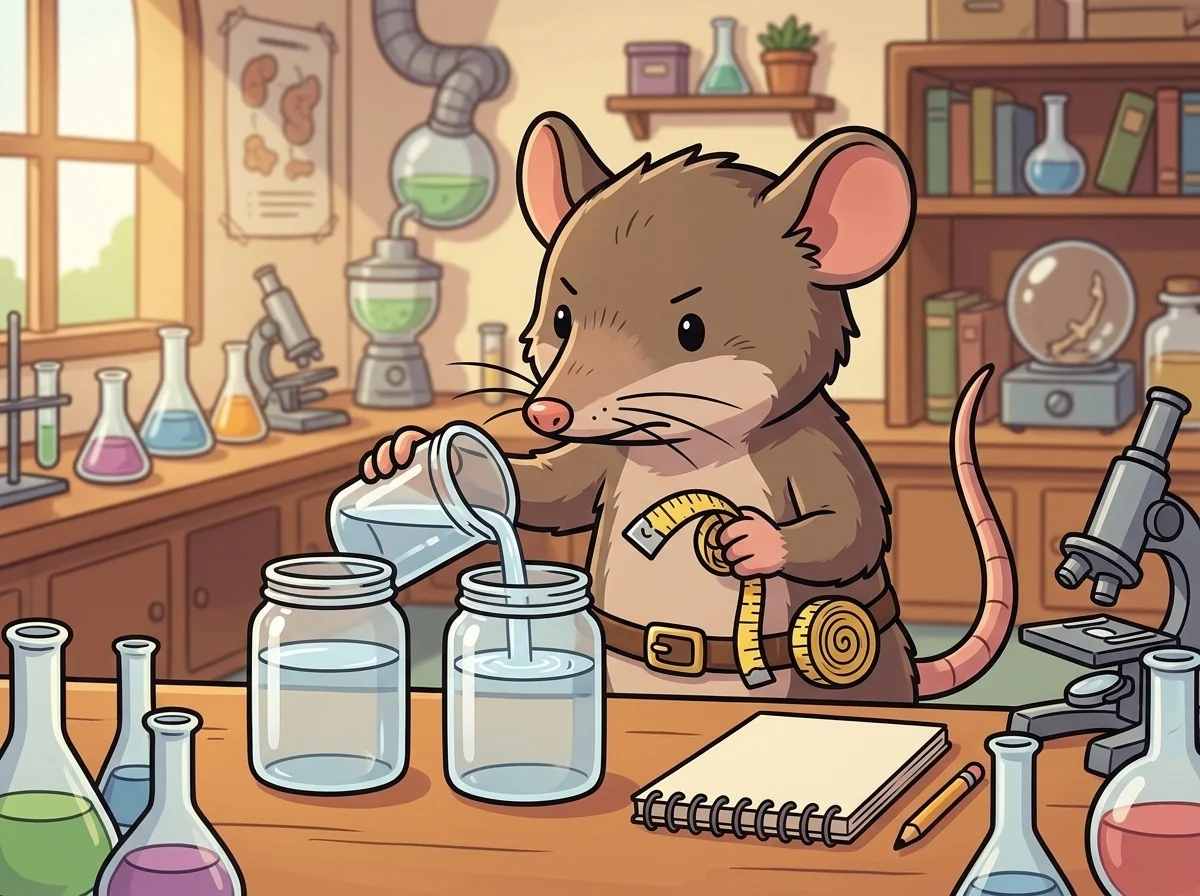
Smithy, the old badger who ran the lab, met her at the door. He set two nearly-identical jars of water on the table and asked, "Which has more?"
Meter didn't say that one. She lifted each jar, then reached for a measuring cup. She poured the first: "Two hundred and ten milliliters." The second: "Two hundred and forty." She set them down. "This one has more — by exactly thirty milliliters. By eye I couldn't have told you. By measure, I know."
Smithy smiled slowly. "Most kids point and say 'that one, obviously.' Half of them are wrong. You didn't guess — you measured, with a number and a unit. That's how we actually know things here. You belong."
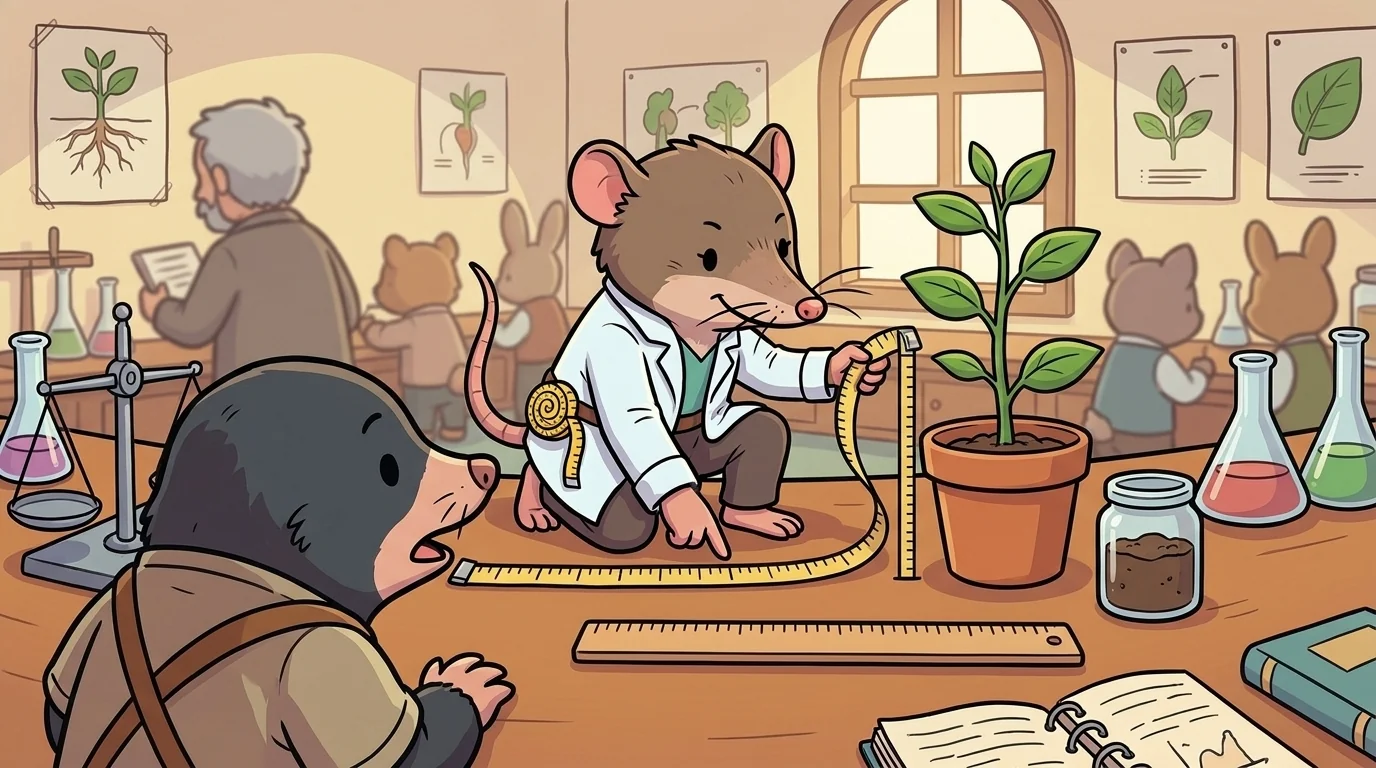
Her corner of the lab filled with kids who trusted their eyes too much — and one afternoon a young mole was frustrated over an experiment that "wasn't working."
"My plant grew a TON this week," the mole said, "way more than last week, I'm sure of it — but my results look boring and I don't know why."
Meter knew that eyeball-certainty. She'd been fooled by it for years.
"How much did it grow, exactly?" she asked. The mole didn't know — he'd only looked. "That's the whole trouble. 'A ton' isn't a result. Let's get the number." She measured. "It's four centimeters taller than your last mark." She checked his notes. "And last week it grew... four centimeters too. Exactly the same." The mole's mouth fell open. "But it FELT like way more!" "It always does," Meter said gently. "Your eyes told you a story. The ruler told you the truth. Four and four — steady growth. That's not boring, that's a real, measured PATTERN. But you'd never have seen it by feel."
The mole started measuring his plant with a number each day, and the fuzzy arguments in his own head went quiet. "Oh," he said. "When I actually measure, I don't have to WONDER if it's more. I just... know."
"That's the calm of a number," Meter said. "How much, exactly? Measure it, and the guessing stops. Feelings start you off. Measurements let you KNOW."
Later, when the lab had emptied out, the mole came back with a quieter question.
"When you measure everything so exactly," he said, "instead of just going with your gut — doesn't it take the fun out? Always stopping to get a number?"
Meter considered it, coiling her tape-charm.
"It felt like a chore at first," she admitted, "back when I trusted my gut. Stopping to measure seemed slow." She twitched her whiskers at a neatly-numbered notebook. "But somewhere I learned that GUESSING is the exhausting part — the endless arguing, the being-sure-and-wrong, the fuzzy 'is it more? is it less?' that never settles. A measurement ENDS all that." She touched her tape. "There's a calm, settled, now-we-know feeling in an exact number — not the jittery uncertainty of trusting a feeling that keeps fooling you, but the quiet solidity of pointing at 'fifteen and a half centimeters' and knowing it's simply TRUE, no matter what anyone wishes. Exact. Certain. Restful." She coiled the tape neat. "There's a deep comfort in a number you can trust: the fuzzy feeling turned into a fact that can't be argued with. That's my favorite thing — not the loudest opinion, but the exact amount, measured, and finally KNOWN."
The mole nodded, and Meter watched the jittery guessing go quiet in him — the same calm, exact certainty that had once, at a workbench long ago, steadied her own fooled-by-feelings eyes into a shrew who could finally trust a number over a wish.
The LabSmith ensemble
Meter is part of LabSmith's distributed-narrative cast. Each character embodies a different curricular primitive; together they teach the full subject.
-

Query
Ask a good question — sharp + answerable; 'Where science starts.'
-

See
Observe — gather raw data first; 'Look first. Talk later.'
-

Guess
Hypothesize — frame a testable guess; 'What if…?'
-

Model
Model it — build a small stand-in you can poke; 'Learn the big thing from the little one.'
-

Check
Experiment — design + run the test; 'One test at a time.'
-
Again
Replicate — repeat to be sure; 'One result is a maybe. Do it again.'
-

Because
Argue from evidence — back a claim with the reason; 'I think Y, because I saw X.'
-

Explain
Explain the mechanism — the how-and-why that connects cause to effect; 'Know THAT, then know WHY.'
-

Reflect
Learn — interpret results + revise; 'What did we learn? What surprised us?'